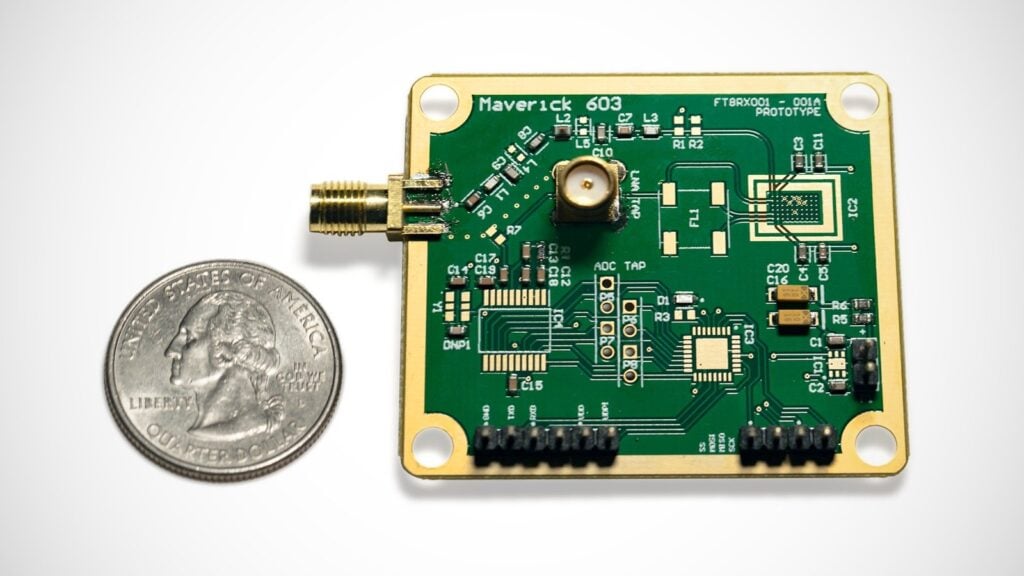
Maverick-603: An Affordable FT8 Receiver with an Open Source RF Chip

The Maverick-603 is a US$149 FT8 receiver based on an open source RF chip design which is capable of acquiring signals between 7 MHz and 70 MHz (technically 1 MHz to 100 MHz). It is currently undergoing Crowd Funding on Crowd Supply with 7 days left in the campaign. Shipping is expected to begin in April 2023.

FT8 is a popular weak signal propagation digital mode used by ham radio enthusiasts. FT8 signals can be received and decoded all over the world even with low transmit power and poor propagation conditions thanks to its highly error tolerant encoding. A dedicated FT8 receiver allows enthusiasts to set up a 24/7 FT8 monitor without dedicating more expensive ham radio equipment to the task. Note that a computing device like a PC or possibly a Raspberry Pi 4 will still be required to run the FT8 decoding software as this is a software defined radio.

The Maverick-603 is based on a custom open source RF chip design made possible by the company eFabless. It is now possible to cheaply design and produce custom ASIC chips (at least at the lower end of the technology scale), replacing more costly FPGA designs. The technical specs of the Maverick-603 are:

  • MCU: ATMEGA1608
  • Power Supply: 3.3 V / 10 mA
  • Operating Frequency Range: 1 to 100 MHz
  • Minimum Signal Strength: -25 dBm
  • Input Antenna Impedance: 50 Ohm
  • Data Interface: SPI
  • Board Size: 2" x 1.75"
  • Capable of receiving FT8 signals
  • 7 - 70 MHZ frequency range
  • Low-power operation (1.8 Volts) means no battery or outlet is required
  • USB Connection
  • A compact surface area
The Maverick-603 FT8 Receiver

SDR Special Tool Kit: A Ruggedized Enclosure for two RTL-SDR V3 Dongles

Terminal Armament, one of our resellers of RTL-SDR V3 dongles in the USA has created a companion product called the SDR Special Tool Kit (SDR-STK) which is a tactical ruggedized enclosure for two RTL-SDR V3 dongles. The SDR-STK consists of a two port USB hub enclosed in a water-resistant housing, and a rugged screw on USB-A cable. Two SMA connectors protrude out the top. The design is open source with designs and software due to be released on their GitHub in time.

The SDR-STK is estimated to ship within 5-7 weeks, and is available for pre-order via the Terminal Armament website.

The RTL-SDR dongle has long been the standard for an entry-level software defined radio. And while we do love it, the USB dongle form-factor is simply not suited for rigorous outdoor use. This is why we've developed the SDR-STK.

The SDR-STK is a ruggedized two-port USB hub specifically designed to fit two standard RTL-SDR dongles, and provide a durable, water-resistant housing. Having two dongles also grants capabilities not available with just one; these go beyond simply increasing the bandwidth. With one receiver acting as a tuner, you can have the second one preforming other tasks such as wide-band scanning, listening to a trunked radio control channel, or simply receiving other information such as ADS-B packets.

The SDR-STK isn't just a one-off hardware product. In the coming weeks while the pre-order is active, we will be releasing various software utilities for the SDR-STK on our GitHub, as well as the PCB schematic files. We're firm believers in Open-Source hardware software, and we hope to use this launch to kickstart several other communication related products and projects such as better Android SDR applications, and other SIGINT tools.

The SDR-STK includes itself, and a custom 1.5 foot USB Type A Male cable. Antennas and RTL-SDR's are not included unless specified or ordered in conjunction with the SDR-STK.

The RTL-SDR Just Got Better - Terminal Armament SDR-STK

A Software Based VGA AGC Implementation for the RTL-SDR

Thank you to Chris G for writing in and sharing with us his software VGA ADC controller for the RTL-SDR. AGC or 'automatic gain control' is an algorithm that attempts to automatically adjust the gain on the RTL-SDR in order to maximize the signal to noise ratio. The built in hardware AGC's on the RTL-SDR are intended for wideband TV signals, and work poorly with the narrower signals that SDR users typically deal with. However, it's possible that a software AGC implementation could be used instead.

Initially, I wanted to see how well things would work if I could manually control the VGA gain to avoid A/D overload within the 2832 chip.

I liked how things worked so I said: let's make things automatic! I implemented two variants of my AGC. One variant (my favorite) is an implementation of an AGC by Harris and Smith. It is an LMS algorithm that has equal transient response to a sudden increase in input signal magnitude and a sudden decrease in signal magnitude.

Since I'm doing this stuff in software, I operate on blocks of IQ data rather than operating on a sample by sample basis.

Initially, I observed limit cycles for at least two reasons:

  1.  The (approximately) 3.5dB step size in VGA gain adjust.
  2. The fact that when I receive a block of IQ data, another block is in transit.

This resulted me adjusting the gain while a block of data was in transit.

For item 1, I allow the deadband go be settable.

For item 2, I allow a "blanking time" to be settable. For my use case, If the AGC just made an adjustment, I skip making an adjustment while the next black is in transit.

Here is output of my 'get agcinfo' command.

--------------------------------------------
AGC Internal Information
--------------------------------------------
AGC Emabled : Yes
AGC Type : Harris
Blanking Counter : 0 ticks
Blanking Limit : 1 ticks
Lowpass Filter Coefficient: 0.800
Deadband : 1 dB
Operating Point : -12 dBFs
IF Gain : 11 dB
/_/_/_/_/_/_/_/_/_/_/_/_/_/_/_/_/_/_/_/_/_/_/
Signal Magnitude : 27
RSSI (After Mixer) : -24 dBFs
/_/_/_/_/_/_/_/_/_/_/_/_/_/_/_/_/_/_/_/_/_/_/

Note that my setpoint and gain adjustment works in decibels. That way, I treat the AGC as a linear system (it's actually uses an LMS algorithm) to simplify processing.

Now, I have used the same algorithm for my HackRF software.

I should mention that I implemented a pretty nice software squelch system for the rtl-sdr (and HackRF of course) if you have any interest in that.

I have a github repository at github.com/wizardyesterday/RtlSdrDiags.

I've thought about adding an I2C DAC whose output is connected to the VGA analog gain control line, but I really hate to butcher my v3 dongle. Having 1dB (or less) gain resolution would be nice though.

Another thing that I noticed is that, when writing to the tuner registers, the I2C repeater is enabled and you hear a spike in the demodulated audio. This may also occur (I haven't done that experiment) when disabling the repeater. Maybe not......

I have composed a report in, github.com/wizardyesterday/RtlSdrDiags/blob/master/doc/agcResearch/README.txt

If you get curious how I implemented my AGC, you can look at the file, github.com/wizardyesterday/RtlSdrDiags/blob/master/radioDiags/src_diags/AutomaticGainControl.cc.

The header file is in radioDiags/hdr_diags/AutomaticGainControl.h.
RTL-SDR Blog L-Band Patch, Bullseye, YouLoop Sale

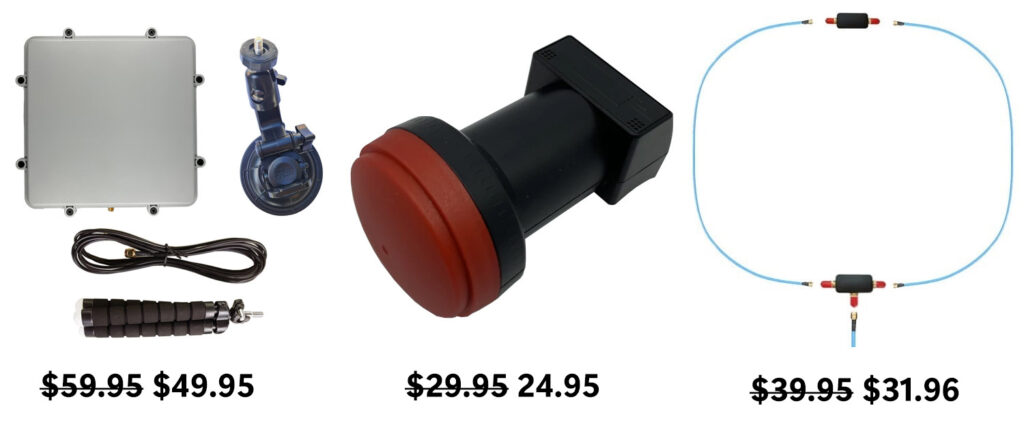
This Black Friday we are offering a discount on our L-Band Patch, Bullseye and YouLoop antennas in our store and marketplace listings! The sale will run until the end of November.

Our L-Band patch is an active design for receiving L-band satellites such as Inmarsat, Iridium, GPS and other satellites that transmit between 1525 - 1660 MHz (please note that you cannot use it for weak signals that require a dish like HRPT or GOES).

The Bullseye LNB is a TCXO stabilized LNB for the QO-100 geostationary amateur satellite and other Ku-band satellites.

The YouLoop is a super portable passive HF/VHF loop antenna designed for super low NF/MDS receivers like the Airspy HF+ Discovery.

  • L-Band Patch Antenna: US $59.95 $49.95
  • Bullseye LNB: US $29.95 $24.95
  • YouLoop: US $39.95 $31.96

Pricing includes free shipping to most countries. Please note that pricing does not include VAT and/or taxes which may be added for your country.

SDRplay RSPdx Black Friday and Holiday Season Sale Now Active

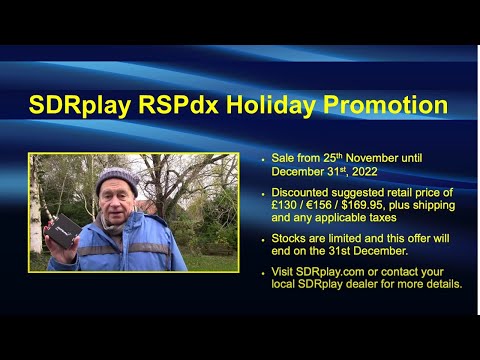
SDRplay have today announced a sale on their "RSPdx" product which runs from today until December 31st. The new pricing is  £130/€156/$169.95 plus shipping and any applicable taxes. This pricing is available for direct sales from SDRplay, and at any participating resellers. The pricing on SDRplay's direct sales platform before the sale was US$214 plus shipping.

Note that individual resellers may be offering slightly different prices depending on if free shipping is offered. For example Ham Radio Outlet in the USA is offering the RSPdx for $179.95 including free shipping.

The RSPdx is designed for high performance DX reception and SDRplay note that it achieves this with additional filtering, improved intermodulation performance, a DAB notch filter, additional attenuation steps, and high dynamic range enhancements for frequencies under 2 MHz.

At SDRplay, we recognise that times are very tough for a lot of people. In view of the economic pressures that people are facing, we want to lend a helping hand by offering the very popular RSPdx at a special low price for this holiday buying season. After discussions with our dealer network, from Black Friday until the 31st December, we (along with participating dealers) plan to offer the RSPdx at a holiday discounted suggested retail price of £130/€156/$169.95 plus shipping and any applicable taxes. This represents a substantial discount of more than one fifth when compared to the normal retail price.

Starting midnight EST, Thursday November 24th visit https://www.sdrplay.com/purchasehome/  to purchase an RSPdx at the special price or contact your local SDRplay dealer for more details.  Please also note that stocks are limited and this offer will certainly end on the 31st December and prices will revert to normal commercial levels thereafter.

This is a great opportunity to get the RSPdx as a gift for a newcomer or a returning radio enthusiast at a price which won’t be repeated, as our suppliers are already increasing their prices for the new year.

  • Prices shown are prices offered when buying direct from SDRplay. Shipping and taxes are extra.  SDRplay ships from the UK to most countries in the world.  However some countries will require import duty to be paid on top.
  • SDRplay dealers who usually include free shipping will adjust the prices accordingly
  • Check with your local dealer to see if they are participating.
  • Links to both the SDRplay direct purchasing page and our list of authorised resellers can be found here
SDRplay - Special RSPdx Holiday Promotion

Airspy and YouLoop Black Friday Sale Now Active: 20% OFF

Airspy is holding their annual Black Friday sale, this year offering 20% off their range of products. The sale is active at all participating resellers, which includes our own store where we have the YouLoop on sale for US$31.96 including free shipping to most countries in the world, instead of the usual US$39.95. Please note that due to EU VAT collection laws, EU customers must purchase the discounted YouLoop from our eBay or Aliexpress stores. 

The YouLoop is a low cost passive loop antenna for HF and VHF. It is based on the Möbius loop design which results in a high degree of noise cancelling. However the main drawback is that it is a non-resonant design, which means that it works best when used with ultra sensitive receivers like the Airspy HF+ Discovery. 

Some good reviews include the YouTube videos done by Frugal Radio where he reviews HF reception and VLF & LF reception with an Airspy HF+, and later tests it with an RTL-SDR Blog V3 using direct sampling. Techminds also has an excellent review on his YouTube channel. We also have a product release overview on this post from March 2020.

During the sale the price of Airspy SDRs and their upconverters are:

  • Airspy R2: $160.00 $135.20
  • Airspy Mini: $99.00 $79.20
  • Airspy HF+ Discovery: $169.00 $135.20
  • Airspy SpyVerter: $49.00 $39.20

Raspberry NOAA V2 Edition 2023 Image Released

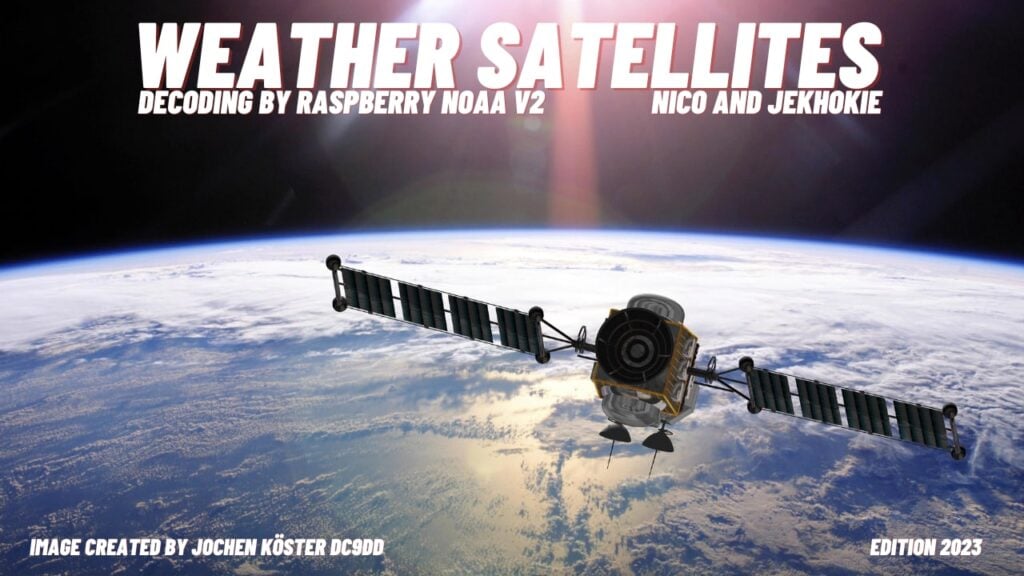
Thank you to Manuel Lausmann for submitting news about the release of the "Raspberry NOAA V2 Edition 2023" image for Raspberry Pi's. This image has been created by Jochen Köster (DC9DD), and contains a few enhancements over the previous image, mainly by including a program that allows users to create composite images of images from the Meteor weather satellites. Manuel writes:

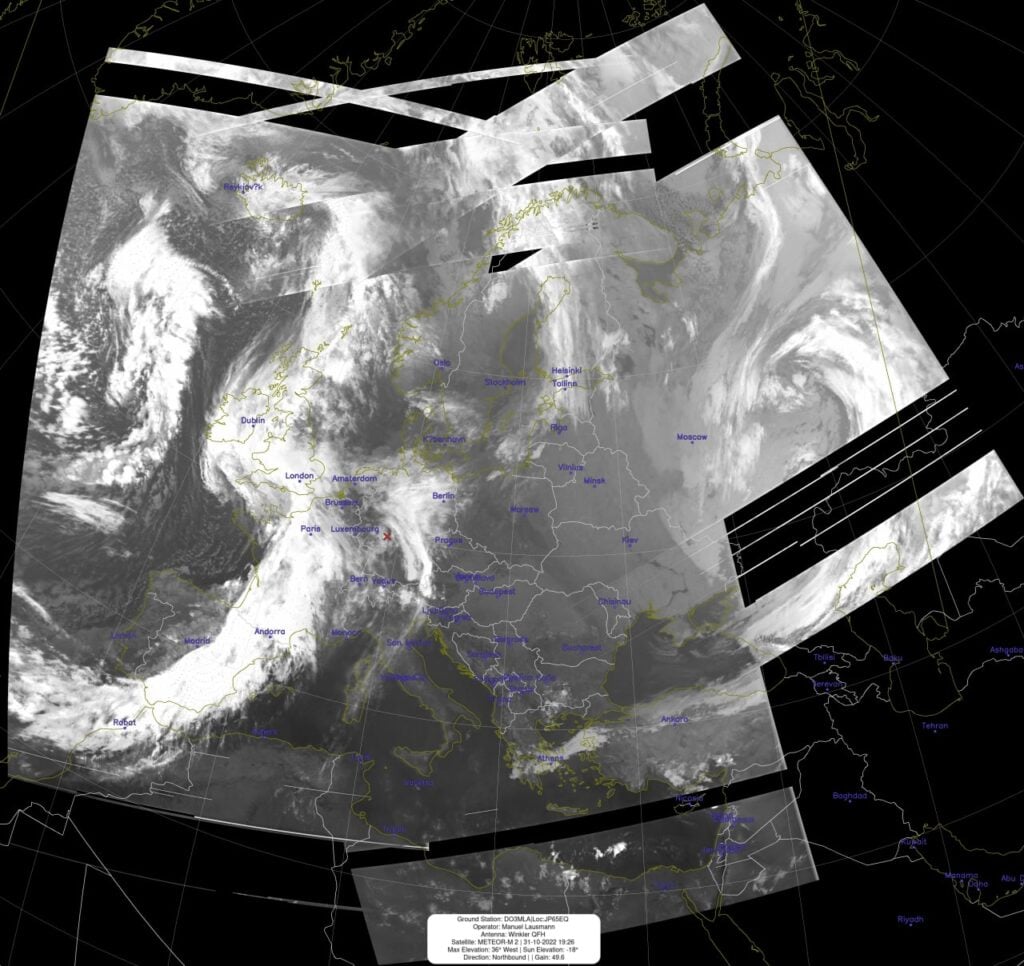
This is based on the well-known Raspberry Noaa V2. In this image, however, the latest MeteorDemod has been added, which makes it possible to generate composite images, which was previously only possible under Windows with Meteorgis.

Furthermore, the image has an additional FTP uploader. The image was created by Jochen Köster DC9DD. It's available from today. This image is also part of my off-grid station in Northern Norway.

Download link for the image: https://www.qsl.net/do3mla/raspberry-pi-images.html

Here is a link to the Facebook group for the image: https://www.facebook.com/groups/raspberrynoaav2edition

Here is a link to ranged from my off-grid station where this image is running: https://usradioguy.com/science/off-grid-apt-lrpt-satellite-ground-station

An example of a composite image from multiple Meteor satellite images.

GNU Radio Conference 2022 Talks Available on YouTube

During September 26 - 30 GNU Radio Conference 2022 was held in Washington DC. GNU Radio Conference (aka GRCon) is an annual conference centered around the GNU Radio Project and community, and is one of the premier software defined radio industry events. GNU Radio is an open source digital signals processing (DSP) tool which is used often with SDRs.

A few days ago videos of all the presentations were released on their YouTube channels, and all the talks can be found on this playlist. The videos contain a mix of in person and remote talks. A schedule of all talks can be found on the GNU Radio website.

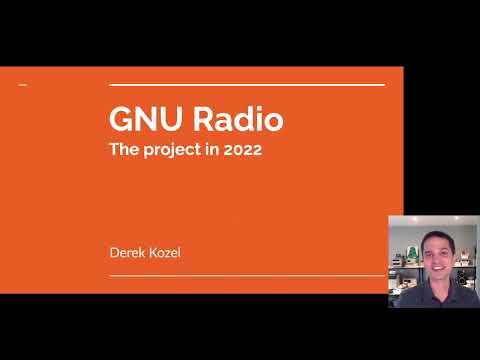
GRCon22 - GNU Radio Project Update