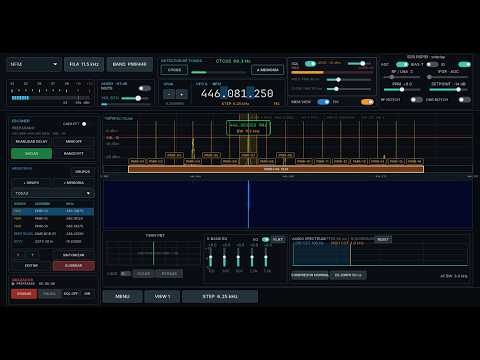
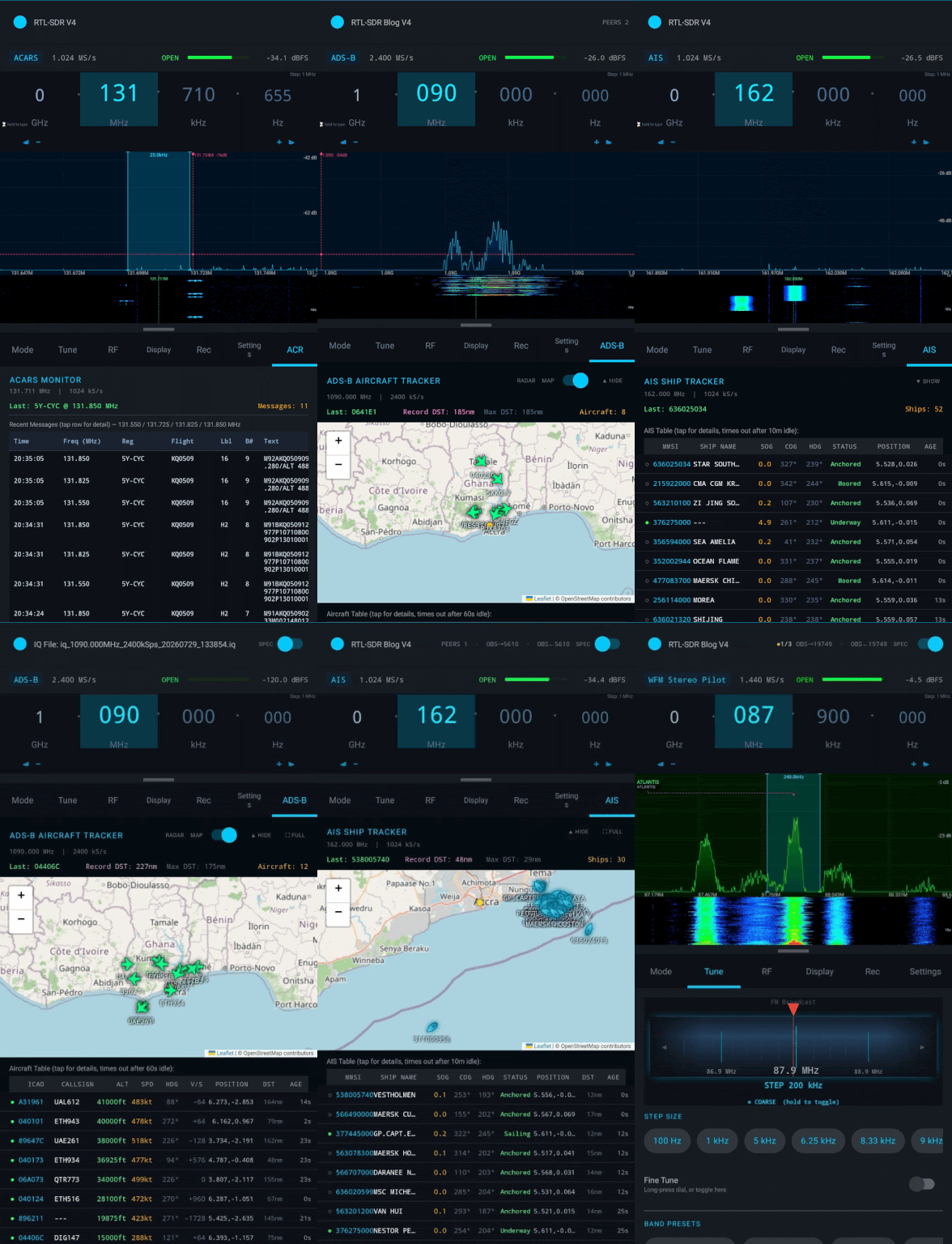
Thank you to Luis Lopez Martinez for writing in and sharing the release of his open-source software, IC-SDR, a new multi-mode SDR application for Windows written in Gowith a focus on performance and efficiency. Luis writes:
IC-SDR supports AM, NFM, WFM, LSB and USB demodulation, along with several integrated digital decoders:
AIS
ADS-B (1090 MHz and UAT 978 MHz)
Radiosondes
APRS
RTL_433
DMR
SSTV
TETRA
It also includes a memory bank, real-time spectrum and waterfall displays, an audio recorder with automatic silence removal, and a frequency-segment scanner with instant triggering.
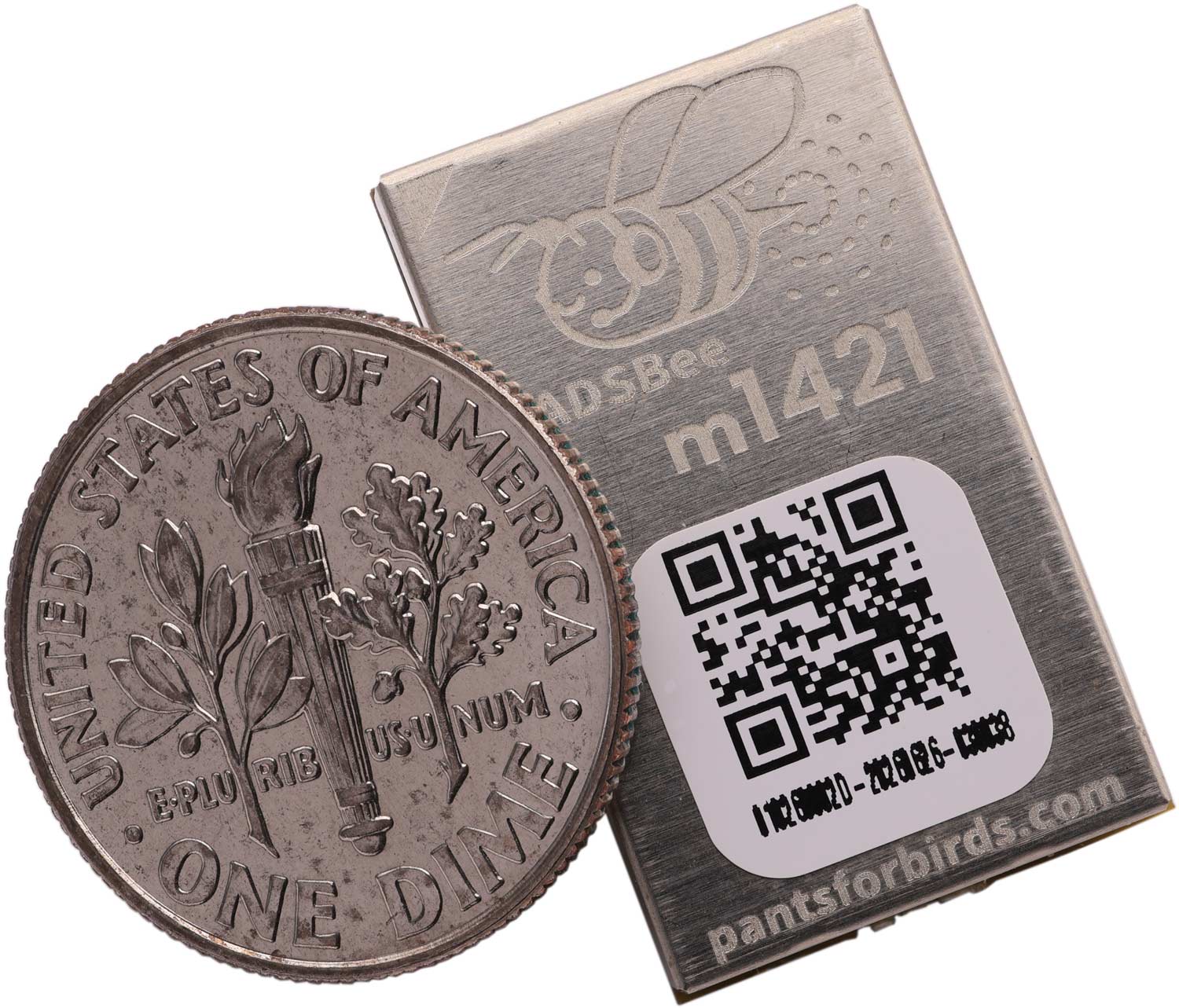
'Pants for Birds' recently announced the release of the ADSBee m1421 module, which they describe as the world's smallest dual-band ADS-B receiver.
The ADSBee m1421 is based on the LR2021 chip, and while it supports dual-band 1090 MHz and 978 MHz UAT, they note that 1090 MHz support is somewhat limited. This is because the LR2021 can listen to only one Mode S packet type, so it cannot receive squawk codes and receives fewer non-ADS-B packets. This, however, does not affect the usual application: tracking aircraft. The LR2021 also cannot implement timestamping or RSSI, meaning that MLAT is not possible.
Apart from its ADS-B capabilities, they have also broken out the LR2021’s 2.4 GHz front end as a waveguide, allowing it to be used as a mesh transmitter or LoRa receiver.
The ADSBee m1421 Module - Described as as the world's smallest ADS-B Receiver.
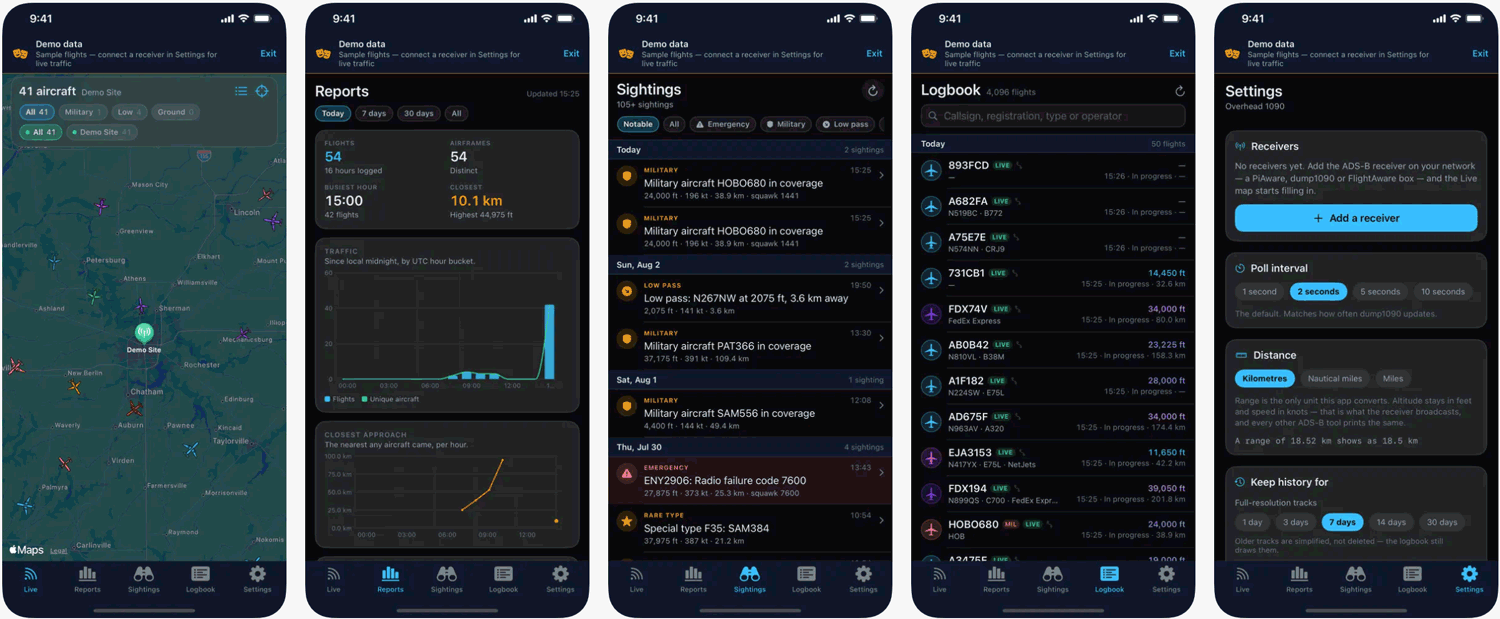
Thank you to Michael Russo for submitting news about the release of his new Apple iOS/tvOS app called 'Overhead 1090'. Overhead 1090 is an iPhone/iPad/Apple TV client for dump1090-compatible RTL-SDR-based receivers such as dump1090-fa, readsb, and PiAware builds. Michael writes:
It reads the aircraft.json feed over the LAN and adds what the stock web maps don't have: a persistent logbook of every airframe received, daily traffic reports, and a sightings feed for emergency squawks and rare types. The Apple TV version is the headline feature: a full-screen steerable radar scope for the living room.
Everything is local. No cloud, no account, no analytics (App Store label is "Data Not Collected"). It supports multiple receivers and includes a demo mode with sample traffic. One $4.99 purchase covers all three platforms.
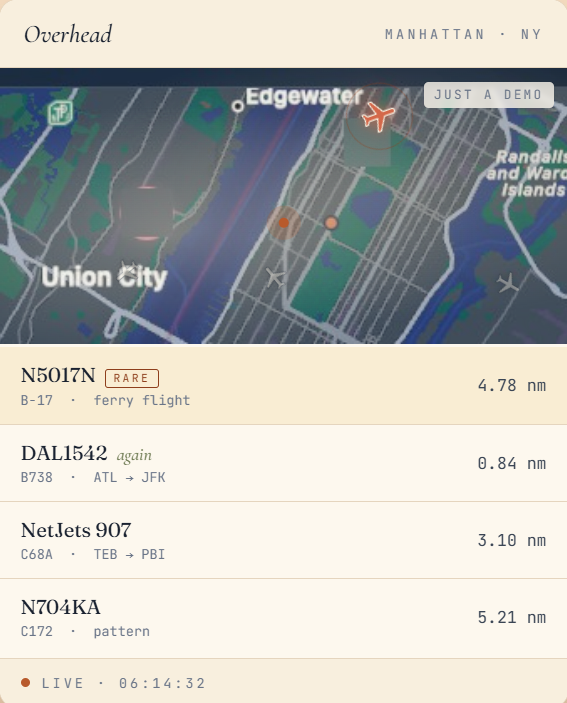
Thank you to Chris Miller for submitting news about the release of his (paid) Mac app called Overhead Sky. This app sits in the MacOS menu bar, and names aircraft as they pass overhead, by making use of the adsb.lol ADS-B data aggregator.
The app costs $24.99 one off, or $3.99 monthly, however Chris writes that people who feed adsb.lol with an RTL-SDR or other SDR get the app discounted at $9.99. Chris writes that detecting people feeding to adsb.lol was a challenge, and shares his methods below:
I started on a commercial flight-data API and found it bills per aircraft returned rather than per call, which means one person leaving the app running over a busy sky costs more in a month than the app costs in a year. So I went to the community feeds and read the licences properly, and most said no. airplanes.live is non-commercial. ADS-B Exchange's affordable tier is a non-commercial community tier, and the site is Jetnet-owned now. adsb.lol is ODbL, which permits commercial use with attribution. So that is what it runs on, credited in the app, on the privacy page, and in the App Store description.
Two things follow from being a paid product living on a volunteer commons, both written down before it went on sale. Ten percent of profit goes back to the ADS-B open-data community, totalled once a year and published so the promise stays checkable. And anyone who feeds pays $9.99 instead of the full sticker.
The verification is the part I think fits your readership best. adsb.lol has no login, so the app calls GET /0/me, which reports the caller's own receiver based on the source IP of the request. If your Mac shares a public IP with your receiver, your beast or mlat client shows up and you are verified with no input at all. That call has to run from the user's machine rather than my server, because through a proxy it would judge my IP and match nobody.
The same reasoning sets the data path. Positions go from the Mac straight to adsb.lol, coarsened to about a one kilometre square first, because adsb.lol rate limits per IP and routing every user through one Cloudflare egress would have earned the block it deserved. Only route lookups pass through my server, carrying a callsign already on the user's screen and no location, unlogged.
So that leaves two honest gaps, since they belong in any piece about this. The app reads the aggregated network rather than a local dump1090 or tar1090 feed, so it is API-backed rather than receiver-backed today. And I do not run a receiver myself yet (though I hope to eventually).
Thank you to Richard (9G5AR) for writing in and sharing with us the release of his open source Android app called 9GRadio. Richard writes that 9GRadio is an app designed for spectrum monitoring/analysis and the decoding of analog/ham/aviation and marine radio traffic.
In terms of demodulation it supports AM, FM, NFM, WFM, WFM Stereo, USB, LSB, CW, CWR, DSB and RAW IQ modes.
For digital decoding, it supports APRS, digital voice modes such as DMR, D-STAR, YSF, dPMR, NXDN, and aircraft, marine, and datalink modes such as ADS-B, AIS, ACARS, RDS, and multilateration.
Richard also notes that 9GRadio includes a full multilateration stack for locating transmitters, which works with 2+ networked 9GRadio receivers. Interestingly, the multilateration stack is noted to be protocol-agnostic, meaning it should work not only with ADS-B, but also with any mode that provides a digital identity for a transmission, such as AIS, ACARS, RDS, and digital voice modes.
The app is not available on the Google Play Store, but the APK is available for sideloading on the project's GitHub Releases page, along with the open source code.
Recently, we posted about DeepSDR, which is a program that automatically transcribes voice data from public safety radio communications and uses an LLM to categorize and plot incidents on a map as they happen.
In that post, we noted that we expect to see more projects like this soon, and sure enough, another program called "Scanner Command" with a similar angle has been submitted to the blog by author Benjamin Blood. Like DeepSDR the software listens to public safety and then uses voice transcription and an LLM to automatically understand, categorize and map incidents on the map. One additional feature that Scanner Command has is a fun tool that correlates ADS-B data with airband voice. Benjamin explains it best:
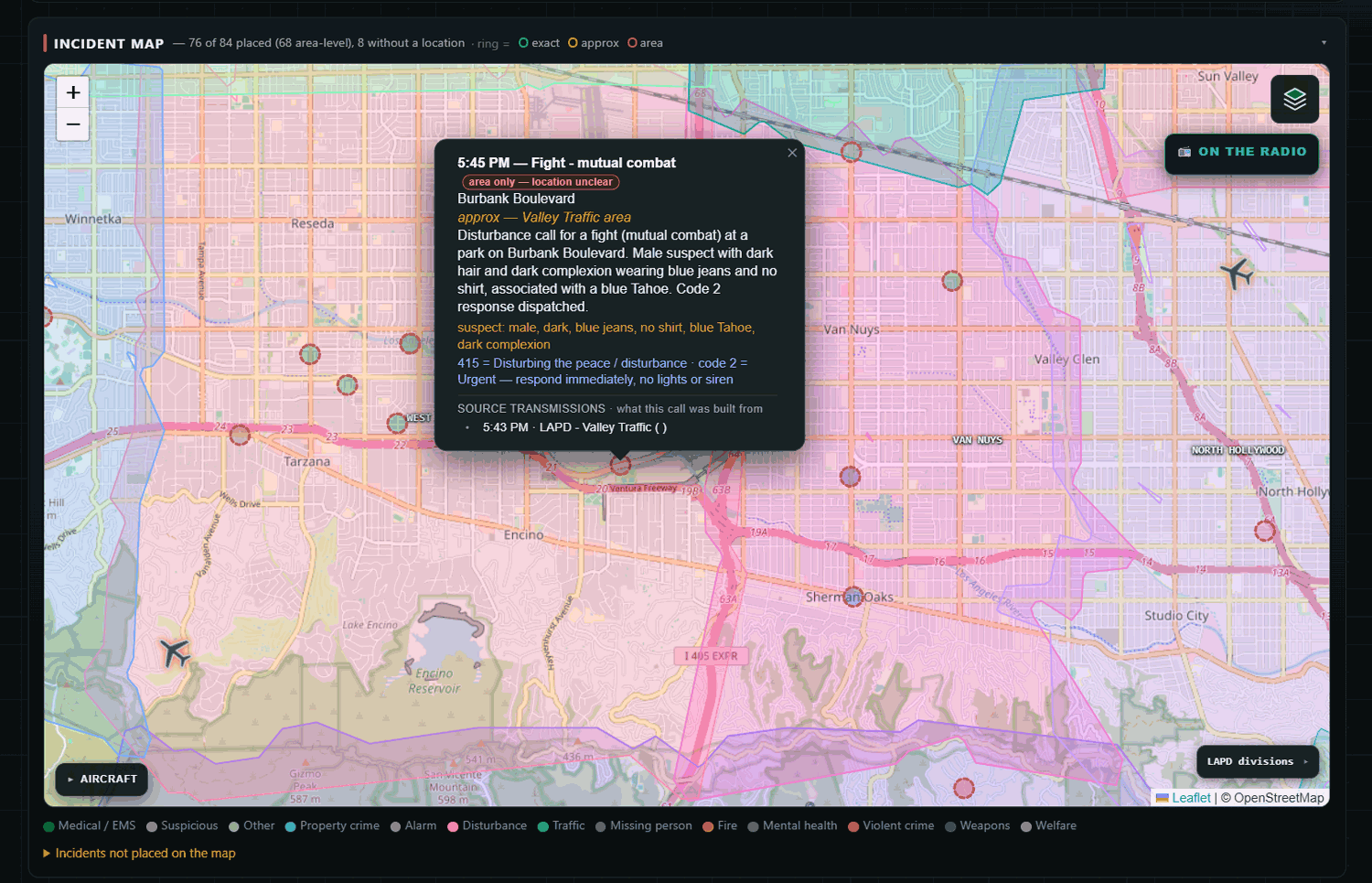
Scanner Command turns a radio scanner into a live AI incident map. A Uniden SDS200 covers the trunked digital public safety side (the LA area's P25 Phase II system, with ProScan driving the scanner and handing off every recording), and two $45 RTL-SDR dongles handle the rest, one decoding ADS-B with readsb, one capturing VHF airband transmission by transmission. Everything gets transcribed locally with Whisper, an AI extraction pass works out what happened and where, and about 30 seconds after a call ends it's a color-coded pin on the map with the audio one click away. Location matching is honest on purpose: an exact intersection match gets a solid pin, an area-only match gets a dotted one, and it tells you which.
Here's the design idea underneath it, and what I think separates it from the other transcribe-and-map projects out there: this is built for tactical situational awareness when the grid's down. The system does its learning while it's online, building its own gazetteer of local streets and places, learning unit callsigns and talkgroup names, priming the transcriber's vocabulary from real local traffic, precisely so it's more capable when it's cut off. Map tiles, geocoding, and hazard data are all cached locally with that scenario in mind.
The picture in my head has always been: grid's down, the box is running on backup power serving wifi, and my neighbors connect with their phones and everyone can see what's happening around us, instead of one guy hunched over a scanner relaying it. It's not shelf gear you dust off when something happens; the whole point is that running it every day is what trains it for the day you need it. Transcription is already fully local, the LLM extraction step currently uses a hosted model when online (it runs me about a dollar a day at 24/7), and the next build phase is a GPU box that closes that last gap with a local model.
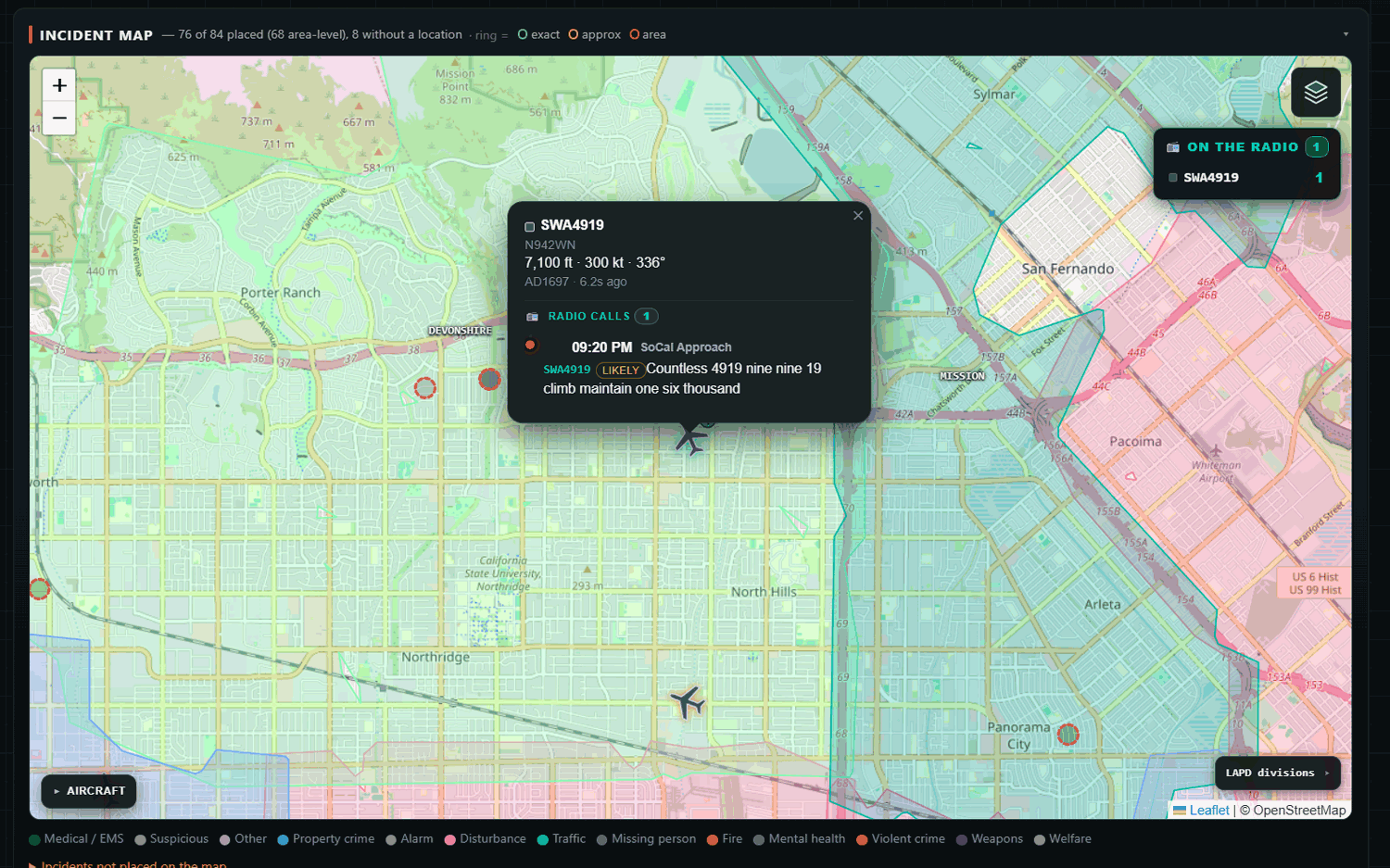
The feature people are having the most fun with is the airband/ADS-B correlation. The system pulls spoken callsigns out of airband transcripts and matches them to ADS-B tracks by time and geometry, with match windows scaled by altitude and speed, plus hex-to-tail-number derivation. Click a plane on the map and hear what its pilot actually said, with a confidence badge when the match came from a partial readback. Beyond that: an ATAK feed (CoT/KML/GeoJSON), twice-daily AI briefs, a BOLO board, incident threading with a unit activity board, and helicopter orbit detection.
ADS-B aircraft position data automatically linked to airband voice transcripts
Benjamin adds that a public demo is available at https://demo.scannercommand.com. But he notes that "the public demo is a replay of two real days of traffic from my setup".
The software has not yet been released, and it does not appear to be free or open-source. There is a signup waitlist available on the scannercommand.com website.
This is an exciting time with AI not only helping to rapidly develop new software, but now being used to summarize and condense the vast amount of information about the state of the surrounding world available in the RF spectrum.
Scammer Command example mapped incident report
I Turned My Police Scanner Into a Live AI Incident Map (24/7)
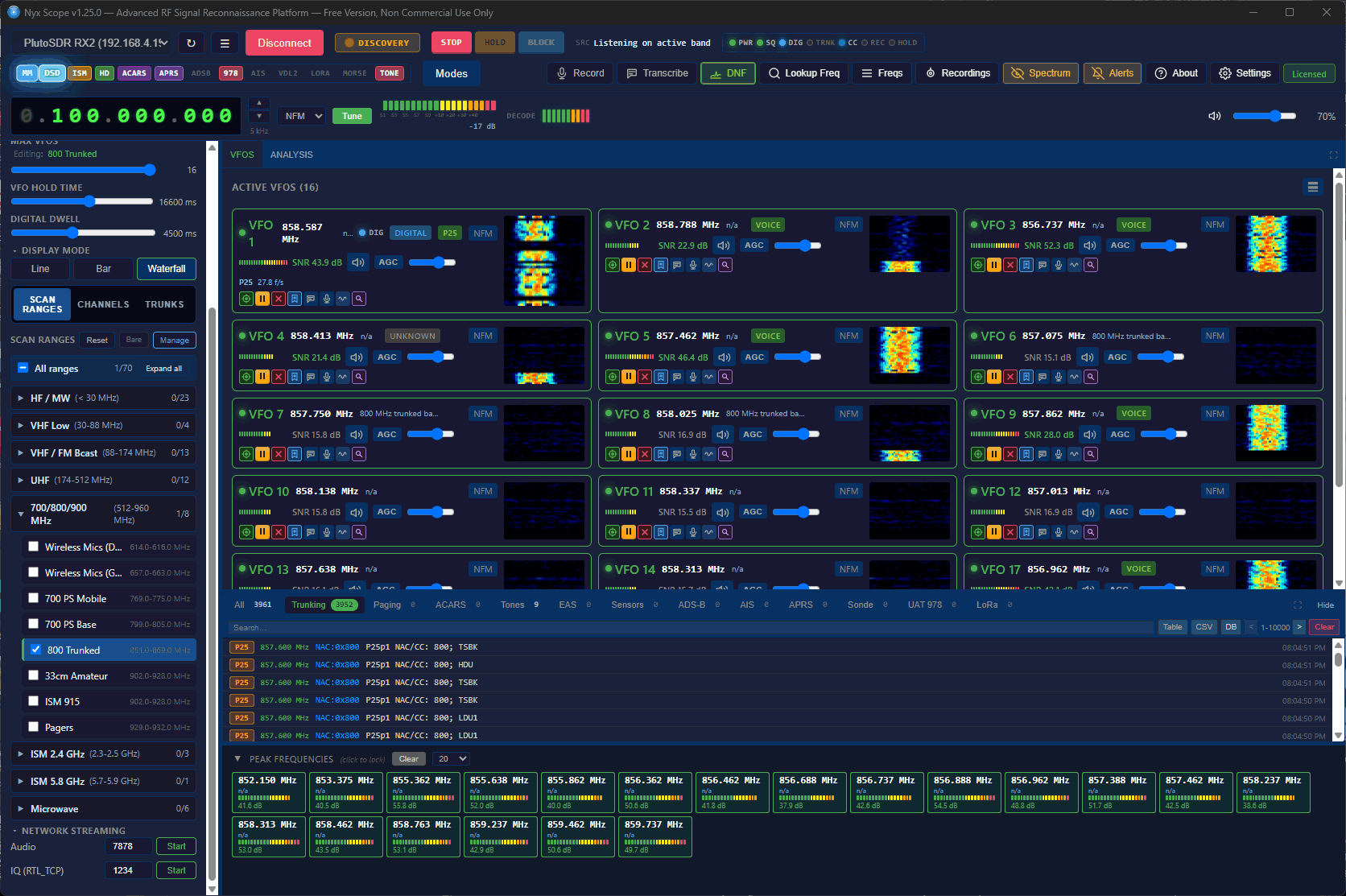
You get spectrum and waterfall, multiple concurrent VFOs, trunked-radio following, digital voice, aviation and marine tracking, paging, ISM sensors, HD Radio, and transcription, in one binary.
NyxScope includes decoders for P25 Phase 1 and Phase 2 voice, EDACS and NXDN control channels, ADS-B, AIS, ACARS, POCSAG, FLEX, LoRa CSS PHY + LoRaWAN MAC, Morse, RDS, CTCSS/DCS, Iridium decoding (with voice), and also includes a signal classification tool, Bluetooth LE scanner, and Whisper voice-to-text transcriber. It also outsources decoding of other protocols to mature decoding software such as multimon-ng, rtl_433, dsd-neo, nrsc5, direwolf, dumpvdl2, dump978, rs41mod where required, noting that the outsourced decoders are bundled with the software, meaning no extra installation work is required.
The software supports RTL-SDR, HackRF, Airpsy, bladeRF, SDRplay, Fobos and PlutoSDR. It also supports using multiple SDRs used in parallel.
The software does not appear to be open source, but it is provided for free with a limitation of 3 concurrent VFOs and a limitation on recording, transcribing, and pager messages. A perpetual per-machine license for $89.95 can be purchased to lift these restrictions and add access to their FCC frequency lookup database.
AI-Disclaimer: While the developers have not noted any use of AI tools, we suspect that AI was used in the creation of this software.
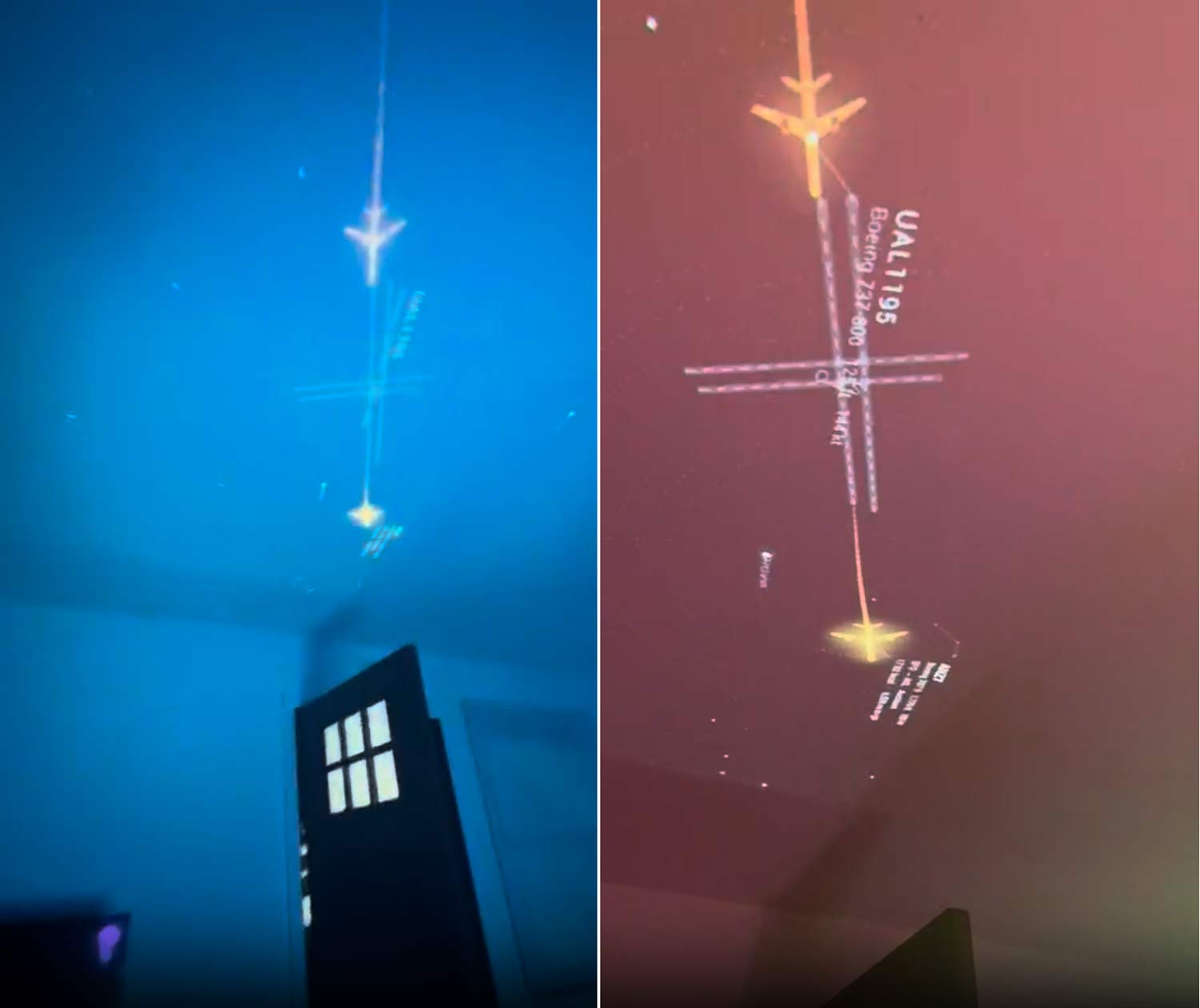
Recently, Cameron Paczek has created a new project called SkyLight, where art meets technical implementation by displaying a live view of aircraft flying overhead on your ceiling. SkyLight consists of a projector, Raspberry Pi 5, RTL-SDR dongle, and some custom software.
The Raspberry Pi 5 and RTL-SDR receive live ADS-B data from local aircraft, and the projector points up at the ceiling and displays the live locations of aircraft as they fly overhead, effectively giving you a simulated X-ray through your roof. The projections also include the sun, moon, bright stars and constellations, and live satellites.
This project reminds us of a British Airways billboard in 2014 that used live ADS-B data to have a child on the screen point directly at incoming aircraft. We note that these SkyLight and billboard projects would not be possible without live ADS-B data, as ADS-B aggregation sites like ADSB-Exchange and Flightradar24 typically have a few-minute delay and require payment for their APIs.
Cameron aims to productize his idea into a ready-made kit and crowd-fund it in the near future. If you are interested, you can sign up for his notification mailing list over at skylightceiling.com.
AI Disclaimer: We note that this project appears to have been coded with the help of AI tools.
Skylight Ceiling Projecting Live Aircraft via ADS-B data on the Ceiling