Tagged: hackrf

Tech Minds: A Beginners Guide to the HackRF and Portapack with Mayhem Firmware

In one of his latest videos Matt from the Tech Minds YouTube channel has created a beginners guide to the HackRF and Portapack with the Mayhem Firmware. The HackRF is a popular affordable software defined radio with wide frequency range and transmit capabilities. An addon called the Portapack allows the HackRF to go portable, and custom firmware called 'Mayhem' significantly expands it's capabilities.

Matt uses a Chinese HackRF and Portapack clone set from Banggood which can be found very cheaply for around $200 shipped. The original Portpack can be found from the Sharebrained store for $200, and then original HackRF can be found form various resellers listed on the greatscottgadgets website.

In the video Matt unboxes the Portapack, shows an overview of the hardware and then goes on to show how to update the stock firmware to the Mayhem firmware. He then demonstrates a few of the capabilities of the Mayhem firmware.
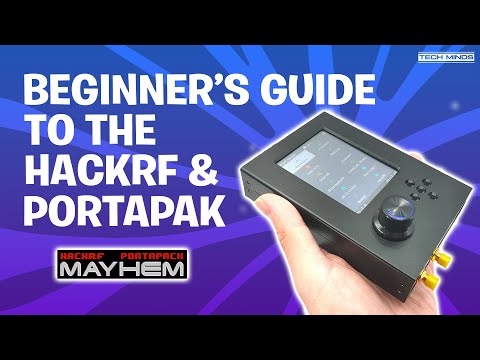
Beginner's Guide To The HackRF & Portapak With Mayhem

Tech Minds: Making your own SDR Software With GNU Radio Companion

In his latest video out on YouTube, Matt from the Tech Minds channel gives us an overview of GNU Radio, and shows a few examples of how it can be used to receive, transmit and decode digital data.

GNU Radio is a popular open source DSP framework for software defined radios. With it you can graphically implement any sort of digital signal processing chain that you like, which can be used for decoding/encoding and demodulating/modulating signals.

GNU Radio can be extremely complex and powerful, but in the video Matt shows some simple starter example flowgraphs like an LSB demodulator, and a simple wav file source transmitter for the HackRF. 

How To Make Your Own SDR Software With GNU Radio Companion

Lab401: HackRF on Windows YouTube Tutorials

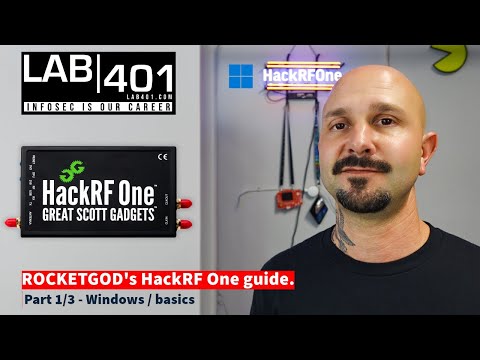
Over on the Lab401 YouTube channel, 'RocketGod' has uploaded three videos that are various tutorials for the HackRF on Windows. The first video covers the basics like installing software and shows how to decode pager signals with PDW.

The second video shows how to decode police transmissions, car key fobs, use rtl_433, and how to use Universal Radio Hacker to capture and analyze signals. 

The third video is not yet released, but is due to premier on YouTube in 10 hours from the time of this post. In that video RocketGod will show how to install and use DragonOS, and how to install and use SDR Trunk which turns the HackRF into a police scanner. Finally, he will demonstrate SDR Angel and show it decoding ADS-B signals from aircraft to show you live flight tracking data.

Part 1 is embedded below, and Part 2 and Part 3 are linked here.

ROCKETGOD's HackRF One guide - part 1/3 Basics, Windows apps, setting up - LAB401

Demonstrating the FM Capture Effect – Why Aircraft use AM

Over on his YouTube channel Tall Paul Tech has uploaded a video that demonstrates the FM (frequency modulation) capture effect. Apart from the costs and difficult logistics to change from AM to FM worldwide, the FM capture effect may be one additional reason as to why aircraft still choose to use AM modulation for communications instead of FM.

The FM capture effect is a phenomenon that occurs when two FM transmitters transmit on the same frequency at the same time. What will happen with FM is that the stronger of the two transmissions will be the only one heard, with the weaker one totally muted. This is in contrast to AM where both signals can be heard, albeit garbled like two people talking at the same time.

With aircraft this is important as for example if some aircraft accidentally leaves a blank transmission open, another aircraft can still transmit on top of the blank transmission and still be heard. Or allowing air traffic control to hear if multiple aircraft are trying to transmit at once, and handle communications appropriately based on urgency. The disadvantage is that without the capture effect, AM is more prone to interference from interference and atmospheric noise like lightning.  

In his demonstration Paul uses two HackRF's with their clocks linked and an RTL-SDR to simulate two transmitters and a receiver.

Demonstrating FM Capture Effect

Receiving Images from the US DoD Coriolis Satellite

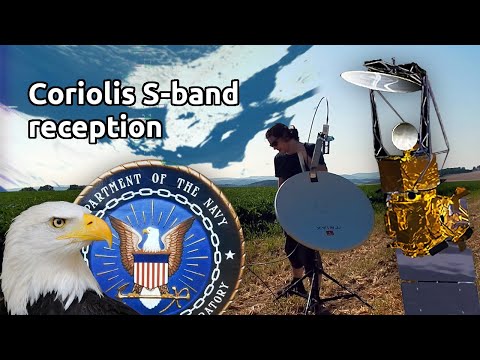
Over on dereksgc's YouTube channel another recent video from his satellite decoding series shows how to download images from the Coriolis satellite, a US Department of Defense satellite launched in 2003, that is among other uses designed to measure wind speed and direction from space using a radiometer.

The entire history of an orbit is only downlinked in the S-band when over an official ground station, however it also has a 'tactical' downlink for live data that the US Navy uses. As the data is unencrypted, with a satellite dish, 2.2 GHz feed, LNA and a software defined radio like the HackRF, anyone can receive the data.

In his video dereksgc explains the satellite, shows his hardware, and demonstrates reception. He then passes the recording into SatDump which results in the images. The images themselves are nothing interesting to look at, as they are produced by a sensor designed to measure wind. But dereksgc shows how multiple images can be composited into something a little more interesting.

Progress Updates on the GSG Universal Radio Test Instrument (URIT)

In May we posted about how Great Scott Gadgets (GSG), the team behind the HackRF SDR and several other popular products, are in the early stages of developing a new type of SDR product called the "Universal Radio Test Instrument" or URTI for short.

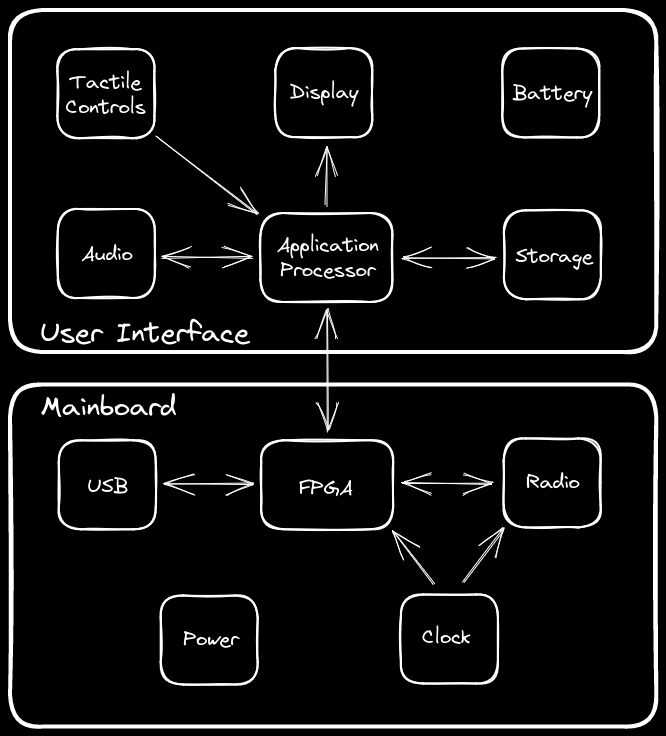
Thank you to a few blog readers for pointing out that earlier this month the URTI GitHub lab-notes were updated with a progress report, and some further information about the architecture. The URTI will be split into a mainboard PCB, and a user interface PCB. The former will contain the USB interface, FPGA computing, and radio, and the latter will run a display and tactile controls. 

For the radio components, the team appear to be using similar components to what is used in the HackRF. They have selected the MAX5865 as their analog to digital converter (ADC) chip which is a faster sampling version of the MAX5864 which is used in the HackRF. They've also chosen either the MAX2831 or MAX2830 as their quadrature transmitter, and the MAX2120 as their quadrature receiver. They are also using the RFFC5072 chip as their mixer. These are again similar or the same as parts used in the HackRF.

In the update they also make notes on their SMA connector selection, PCB trace width selection, and their selection of Unun, RF switch, clock generator and RF limiter parts. They also note progress on their software which will provide a DSP library for the FPGA, and their tests of a display via a hand held game console.

In the next stage of development the team will be designing and assembling the mainboard to try and quickly make a platform available for software developers to get started on.

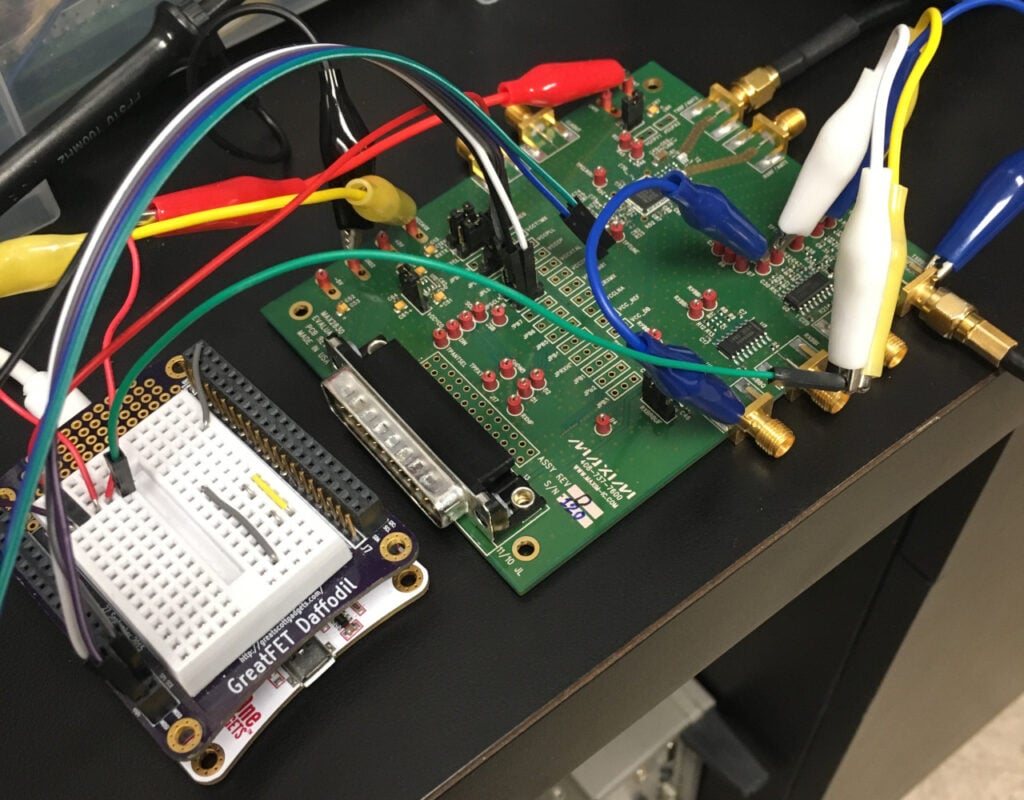
Testing the MAX2830 Chips with a GreatFET
URTI Overall Architecture
URTI Mainboard Architecture

Reverse Engineering a Wirelessly Controlled Adjustable Bed with a HackRF and Logic Analyzer

Over on his blog Chris Laplante has written up a post showing how he was able to reverse engineer his wirelessly controlled adjustable "TEMPUR-Contour Elite Breeze" bed. Originally the bed did have an Android App for smartphone control, however it was never updated since 2014 and so it no longer works on his modern Google Pixel device. So in order to have it controllable by his home automation system Chris decided to reverse engineer the wireless signal used by the bed's remote control. 

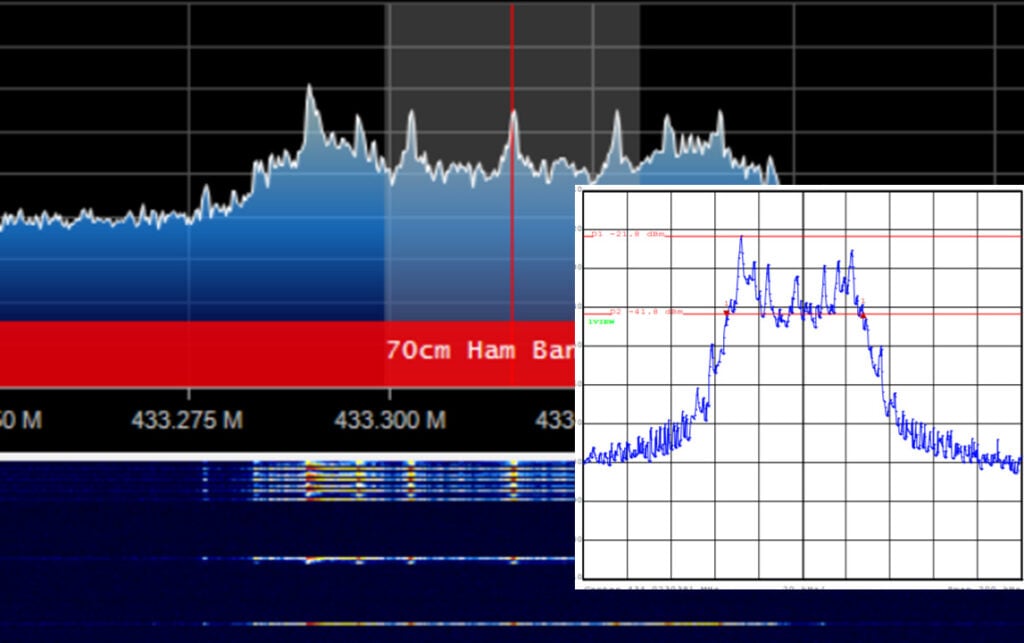
He first searched the FCC filing, finding that it transmitted in the ISM band at 433.050 to 434.790 MHz. Then using his HackRF he was able to capture the signal and determine that it used Gaussian frequency shift keying (GFSK) modulation.

The GFSK signal from the Tempur Pedic wireless remote control.

While the HackRF got him this far, he decided to follow a new line of investigation next, instead now using a logic analyzer to probe the SPI bus which talks to an Si4431 RF transceiver on the remote control. From this he was able to determine the important properties of the signal such as the frequency, data rate, frequency deviation, channel mapping and packet structure.

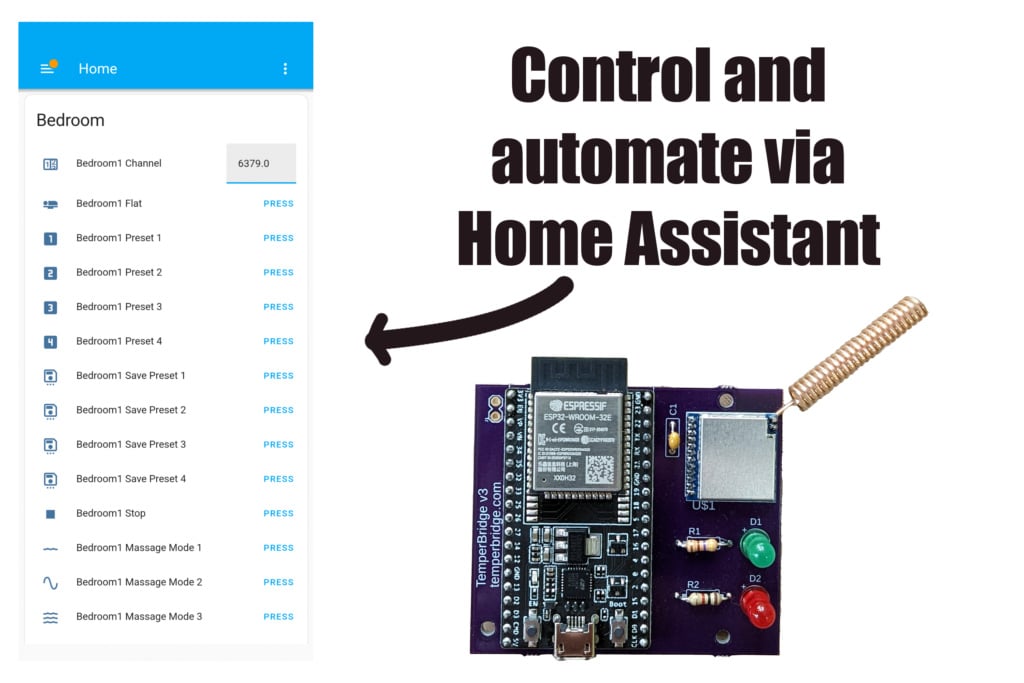
With all this information Chris was in the end able to create a product called "Tempur Bridge" that he is now selling on Tindie. It consists of an ESP32 WiFi connected microcontroller and a Si4463 RF transceiver chip. With his product Chris is now able to control his bed through a WiFi connection in Home Assistant.

Chris's TemperBridge product for WiFi control of a Tempur Pedic adjustable bed.

[This story was also seen on Hackaday]

Bouncing LoRa Signals off the Moon with a HackRF

One part of the amateur radio hobby is 'EME', or Earth-Moon-Earth. The idea is to bounce radio signals off the surface of the moon, and have them received over a vast distance. Typically weak signal amateur radio modulation schemes such as JT65 are used due to their ability to be decoded even with the very weak signals that come back from the moon bounce.

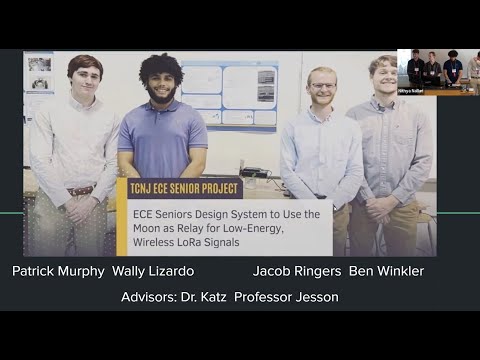
Recently a group of students from the College of New Jersey are attempting to bounce signals off the moon using the LoRa modulation scheme. LoRa is a modulation scheme designed to be used with IoT devices, however it also has great performance when signals are weak so it's a good candidate for moon bounce.

The students are using a HackRF and the SDR-Angel software with the signal being transmitted in the amateur radio bands at 1296 MHz. The antenna hardware consists of an 1296 MHz feedhorn attached to an 8-meter dish. They hope that the use of LoRa modulation can reduce the power requirements for EME.

The main goal of this project is to establish Earth-Moon-Earth communication with LoRa modulated signals. There are three main goals that this project is trying to accomplish. The three goals of our project are to reflect a signal off the Moon and receive it back here in New Jersey, transmit a signal from here in New Jersey, bounce it off of the Moon, and then receive the signal on a dish located in Alaska, and our final goal for this project is to establish two way communication between New Jersey and Alaska.

Our initial approach to this project is to use SDRAngel to modulate and demodulate our signal. SDRAngel is a free, open-source software that we can use to transmit and receive signals via SDR (Software Defined Radio).

Our modulation technique, LoRa, uses Chirp Spread Spectrum modulation that allows for low power, long range transmissions at the cost of a low data rate.

The peripheral of choice for this project is the HackRF One, a SDR peripheral that allows us to send and receive signals.

This story was also presented on Hackaday.

Bouncing LoRa Signals Off the Moon - TCF 2023, track 5, TCNJ student presentations