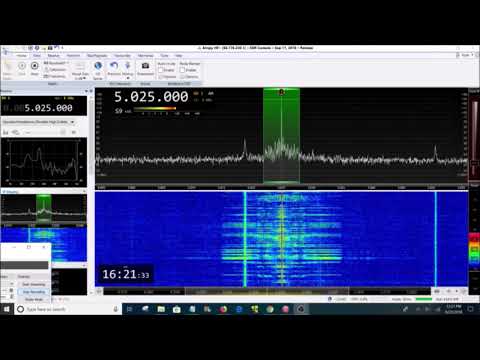
This weeks video on the TechMinds channel explores the various online web SDRs that are available to access for free. Accessing these online SDRs does not require any hardware apart from a PC and internet connection, although of course you are then receiving signals from a different location to yourself.
In the video he shows how to access the SDR# Spy Server Network which mostly consists of Airpsy and RTL-SDR units, the SDR-Console V3 Server network which consists of a wide array of different SDRs, the browser based WebSDR network which is mostly soundcard based SDRs but also RTL-SDR and other SDRs, and finally the KiwiSDR network which is made up of KiwiSDRs.
Using Software Defined Radio Without SDR Hardware - WebSDR
Over on his YouTube channel Frugal Radio has released the second episode in his 2020 SDR Guide series. In this video, Frugal Radio shows how to connect to remote SDRs such as KiwiSDR OpenWebRX, WebSDR, SDR-Console v3 Servers, and SDR# SpyServers. He shows how to use these remote SDRs to monitor long range aviation channels, amateur radio operators, and VHF Public Safety channels in the US. He also demonstrates how to decode HFDL signals from aircraft using WebSDR and free software, and verifies the aircraft locations via online tracking sites.
2020 SDR Guide Ep 2 : How to use over 500 remote SDRs free online (webSDR, KiwiSDR & HFDL decode)
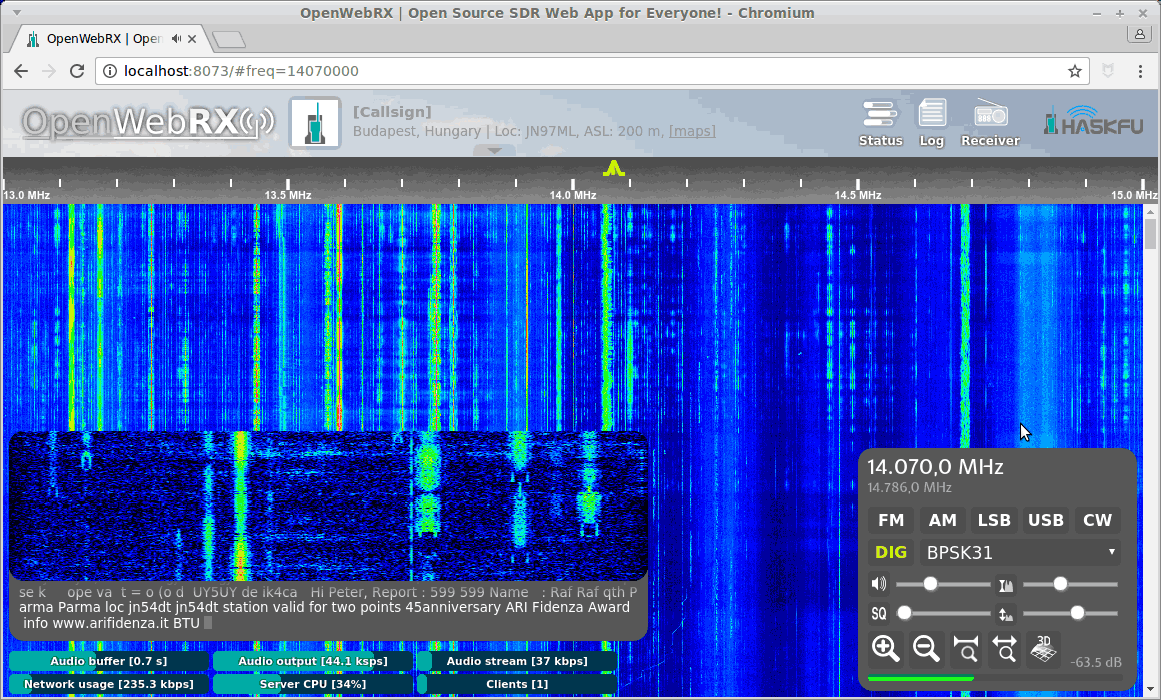
OpenWebRX was first developed by Andras Retzler and is and open source program that allows users to make RTL-SDRs, KiwiSDRs and other SDRs accessible over the internet via a web browser. Recently the OpenWebRX public directory at SDR.hu, also run by Andras, has been closed. In the past we've posted about Andras' decision to move on from OpenWebRX and how sdr.hu went from public access to requiring an amateur radio callsign to access. Now Andras has decided to take the final step and close sdr.hu for good. The sdr.hu website now reads:
The SDR.hu project has been finished
I'd like to say a big thanks to everyone who joined my journey with this project!
I hope you had a good time listening on the site, and learnt some things about SDR. The purpose of this site was to provide a technological demonstration for amateur radio operators about Software Defined Radio, and I hope this goal has been reached. As this website was a one-person hobby project, with my tasks and responsibilities growing, and my focus moving to other projects at which I hope to make a greater positive impact, I'm unable to further develop SDR.hu and protect it from abuse.
Furthermore, I think this site has some good alternatives now. Nevertheless, in my opinion amateur radio receivers should be shared with strict access control in the future.
If you have more questions, feel free to consult the FAQ.
73!
Andras, HA7ILM
We want to note that although KiwiSDR makes use of OpenWebRX, the KiwiSDR project is not affected by this closure as they use a custom fork of OpenWebRX, and there is an official KiwiSDR directory at kiwisdr.com/public, a map version at map.kiwisdr.com, and an SNR score directory at snr.kiwisdr.com. Unfortunately the one major drawback is that these directories do not list public RTL-SDRs or other SDRs running OpenWebRX as only sdr.hu did that.
Also, although Andras has stopped development on OpenWebRX, a fork of the project led by Jakob Ketterl (DD5JFK) is alive and well at github.com/jketterl/openwebrx and openwebrx.de.
The KiwiSDR is a US$299 HF SDR that can monitor the entire 0 - 30 MHz band at once. It is designed to be web-based and shared, meaning that the KiwiSDR owner, or anyone that they've given access to can tune and listen to it via a web browser over the internet.
OpenWebRX is code originally created by András Retzler and a modified version runs on the KiwiSDR devices. This code is what allows them to be accessed online by a browser and was popularized by it's use in the KiwiSDR. The original code can also be used by other compatible SDRs such as the RTL-SDR.
Recently András released news that he is discontinuing work on OpenWebRX due to interest in other projects, but it will remain on GitHub as open source code. András also notes that the security of OpenWebRX will soon be in question as it utilizes Python 2, which has been designated end of life on January 1 2020. In addition, if you've been following OpenWebRX since the beginning, you'll know that in the past OpenWebRX was involved in an legal/ethical issue over open source licencing with KiwiSDR. Although the problems with KiwiSDR were resolved amicably, Andras also references his frustrations with similar situations to do with his code being forked again and again.
We note that maintenance and development of the KiwiSDR OpenWebRX code will continue as they are considered separate projects. Due to some confusion, we importantly reiterate that the KiwiSDR product is unaffected by OpenWebRX being discontinued. Although KiwiSDR is based on OpenWebRX they use their own custom branch of the software that is maintained by the KiwiSDR owners and not by András.
András also runs the popular sdr.hu OpenWebRX/KiwiSDR directory, which was/is considered the main directory for finding and accessing public KiwiSDR and other SDR devices running OpenWebRX. Recently the directory was restricted, and now can only be accessed by those with a ham radio callsign. It is unclear why this decision was made as sdr.hu was very popular with shortwave listeners and radio newbies who are typically not hams. But the sdr.hu FAQ notes "The purpose of the site is to serve amateur radio. I decided to restrict access to the receiver list in order to protect the site and its purpose in the long term."
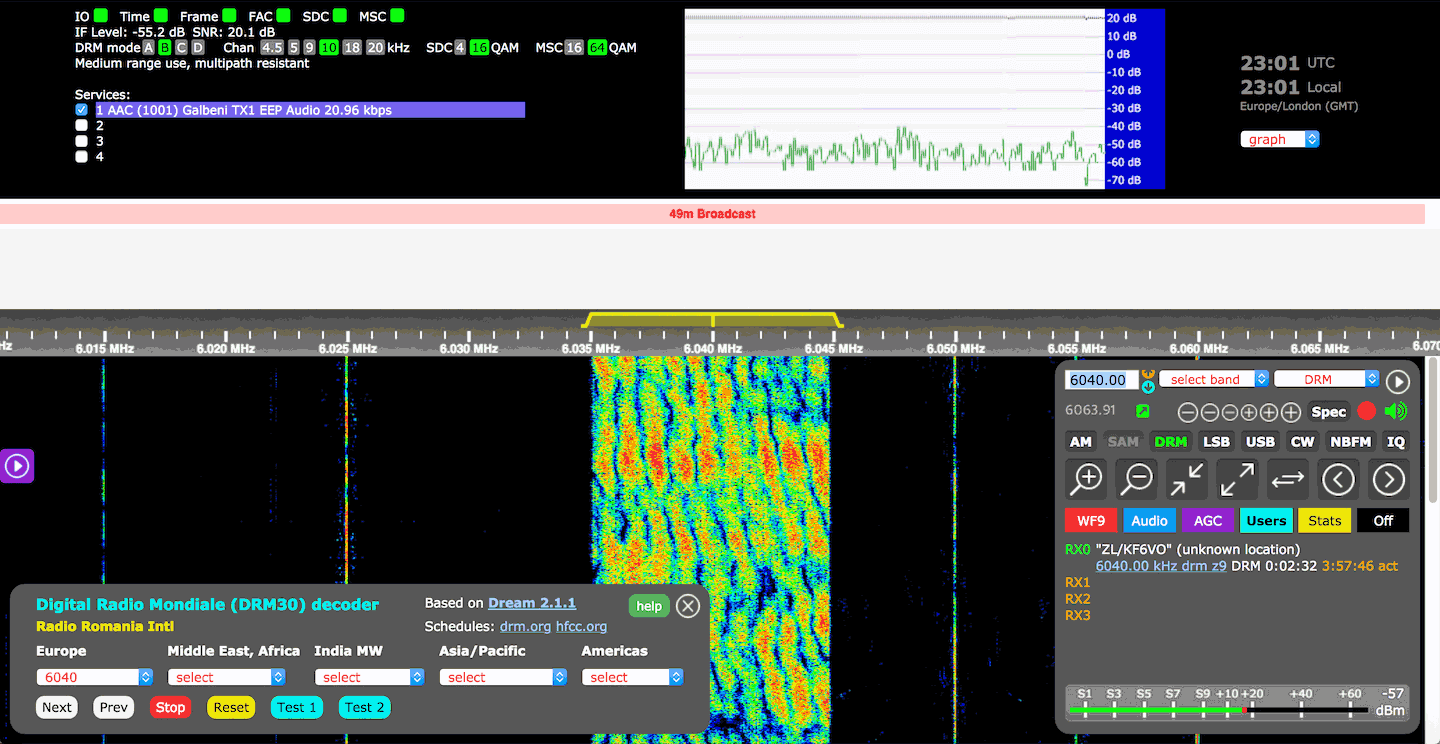
KiwiSDR have recently implemented DRM decoding into their OpenWebRX implementation. Digital Radio Mondiale (DRM) is a type of digital shortwave radio signal that is used by some international shortwave radio broadcasters. It provides superior audio quality compared to AM stations thanks to digital audio encoding.
The KiwiSDR is a US$299 HF SDR that can monitor the entire 0 - 30 MHz band at once. It is designed to be web-based and shared, meaning that the KiwiSDR owner, or anyone that they've given access to can tune and listen to it via a web browser over the internet. Many public KiwiSDRs can be found and browsed from the list at sdr.hu.
The new DRM implementation is based on DREAM 2.1.1 which is an opensource DRM decoder that can be used with any HF capable SDR. Due to computational limits of the BeagleBone singleboard computer which the KiwiSDR runs on, only one DRM channel can be decoded at any one time, restricting this capability to only one user at a time. However, if the KiwiSDR is running on the newer BeagleBone AI, it can support up to four DRM channels. KiwiSDR write that work is still ongoing to improve the code, so this situation may improve in the future.
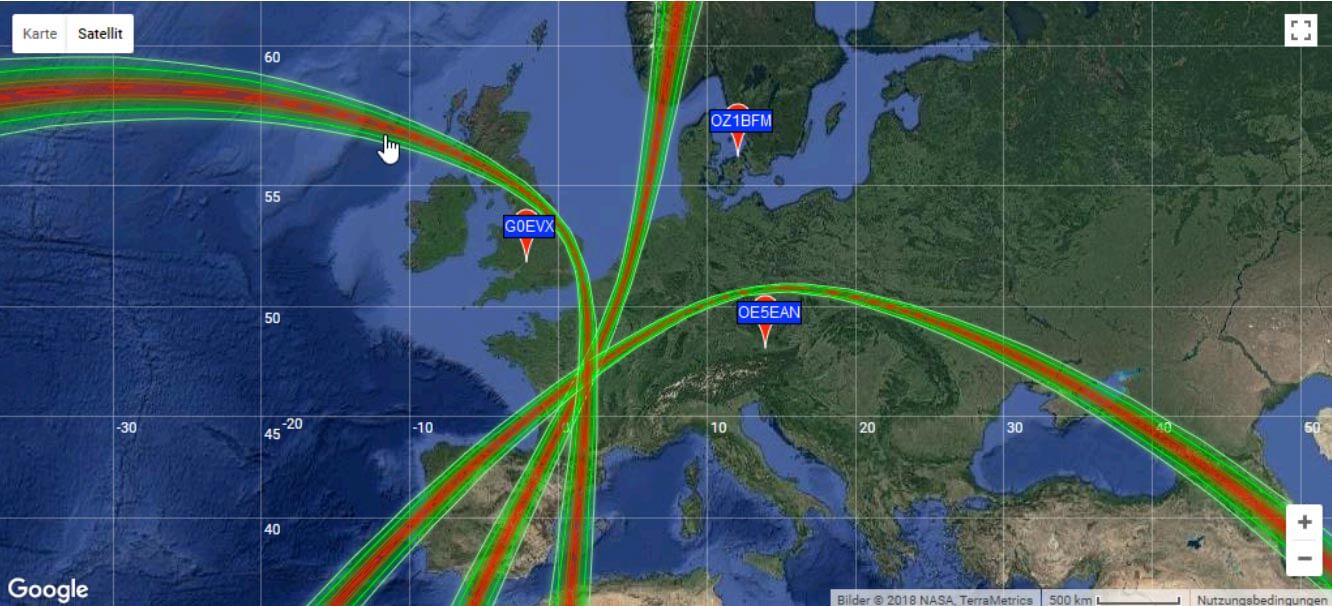
Thank you to John ZL/KF6VO (creator of the KiwiSDR) for submitting some interesting KiwiSDR related conference talks that might be of interest to some readers. If you were unaware the KiwiSDR is a US$299 HF SDR that can monitor the entire 0 - 30 MHz band at once. It is designed to be web-based and shared, meaning that the KiwiSDR owner, or anyone that they've given access to can tune and listen to it via a web browser over the internet. Many public KiwiSDRs can be found and browsed from the list at sdr.hu or by signal strength and location on this website. One of the most interesting KiwiSDR features is it's TDoA capabilities, which allow users to geographically locate HF transmitters.
Introduction to the KiwiSDR and Bodnar GPSDO
Rob Robinett, AI6VN, gave a talk at the HamSCI Workshop 2019 (USA) “Introduction to the KiwiSDR and Bodnar GPSDO”. In addition to Kiwi basics he shows a live demo of the performance advantages in using an external GPSDO as the Kiwi ADC clock. A line-of-sight measurement of frequency/time station WWV in Colorado using the Kiwi’s internal GPS-compensated crystal oscillator (XO) is compared against using an external Bodnar GPSDO. The Kiwi’s IQ display extension shows the frequency/phase difference between the ADC clock, internal or external, and WWV. Rob also discusses the publicly available (kphsdr.com:8074) eight Kiwi installation he made at coastal radio station KPH north of San Francisco.
Introduction to the KiwiSDR
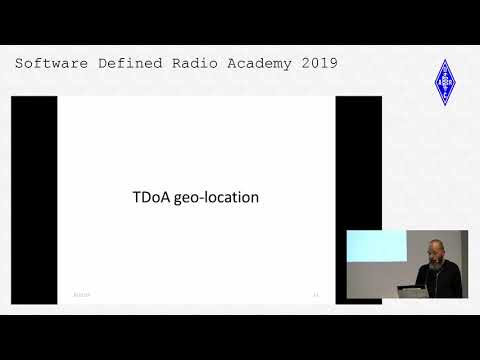
KiwiSDR as a new GNURadio source and TDoA geo-location
Christoph Mayer, DL1CH, is the author of the Kiwi’s TDoA algorithm. His talk “KiwiSDR as a new GNURadio source and TDoA geo-location” was given at the Software Defined Radio Academy (SDRA) as part of HAM Radio 2019 in Friedrichshafen, Germany. He includes a very technical description of the TDoA process used by the Kiwi including a live demo of direction finding a 16 MHz over-the-horizon-radar (OTHR) signal from Cypress.
Christoph Mayer, DL1CH: KiwiSDR as a new GNURadio Source
The Airspy HF+ and the KiwiSDR are two HF specialty SDR radios. The HF+ advertises excellent dynamic range and sensitivity, whilst the KiwiSDR has it's strength in it's internet connectivity and 30 MHz wide live bandwidth.
Over on YouTube icholakov has uploaded a video comparing the two SDRs on daytime medium wave and shortwave reception with a W6LVP amplified magnetic loop antenna. It is expected that the two SDRs should be quite similar in easy receiving conditions, but the Airspy HF+ should shine in challenging conditions with strong blocking signals and weak signals being received at the same time. The Airspy HF+ should also be a bit more sensitive in all conditions. It's not clear if there were any strong blocking signals in the tests, but the results appear to confirm the sensitivity expectations.
Earlier this month we posted about the KiwiSDR direction finding update, which now allows anyone with internet access to utilize public KiwiSDR's for the purpose of pinpointing the physical location of a transmitter that transmits at a frequency below 30 MHz.
A few people have had trouble understanding how to use the direction finding feature, so KiwiSDR fan Nils Schiffhauer (DK8OK) has written up a KiwiSDR direction finding usage guide. Nils' guide explains the basic technical ideas behind the TDoA (Time Difference of Arrival) direction finding technique used, and highlights some important considerations to take into account in order to get the best results. For example he discusses best practices on how to choose receiver locations, how many receivers to choose, and how to properly take into account the time delaying effects of ionospheric propagation with HF signals.
Finally at the end of the document he shows multiple case studies on HF signals that he's managed to locate using the discussed best practices. Looking through these examples should help make it clear on how receiver locations should be chosen.