Tagged: rtl2832

Radio For Everyone new Posts: RTL-SDR Accessories, 5 Easy Mods, FAQ, Legal/Moral Issues and Portable SDR

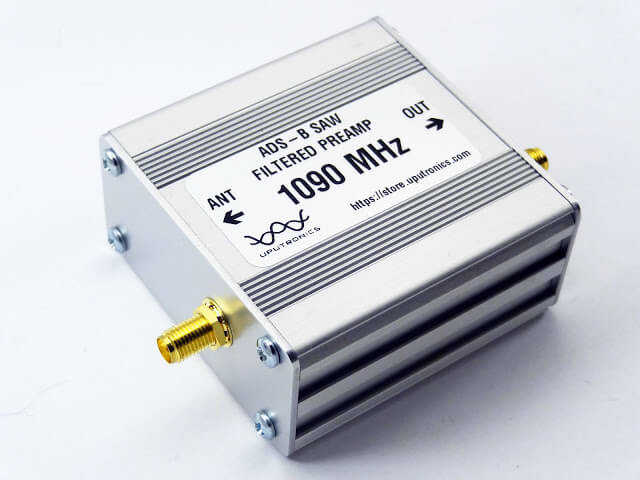
Akos from the radioforeveryone.com blog (previously sdrformariners/rtlsdrforeveryone) has recently added several new posts. The first new post is a beginners guide to RTL-SDR accessories. In this post he shows and links to his reviews of various RTL-SDR accessory products such as upconverters, baluns, filters, preamps and adapters.

In the second post he shows a guide to 5 easy mods that can be performed on RTL-SDR dongles which will improve their performance. The mods include using a ground plane, using a wire antenna, extending the coax, removing the IR and LED diodes, and putting the dongle into a metal tin.

In the third post he discusses portable software defined radio and shows exactly what products and software you need to set up a an Android or Raspberry Pi based mobile SDR station.

In the remaining new posts Akos has created an RTL-SDR FAQ and a guide to understanding the legal and moral issues of SDR. Finally the last new post we saw is where Akos tests a cooled RTL-SDR V3 vs a stock V3. His results appear to show that the cooled dongle achieves slightly more (avg. 3.73%) position reports.

Akos' guide to RTL-SDR Accessories.
Akos’ guide to RTL-SDR Accessories.

Decapping the R820T and RTL2832U Chips

Over on YouTube the electronupdate channel has posted a video showing the decapping of the R820T and RTL2832U chips. Decapping is the process of removing the plastic packaging on integrated circuit chips, thus exposing the internal circuits printed on the silicon die for viewing. In the video he shows microscope images of each of the decapped chips and explains a bit about what each part of the chip does.

Over on his blog he’s also posted the full decapped images of the R820T and RTL2832U for viewing.

The decapped R820T tuner die.
SOFTWARE DEFINED RADIO TEARDOWN: R820/RTL2832U DECAP

3D Printing an RTL-SDR Cooler Block

Over on the 3D printing sharing site Thingiverse, user “Way” has uploaded a 3D printer design for an RTL-SDR cooler block. The block works by allowing a PC cooling fan to blow air efficiently over the dongle body, removing any heat generated.

Cooling a dongle helps to avoid the L-Band problem, which is when R820T/2 units get hot and stop working about ~1.3-1.5 GHz. Generally passive cooling is enough (like with the thermal pad and metal cases used on our V3 dongles), but further cooling can apparently help increase sensitivity slightly although we are unsure if there is any statistically significant difference.

“Way” has made two designs, one to fit a 40 x 40 mm fan, and another to fit a 50 x 50 mm fan. The fan simply screws to the top of the block, and the dongle is placed at the bottom. Air is ducted over the dongle body and escapes out the back.

RTL-SDR 3D Printed Cooler

Analyzing HF Over the Horizon Radar in GNU Radio

Over the Horizon radar is typically used at HF frequencies and is used to detect targets from hundreds to thousands of kilometers away from the radar station. On HF they are very common and can be easily heard as continuous or bursty buzzing sounds.

Over on his blog Daniel Estevez writes how he was inspired by Balint Seebers GRCon16 talk to perform his own investigations into HF OTH radar. Daniel first analyzed a recorded IQ signal of a presumed Russian radar in Audacity, and noticed that it consisted of 15 kHz wide pulses repeated at 50 Hz intervals. He then used GNU Radio and the Quadrature Demod block to FM demodulate the pulse and see how the frequency changes over time. From this he was able to determine the original transmitted radar pulse characteristics

Next he performs pulse compression, which is essentially a cross correlation of the received pulse and transmitted pulse which was determined from the characteristics found earlier. The signal being received at Daniels location is distorted, because it will arrive from multiple paths, since the signal will bounce of multiple layers of the ionosphere. With this pulse compression technique Daniel is able to determine the time of flight for the different multi-path components of the received pulse. By graphing all the results over time he was able to obtain this image illustrating relative propagation distance over time.

Check out Daniels post for the full details and his code.

Ionosphere Propagation Graph

30% Off Outernet L-Band RTL-SDR DIY Kits – $70 for RTL-SDR, LNA, Antenna, CHIP and Battery

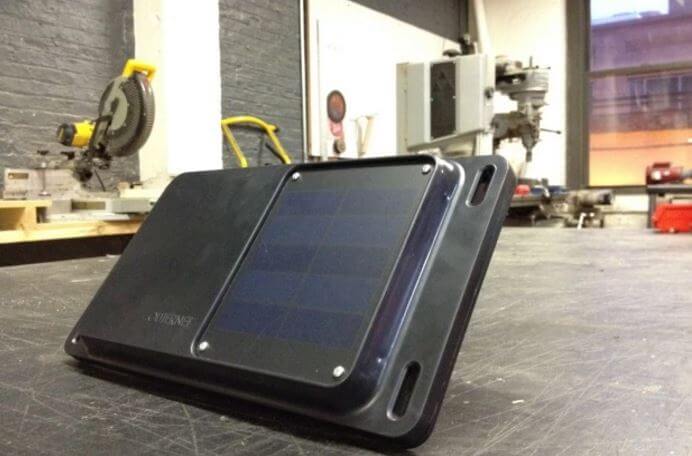
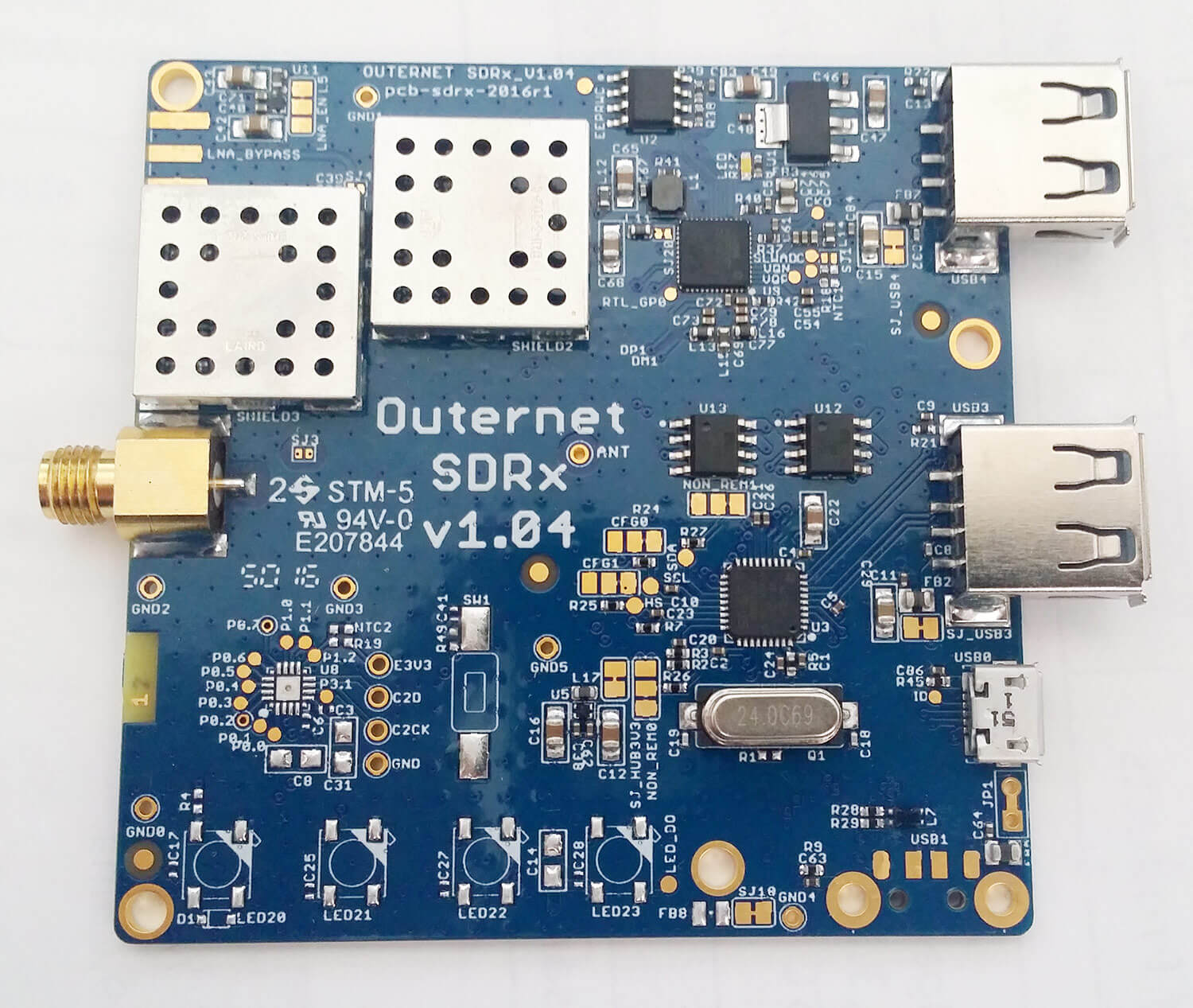
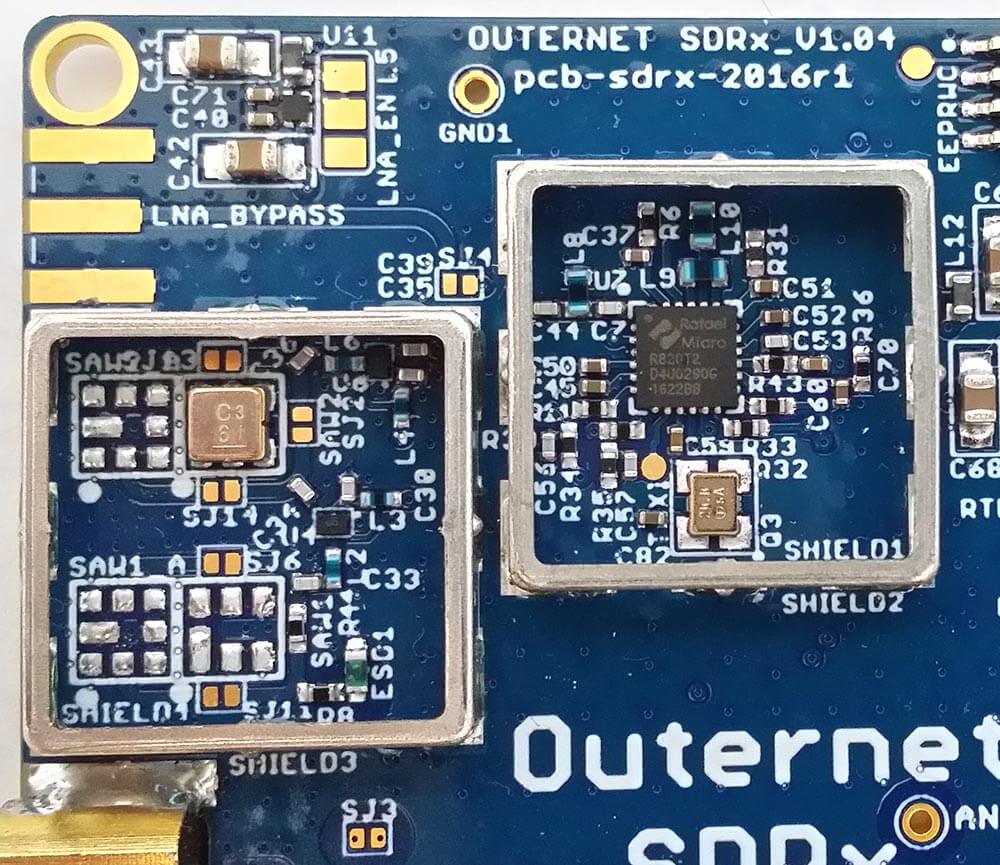
Outernet is an L-band satellite service that aims to be a “library in the sky”. They are constantly transmitting data such as up to date news, weather updates, Wikipedia pages, books, ISS APRS repeats and much more. Their DIY receiver kit consists of a lithium battery pack, L-band patch satellite antenna, LNA with built in filter, C.H.I.P mini Linux computer and an RTL-SDR E4000 or V3.

The DIY kit is normally priced at $99 USD, but right now they are running a 30% off Christmas promotion, bringing the price down to $69.30 USD. If you don’t need the battery pack, the sale price is then only $55.30 USD. This seems like a very good deal as normally just the patch antenna and Outernet LNA would be almost $50 USD in total.

To get the discount you must purchase directly from their store and use the coupon 30OFF. The promotion ends 31 December 2016 at 11:59 PM CST so get in quick.

The Outernet items you get for $70 USD.

Windows Version of the Fully Exposed RTL-SDR Driver now Available

Last week we posted about Milen Rangelov’s (gat3way) new RTL-SDR driver which has exposed filter and gain settings for the R820T/2 chip. This should let you tweak for optimal reception much better. Previously the driver was only available for Linux, however, now over on SourceForge user randaller has ported this driver to Windows.

To use the driver in SDR# simply unzip all the files into the SDR# folder, then while using the dongle in SDR# open the librtlsdr_wincontrol.exe file to open the control interface. The interface also has the ability to directly write values to a register, which together with the newly released register datasheet, can be useful for experimenting with the R820T2 chip.

The description reads:

Unpack all files to SDRSharp folder, start SDR# playback, then run controller exe file.
Do not forget to allow software to use UDP/32323 port in your firewall.

You may use this rtlsdr.dll with osmocom or other software, of course.
It is fully compatible to original one.

There are UDP server on 32323 port inside of rtlsdr.dll. It accepts and answers \n-terminated strings and accept two easy commands: get and set register. Examples:
g 5\n – will return value of R5
s 7 10 15\n – will set four lowest bits (mask 0x0f) of R7 with value 10
s 12 174 255\n – will write complete byte to R12
All values should be decimal.
You may use this feature to develop own gui controller with beauty knobs.


The driver GUI.
The driver GUI.

Review of the ThumbNet N3

Back when it was released in November we posted an initial unboxing and initial first impressions review of the ThumbNet N3 RTL-SDR dongle. In this post we continue that review and post a few more in depth results.

The ThumbNet N3 is the latest iteration of ThumbNet redesigned RTL-SDR dongles. It’s main features include a shielded PCB, metal enclosure, F-type connector, Mini-USB connector, all linear power supplies and an external power mode. It is designed specifically to be used in the ThumbNet system, but because they need to order the units in bulk they sell the excess off to other users too on their new site Nongles.com. The N3’s list of features is shown below.

  • Full backward compatibility with existing RTL-SDR dongles and software
  • High stability TCXO (+/-0.5ppm) (ensuring rock-solid stability from start-up and over a wide range of temperatures)
  • Standard R820T2 + RTL2832U (plus 24C02 EEPROM) chipset
  • Improved/enhanced decoupling. (Common-mode choke on USB port)
  • Low-noise, linear only power regulation (separate 1.2v and 3.3v regulators)
  • External DC (+5v, 450mA) supply connector
  • Mini-USB connection (allows easy separation of the RF unit from the noisy PC)
  • F type RF connector (very common and compatible with existing ThumbNet tracking stations)
  • Large (6x4cm) contiguous ground-plane (for better thermal dissipation)
  • Static drain-away resistor on the RF input (1K to ground)
  • All unnecessary parts (IR receiver, high-current LED etc.) eliminated to reduce parts count and noise
  • Circuit board can be mounted into a common 1455 case

ThumbNet/ThumbSat is a company that hopes to help experimenters get mini satellites into orbit starting from $20k USD. The ThumbNet project aims to provide hundreds of schools and educational institutions with RTL-SDR based satellite receivers in the hope that they will use them as an educational resource, and at the same time help set up a worldwide monitoring network, so that the live data from the launched satellites is always available to the satellite experimenters.

The ThumbNet N3
The ThumbNet N3

Click Continue for the rest of the review

Continue reading

Receiving CB Radio with an RTL-SDR Dongle

Back in July we posted a story by Mario Fillipi (N2HUN) who wrote an article about using the RTL-SDR to receive CB radio, and how while the CB radio heyday is over, there are still opportunities for good listening available today.

Recently Mario has posted a new article on swling.com where he discusses his CB radio listening hobby further. To listen to the CB band at 26.965 – 27.405 MHz he uses an RTL-SDR dongle together with a ham-it-up upconverter. While an upconverter is not required since most RTL-SDR dongles typically tune down to 24-25 MHz, he finds that using one helps because it can help block out interference from the strong broadcast FM band.  We note that you could also use one of our BCFM Block filters for the same purpose.

Mario notes that recently he noticed the CB band was open during the night. Usually the frequencies that CB radio uses propagate best during the daytime, and poorly at night. But on some occasions it can open up at night as well. He writes that on some occasions during a winters night during a snowstorm he has been able to receive the world on CB, from Europe, the Caribbean and Australia.

CB Band Voice in SDR# with an RTL-SDR and Ham-it-up Upconverter