YouTube user Troy McQuinn has uploaded a video showing how he is able to decode amateur radio APRS signals. APRS is an acronym for Automatic Packet Reporting System and is used by ham radio users to send data like messages, announcements and also GPS coordinates. To decode APRS he uses SDR# and pipes the audio to QTMM AFSK 1200 Decoder.
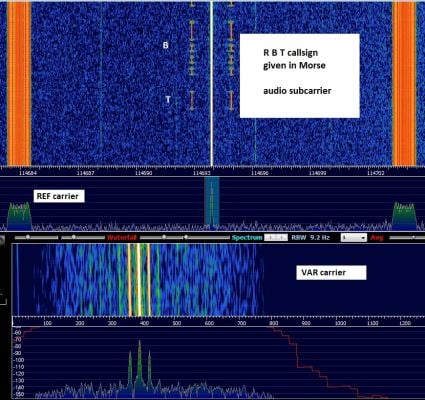
VHF Omni Directional Radio Range (VOR) signals are used in aviation as a short range radio navigational system. Amateur radio hobbyist F4GKR decided to study these VOR signals by recording them using his RTL-SDR, and then analyzing them in MATLAB. On his post he shows his method of analysis and discusses his results.
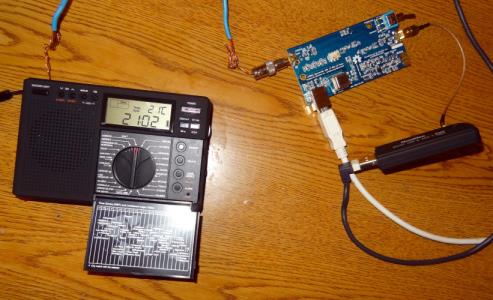
His results show that the RTL-SDR and portable receiver are comparable in terms of performance, with a slight edge to the RTL-SDR. He adds that software tweaks available in SDR# can improve the voice quality for the RTL-SDR. However his final recommendation for general shortwave listening is that the portable is still the better option due to it’s ease of use.
RTL-SDR + Upconverter vs. Portable Shortwave Radio
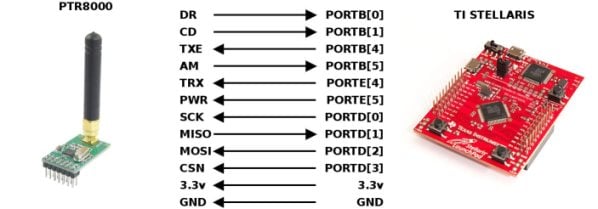
In order to validate that his hardware settings were set correctly and that the NRF905 was transmitting correctly, he used an RTL-SDR and his recently written NRF905 decoder program to check the output frames.
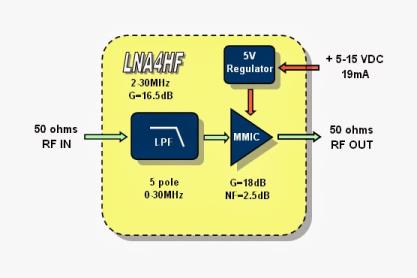
Back in November last year we posted about the possibility of an “LNA4HF” low noise amplifier (LNA) for the HF bands being made available for sale. The LNA4HF is now available for purchase.
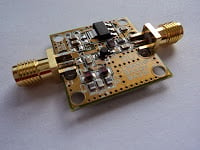
The LNA4HF is a low noise amplifier with built in low pass filter that runs on a 6-12 V power supply and covers a frequency range of 150khz to 30MHz, with a 18-20 dB gain and 1-2 dB noise figure. It costs 20 Euros. The low pass filter can also be disabled with a small board modification which will allow the amplifier to be useful at up to 2 GHz.
LNA4HFLNA4HF Block Diagram
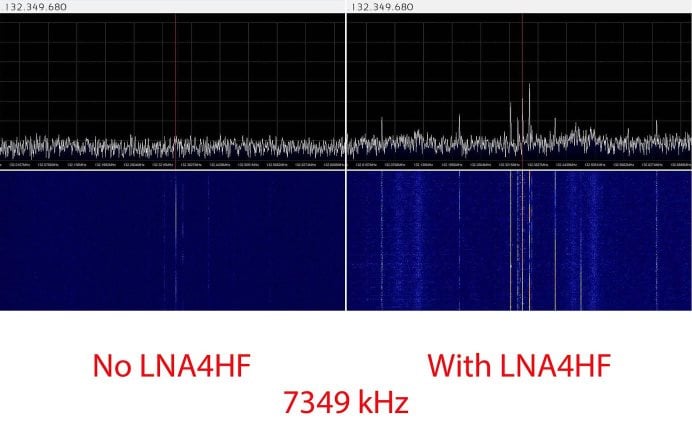
Akos from the SDR for Mariners blog has reviewed the LNA4HF on his latest post. His results show that the low pass filter significantly reduces broadcast FM interference and that the amplifier also increases signal strength by around 20 dB as advertised.
The console based FM decoder for the RTL-SDR, rtl_fm has had a code overhaul which contains improvements and bugfixes. The updated code has been merged into the official rtl-sdr release.
The rtl_fm guide has also been updated to include information on the new options.
The rtl_acars console based ACARS decoder which is based on rtl_fm has been updated by a new author, gat3way on Reddit. The new updates include decoder sensitivity improvements and the following:
Multiple frequencies scanning is now supported (by providing multiple -f arguments at command line and -l ). Since there is no audio output and it’s hard to determine right squelch level, a squelch debug option (-r) is implemented. Use it to experiment with squelch value, it’s simple: good squelch values flood stdout with “hopping freq!” messages yet avoid too high squelch levels. In general, values between 20-30 work good with my setup (big city, lots of radio interference, NOAA turnstile which gives -3db due to rhcp polarization).
Aircraft and airline databases now supported (using the acarsdec builtin ones). DBs are text files using simple format, so you may easily update them. I would very much appreciate your help to keep that up-to-date.
Certain improvements in frequency hopping code as compared to rtl_fm, but don’t expect wonders, it takes time to retune so data loss is not avoidable especially if you provide lots of frequencies to scan or huge ranges.
A simple Makefile to make it simpler 🙂
In the future gat3way hopes to support the decoding of multiple ACARS channels as well. The updated rtl_acars software can be downloaded from github here.
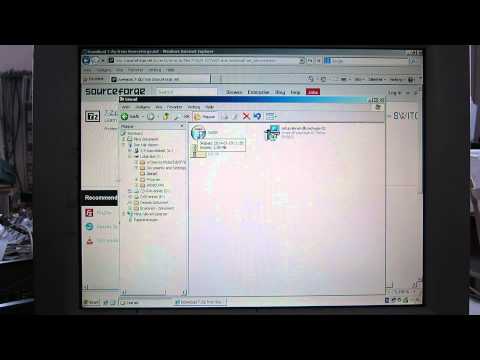
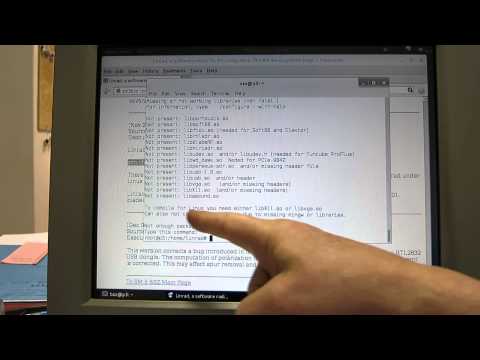
Linrad is an advanced SDR software program which supports the RTL-SDR. It is not as easy to use as the more popular SDR#, but some people prefer to use it as it has a very high information density GUI. The author of Linrad has uploaded two videos to YouTube that show how to install Linrad on Windows XP and Linux, which may be useful to those wishing to try Linrad out.