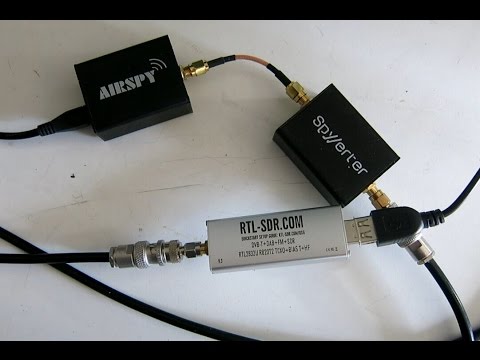
By cooling the dongle, and especially the R820T chip, Nobu writes that he sees improved ADS-B decoding performance as his range is increased. Without cooling the R820T chip can get quite hot and causes failing reception at around 1.5 GHz. Passive cooling is usually enough to fix reception at those higher frequencies, but active cooling via a fan can take it further and actually improve sensitivity slightly.
To add to his post, we suspect that the sensitivity of the R820T/2 front end reduces by about 0.5 dB at most when it heats up (after a few seconds), so forced air cooling should be able to improve sensitivity by about this much.
The IF Average tool is a RTL-SDR compatible plugin for SDR# which allows you to plot an average of the current spectrum shown in SDR#. This is especially useful for radio astronomers who often need to average the spectrum for a long time in order to get a good plot of the Hydrogen Line. Recently the plugin was updated to support newer versions of SDR# and to upgrade some features. Daniel Kaminski, the author of the plugin writes:
I used ultrafast FFT which works on 4k to 512k bit space. With this plugin it is possible to average up to 64000000 samples in real time. XNA allows to shows the calculation results in real time.
To install the plugin you will need to install the XNA Framework 4.0 Redistributable first. Then copy the plugin files over to the SDR# folder and add the “magicline” to the SDR# Plugins.xml file.
Back in April we posted about how KD0CQ found that he could receive signals up to 4.5 GHz with an RTL-SDR by using a $5 downconverter for DirecTV called the SUP-2400. The RTL-SDR can only receive up to a maximum frequency of about 1.7 GHz, but the SUP-2400 downconverter can be modified to convert frequencies at around 2.4 GHz down into a range receivable by the RTL-SDR.
When we first posted the story the instructions for modifying the SUP-2400 to use as a downconverter weren’t uploaded yet, but they are now. The modification requires decent soldering skills as it involves desoldering a few small SMD components and bridging some points with wires.
Over on YouTube user T3CHNOTURK has uploaded a video showing the downconverter in action. With the SUP-2400 downconverter and RTL-SDR he is able to receive some WiFi at 2.447 GHz as well as signals from a wireless keyboard at 2.465 GHz
RTLSDR Receiveing wifi & 2.4 ghz ism band with moded SUP-2400 Downconverter
One problem that sometimes arises when using embedded single board computers like the Raspberry Pi is that they often cannot provide enough current to power devices through the USB port.
Over on YouTube user KD9 BVO wanted to use his RTL-SDR with a Raspberry Pi, but found that the Raspberry Pi shut down whenever he plugged it in, due to it using too much current. To get around this problem he decided to build a DIY powered USB hub. This solution allows the RTL-SDR to be powered via the hub itself, rather than through the Raspberry Pi USB port.
In the video he takes an existing unpowered hub and shows how to modify it to provide power directly to the RTL-SDR via an external power supply.
Adam 9A4QV has once again uploaded three new videos to YouTube, all related to L-band satellite reception. The first video shows how much L-band reception can be improved by using two LNA4ALL low noise amplifiers together with a filter placed in between them. Using two LNA’s instead of one improves the reception by about 2-6 dB. He also shows that L-band Inmarsat satellite signals at 1.5 GHz can even be received by his 1090 MHz folded monopole ADS-B antenna placed indoors.
The second video shows a reception report of the new Outernet signal. The Outernet signal is a new satellite data service being provided that broadcasts up to date news as well as various files and information such as educational videos and books for people in third world countries without internet. They have said that they are working on free decoding software for their service which should be released soon. The Outernet signal is a bit weaker than typical AERO signals, but can still be received quite easily with an RTL-SDR, patch antenna and 2 x LNA4ALL. The Outernet downconverter mentioned in a previous post should of course also work well.
His third video shows some tests on his L-band filter, showing return and insertion loss.
Over on YouTube Adam 9A4QV has uploaded a video showing how good L-band reception can be with only a cheap home made patch antenna, RTL-SDR dongle and LNA4ALL. The video is in response to a question on our previous post, which discussed the prototype Outernet downconverter. The question asked what difference can we expect with the downconverter compared to just using an LNA, like the LNA4ALL.
In the video Adam shows that L-Band reception with the LNA4ALL can be as good as with the downconverter. The main problem with L-band reception on the RTL-SDR is that some units tend to fail to receive properly at around 1.5 GHz. The downconverter bypasses this problem by receiving L-band at around 200 MHz instead. Though we believe that this problem is solved on the units we sell as we heatsink to a metal enclosure, and if that is not enough, it can be solved further by using this modified driver. The other advantages of the downconverter is that it includes filtering, an LNA, and allows you to use much longer runs of lossy cable, which is useful if for instance you want to put a permanent L-band antenna on the roof.
Outernet are a startup company that hope to revolutionize the way people in regions with no, poor or censored internet connectivity receive information. Their service is downlink only, and runs on C and L-band satellite signals, beaming up to date news as well as other information like books, educational videos and files daily. To receive it you will need one of their official or homemade versions of the Lighthouse or Lantern receivers (the latter of which is still to be released), or an RTL-SDR or similar SDR. Recently they began test broadcasts of their new 5 kHz 1539.8725 MHz L-band signal on Inmarsat I4F3 located at 98W (covers the Americas), and they hope to begin broadcasts in more regions soon too.
The typical RTL-SDR is known to often have poor or failing performance above 1.5 GHz (though this can be fixed to some extent), so Outernet have been working on an L-band downconverter. A downconverter works by receiving signals, and shifting them down to a lower frequency. This is advantageous because the RTL-SDR is more sensitive and does not fail at lower frequencies, and if used close to the antenna, the lower frequency allows longer runs of cheap coax cable to be used without significant signal loss.
Earlier this week we received in the mail a prototype of their downconverter. The downconverter uses a 1.750 GHz LO signal, so any signal input into it will be subtracted from this frequency. For example the STD-C frequency of 1.541450 GHz will be reduced to 1750 MHz – 1541.450 MHz = 208.55 MHz. This also means that the spectrum will appear reversed, but this can be corrected by selecting “Swap I & Q” in SDR#. The downconverter also amplifies the signal with an LNA, and has a filter to remove interfering out of band signals.
The prototype Outernet downconverter circuit board.Specsheet for the downconverter.
We tested the downconverter using their patch antenna which they had sent to us at an earlier date (the patch antenna is used and shown in this Inmarsat STD-C reception tutorial). Our testing found that overall the downconverter works extremely well, giving us much better signal levels. Previously, we had used the patch + LNA4ALL and were able to get reception good enough to decode STD-C and AERO signals, but with the requirement that the patch be carefully pointed at the satellite for maximum signal. With the downconverter the signals come in much stronger, and accurate pointing of the patch is no longer required to get a signal strong enough to decode STD-C or AERO.
The downconverter can be powered by a bias tee connection, and this works well with our bias tee enabled RTL-SDR dongles. We also tested with the bias tee on the Airspy R2 and Mini and had no problems. It can also be powered with a direct 5V connection to a header, and they note that the header will be replaced by a USB connector in the production version.
The release date and exact price that these will be sold at is not confirmed, but we believe that it will be priced similarly to upconverters at around $50 USD or less. A good low cost downconverter should help RTL-SDR and other SDR users receive not only the Outernet signal better, but also other satellite signals such as STD-C and AERO. Although the input is filtered and the RF frequency is specified at 1525 to 1559 MHz, we had no trouble receiving signals up to GPS frequencies of 1575 MHz, and even up to Iridium signals at 1.626 GHz, though reception was much weaker up that high.
Below are some screenshots of reception. Here we used the Outernet patch antenna sitting in a windowsill with the downconverter directly after the antenna, and then 10 meters of RG6 coax cable to the PC and bias tee enabled RTL-SDR. We found that with the downconverted ~200 MHz signal the loss in the RG6 coax was negligible. Better reception could be obtained by putting the patch outdoors. In some screenshots we used Vasilli’s R820T driver with the decimation feature, which allows you to zoom into narrowband signals much more clearly.
Some AERO Signals Zoomed in with the Decimation feature in SDR#. Received with the Outernet downconverter and patch antenna.Some AERO and other Signals Zoomed in with the Decimation feature in SDR#. Received with the Outernet downconverter and patch antenna.Signals zoomed out. Received with the Outernet downconverter and patch antenna.
His results show that the dish outperforms the helix antennas by a significant amount, but only once he took it outdoors. The 10-turn helix antenna also worked better than the tin can helix, although he found that it required very accurate pointing.
Inmarsat are geostaionary satellites that transmit signals on L-band at around 1.5 GHz. They transmit signals that can be decoded with an RTL-SDR, such as STD-C EGC (weather, messaging and safety messages for boats), as well as AERO (the satellite version of ACARS for aircraft).