Back in August we posted how Albert Lederer had created a RTL-SDR interface for the LabVIEW visual programming language which could be run on a host PC. LabVIEW is a visual programming language which is used commonly by engineers and scientists to quickly build applications for things like product testing, system monitoring, instrument control etc.
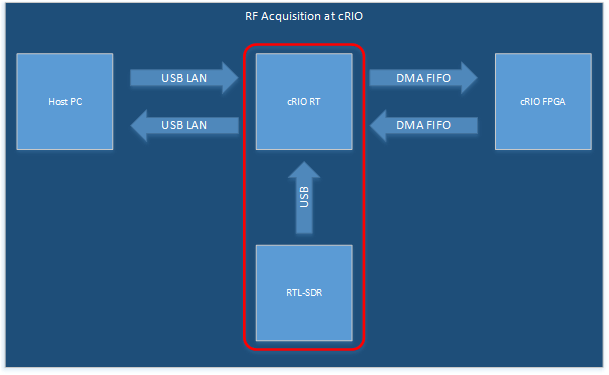
In his latest post/tutorial uploaded a few days ago he shows how to run the RTL-SDR RF acquisition on a myRIO, which is a development processing board that can run Linux and has an on board FPGA. LabVIEW can then be used to control the RTL-SDR from the host PC.
The whole point of running the RTL-SDR on the myRIO is to eventually make use of the on board FPGA. In future posts he hopes to show us how to use the on board FPGA to offload digital signal processing (DSP) tasks, which would significantly speed up applications.
Data flow for offloading RTL-SDR DSP tasks onto the FPGA
ThumbSat is a company that aims to help experimenters design and launch experiments on their mini satellites (10x smaller than a regular cubesat with most of the same functionality) into orbit. They write that for about $20k they will fully design a satellite based experiment and launch it into orbit – all you need to do is provide the orbital experiment that you would like done.
To aide with the reception, they also have the ThumbNet project which aims to setup a network of satellite receivers around the world. They do this by providing school students around the world with low cost satellite receivers. The satellite receivers consist of modified/upgraded RTL-SDR dongles and satellite antennas.
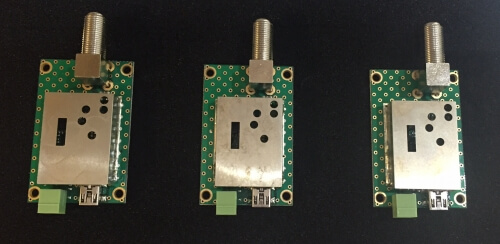
Today the ThumbNet project announced the latest iteration of their RTL-SDR dongle, called the ThumbNet N3 SDR Receiver. This receiver has some interesting design changes when compared to any other dongle that we’ve seen so far. The biggest change appears to be that this dongle uses an external power port for power. They also replaced the 1.2V switching regulator with a 1.2V linear regulator for lower noise operation. This is useful because switching regulators can cause noise, whilst linear regulators are much cleaner. However, using a linear regulator increases the power consumption significantly, and the new dongle draws 450mA of current (vs 250-280 mA on standard or our V3 dongles), meaning that some USB ports may be unable to power the device unless the external power supply port is used.
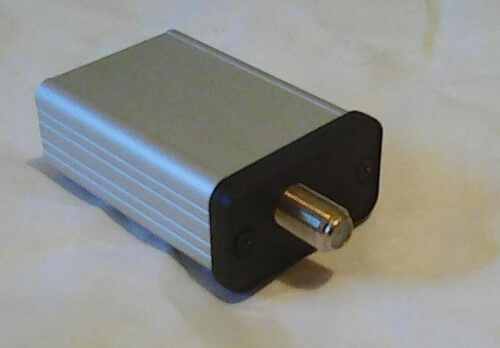
The other interesting change is that they have changed the PCB form factor, and it can now fit into a common 1455 aluminum case. Also, similarly to our V3 RTL-SDR dongles, they have decided to add a common mode choke to the USB lines, which significantly reduces USB noise. To add ESD protection they also added a static bleed resistor. Finally, like their previous receivers they continue to use a F-type RF connector and a TCXO for frequency stability.
The price is $25.75 each plus flat rate global shipping of $4.50 and the receivers are expected to ship in mid-October. While we have not yet tested this model, it looks to be like a good receiver for those who need very low noise, or external power options.
They write:
The next Generation, ThumbNet N3 is designed from the ground up to be as simple to use as older generation dongles, but with powerful hardware features for advanced hobbyists and experimenters.
We removed all of the excess components that were sources of noise or interference in other dongles, and optimized the circuit for simplicity, sensitivity and selectability. Then we added a port to use a cable with the extremely common mini-USB connection so that the N3 is less prone to noise from the host computer than a traditional dongle. Finally, the use of standard Surface Mount 0603 or larger components makes it simple for testing or modification.
We built them for our own use, then decided to offer them to everyone.
A quick list of the features of the N3:
– Full backward compatibility with existing RTL-SDR dongles and software – High stability TCXO (+/-0.5ppm) (ensuring rock-solid stability from start-up and over a wide range of temperatures) – Standard R820T2 + RTL2832U (plus 24C02 EEPROM) chipset – Improved/enhanced decoupling. (Common-mode choke on USB port) – Low-noise, linear only power regulation (separate 1.2v and 3.3v regulators) – External DC (+5v, 450mA) supply connector – Mini-USB connection (allows easy separation of the RF unit from the noisy PC) – F type RF connector (very common and compatible with existing ThumbNet tracking stations) – Large (6x4cm) contiguous ground-plane (for better thermal dissipation) – Static drain-away resistor on the RF input (1K to ground) – All unnecessary parts (IR receiver, high-current LED etc.) eliminated to reduce parts count and noise – Circuit board can be mounted into a common 1455 case
Ideal for experimentation:
– Can be connected to an external power supply for very clean power – All of the important tracks are visible on the top side of the board for easy access – All of the RF parts are on the top of the board (only regulators and decouplers on the back) – Logical, simple layout using 0603 (or larger) SMT parts – IF port break in connector (between front end and IF/USB chip) provided
While not required for operation, the N3 receiver is designed to be able to utilize a clean source of power from an external 5v power supply, instead of using the noisy power line coming from the computer’s USB port. This gives a tremendous advantage to the purist or experimenter who wants to utilize power from the N3 to power any external experiments. (When the external power supply is active, no power is drawn from the USB port to power the N3.)
PLEASE NOTE: The N3 draws approximately 450mA of current and care should be taken, even when using a powered USB hub, as it could possibly exceed the current limit of the USB port.
The ThumbNet N3The ThumbNet N3 inside its optional 1455 aluminum enclosure.
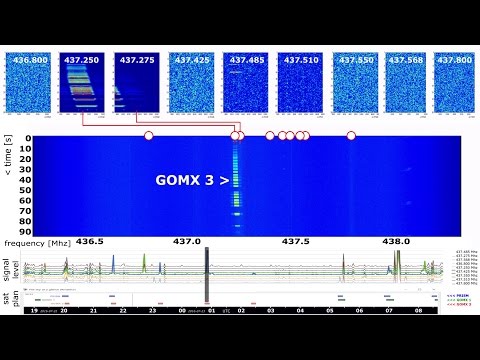
Over on hackaday.io there is a project blog for the “Distributed Ground Station Network”. This is essentially an idea to build a large network of distributed RF receivers which automatically receive signals from sources like cube satellites and other beacons. The project mainly uses RTL-SDR dongles at the moment for their RF receivers. In some ways it appears to be similar to the SatNOGs project which won the hackaday prize two years ago but the DGSN appears to be more focused on “reverse GPS” which allows the detection and tracking of the location of small satellite signals through distributed receivers.
They write:
The Distributed Ground Station Network (DGSN) is a novel network concept of small ground-stations and connected via the internet for performing automatic scans for cubesats and other beacon signals. By correlating the received signal with the precise, GNSS synchronized reception times of at least 5 ground stations, it enables the positioning of the signal’s origin. Thus a global tracking of small satellites becomes possible in this “reverse GPS” mode. It allows mission operators to position and track their small satellites faster after piggy-back commissioning, when the final orbit is yet undefined and could differ from the specified orbit. Furthermore it allows permanent communication in “data-dump” mode. In this mode, DGSN ground-stations relay the received data to the servers and thus to the operator. Let’s track everything, together!
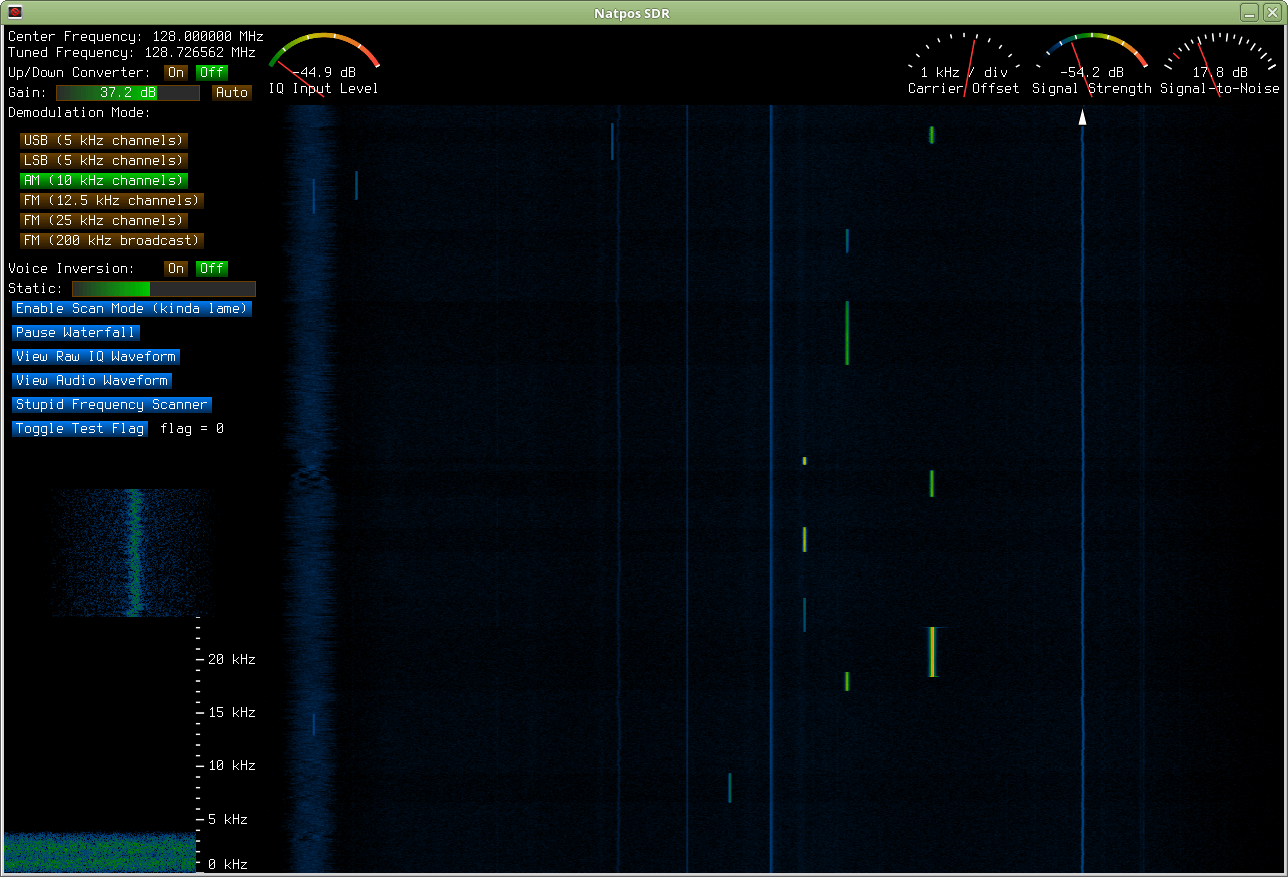
The thing I like most is that I can replay past transmissions by clicking in the waterfall history. Using other SDR software, when a new transmission pops up, I feel like I’m in a race to tune to it before it ends so that I can at least hear some of it, but in my software, I don’t even have to pay attention to what’s happening now, and so I seldom do. Usually I don’t notice transmissions on new frequencies until they’ve ended, but I still get to listen to them.
I also put some effort into trying to make sure AM and FM transmissions were equal in volume, as well as at the correct volume according to how well they were modulated, in that I aimed for 100% modulation leading to audio output that’s 6 dB below the ceiling. It seemed as if it was quite random in other software, as switching from AM to FM might cause a huge jump or drop in audio volume. I don’t like to play with my volume controls, so I did my best to make it so that I don’t have to. I’m also not at all fond of the “click the numbers” method of changing the center frequency which seems to be so common. So in mine, I just type in the MHz on the number keypad and press enter.
I’m also much more fond of my waterfall coloring scheme than any other I’ve seen. It seems much smoother and more informative, at least to me anyway. I suppose that’s rather subjective.
…but it’s rather hard to compare it to other software given that I only got to use other software for two or three days. I rather soon knew I wanted to write my own, and I wanted to use the V4L2 API (that dvb_usb_rtl28xxu module you have to blacklist to use rtl-sdr is an SDR driver, not a video driver), but I had to upgrade to Linux Mint 18 to get access to it since it’s a new API, and after doing so, I haven’t been able to get any of the existing SDR software to both compile and work after it’s compiled. So I just focused on writing my own, since I was wanting to do so anyway. (No support for that V4L2 API though, as it turns out its buggy and offers no way to control the dongle’s gain, so it’s basically unusable.)
Akos from the RTLSDR4Everyone blog has recently uploaded a review of the FlightAware ADS-B ProStick RTL-SDR dongle. The FlightAware (FA) dongle is a standard RTL-SDR with SMA connector, but with a very low noise figure LNA built into the front end. This low noise figure helps improve the SNR of ADS-B signals, resulting in more decodes and further range. We previously reviewed the FlightAware dongle in our own review available here.
In his post Akos reviews the FA dongle on its use as a general RTL-SDR as well as an ADS-B receiver. His review is initially critical to some of the misinformed advertising claims made by FA. He then goes on to show some noise floor scans and some ADS-B reception comparisons. Finally he shows some modifications that can be made to improve the cooling of the PCB.
He concludes that the FA ProStick works very well on improving ADS-B performance, but that overloading due to the increased gain is common.
A four week free class on signal analysis using SDR’s like the RTL-SDR will be taking place in the “Unallocated Space” technology community center in Baltimore-DC area. It starts on Tuesday September 20, 2016 at 7pm to 10pm. The class will help participants set up their systems, and cover locating, identifying, demodulating, and decoding common RF signal types. On the final week they will host a wireless capture the flag competition, where students will use their skills to solve problems and earn points.
You will need to bring your own SDR hardware such as an RTL-SDR, as well as an omnidirectional antenna and a PC/laptop capable of running your SDR.
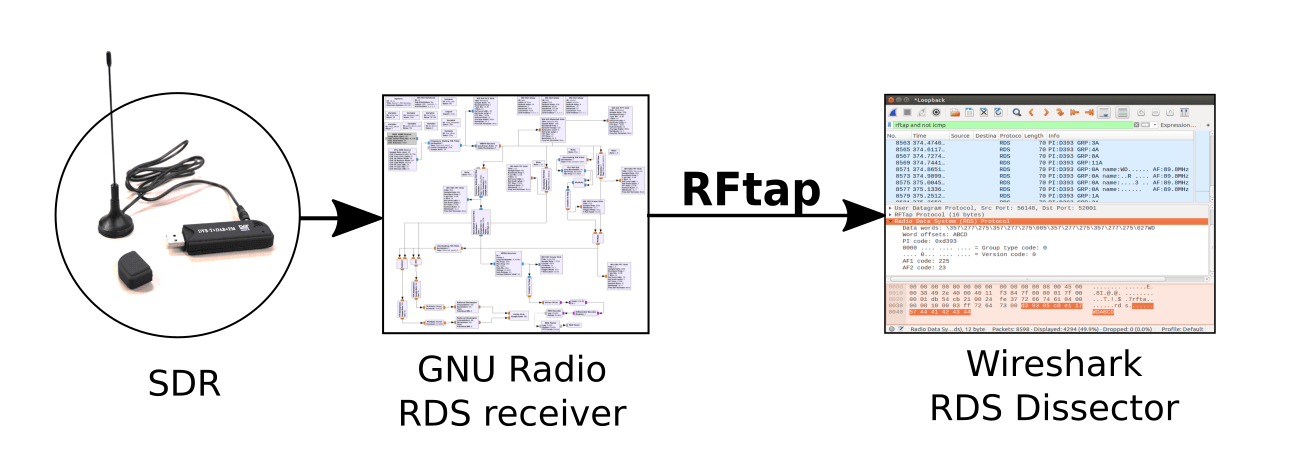
Recently a new Linux based tool called RFTap has been released. RFTap acts as a bridge between GNURadio flow graphs and Wireshark. GNU Radio is a visual based programming environment for digital signal processing applications, such as RF signal decoders. GNURadio supports many different SDR’s including the RTL-SDR. Wireshark is a network packet analyzer/dissector that aides with troubleshooting and analysis of network protocols. RFTap also supports other DSP languages like Pothos, liquidsdr, LuaRadio as well as other packet analyzers like TShark, tcpdump, Scapy.
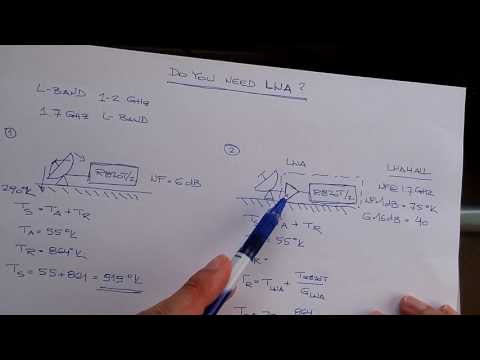
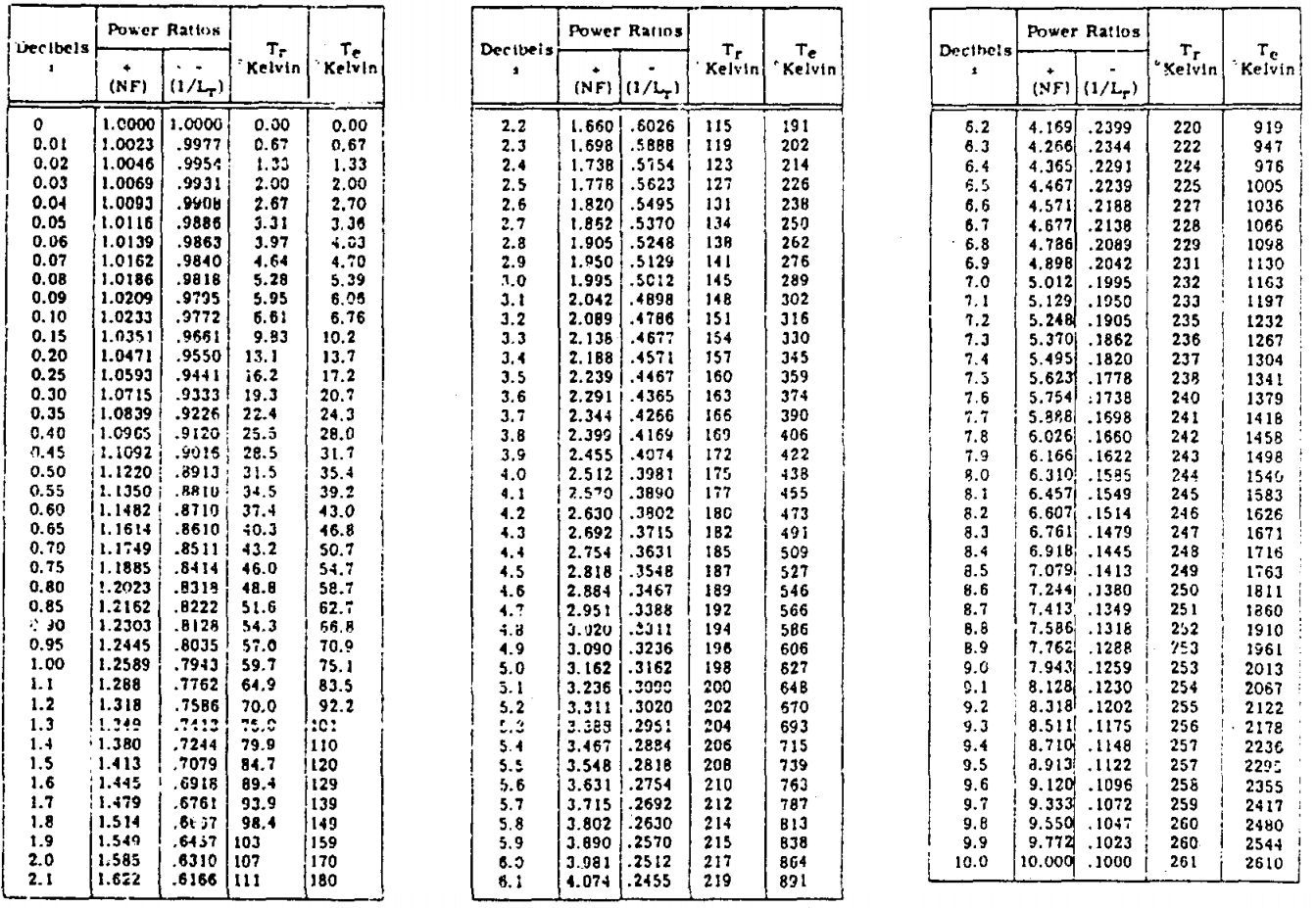
Over on YouTube Adam 9A4QV (creator of the LNA4ALL and other products) has uploaded a video that explains Friis formula for noise, using simple calculations and theory. These calculations explain why an LNA can significantly help reception on L-Band with an RTL-SDR. In his video he uses graphs and tables provided in this document released by the US Naval Academy. At the end of this post we attached images of the graph and table that he uses in the videos calculations for easy access.
The calculations show how the noise figure and gain of the first LNA in the system dominates the result. The final result of his video shows that using an LNA with a noise figure of 1 dB and 16 dB gain can give an improvement in SNR of about 7.8 dB over a standard RTL-SDR which has a noise figure of 6 dB. This is the improvement on L-band from simply placing the LNA by the dongle, and it does not take into account the extra improvement that could be had by placing it by the antenna, if a run of coax is used. The equations can also be adapted to other frequencies, and they show that as the frequency decreases, the effect of the noise figure of the LNA becomes less important.