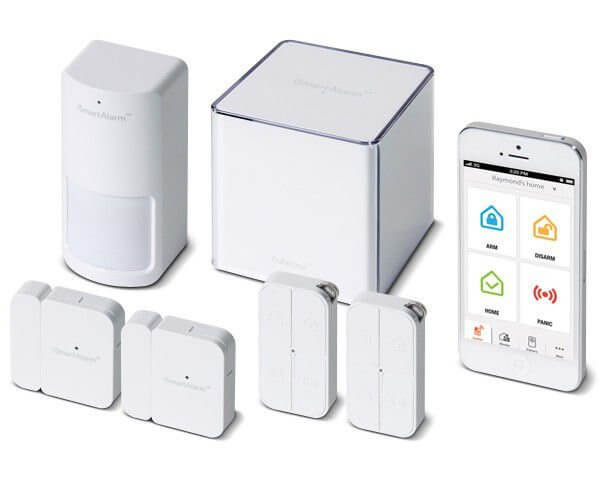
In his post he specifically attacks the iSmartAlarm (ISM). This is an IoT home alarm system that comes with several sensors, and can be controlled via an app on your smartphone. The unit uses the Texas Instruments CC1110 RF SoC, which implements the SimpliciTI low-power radio network protocol. Dayton notes that the majority of attacks not specific to a single manufacturer, and could be applied to other IoT devices as well.
Using a variety of hardware including a logic analyzer, Yardstick One, GoodFET, RFCat, USRP B210 software defined radio and several pieces of software including GNU Radio, GQRX, Baudline, Audacity, Dayton was able attack the alarm in the following ways:
Brute-force attack on the alarm system device source addresses.
Remotely clone authenticated devices used to interact with the alarm system security features.
Decryption of authenticated devices radio communications, allowing remote attackers to craft packets used to send arbitrary commands to the alarm system.
RF Jamming.
Assisted replay attack.
The post goes into deep detail on the methods he used to reverse engineer the device and is a great tutorial for anyone wanting to get into wireless IoT security research.
If you’ve been paying attention to the news then you might have heard of the recent Dallas tornado siren hack. Earlier in the month a hacker took control of 156 tornado warning sirens placed all around the city of Dallas, Texas in the United States. The sirens are activated via an RF control signal, and the hacker transmitted the control signal, causing all the sirens to activate causing a city wide false alarm. The attack could have been performed with a transmit capable software defined radio like the HackRF, or any other transmit capable radio such as a handheld radio.
In the blog post and video first Balint discusses the difference between a single frequency network, and a repeated network. In a single frequency network, one powerful transmitter up on a hill would be used to activate all the sirens, whereas with a repeater network several dispersed transmitters might be used to repeat the signal over a wide area.
He then discusses the difference between an analog and digital command transmission system. In an analog command transmission a simple series of tones might be used to activate the sirens. In this case the hacker could simply listen for the tones when the siren is activated during the monthly test, and save them away for a future replay attack. In a digital system instead of tones an encrypted packet of data could be used instead. Depending on how the encryption is implemented this could prevent a replay attack.
The attack works by first infecting a computer with their malware software. The malware then utilizes the USB data bus to create electromagnetic emissions on a connected USB device. In these tests they use a USB flash drive and write a file to the device in such a way that the emissions produced are transmitting decodable data. They write that any binary data can be modulated and transmitted to a nearby receiver, such as an RTL-SDR dongle. Data rates can reach up to 80 bytes/s. The data is modulated with binary frequency shift keying, and their receiver code is implemented in GNU Radio.
This story has also been featured on arstechnica and threatpost. The video below demonstrates the attack.
Earlier this week wired.com released a story indicating that researchers from the University of Birmingham have discovered two vulnerabilities that can be used to unlock almost any car. The first vulnerability concerns Volkswagen Group vehicles (VW, Audi, SEAT, Skoda) sold since 1995. Essentially their research found that the keyless entry systems of VW Group vehicles relies only on a few global master keys which they have been able to recover through reverse engineering of an undisclosed component used in a VW car. Then by sniffing the wireless key’s signal with an RF module or SDR like the RTL-SDR or HackRF they are able to recover the cryptographic algorithms used and then using the global key clone the wireless key signal, which can then be re-transmitted with a simple Arduino.
In their second research findings, the researcher’s write how they have been able to crack the Hitag2 rolling code system which is used in many vehicles such as Alfa Romeo, Chevrolet, Citroen, Dacia, Fiat, Ford, Lancia, Mitsubishi, Nissan, Opel, Peugot and Renault. Again, the hack works by sniffing a few wireless keyfob rolling code signals with an SDR or other device. Once the signals have been sniffed a simple laptop computer can reportedly break the encryption within one minute.
Here are some interesting excerpts from the conclusions of the paper:
The results of this paper show that major manufacturers have used insecure schemes over more than 20 years. Due to the widespread use of the analyzed systems, our findings have worldwide impact. Owners of affected vehicles should be aware that unlocking the doors of their car is much simpler than commonly assumed today. Both for the VW Group and the Hitag2 rolling code schemes, it is possible to clone the original remote control and gain unauthorized access to the vehicle after eavesdropping one or a few rolling codes, respectively. The necessary equipment to receive and send rolling codes, for example SDRs like the USRP or HackRF and off-the-shelf RF modules like the TI Chronos smart watch, are widely available at low cost.
A successful attack on the RKE and anti-theft system would also enable or facilitate other crimes:
– theft of the vehicle itself by circumventing the immobilizer system or by programming a new key into the car via the OBD port with a suitable tool
– compromising the board computer of a modern vehicle, which may even affect personal safety, e.g., by deactivating the brakes while switching on the wiping system in a bend
– inconspicuously placing an object or a person inside the car. The car could be locked again after the act
– on-the-road robbery, affecting the personal safety of the driver or passengers if they (incorrectly) assume that the vehicle is securely locked
Note that due to the long range of RKE systems it is technically feasible to eavesdrop the signals of all cars on a parking lot or at a car dealer by placing an eavesdropping device there overnight. Afterwards, all vulnerable cars could be opened by the adversary. Practical experiments suggest that the receiving ranges can be substantially increased: The authors of [18] report eavesdropping of a 433 MHz RFID system, with technology comparable to RKE, from up to 1 km using low-cost equipment.
The findings were presented at the Usenix Advanced Computing Systems Association conference during August 10-12, 2016 in Austin, TX. The white paper is titled “Lock It and Still Lose It—On the (In)Security of Automotive Remote Keyless Entry Systems” and can be downloaded here. Of course they did not publish the actual VW master keys in their paper and they have notified VW and NXP who make the Hitag2 chips in advance, noting that Hitag2 had actually been broken for several years prior.
Back in February we showed how Smay Kamkar was able to bypass rolling codes with his RollJam device, however the findings by these researcher’s is different in that they are actually able to generate new rolling codes, such that a simple Arduino with transmitter can act as a second wireless remote.
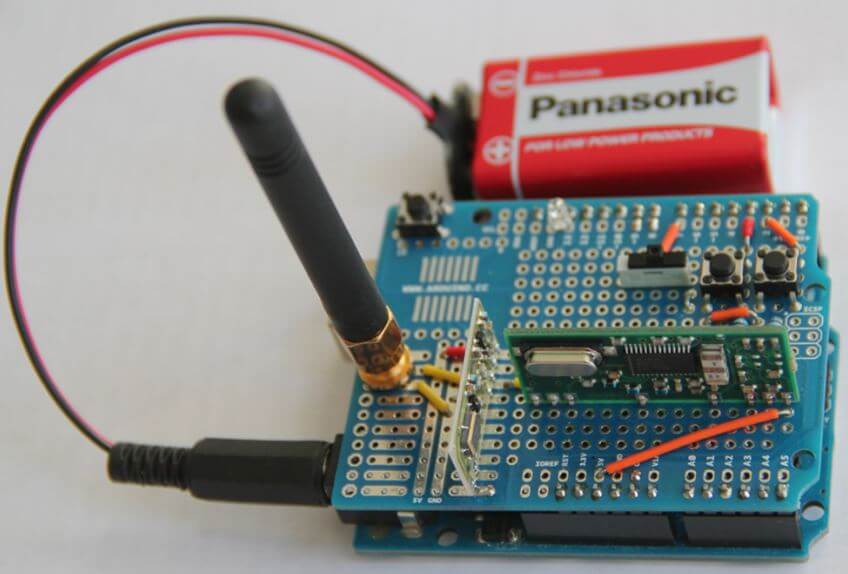
A $40 Arduino which can be used to record wireless rolling codes, then transmit new ones once the encryption has been broken.
To reverse engineer the drones wireless communications system the teams used software defined radios like the HackRF and BladeRF, and also an alternative method involving just using an Arduino and nRF24L01+ receiver chip. Once the signal was received, they used GNU Radio to decode the signal into packets of data. After analyzing the data they found that the data bytes were easily reverse engineered and then were able to transmit their own data packets to control the drone. The post goes into further detail on the specifics of the reverse engineering.
The Syma X8C drone to be stolen in the competition.
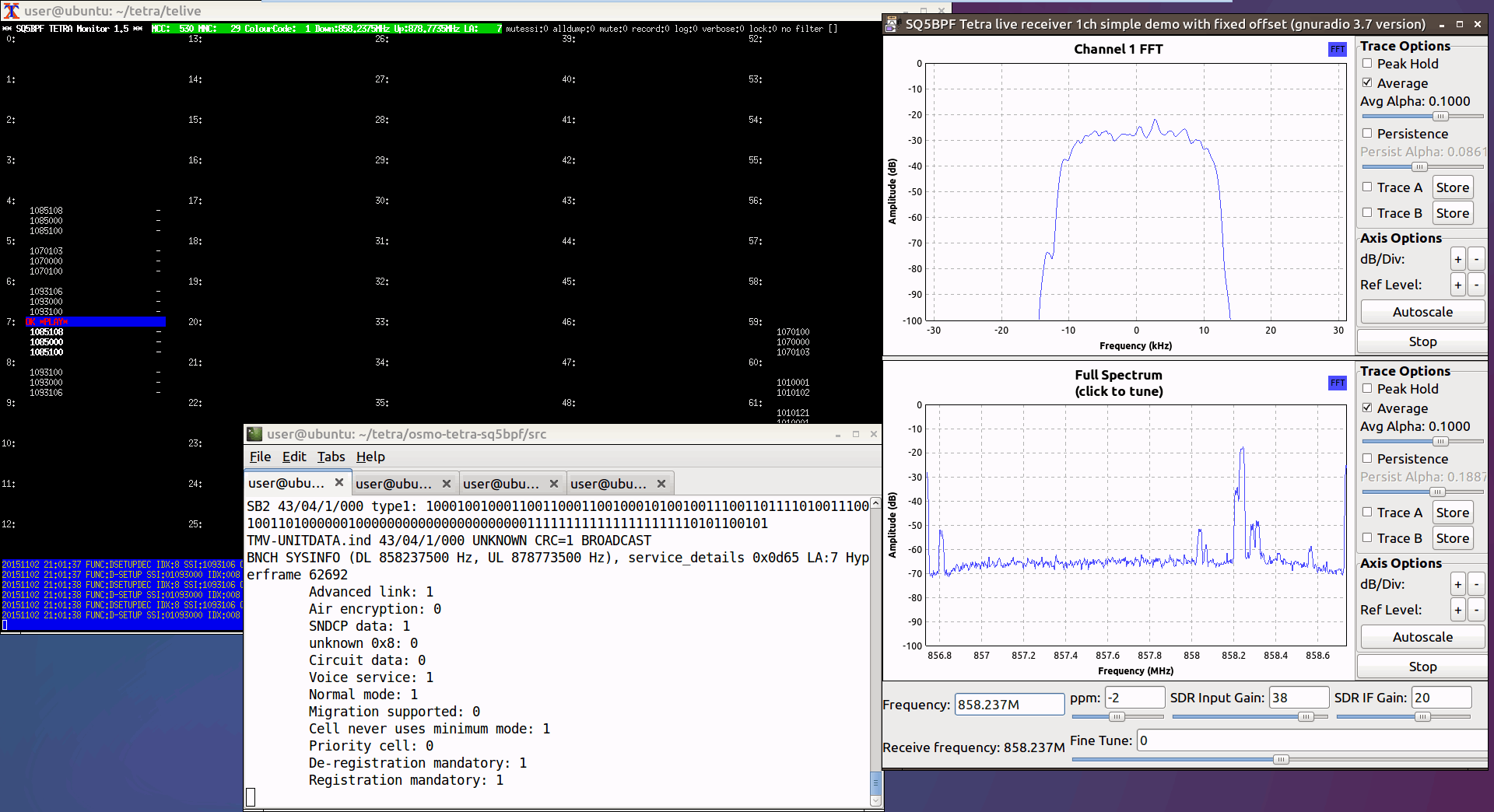
Dejan Ornig, a 26 year old student at the University of Maribor’s Faculty of Criminal Justice and Security was recently almost jailed for finding a security flaw in Police TETRA communications in his home country of Slovenia. Back in 2013 his University Computer Science class of 25 was assigned a task to research security vulnerabilities in TETRA. TETRA is a RF digital communications protocol often used by authorities due to its ability to be secured via encryption. During his research he used an RTL-SDR and the open source Osmocom TETRA decoder, and discovered a flaw in the Slovenian Police’s TETRA configuration which meant that encrypted communications were often being broadcast in the clear. Translated, Ornig said:
For $20 I bought a DVB-T receiver (RTL-SDR), on the Internet, I have found also freely available and open-source software OsmoCOM. Free access solution for decoding the signal Tetra eighth-tetra is already prepared in advance programming framework based on the platform GNU.
He goes on to say (translated):
I was even more surprised when I found that most users do not have authentication turned on the radio terminal, even though the Ministry of the Interior in the documents and tenders repeatedly wrote to all the radio terminals to access networks using authentication.
Shortly after discovering the flaw, Dejan privately contacted the authorities with his findings. But after two years of repeatedly contacting them and waiting for a fix, Dejan decided to take his story to a local news agency in February 2015. At this point the Slovenian Police became interested in Dejan, and instead of fixing the problem, decided to conduct a search on his house, seizing his computer and RTL-SDR. After the search the Police made life harder for Ornig by trying to lump on other problems. During the search they found a “counterfeit police badge” in his house and apparently accused him of impersonating a police officer, and after a search of his PC they also decided to charge him after finding out that he covertly recorded his ex-employer calling him an “idiot”.
Ornig has now been given a 15 month suspended jail sentence for attempting to “hack” the TETRA network. Fortunately the suspended part means that in order to not go to jail Ornig simply must not repeat his crime again within 3 years. While SDR’s and radios are not illegal in most countries this is a reminder to professional and amateur security researchers to check that what you are doing is legal in your country. Even if it is for the overall good, Police often do not have the technical competence to understand security researchers and may react illogically to findings. The good news about Ornig’s story is that apart from the suspended jail sentence the authorities appear to have now worked with him to fix the problems.
Over on his blog Caleb Madrigal has written a short article that describes how he was able to perform a simple relay attack against a Jeep Patriot vehicle which allowed him to unlock and lock his car via his HackRF. The replay attack is a very simple attack that can easily be performed with a TX capable SDR, like the HackRF. Essentially, all that is done is that a signal is recorded, and then rebroadcast (replayed) again. Normally, wireless car locks have rolling code security measures that prevent such an attack, but it appears that the 2006 Jeep Patriot has no such measures.
Caleb first recorded the unlock and lock signals using his HackRF with GNU Radio. He then took the step of opening the recorded file up in Audacity and isolating the unlock and lock audio signals, and then saving each signal to a separate file. Finally, after doing this he was able to transmit the unlock and lock waveforms which successfully locked and unlocked the Jeep.
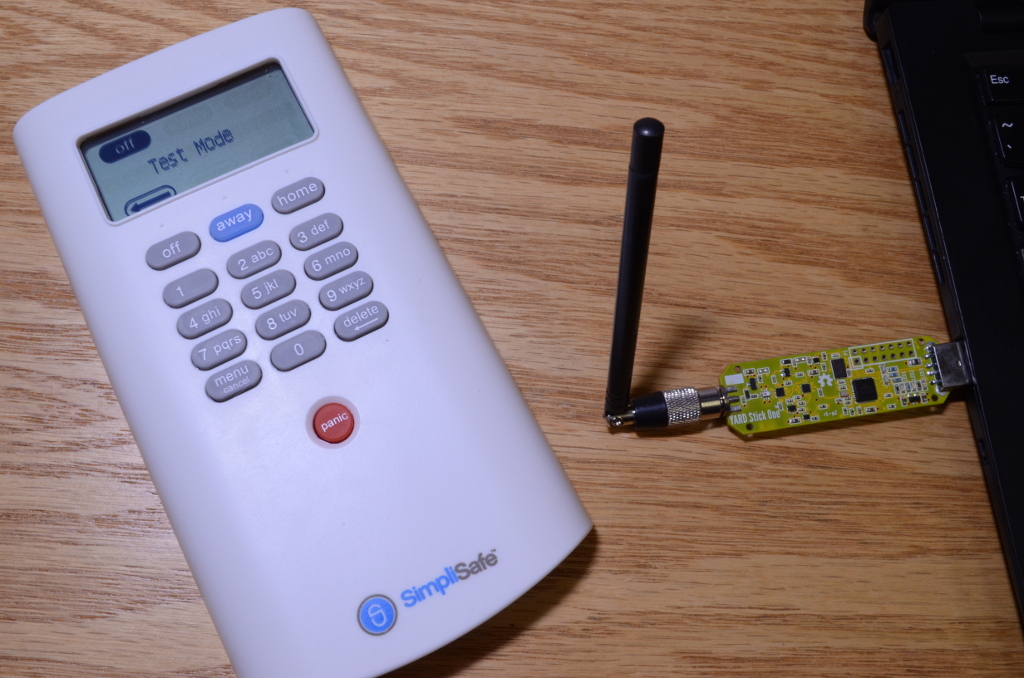
SimpliSafe is a home security system that relies on wireless radio communications between its various sensors and control panels. They claim that their system is installed in over 300,000 homes in North America. Unfortunately for SimpliSafe, earlier this week Dr. Andrew Zonenberg of IOActive Labs published an article showing how easy it is for an attacker to remotely disable their system. By using a logic analyser he was able to fairly easily reverse engineer enough of the protocol to discover which packets were the “PIN entered” packets. He then created a small electronic device out of a microcontroller that would passively listen for the PIN entered packet, save the packet into RAM, and then replay it on demand, disarming the alarm.
A few days later Micheal Ossmann (wireless security researcher and creator of the HackRF SDR and YardStick One) decided to have a go at this himself, using a YARD Stick One and a HackRF SDR. First he used the HackRF to record some packets to analyze the transmission. From the analysis he determined that the protocol was an Amplitude Shift Keying (ASK) encoded signal. With this and some other information he got from the recorded signal, he could then use his Yardstick One to instantly decode the raw symbols transmitted by the keypad and perform a replay attack if he wanted to.
Next, instead of doing a capture and replay attack like Andrew did, Micheal decided to take it further and actually decode the packets. This took him a few hours but it turned out to not be too difficult. Now he is able to recover the actual PIN number entered by a home owner from a distance without having to do any transmitting. With the right antenna someone could be gathering 100’s of PINs over a distance of many miles. Also, an expensive radio is not required, Micheal notes that the gathering of PIN numbers could just as easily be done on a cheap $10-$20 RTL-SDR dongle.
Micheal notes that the SimpliSafe alarm seems to lack even the most basic cryptographic protection, and that this is a problem that is seen all too often in wireless alarm systems. Rightly so, Micheal and Andrew are not publishing their code, although it seems that anyone with some basic knowledge could repeat their results.