Over on YouTube Leif (sm5bsz) has uploaded a video where he compares the Airspy HF+ with the Airspy+Spyverter combination. In the test he compares the two radios at 7 MHz. The signals come in from an antenna, are amplified and then passed into a notch filter which notches at 7.198 MHz. The antenna signal is then passed into an attenuator, and then through a directional coupler and then split into the two radios. A signal generator is used to inject a signal via the directional coupler at the notch frequency, and this signal is used to compare the two radios. This method stops antenna noise from appearing at the notch frequency and so any non-linearities appearing in the notch must be a problem with the radio.
The results that Leif finds are quoted below. They show that although the Airspy HF+ has good linearity, it can still be significantly improved in tough environments by adding a front end filter for the band of interest.
The Airspy HF+ and the Airspy+Spyverter are compared on 7 MHz with and without a band pass filter on the input. Without the filter the HF+ is a little better than the Airspy+Spyverter combo, but when the filter is inserted, the HF+ is MUCH better than the combo.
hfplusfilter
In an earlier video Leif also compares the two Airspy units on FM broadcast and the 2 meter band. Again he shows that the Airspy HF+ is better than the standard Airspy, but adding a filter to block out the broadcast FM can still help fairly significantly when trying to listen to the 2M band on the HF+.
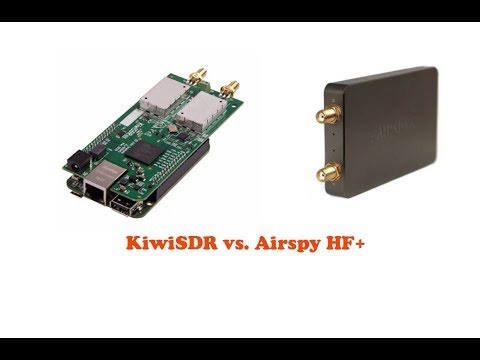
Over on YouTube user icholakov has uploaded a video comparing the Airspy HF+ with the KiwiSDR. The Airspy HF+ and KiwiSDR are both high performance yet low cost SDR platforms. The differences are that the Airspy HF+ is normally connected directly to a PC (but can be run remotely too) whereas the KiwiSDR is designed to be run remotely only, and so can only be accessed through a browser platform. In addition the HF+ only has maximum live bandwidth of 660 kHz whereas the KiwiSDR samples the entire 30 MHz of the HF band. Both are very sensitive and fairly resistant to overloading, but the HF+ should be better in both regards.
In his video icholakov does side by side comparisons with each radio. He writes
Comparing short wave and medium wave reception from Airspy HF+ SDR Console 3 and KiwiSDR with its built in web server. Using the same 80m dipole antenna. No special noise cancelling on the Airspy HF Plus.
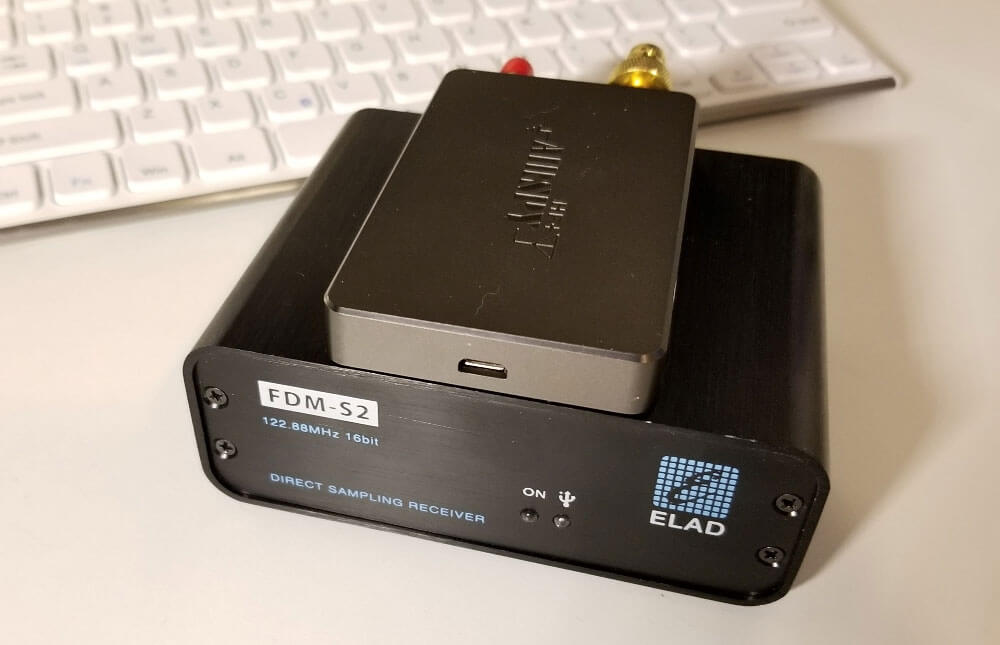
It appears that the Airspy HF+ even outperforms the FDM-S2 on one particular test where he tries to listen to 1540 kHz which is just 10 kHz away from a strong signal at 1550 kHz. He also writes:
It became apparent quickly that the upstart HF+ provides strong competition to the Elad SDR. Clearly, the AirSpy’s trade-off is bandwidth for raw performance at lower cost–approx. 660 kHz alias-free coverage versus about 6 MHz maximum for the Elad.
Also in a later post on the swling.com blog Guy makes an addendum where he swaps out his ALA1530S+ Wellbrook loop antenna for the ALA1530LN Pro which overloads his receivers less. He notes that with the new antenna 6 dB of attenuation is required for the FSM-S2 in order to prevent overloading. With the HF+ very little overloading apart from a weak image could be found, and that was removed by adding 3 dB of attenuation.
He also tests longwave reception with the two receivers, and this time finds that the HF+ seems to have additional MW spurs in the LW band, compared with the FDM-S2.
The Airspy HF+ is a much anticipated and recently released software defined radio that specializes in HF and VHF reception. However, one little known and not often advertised feature is that it can actually be used for L-band reception between 1.2 and 1.67 GHz as well. This means that it could be used for signals such as AERO, STD-C, Iridium, the 23cm amateur radio band and more.
Over on YouTube Adam 9A4QV has uploaded a video that tests the HF+ with Alphasat AERO signals at about 1.545 GHz. He notes that the sensitivity is quite good as it is able to receive the satellite signals directly with only the antenna connected and no external LNA used. Of course adding in an external low noise figure LNA and filter would improve the signal even further. Adam notes that reception on the 23cm amateur band (1240 MHz to 1300 MHz) is also quite good with sensitivity reaching about -130 dBm.
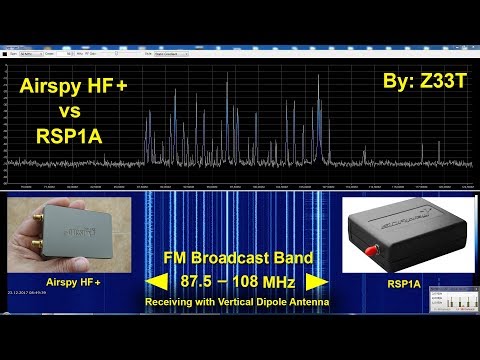
Frequent reviewer of SDR products Mile Kokotov has just uploaded on his YouTube channel a new video where he compares the Airspy HF+ against the SDRplay RSP1A on FM broadcast reception.
At first Mile compares the two against strong broadcast stations, and then later compares them on weak DX stations surrounded in amongst other strong stations. With the strong stations a difference between the two radios is impossible to detect. But with the weaker stations that are surrounded by strong signals the Airspy HF+ has the edge with it's higher dynamic range and sensitivity.
Mile writes:
In this video I am comparing two popular SDR-Receivers (Airspy HF+ and SDRplay RSP1A) on FM Broadcast Band.
I have made few recordings with every receiver with the same antenna trying to set the best SNR = signal-to-noise ratio.
My intention was to ensure the same conditions for both SDR`s in order to make as fair as possible comparison.
No DSP enhancing on the SDR`s was used.
Antenna was Vertical Dipole.
When receiving signals are strong enough, You should not expect the difference between most receivers to be very obvious!
If you compare one average transceiver (which cost about $ 1000 USD) and top class transceiver which cost ten times more, the difference in receiving average signals will be very small too. Almost negligible! But when you have difficult conditions, the very weak signal between many strong signals, than the better receiver will receive the weak signal readable enough, but cheaper receiver will not. Today it is not a problem to design and produce the sensitive receiver, but it is far more difficult to design and produce high dynamic receiver for reasonable price! The Airspy HF+ and RSP1A are very very good SDR-receivers. They have different customers target and have strong and weak sides. For examle Airspy HF+ has better dynamics in frequency range where it is designed for, but RSP1A, on the other hand, has broadband coverage...
Airspy HF+ vs SDRplay RSP1A Comparison on FM Broadcast Band
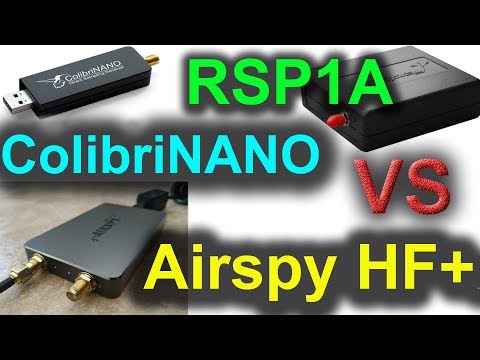
Over on his YouTube Channel Mile Kokotov has uploaded a video that compares three mid priced SDRs: the Airspy HF+, the SDRplay RSP1A and the ColibriNANO. Each SDR is compared on several ALPHA and NBD morse code stations which exist in his tests from between 14 kHz to 474 kHz. He writes:
In this video I am comparing three SDR-Receivers. I have made few recordings with every receiver with the same antenna and choose the best one (one with the best SNR = signal-to-noise ratio). My intention was to ensure the same conditions for all three SDR`s in order to make as fair as possible comparison. For example, I was set the frequency span displayed on the window to be as same as possible for all three receivers. The vertical axis for the signal stregth, was set to be equal (in decibels) too.Airspy HF+ and ColibriNANO was set to their minimum sample rate (48 kHz). RSP1A was set to minimum sample rate (2 MHz and 8 decimation).
No DSP enhancing on the SDR`s was used except APF (Audio peak filter) on ColibriNANO (I forgot to swith off).
The differences between each receiver as very difficult to detect as only really challenging signal conditions will really set them apart. Mile also added in a comment:
You should not expect the difference to be very obvious! If you compare one average transceiver (which cost about $ 1000 USD) and top class transceiver which cost ten times more, the difference in the receiving the average signals will be very small too. Almost negligible! But when you have difficult conditions, the very weak signal between many strong signals, than the better receiver will receive the weak signal readable enough, but cheaper receiver will not. Today it is not a problem to design and produce the sensitive receiver, but it is very difficult to design and produce high dynamic receiver for reasonable price! The Airspy HF+ and RSP1A are very very good SDR-receivers. They have different customers target and have strong and weak sides. For example Airspy HF+ has better dynamics in frequency range where it is designed for, but RSP1A, on the other hand, has broadband coverage...
Most readers of this blog are probably familiar with the more commonly received APT images that are broadcast by the NOAA satellites at 137 MHz, or perhaps the LRPT images also broadcast at 137 MHz by the Russian Meteor M2 satellite. HRPT signals are a little different and more difficult to receive as they are broadcast in the L-band at about 1.7 GHz. Receiving them requires a dish antenna (or high gain Yagi antenna), L-band dish feed, LNA and a high bandwidth SDR such as an Airspy Mini. The result is a high resolution and uncompressed image with several more color channels compared to APT and LRPT images.
In his video Tysonpower shows how he receives the signal with his 3D printed L-band feed, a 80cm offset dish antenna (or 1.2m dish antenna), two SPF5189Z based LNAs and an Airspy Mini. As L-band signals are fairly directional Tysonpower points the dish antenna manually at the satellite as it passes over. He notes that a mechanised rotator would work a lot better though. For software he uses the commercial software available directly from USA-Satcom.com.
The new Airspy HF+ SDR receiver has now been shipped to multiple customers and reviewers, and new reviews are coming online fast. If you weren't already aware, the Airspy HF+ was a hotly anticipated low cost, but high performance HF speciality SDR receiver. The claims are that it can compete with the high end $500 US+ units. We have our own review of an early model here. Below are some new reviews that we are aware of.
Nils DK8OK's photo of the Airspy HF+.
Nils Schiffhauer - DK8OK
On his blog Nils presents us with a comprehensive set of audio recordings comparing the $525 US Elad FDM-S2 with the $199 US Airspy HF+. He compares the two receivers on various shortwave broadcast stations, time stations, and an airport VOLMET. The recordings are identical, with the two radios recording the same signals simultaneously via a splitter.
Both receivers produce excellent results so you will probably need headphones and keen ears to be able to tell the difference.
Mile Kokotov
In this review YouTube video Mile Kokotov presents a comparison of the Airspy HF+ vs. the ColibriNANO, a similarly specced SDR dongle. He writes:
In this video I am comparing two high quality SDR Receivers: Airspy HF+ and ColibriNANO. They both have 16 bit Analog-to-Digital Converter. Comparison was made with the same overall conditions.
For example, both receivers was set with equal size spectrum windows, with the same amount of decibels in their scale, and the same high of the spectrum windows. ColibriNANO has LNA gain slider which was set to maximum SNR.
Airspy HF+, on the other hand, has no LNA gain control. The SV2HQL/Beacon was chosen as a test signal on 3579.32 kHz (on 80m band)
Antenna is half-wave resonant Dipole (40 meters long) for 80m band.
In the second part of the video I was inserted 27 dB external Attenuator on both receivers. ColibriNANO automatically increased the LNA gain and sets itself to maximum SNR. With this amount of attenuation, The Airspy HF+ noise floor level was at about the same place in spectrum window like ColibriNANO, Unlike in the first part of the video, when no external attenuator was used.
Both SDR-receivers are very good! Which is better? I leave on you to judge...
Airspy HF+ vs ColibriNANO Comparison on 3.579 MHz
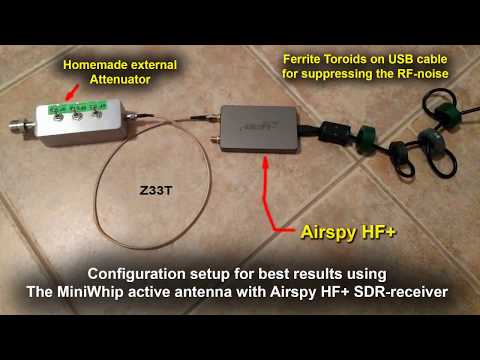
Mile also does a second test with his HF+ and an active Mini-Whip antenna. He writes:
Airspy HF+ is superb High-Dynamic HF and VHF SDR-receiver and I am impressed with it. In order to minimize possible negative effect on signal path from antenna connector to tuner input, Airspy HF+ has no internal attenuator. Developers takes in account that this SDR-receiver has enough dynamic range that is very difficult to overload it. Actually it is true for most cases. But, if we want to use some type of active antenna (with internal amplification) like Mini-Whip Active Antenna for example, it is good idea to add an external attenuator between antenna and receiver HF-input connector, in order to have opportunity to lower the signal level from the active antenna, and to avoid possible overload issues. In this video I am presented some scenario (receiving MW AM band) when my homemade external step-attenuator is more than welcome! By the way, the external step-attenuator is very easy to made in almost no money. All you need is 9 resistors, three switches and one metal box) I have 5.5 dB switch, 10.5 dB switch and 22 dB switch. It can be set for 8 various combinations: 0, -5.5 dB, -10.5 dB, -16 dB, -22 dB, -27.5 dB, -32.5 dB and -38 dB.
You can see on this video that the AM Broadcast signal from Macedonian Radio on 810 kHz is very strong. The Antenna is about 30 km from my house. It is self standing huge 185 meters high vertical antenna, radiating enormous RF-power, so I have to use my homemade attenuator I mentioned it before.
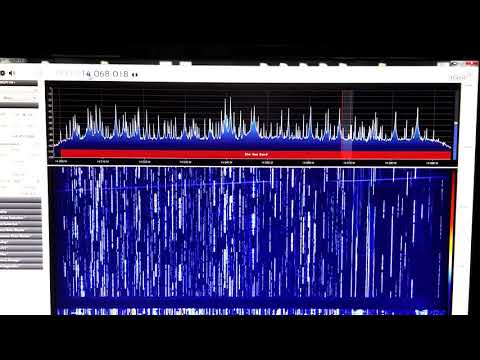
Airspy HF+ SDR Receiver with Mini-Whip Active Antenna and External Attenuator
The SWLing Post Blog
Here Thomas of the SWLing post blog has posted a brief review of his HF+ unit. He notes how the HF+ is very compact, with a durable enclosure and how easy it was to set up with it being completely plug and play. So far Thomas hasn't fully evaluated the performance, but his first impressions are good.
Adam 9A4QV
In his two videos Adam doesn't directly review the Airspy HF+, but he does show some pretty impressive reception with his Skyloop antenna.
CQWW-2017 the end of the contest AirspyHF+
CQWW-2017 using AirSPY HF+ and 250 feet long skyloop antenna

![[EN subs] HRPT - Erste Bilder! und mein Setup](https://www.rtl-sdr.com/wp-content/plugins/wp-youtube-lyte/lyteCache.php?origThumbUrl=https%3A%2F%2Fi.ytimg.com%2Fvi%2FxuqsLo48eWg%2F0.jpg)