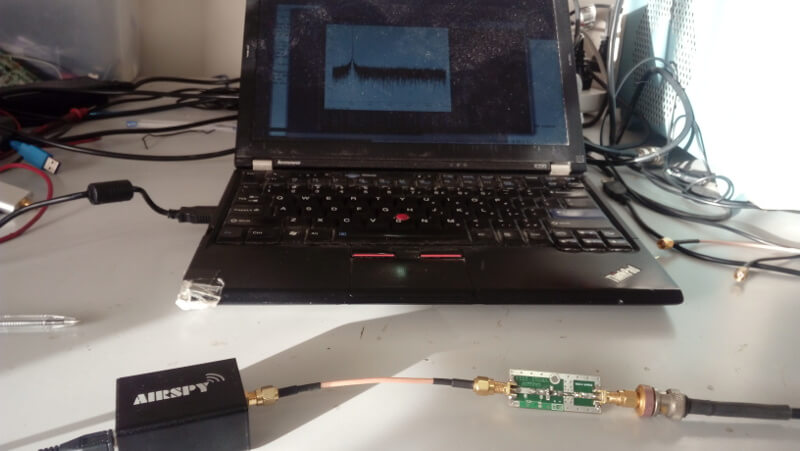
The Noise Figure (NF) is an important metric for low noise amplifiers and SDRs. It's a measure of how much components in the signal chain degrade the SNR of a signal, so a low noise figure metric indicates a more sensitive receiver. The Noise Figure of a radio system is almost entirely determined by the very first amplifier in the signal chain (the one closest to the antenna), which is why it can be very beneficial to have a low NF LNA placed right at the antenna
It’s a GNU Octave script called nf_from_stdio.m that accepts a sample stream from stdio. It assumes the signal contains a sine wave test tone from a calibrated signal generator, and noise from the receiver under test. By sampling the test tone it can establish the gain of the receiver, and by sampling the noise spectrum an estimate of the noise power.
As expected, Rowetel found that the overall noise figure was significantly reduced with the LNA in place, with the Airspy's measuring a noise figure of 1.7/2.2 dB, and the HackRF measuring at 3.4 dB. Without the LNA in place, the Airspy's had a noise figure of 7/7.9 dB, whilst the HackRF measured at 11.1 dB.
Some very interesting sources of noise figure degradation were discovered during Rowetel's tests. For example the Airspy measured a NF 1 dB worse when used on a different USB port, and using a USB extension cable with ferrites helped too. He also found that lose connectors could make the NF a few dB's worse, and even the position of the SDR and other equipment on his desk had an effect.
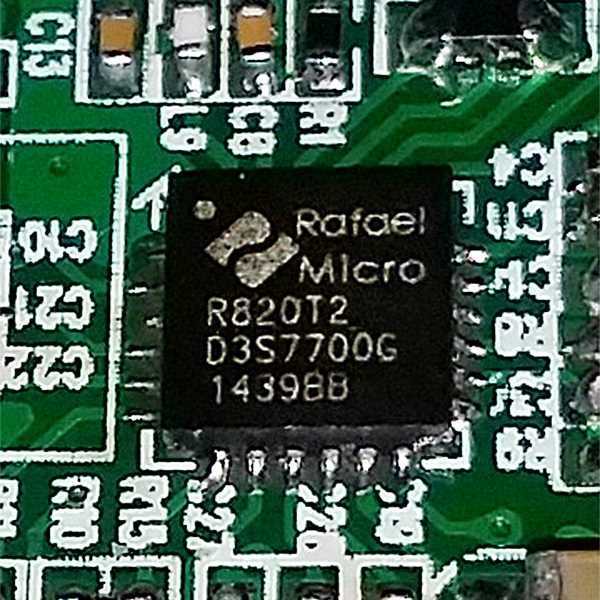
The R820T2 is the main tuner chip used in most RTL-SDR dongles. Several months ago Rafael Micro ceased regular production of their R820T2 chip, and the older R820T has also been discontinued for some time too.
However, Rafael are still producing new quality R820T2 chips for factories if they make very large bulk orders. Since it is one Chinese manufacturer producing all of RTL-SDR.com V3, NooElec, FlightAware and most generically branded dongles, the volume restriction is not a problem for them as long as the RTL-SDR is still in demand. So most dongles using R820T2 RTL-SDRs should be able to continue business as usual for the forseeable future. But we have also recently seen that a lot of generically branded RTL-SDR dongles presumably produced at other factories have started to ship with the less desirable FC0012/13 tuner chips instead.
The R820T chip is already 8 years old, and the R820T2 has been around for the last two years. The R820T2 was a slight improvement on the R820T, due to a higher quality manufacturing process used to produce it. The change in manufacturing process resulted in mostly higher yields, less chip-to-chip variance, better sensitivity, reduced L-band heat VCO lock issues, and wider filters.
Recently the Youssef from the Airspy team announced the likely early retirement of their Airspy Mini and R2 line of products(see update below, Airspy Mini/R2 production will continue) These are SDRs that used the R820T2 tuner chip combined with a 12-bit ADC, allowing for significantly better performance compared to an RTL-SDR. It seems that they were able to acquire R820T2 chips from a distributor, but the stock proved to be very low yield. Possibly once discontinued a lot of low quality chips were dumped onto the distributors for final sale. They write:
I have some bad news. Rafael Micro officially discontinued the R820T2 since a few months. This is the tuner we use in the Airspy R2 and Airspy Mini.
We tried to secure an extra batch from Rafael (even at a higher price) but the quality of the silicon of the samples we received wasn't very good and most units didn't pass our automated QA tests. Sacrificing the performance is out of question. The alternatives proposed by Rafael are not pin compatible and require both a significant hardware redesign and new tuner control code - and this is a large investment with very little guarantees on the final result.
I can say this has been one of the longest running designs that resisted the new silicon tuner SDR's popping in and out while setting a standard for performance and price.
For now, our distributors are running out of R2/Mini's very quickly and, until a final solution is found or a new replacement is designed, there won't be any new batches out.
I was checking my notes for alternatives to the current Airspy R2/Mini design and wondered if consulting the community would give some constructive input. As the market is already crowded with low cost receivers and transceivers, but yet Icom manages to sell a 4 figures SDR, I was thinking of making something that is as open as possible for extensions and work good enough for the most demanding operators and pro's, all while being affordable.
The idea is to replace the R820T2 tuner with one of its latest high performance siblings, then replace the old LPC4370 with the brand new i.MX RT1020. This MCU can be interfaced with a good ADC and has enough processing power for oversampling and decimation through the Cortex M7 core, which will bring the final resolution higher. The general goals:
Better RX performance than the general purpose low cost silicon transceivers
12 bit RX at 10MHz bw and up to 16bit at narrow band
Coverage from 30 MHz to 1.8 GHz or more
Switched pre-selectors
Open source
Same form factor as the Airspy HF+ (same box actually)
Leverage the RF manufacturing and testing capability developed at Itead Studio
Affordable
UPDATE (May/2018): The Airspy team have managed to acquire a new batch of good R820T2 chips, so production of the R820T2 based Airspies can continue as per usual.
So in conclusion there is no need to panic buy R820T2 RTL-SDRs as production will continue as per normal for the forseeable future as the RTL-SDR demand is high enough for factories to make large bulk orders of new R820T2 chips. Even if the R820T2 is fully discontinued, there are alternative tuners with the same performance that we can switch to after a minor redesign.
Note that we're currently out of stock of RTL-SDR V3's on Amazon and low in stock on our store but this is not related to R820T2, but rather simply shipping delays. We should be fully back in stock within a few weeks.
Jon Hudson, head of marketing at SDRplay has recently released a helpful tutorial that shows how to access remote servers in SDR-Console V3, and also how to set up your own server too. As you may already know, SDR-Console V3 provides a remote server platform which allows you to access all sorts of SDR hardware remotely over a network connection or over the internet. Some SDR hardware owners even opt to share their radio hardware publicly over the internet for anyone to access. The video description reads:
This video is a screen-by-screen guide to both accessing, and setting up your own, remote SDR radio using the new (Feb 2018) SDR Console V3 software from SDR-Radio. Although the guide uses an RSP2 from SDRplay, this will work with all the popular SDRs
Please note - you need to have a good internet connection since (unlike in V2), the entire I/Q data is being sent over the internet. This also limits how much visual bandwidth you are can see at any one time.
SOME IMPORTANT WARNINGS IF YOU ARE ADDING YOUR OWN SDR! Be careful not to plug multiple SDRs into a single USB2 socket - for multiple SDRs, you may need a powered hub ( like this: https://www.amazon.co.uk/UGREEN-Adapt... )
Once you are up and running - please go to http://www.sdr-radio.com/Software/Ver... and view your listing - if there is a yellow triangle, then you are not accessible outside your own firewall - attention is needed! Just because you can access it on your own LAN doesn't mean it's accessible via the internet!!!
The RSP family of SDRs from SDRplay cover 1kHz to 2 GHz with no gaps and give up to 10MHz spectrum visibility.
Jon's video first shows how to use SDR-Console V3 to access those publicly shared SDR radios over the internet. The second part of the video demonstrates how to set up your own server that you can use remotely for personal use, or to share over the internet.
The SDR-Console V3 server accepts various kinds of SDR hardware including RTL-SDR, Airspy, SDRplay, HackRF, Elad, LimeSDR and many more SDR units so this is a good way to explore various types of hardware, or simply to explore signals from different areas around the world.
Recently a few more reviews of the HF+ have been released and we list some of them below for those thinking about purchasing one.
SDRPlay RSP-1A vs. Airspy HF+ on Shortwave and Medium Wave
In this video icholakov compares the RSP-1A with the HF+ on shortwave and medium wave reception. He writes:
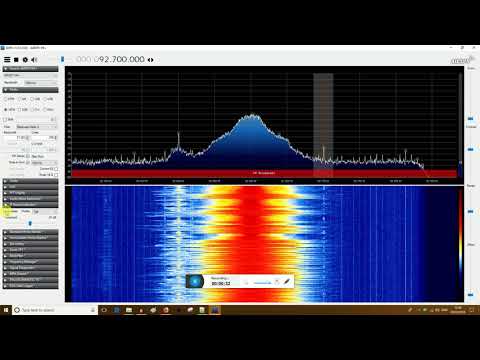
Comparing reception of two popular SDR Receivers using the same antenna at 5 PM local time. Short wave and medium wave frequencies. Using the same SDR Console 3 software for both. I have not ced enough variances using different usb cables and different host laptops to say that in this case the two are pretty much on par. The laptop running RSP-1A happened to have a better audio profile but that's the laptop not the sdr. I only see a noticeable difference when receiving the low power 10 Watt Travel Information radio from the Florida Turnpike on 1640 kHz. I assume that it is coming via ground wave.
SDRPlay RSP-1A vs. Airspy HF+ on Shortwave and Medium Wave
Airspy HF+ vs Elad FDM-S2 Weak Signal Comparisons
In this guest post on the swling.com blog Guy Atkins put up a number of audio samples recorded from the HF+ and FDM-S2. The audio samples were not labelled with the radio they came from and he asked readers to vote on which audio sample sounded better. A week later he released the results which showed that the HF+ and FDM-S2 had mostly 50/50 votes, indicating that one did not really sound better than the other.
In this video by YouTube user stereo11 the selectivity of the HF+ is tested by attempting to receive weak far away stations that are very close to a powerful local station on the frequency spectrum. The HF+ and the SDR# software is able to easily reject the strong station once the IF is adjusted.
Airspy HF+ SDR - selectivity check next to local
Overview of the HF+
This YouTube video by Radio-Noticias revista española de radioafición is in Spanish, but can be decently autotranslated using YouTube captions to English. It provides a good overview of the HF+ design and features.
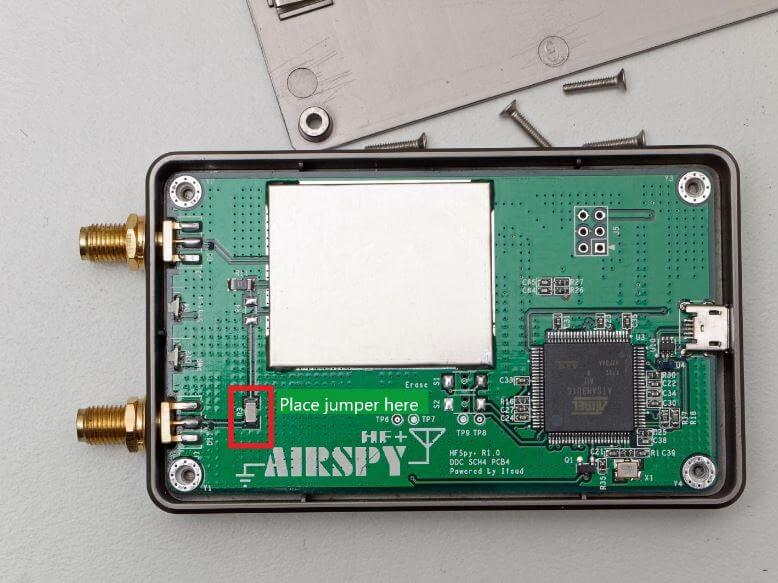
However, the good news is that it seems that a recent firmware patch fixes this issues. The firmware update with instructions can be found at the bottom of the HF+ page on the Airspy site. The firmware update involves opening the case and briefly shorting two pads so it is only really something to do if you are experiencing problems in the first place. It also appears that performing a simple hardware mod helps too.
Previous Reviews
In the past we reviewed the HF+ ourselves and that review can be found here. You can also search our previous posts for various other HF+ reviews that we've posted about before.
During the early phases of the design R3 was a place holder for a 0 ohms resistor that allows experimenters to customize the input impedance. For example:
A 300 pF capacitor will naturally filter the LW/MW bands for better performance in the HAM bands
A 10µH inductor would allow the use of electrically short antennas (E-Field probes) for MW and LW
A short (or high value capacitor) would get you the nominal 50 ohms impedance over the entire band, but then it’s the responsibility of the user to make sure his antenna has the right gain at the right band
A custom filter can also be inserted between the SMA and the tuner block if so desired.
R3 and the nearby resistors have been intentionally left outside of the RF shield, and their size was picked to be big enough to allow anyone to play with them. You will notice the size difference with the rest of the components.
In general, unless one knows what he’s doing, it’s not recommended to alter a working system. “If it’s working, don’t fix it”. But, we are hobbyists, and not doing so leaves an uncomfortable feeling of something unachieved. Most brands addressing the hobby market leave some tweaks and even label them in the PCB.
The main purpose of the HF+ is the best possible performance on HF at an affordable price. This is to incite HAMs to get started with this wonderful technology while using an SDR that isn’t worse than their existing analog rig.
The MW/LW/VLF crowd may have slightly different requirements, but that can be addressed by shorting a resistor.
The HF+ Mod (Edited by Bjarne, original photo by Nils Schiffhauer)
Medium Wave DXer Bjarne Mjelde has recently written up his experiences with the new Airspy HF+ software defined radio. If you weren't already aware, MW DXing is the art of attempting to receive extremely weak and distant broadcast AM stations which may be close to powerful local stations. Generally a radio with high end dynamic range specifications is required for this task. The HF+ is a new low cost SDR that aims to meet those very needs.
In his review Bjarne noted that the MW band sensitivity of the HF+ was good, but not quite as good as the more expensive Perseus and Cloud-IQ SDRs. He also noted that the LW band was more attenuated than expected. However, he discovered that there is an optional hardware modification for the HF+ that involves simply bypassing a capacitor on the PCB with a short circuit. After performing this mod Bjarne found that the sensitivity was significantly improved on the MW and LW bands. Also although sensitivity above 15 MHz was expected to be reduced, Bjarne found no noticeable detrimental effects.
Bjarne concludes that the HF+ is a very capable receiver that after modding satisfies the needs of a demanding MW DXer, although he does note the drawback of the limited 660 kHz of bandwidth. In other previous reviews of low cost SDRs on his blog, Bjarne reviewed the SDRplay RSP1A, ColibiriNano and the Airspy R2 + SpyVerter. Basically he found that none really satisfied his MW DXing needs, with the RSP1A being suprisingly good but failing with strong signals, the Airspy R2 + SpyVerter having too high of a noise floor, and the ColibriNANO being okay, but with a high internal noise level.
The HF+ Mod (Edited by Bjarne, original photo by Nils Schiffhauer)
Thanks to Stefan Dambeck for letting us know that there is now a fork of libairspyhf made by DL9RDZ which contains an adapted version of airspyhf_rx (the raw IQ generator). This enables the Airspy HF+ to be easily integrated into OpenWebRX.
If you weren't aware, OpenWebRX is a browser based SDR interface and server software that allows an SDR to be used by multiple people at the same time over the internet. It performs audio demodulation and compression on the server side allowing for very low and efficient network usage. In this way it is different to Airspy official server solution SpyServer which sends the IQ data over the network. So an OpenWebRX server uses significantly less network bandwidth and might be more suitable for those on slower or capped internet connections.
At the moment we're not seeing any public HF+ servers available on the OpenWebRX database at sdr.hu, but this may change in the future.
Airspy HF+ Running on the OpenWebRX Web Browser Interface
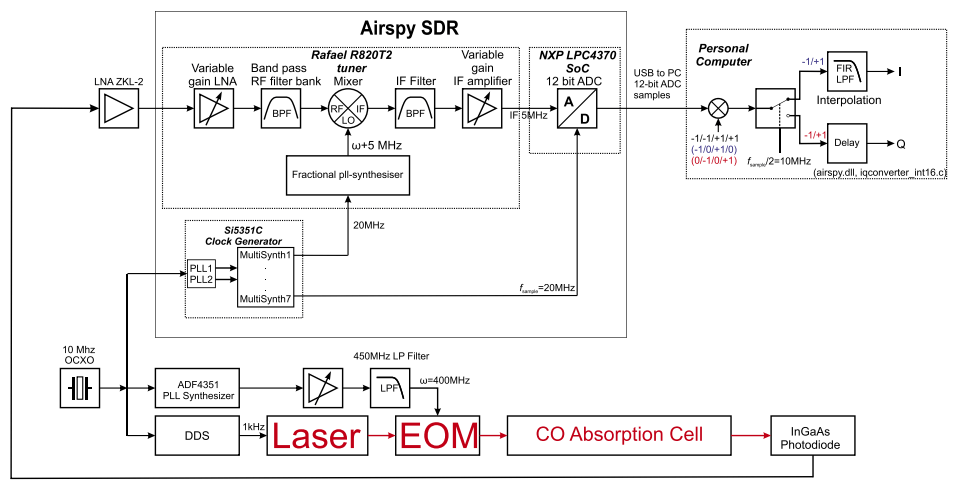
In the experiment a laser is fiber optically coupled to an eletro-optic phase modulator, which modulates a 400 MHz FM signal onto the light. The light is then passed into a Carbon monoxide absorption cell with a photodiode used to take the spectroscopic measurements. The signal from the photodiode is passed into a LNA and then into the Airspy where the signal can then be processed on the PC.
The paper is very technical, but describes the setup, and how they characterized and calibrated the Airspy for their measurements. They conclude with the following:
A successful demonstration of a commercially available software defined radio as a lock-in amplifier was performed. For this purpose, the tuner front end and back end were characterized. The sensitivity and non-linearity of the receiver circuit was measured and analyzed. Acquisition of a CO spectral line was demonstrated using FM-spectroscopy with a repetition rate of 1 kHz. This proves the usability of an off-the-shelf SDR as a cheap but powerful lock-in amplifier by adding PLL driven frequency generators. The drawback of the arbitrary initial phase of the used phase locked loops can be either solved by software or hardware measures.
This experiment is somewhat similar to one we posted about earlier in the month where an RTL-SDR was used in an optical interferometer lab experiment.
FM Spectroscopy with an Airspy Software Defined Radio.