Category: Airspy

Receiving Inmarsat L-Band AERO with a DVB-T Antenna, Amplifier and Airspy Mini

To show that a specialized antenna is not required to receive L-band Inmarsat AERO satellite signals, YouTube user SkyWatcher has uploaded a video showing how he was able to receive these signals with a cheap DVB-T antenna. SkyWatcher writes:

I’ve recently upgraded from my RTL-SDR sticks (E4000, R820T2) to an Airspy Mini.

I did some testing during the last week and found it very interesting that I was able to receive Inmarsat L-Band signals indoors, with just a DVB-T antenna and amplifier behind the window, no downconverter, no special antenna, no super low-noise amplifier. The window is facing south, with a few degrees to the east and the satellite I’ve received was Inmarsat 15.43W. So, angle antenna to satellite should be estimated 20 degrees.

I’ve used a 18dB DVB-T/Satellite-TV inline amplifier as a ‘LNA’ (noise < 5dB) and a VHF/UHF DVB-T antenna which seems to be a stacked dipole, and therefore should be quite wideband and should make a reasonable general purpose antenna. Anyway, I did not expect it to work on 1.5GHZ at all. Also, I want to mention that the inline amplifier is rated 5 to 18V, but it works just fine with the 4.5V from the Airspy Mini.

It seems that with 10dB S/N, Aero reception is possible and with about 12dB S/N, it is getting reliable.

In general, I am very satisfied with the upgrade to the Airspy Mini. It has a much lower noisfloor and a much cleaner spectrum, compared to my old RTL SDRs. Also, I am very happy with the CPU-usage which is only about 12% on my i5-3210M when using 2.4MHz bandwith, and 18-20% with a bandwith of 4.8MHz.

Together with the ability to use SpectrumSpy and the very useful decimation-feature, the Airspy Mini is the best option to upgrade from a RTL-SDR for me at the moment. Anyway, of course this is just my very personal opinion… 😉

AERO is essentially the satellite based version of ACARS, and the L-band signals contains short ground to air messages with things like weather reports and flight plans intended to be transmitted to aircraft. To decode it with an SDR, the JAERO software can be used.

Airspy Mini: $99 USD, 24 – 1800 MHz, 12-Bit RX SDR Now Available for Preorder

Over the last few months we’d constantly heard hints that the Airspy team was working on a miniaturized version of their popular Airspy SDR. Today the Airspy Mini has been released for preorder.

The Airspy Mini has similar high performance specifications to the Airspy R2, but comes in a USB dongle sized enclosure and only costs $99 USD – half the price of the $199 USD Airspy R2. The only difference in specification appears to be that the Airspy Mini has 6 MHz of spurious free bandwidth, versus 9 MHz in the Airspy R2, and that it lacks the external clock input and some of the expansion headers which are mainly useful only for advanced experimenters. The other features including its 24 – 1800 MHz operation, 12-bit ADC and 0.5 PPM TCXO all remain the same. The Airspy team also write that the Mini still supports a 20 MSPS mode for ADS-B decoding with the ADSBSpy decoder, which should place its ADS-B decoding performance at an identical level to the Airspy R2, which is very good.

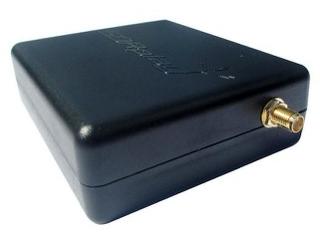
The Airspy Mini SDR Dongle

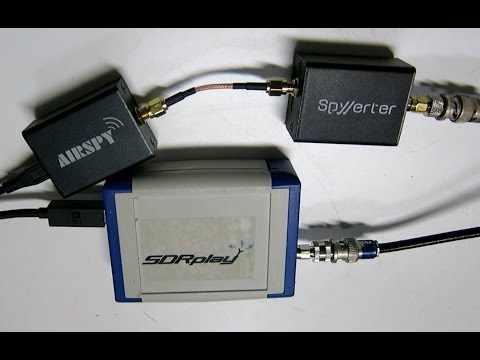
To receive the HF frequencies the Airspy team are also releasing an Airspy Mini + SpyVerter bundle which will cost $149 USD. The SpyVerter is an upconverter designed to work with Airspy products, but has also been found to work well with the RTL-SDR. 

At these prices the Airspy Mini competes heavily with the $149 USD SDRplay RSP which is a similarly specced SDR. In a previous review on this blog that compared the SDRplay RSP and Airspy R2 we found that the Airspy generally performed better in the presence of strong signals.

In the future we hope to review the Airspy Mini and check to see if its performance is similar to the Airspy R2. If its RX performance is at least the same as the R2, then it probably will be the best value SDR for those wanting to upgrade from an RTL-SDR.

The inside of the Airspy Mini.

Using the Airspy as a low cost Spectrum Analyzer with Spectrum Spy

Over on his blog VK4ZXI has been testing the Airspy with the Spectrum Spy software. The Airspy is a $199USD software defined radio that can be considered as a high end upgrade to the RTL-SDR as it has 10 MHz of bandwidth and a 12-bit ADC. The Spectrum Spy software allows the Airspy to be used as wideband spectrum analyzer. In a previous post we reviewed the Spectrum Spy software with the Airspy and found it to have an extremely fast refresh rate. Recent updates since the review have made it even faster.

In his first post VK4ZXI compares the Airspy + Spectrum Spy with the RTL-SDR running RTLSDR-Scanner and Rtl_power, two spectrum analyzer programs written for the RTL-SDR. In his tests he finds that the RTL-SDR and Airspy can obtain similar scans, but the Airspy can scan and refresh the spectrum at much faster speeds than the RTL-SDR, thanks to its 10MHz bandwidth.

Airspy + Spectrum Spy receiving the entire digital TV band over 100 MHz.

In his second post VK4ZXI uses the Airspy + Spectrum Spy together with a cheap BG7TBL noise source to measure the response of a cavity RF filter. This is the same BG7TBL noise source that we used in our “Measuring Filter Characteristics and Antenna SWR with an RTL-SDR and Noise Source” tutorial. The results from the cavity filter measurement show that the Airspy can potentially perform on a level close to an expensive spectrum analyzer.

Measuring the response of a UHF cavity filter with Airspy + Spectrum Spy.

Comparing the FunCube Dongle Pro+, Airspy/SpyVerter and SDRplay on Shortwave

Over on YouTube user London Shortwave has uploaded a video showing a comparison of the FunCube Dongle Pro+, Airspy with SpyVerter upconverter and SDRplay on shortwave reception. The Funcube, Airspy and SDRplay are all $150 – $250 USD software defined radios that have much higher performance compared to the RTL-SDR.

In the video he tests the reception of Radio New Zealand International (RNZI) at 9400 kHz using a 6m copper wire dipole and 9:1 matching balun raised 2m off the ground. He did not use any external antenna preselectors. The RNZI station is weak and appears to be almost blocked by a stronger station so reception of the station is difficult.

In his results it appears that the FunCube and Airspy/SpyVerter are able to clearly receive the RNZI station, but the SDRplay has trouble with images of other stations mixing into the signal.

If you are interested in a comparison of the Airspy, SDRplay and HackRF we previously did our own review here.

Portable SDR Shootout Part 1

AISRec Updated to Version 2.1

AISRec is an RTL-SDR (and now Airspy) compatible AIS (automatic identification system) dual channel decoder. AIS is an acronym for Automatic Identification System and is a system used by ships to broadcast position and vessel information. By monitoring AIS transmissions with the RTL-SDR we can build a boat radar system.

Last time we tried AISRec we found its performance to be very good, with it decoding more messages than other software we tried. The new version includes the following updates:

  • Added auto detection of devices when devices are plugged in.
  • Added the support for airspy. Allow selection of devices by serial number for rtlsdr dongles.
  • Added AISRec core 3.0. The new core is 2x faster than AISRec core 2.0.
  • Added one embedded multi-user TCP server. Any client works with AISRec should implement auto reconnection.
  • Added auto display of local IP for the TCP server.
  • Added one output to one serial port.
  • Added interactive changes of gain parameters for devices.
  • A few changes on GUI.
  • Added an icon for GUI. Users should reset the windows icon buffer to allow the display of the new icon.

In addition, while AISRec hopes to be commercial software one day, at the moment they are currently offering free registration. See their FAQ for information on registering for free.

AISRec running with OpenCPN.

Comparing ADS-B Reception with the RTL-SDR, Airspy and Beast Receivers

Over on satsignal.eu the author has set up a page showing live statistics of his ADS-B reception for the RTL-SDR and Airspy software defined radios, and also for the Beast ADS-B receiver. The Airspy is a $199 software defined radio that many consider as a next stage up from the RTL-SDR, and the Beast is a ~$270 USD dedicated ADS-B receiver.

Unsurprisingly the results clearly show that the Airspy receives ADS-B signals significantly better than the RTL-SDR. However, what comes as a surprise is that it is actually appears to be outperforming the dedicated Beast receiver. In the tests with the outside vertical antenna, the Airspy running on a Raspberry Pi appears to receive a significant higher number of messages and also sees planes out to a further range.

Not too long ago the Airspy team released their ADS-B software for the Raspberry Pi 2. They write that this software uses the full 10 MHz bandwidth and can even decode messages that are overlapping one another. We’ve also been told by the Airspy team that the Airspy is already in professional use as an ADS-B receiver amongst several small airports.

In the future we hope to compare the Airspy against the RTL-SDR on ADS-B reception ourselves, and also compare it against the 8 MHz bandwidth SDRplay whose development team have also recently released a new ADS-B decoder, as well as the recently released FlightAware ADS-B Prostick RTL-SDR.

Beast and Airspy comparison on ADS-B Reception.

Spectrum Spy: New Spectrum Analyzer Software for the Airspy

Software defined radio's can easily be used a very wideband spectrum analyzers by quickly stepping through the spectrum at the largest stable bandwidth supported. The RTL-SDR has had this functionality for some time now through software such as rtl_power and RTL Scanner.

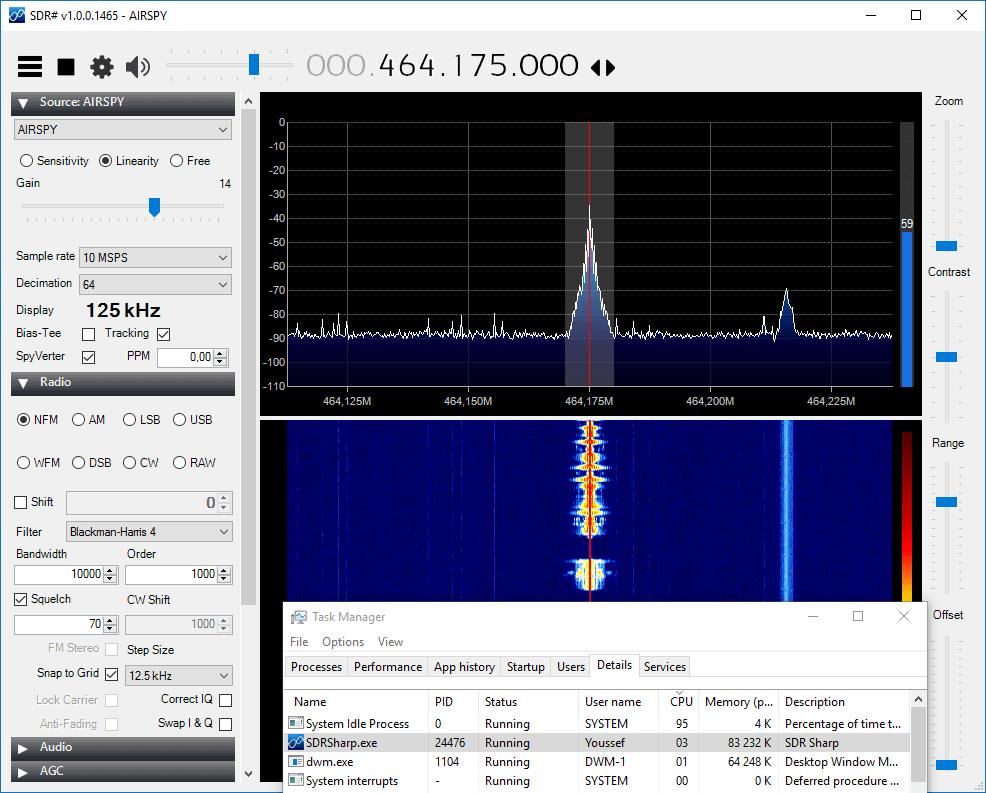
Now Youssef, co-creator of the Airspy and programmer of SDR# has released a similar program for the Airspy called Spectrum Spy. The software comes bundled with the latest SDR# download which can be obtained from airspy.com.

The Airspy is a $199 USD software defined radio with a similar tuning range to the RTL-SDR, but it is significantly better with its 12-bit ADC and up to 10 MHz of instantaneous bandwidth. We review the Airspy, SDRplay RSP and HackRF in this post. With its large instantaneous bandwidth and fast retuning speed the Airspy makes an excellent spectrum analyzer that refreshes very quickly.

Youssef stresses that the software is still in proof of concept stages, and various features are still to be added in the future. He writes:

A new utility app is available for download with the standard SDR# package. It allows the visualization of larger frequency spans by exploiting Airspy's fast frequency tuning capability. The scanning speed is comparable to real spectrum analyzers (may be faster even!) The project is still in a PoC state, but the basic functionality provided is fully operational.

It all started when some customer wanted an example code to implement their own SA using Airspy, so I did more than a code snippet. I hope you enjoy!

We tested the Spectrum Spy software on several bands, and recorded short videos shown below to show how fast it is. 

20 MHz Bandwidth Mobile Phone Band

50 MHz BCFM Band

100 MHz Bandwidth Mobile Phone Band

Includes the uplink and downlink portions. We used our mobile phone to make a call and you can see the uplink at 895 MHz.

1 GHz Full Spectrum

Tweeted Photos

Over on Twitter @uhf_satcom has also been testing out Spectrum Spy and has got some good shots of Ku and L-band satellite bands.

Here @supertrack_it has been using Spectrum Spy to help with the tuning of his 1420 MHz filter.

YouTube video showing Inmarsat C-Band AERO Reception

Last week we posted how programmer Jonti had successfully implemented a C-Band AERO decoder into his JAERO software. C-band AERO signals are the earth downlink portion of AERO. Planes transmit data upwards towards the satellites and then the Inmarsat C-band transmitter re-transmits the information back to a basestation on earth. This is different to the L-band AERO signals which are signals transmitted from the satellites to the aircraft. C-band signals are interesting because they contain plane position info, and so can be used to track aircraft much like what is done with ADS-B reception, but over a much larger area. However, C-Band signals are much more difficult to receive as they are at 3.616 GHz and require a 1.8m or larger satellite dish.

Over on YouTube user AceBlaggard has uploaded a video showing an example of C-Band signals being received with an Airspy SDR and being decoded with the new version of JAERO. About the hardware used AceBlaggard writes:

Hardware is a 1.8M PF dish and Titanium Satellite C1 PLL LNB feeding a Prof-Tuner 7301 sat card which loops out to an Airspy SDR.

Inmarsat C Band aero feed.