Category: Applications

Decoding D-STAR Headers with the RTL-SDR

D-STAR or Digital Smart Technologies for Amateur Radio is a digital voice and data protocol used in amateur radio. I was tweeted a link earlier which shows how the RTL-SDR can decode D-STAR text messages and headers (link is in Italian but Google translate can help, and the pictures show more than enough information). By using SDRSharp and stereo mix you can tune to a D-STAR signal, and pass the audio to a command line based decoding program (dstar.exe) which can be downloaded from the above link, which will then decode D-STAR text messages.
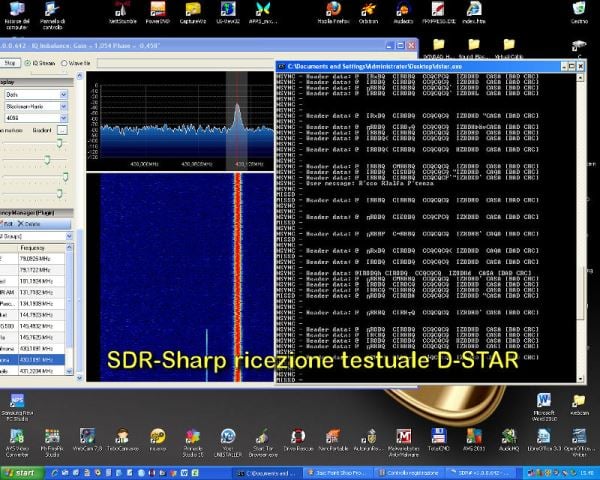
dstar7

Here is also an older video showing D-STAR decoding with HDSDR in action.

Wavesink: New Android RTL-SDR App for FM/RDS/DAB/DRM+

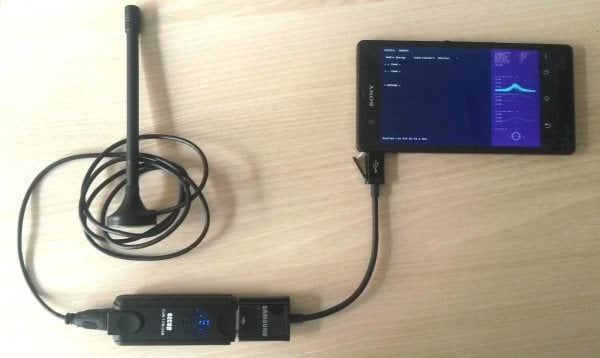
Wavesink is a new SDR Android App, which allows your RTL2832U based dongle to receive FM radio with RDS, Digital Audio Broadcast Radio (DAB) and VHF band Digital Radio Monodial (DRM+). DAB+ support is also to be released by next week, and a station memory will also be added in a future release.

The app is currently in beta development, and only the trial version is released, which will allow you to use the app for 5 minutes at a time. They indicate that the commercial version will be out soon.

To use this with your Android device, you will need a USB OTG (On the Go) cable, and your device must support USB host mode, which most Android devices above 3.1 should support.

I gave the app a quick spin in FM mode, and found that the interface was a little clunky, but the app worked fine, and the FM and RDS signals were decoded correctly.

wavesink

Listening in on Burger Pagers with the RTL-SDR

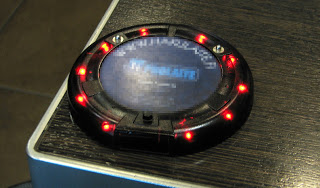
Oona has written on her blog www.windytan.com about how she used an RTL-SDR to listen in on those wireless devices that are given out at some restaurants and cafes to notify you when your food is ready.

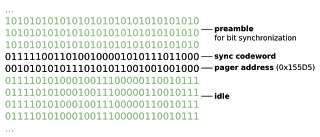
While at a local burger chain she found a label on the back of the device given to her which specified the radio frequency used by the device. By tuning to that frequency with her RTL-SDR, she discovered that the device uses the POCSAG protocol, which is the same protocol that is used by pagers. She then decoded the data packet and found that it contains the device address, which is used to notify the correct device.

burgerPagerpocsagBurger

2-Channel AIS Receiver with RTL-SDR and GNUAIS

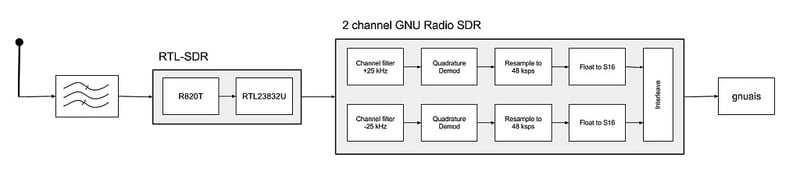
Blogger OZ9AEC has written a post on his blog showing how he made a 2-channel AIS receiver using the RTL-SDR, GNU Radio and GNUAis. AIS is a radio protocol used by boats to broadcast their position and speed which is then used to create a type of radar system to help avoid collisions. AIS signals are transmitted periodically on one of two channels. Two channels are used to improve capacity and help avoid interference if two signals from different boats are broadcast at the same time.

Before this, most AIS receiver implementations we’d seen that used the RTL-SDR received only on a single channel. OZ9AEC’s GNU Radio program receives on both channels simultaneously like a commercial AIS receiver does and is thus a better receiver. He eventually plans to get this receiver to run on a Beaglebone.

See his post for instructions and to download the GRC files.

Update: Another AIS decoder known as gr-ais is also capable of 2 channel AIS, and bristromat from Reddit has written a tutorial on setting it up and running it with OpenCPN.

Two channel AIS Block Diagram

Exploring the Wireless World with the USRP B200

Ettus Research, creators of the high end USRP software defined radios have posted a well produced video on YouTube showing off various applications that an SDR can perform. In the video they go through and explain FM Radio, APRS, AIS, Multi-Channel Decoding, Pagers, ADS-B/Mode S, ACARS, RADAR Analysis and 802.11a decoding.

For these apps they use a USRP B200, which costs $675 USD. Most of the applications shown should also be compatible with other SDRs, such as the cheaper HackRF and BladeRFs. Even the cheap RTL-SDR will at least work for FM Radio, APRS, AIS, Pagers, ADS-B and ACARS. Of course, the USRP is still probably the most top of the line SDR available.

USRP B200: Exploring the Wireless World

Update: The video creator, Balint has also uploaded a video on his personal YouTube channel which is a longer presentation of the topics that were briefly discussed in the USRP video.

Hacking the Wireless World (short version) @ iSec Open Forum

In Car ADS-B with a Raspberry Pi and RTL-SDR

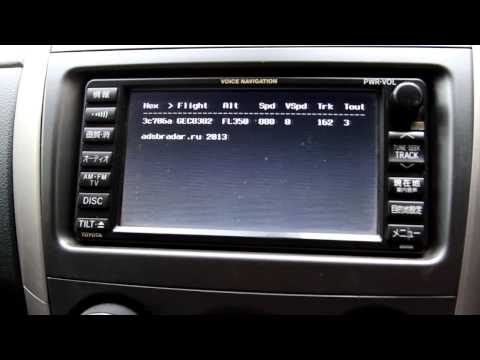
Over on YouTube user adsbrus shows us his project which is an in car ADS-B aircraft tracker using a Raspberry Pi mini computer and an RTL-SDR. The system uses an LCD screen mounted where the car radio usually is to show aircraft identifier, altitude, and speed information in text.

ADS-B in CAR (Raspberry PI & USB TV RTL2832U+R820T)

Improved SDR Support for Kali Linux

The blog at needsec.com brings us news that Kali Linux is soon to be updated to version 1.0.5 which will come with several software defined radio tools preinstalled. Kali is a Debian Linux based operating system that is popular with the security and penetration testing community as it comes with several relevant tools preinstalled. This new version adds several useful SDR software programs including

  • Kalibrate for RTLSDR
  • gr-air-modes
  • RTLSDR Scanner
  • pyrtlsdr
  • GNU Radio Signal Scanner
  • libosmocore 0.6.3
  • grextras
  • gr-baz
  • gr-osmosdr
  • gr-iqbal
  • rtl-sdr 0.5.0
  • HackRF for SDR
  • gr-fcdproplus for SDR
  • UHD Images

via needsec.com

Update: Official Release now out

kali-site-logo2

Potential Major Security Flaw on HP Laptop Discovered with RTL-SDR

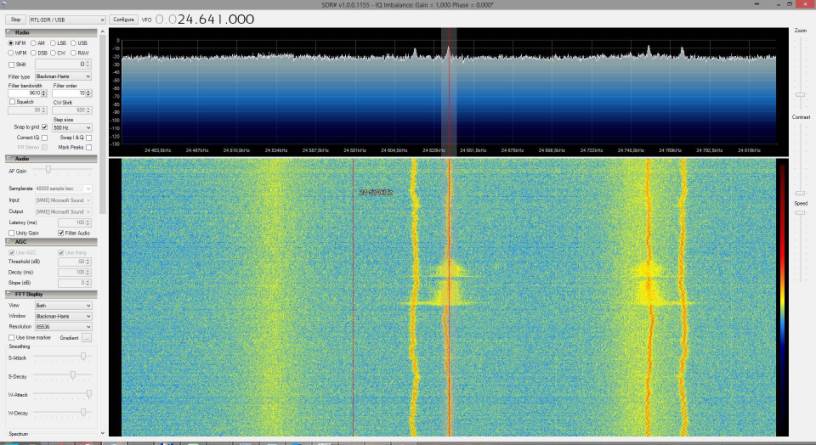
Over on Reddit, user cronek discovered by using his RTL-SDR that the microphone on his HP EliteBook 8460p laptop computer was continuously and unintentionally transmitting the audio from the built in microphone at 24 MHz in FM modulation. He found that the only requirement needed for the microphone to transmit was that the laptop needed to be turned on – even muting the microphone did nothing to stop the transmission.

Click here to read the original post.

I accidentally stumbled upon a signal in the 24MHz range, appearing to be 4 carriers. I tuned to it and heard silence, then someone came into my office and started talking and I could hear them speak. The signal appeared to be coming from my other laptop (not the one running the SDR) and was pretty weak (my antenna, the crappy one that comes with the dongle, stuck to a metal stapler was right next to the HP laptop).

This is of potential concern as as the US Military is apparently transitioning to this particular laptop. However, this may be an isolated incident, as in the thread cronek explains that other laptops he tested did not display this behavior.

HP Laptop Microphone Leak at 24 MHz