Category: Digital Signals

RTLAMR: An RTL-SDR Receiver for 900MHz ISM Smart Meters

Smart meters are meters that monitor electricity usage and wirelessly transmit consumption data to the electricity company. They are a part of the “smart grid”, and allow for better electricity control and usage reporting.

Douglas recently wrote in to us to let us know about his work on RTLAMR, an RTL-SDR based Automatic Meter Reader (AMR) decoder. Currently Douglas has tested the decoder on his local Itron C1SR smart meters, but notes that it should work on any meter using the common AMR protocol known as Electronic Receiver Transmitter (ERT).

Over on his website Douglas has also done a neat writeup discussing the ERT protocol and showing how he decoded it, including the steps of preamble detection, matched filtering, bit slicing and error correction.

We would like to note that we also recently posted about a similar project about decoding Elster R2S smart meters.

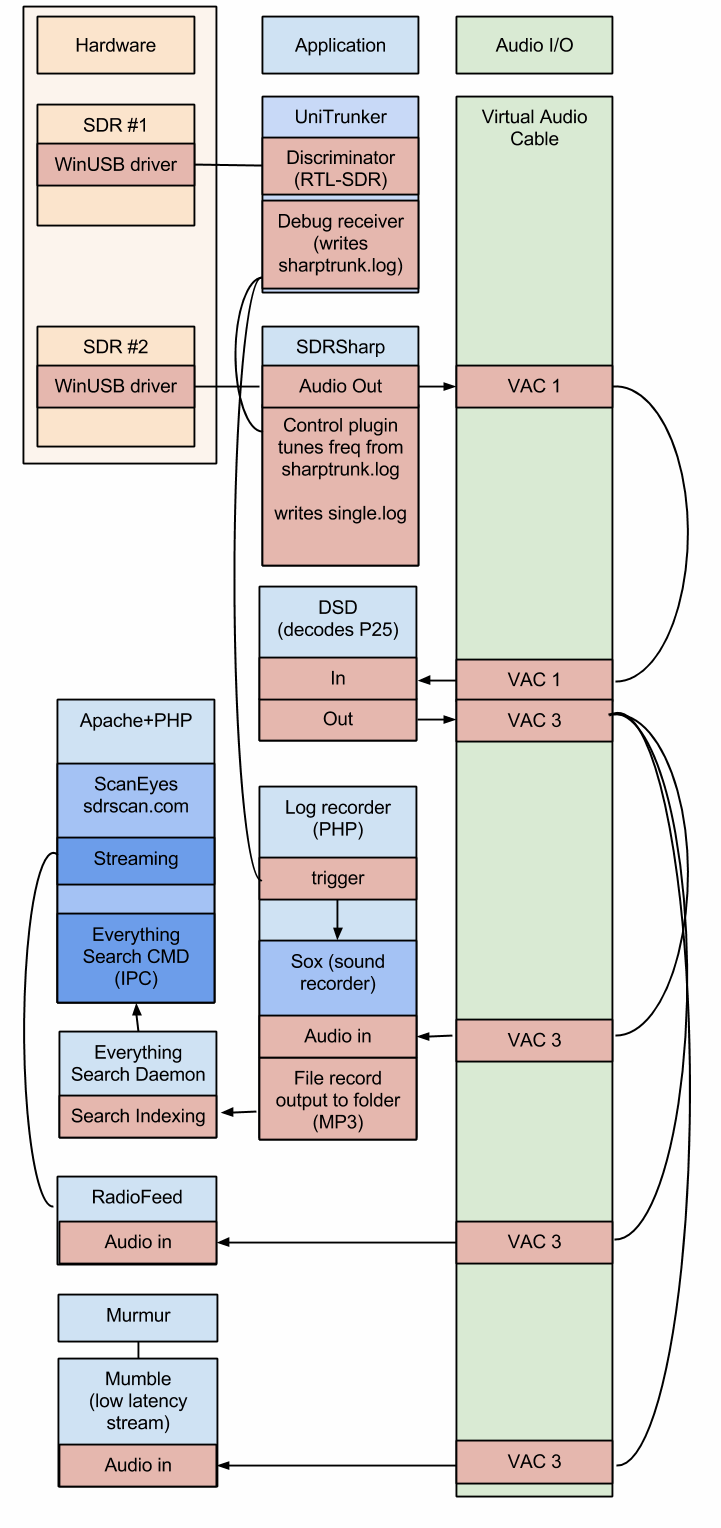
RTLAMR Smart Meter Decoder Flow Diagram

Monitoring APRS with the RTL-SDR

YouTube user Troy McQuinn has uploaded a video showing how he is able to decode amateur radio APRS signals. APRS is an acronym for Automatic Packet Reporting System and is used by ham radio users to send data like messages, announcements and also GPS coordinates. To decode APRS he uses SDR# and pipes the audio to QTMM AFSK 1200 Decoder.

Studying VOR Signals with the RTL-SDR

VHF Omni Directional Radio Range (VOR) signals are used in aviation as a short range radio navigational system. Amateur radio hobbyist F4GKR decided to study these VOR signals by recording them using his RTL-SDR, and then analyzing them in MATLAB. On his post he shows his method of analysis and discusses his results.

VOR Spectrum and Waterfall

Sniffing and Decoding NRF24L01+ and Bluetooth LE Packets with the RTL-SDR

Omri Iluz wrote in to us to let us know about his recent project which involves sniffing and decoding wireless packets at 2.4 GHz from NRF24L01+ and Bluetooth Low Energy (BTLE) transceivers. The NRF24L01+ is a popular wireless transceiver which is used in many common devices such as keyboards, mice, remote controls, toys and appliances.

Since 2.4 GHz is out of any of the RTL-SDR’s receivable range, Omri used a cheap downconverter which he was able to buy from China using Aliexpress. The downconverter converts the 2.4 GHz signal into a lower frequency at around 400 MHz which is in the receivable range of the RTL-SDR.

He was then able to use his NRF24-BTLE-Decoder software that he developed to convert the received data from the NRF24L01+ transceiver into a decoded packet by simply piping the output of RTL_FM into his program.

Since the NRF24L01+ uses hardware similar to the Bluetooth Low Energy (BTLE) protocol, Omri was able to modify his code to be able to also decode BTLE packets.

2.4GHz NRF24 packet received on the RTL-SDR from a Logitech mouse using a downconverter
2.4GHz packet received on the RTL-SDR + downconverter from a Logitech mouse
decodednrf
Decoded NRF24 Packets

Using the RTL-SDR to help Program a TI Chronos RF Watch

Over on our Facebook page, member Александр has posted about a project he found by Georg Campana which involves using an RTL-SDR to capture signals from his TI Chronos watch which has a programmable 433 MHz RF transmitter built into it.

Georg used his TI Chronos watch to transmit a signal copied from remote controls which are used to open his house gate, garage door, light switches and set his house alarm. When he discovered that the watch signal was not transmitting properly, he used his RTL-SDR to compare the signal coming from the watch to the original signals from the remote controls to help him with debugging. In order to detect the bit stream from the RF signal, he used a GNURadio program for decoding wireless temperature sensors, which he modified slightly to work with his watch.

Tools used to program the TI Chronos watch

Using the RTL-SDR as a Cheap TV Satellite Finder

Finding the correct direction to point a satellite for TV reception can be difficult without the right equipment. YouTube user MegaOscarVideos shows us in the video below how he uses an RTL-SDR to accurately aim his satellite for TV reception.

He uses a TV satellite dish with an LNB connected to a bias-T circuit as the receiver, which is then connected to the RTL-SDR. As the satellite is moved he looks for the direction at which the signal level in SDR# increases the most.

RTL SDR as cheap TV Satfinder

Looking at the 432 to 438 MHz ISM Band

Amateur radio hobbyist LA3ZA shows an image on his blog showing how busy the 70cm ISM band can be in his area in Norway. He uses a roof mounted 1.7 m long vertical antenna with 7.2dBi gain in the 70 cm band. Each signal burst may come from a remote car key, weather monitor, electricity monitor, or other telemetry device. Some of these signals may be decodeable with rtl_433.

Busy ISM Band
Busy ISM Band