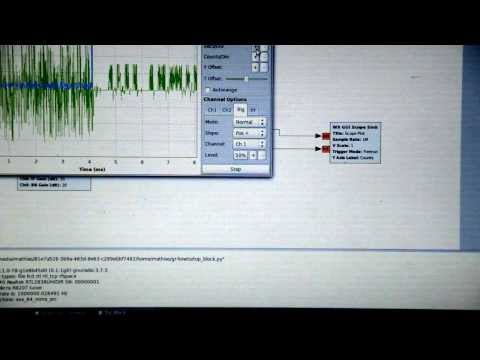
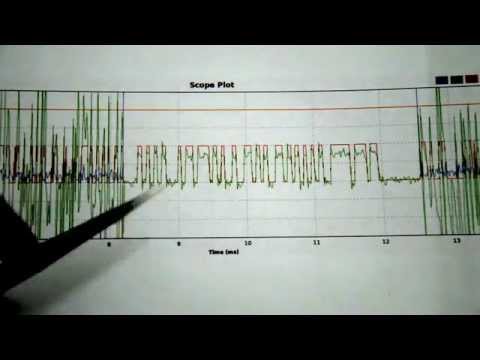
Over on YouTube user MrCircuitMatt has uploaded two videos on how he was able to decode a temperature weather sensor using an RTL-SDR and GNU Radio. His videos go through the GNU Radio technical steps as well as the signal encoding theory he used to decode the temperature.
Using RTL-SDR to read temperature from outdoor sensor, part 1
Using RTL-SDR to read temperature from outdoor sensor, part 2
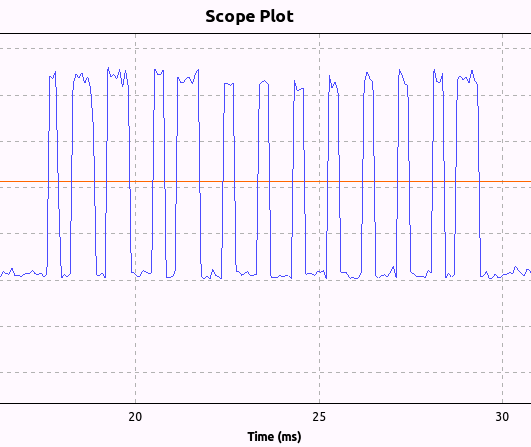
Using an RTL-SDR Clayton Smith was able to reverse engineer his remote controlled ceiling fan. To do this he first used his BladeRF to determine that the remote control was transmitting a signal at 303.747 MHz. He then used a simple GNU Radio flow graph with the RTL-SDR to plot the amplitude of the signal over time which suggested that the signal was using on-off keying. From the plot he was then able to visually determine the bit pattern sent from each button on the ceiling fan remote.
Next he used his bladeRF and another GNU Radio flowgraph to replicate and transmit the the bit pattern which was able to control the ceiling fan from the PC.
Clayton notes that all this reverse engineering was done in half an hour, demonstrating the power of software defined radio.
Ceiling Fan Bit Pattern Recovered with an RTL-SDR and GNU Radio
A RTL-SDR.com reader has written in to let us know about his project involving transmitting Digital Audio Broadcasting (DAB) using GNU Radio and the HackRF. DAB is a digital radio technology that is used to broadcast radio stations. He uses the CRC-DABMUX and CRC-DABMOD software to modulate an audio file into DAB and then uses a GNU Radio python script to write the modulated signal to the HackRF for transmitting.
Programmer Tyler Watt has been working on software that automatically logs each call from an RTL-SDR running DSD (Digital Speech Decoder) and then stores it in a time stamped database as an mp3 file. There is also a web front end for the database which allows public users to search and play recorded calls.
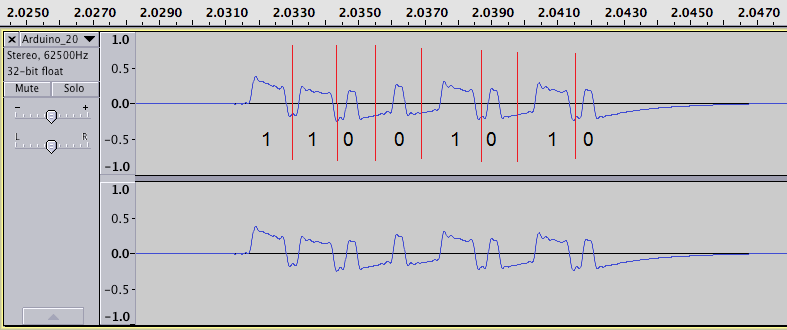
The author used an RTL-SDR and SDR# to listen to the outlets wireless AM transmissions at 434 MHz. He then recorded the signal audio and then used audacity to view the waveform. By analyzing the audio output he discovered that the signal was a Non-Return-To-Zero (NRZ), pulse width modulated (PWM), Amplitude Shift Keying / On Off Keying (ASK/OOK) signal.
Later he was also able to use the RFCat USB dongle to transmit an on off signal from his computer. RFCat is an USB dongle that is capable of transmitting on 433 MHz.
RTL-SDR RTL2832U Software Radio Audio output Analyzed in Audacity for Reverse Engineering a Wireless Power Outlet
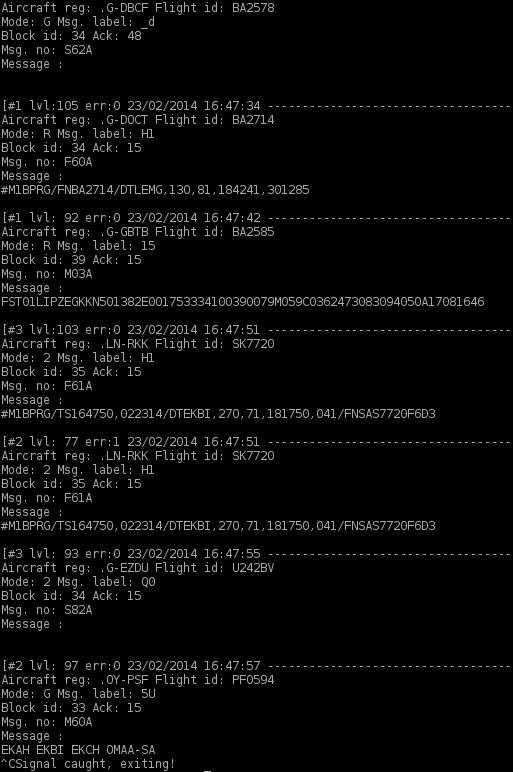
The VHF Data Link mode 2 (VDL2) is a new transmission mode used on aircraft for sending short messages, position data (similar to ADS-B) and also for allowing traffic controllers to communicate to pilots via text and data. VDL2 is intended to eventually replace the standard ACARS modes. It is found at 136.975 MHz.
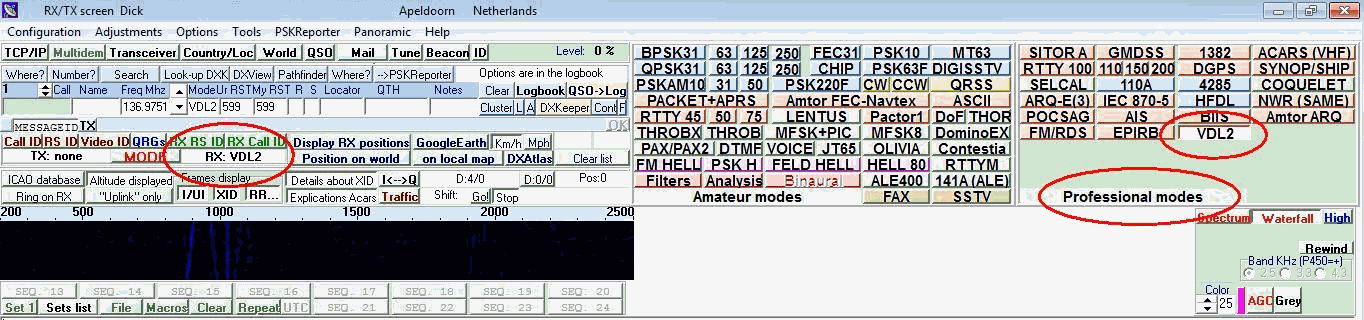
Recently, a wiki page explaining how to decode VDL2 using MultiPSK, Planeplotter and the RTL-SDR has been put up. MultiPSK is a sophisticated software program that can decode a wide range of amateur radio digital signals as well as several professional modes like VDL2. To decode most professional modes like VDL2 however, the paid version of MultiPSK is required, but a 5 minute per use trial of VDL2 decoding can be used for testing. Newer versions of MultiPSK can now even directly connect to the RTL-SDR dongle.
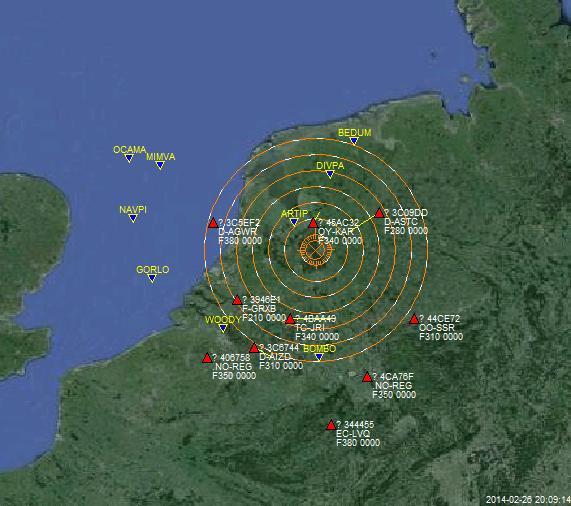
The wiki page shows how to set up the RTL-SDR dongle on MultiPSK to receive VDL2 signals, and then shows how to connect it to PlanePlotter in order to plot the aircraft positions on a map.
The BladeRF is a software defined radio that has transmit and receive capability. Over on his blog, Clayton Smith has recently posted about his experiments which involve using the BladeRF to transmit DVB-T digital TV on one laptop to another laptop running an RTL-SDR in DVB-T mode. This is one of the few applications where the RTL-SDR is used as a DVB-T receiver as it was originally intended. Clayton used GNU Radio, a DVB-T package for GNU Radio and some python scripts to create the BladeRF transmitter.
The newer Linux kernels have DVB-T support for the RTL2832U chip, so the latest version of Ubuntu 13.10 will be able to recognize the RTL-SDR stick as a DVB-T receiver easily. Clayton used VLC in Ubuntu 13.10 to receive the DVB-T signal transmitted by the BladeRF which was tested on the 70cm, 33cm and 23cm bands.
Webcam DVB-T TX by a BladeRF and RX by the RTL-SDR
Acarsdec is a recently released open source, multi-channel realtime ACARS decoder for Linux. It supports direct input from an RTL-SDR dongle, and with the RTL-SDR can listen to four ACARS channels simultaneously. It’s official feature list includes
– up to four channels decoded simultaneously
– multithreaded
– error detection AND correction
– input from sound file , also sound card or software defined radio (SDR) via a rtl dongle