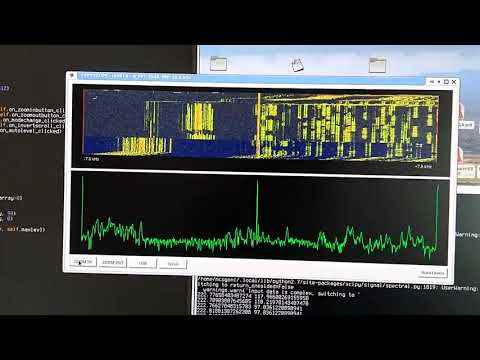
Over on GitHub user mcogoni (Marco/IS0KYB) has recently released a new program called Pepyscope. Pepyscope is a simple and fast panadapter application that is designed to be used with direct sampling capable RTL-SDR's such as our RTL-SDR Blog V3 units. Like other panadapters you simply connect the IF output from the hardware HF radio into the input of the RTL-SDR. Then Pepyscope gives you a waterfall display that helps users to easily visualize the spectrum.
Pepyscope is open source and runs on Linux PCs. So far Marco has tested Pepyscope with a KENWOOD TS-180S (single conversion with IF at 8.83 MHz) and an RTL-SDR v3. He has also uploaded a demonstration video on YouTube.
The SDRplay team have posted some more videos that demonstrate the SDRplay Duo's diversity function. The SDRplay RSPDuo is a 14-bit dual tuner software defined radio capable of tuning between 1 kHz - 2 GHz. It's defining feature is that it has two receivers in one radio, which allows us to combine the signal from two antenna together.
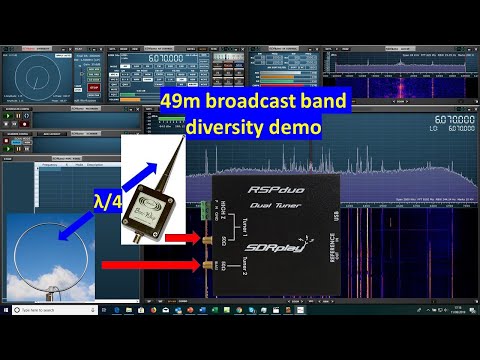
In the video Jon uses a Wellbrook Magnetic Loop antenna and a Bonito Miniwhip antenna both connected to the RSP Duo. Individually each antenna receives the signal relatively poorly and fades in and out as conditions and signal reflections fluctuate. However, with diversity enabled the SNR is improved and fading is significantly reduced.
The method they use to combine signals is a relatively simple method called maximum-ratio combining (MRC). The idea is that the two signal channels are added together, with the currently stronger and less noisy channel having increased gain. So while the signal levels fluctuate, as long as one antenna can receive the signal you will see no fading.
SDRplay HF Diversity Demo
SDRplay note that the key to a good setup is to have the antennas spaced out at a quarter wavelength of the signal frequency that you are receiving. In a second video they show how to properly set up an antenna system for proper HF diversity receiving.
This video demonstrates how SDRuno diversity and the RSPduo can bring enhanced reception at HF using 2 antennas separated by approximately a quarter wavelength. It uses the the current version of SDRuno (V 1.32) and the dual tuner RSPduo SDR from SDRplay.
In this experiment we had a wire dipole with one leg approximately a quarter wavelength from a Boniwhip vertical - both were picking up similar strength signals before going into "diversity" (max ratio combination) mode.
The benefits of diversity tuning at HF are very dependent on many variables, most notably the changing nature of the reflected signal path and the degree to which noise and unwanted signals are not as coherent as the wanted signal.
Antenna and SDRplay set-up for HF diversity reception (rev1)
Over on YouTube Tech Minds has posted a video of him using an Airspy HF+ Discovery to hunt for signals like non-direction beacons (NDB's) and other morse code CW beacons. The Airspy HF+ Discovery is a new software defined radio that builds upon the already excellent original Airspy HF+.
One key improvement that many people have been experimenting with is it's improved VLF and LF capabilities, which is where most beacons are. It is capable of tuning down to 0.5 kHz (500 Hz). Over on Twitter, @prog (creator of these Airspy products) has been experimenting with simple and small ferrite loop antennas for VLF/LF and finding excellent results due to the low noise figure and good impedance matching of the HF+ Discovery.
Hunting LF/MF/HF Beacons With An Airspy HF+ Discovery
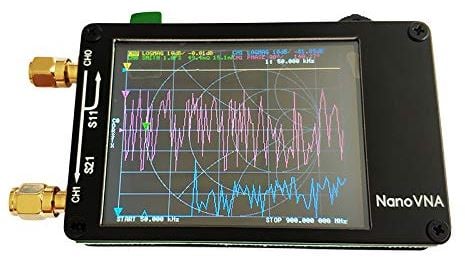
A vector network analyzer (VNA) is an instrument that can be used to measure antenna or coax parameters such as SWR, impedance and loss. It can also be used to characterize and tune filters. It is a very useful tool to have if you are building and tuning home made antennas, filters or other RF circuits. For example if you are building a QFH or ADS-B antenna to use with an RTL-SDR, a VNA can help ensure that your antenna is properly tuned to the correct frequency. Compared to a standard SWR or network analyzer a VNA supplies you with phase information as well.
Until just recently, VNA's have cost roughly US$500 for a decent USB PC based unit like the miniVNA or PocketVNA, and have set people back thousands to tens of thousands of dollars for bench top units.
However, the cost of owning a VNA has now been reduced to only US$50 thanks to the NanoVNA. The open source NanoVNA project by @edy555 and ttrftech has been around since 2016, but only recently have Chinese sellers begun mass producing the unit and selling them on sites like Aliexpress, eBay and now Amazon. We note that it seems that there are some sellers selling them without shielding, so it might be worth double checking the listing to see if they mention that. All the listings we've seen seem to come with simple calibration kits as well.
The NanoVNA: A $50 Vector Network Analyzer
The NanoVNA is a small credit card sized VNA. It has a built in LCD screen that can be used to display graphs directly, or it can also be connected to a PC and the graphs viewed via the NanoVNA Windows software. When purchasing you can opt to include a small battery for portable operation for a few dollars extra. The frequency range is from 50 kHz to 900 MHz, although you should note that above 300 MHz dynamic range performance is reduced.
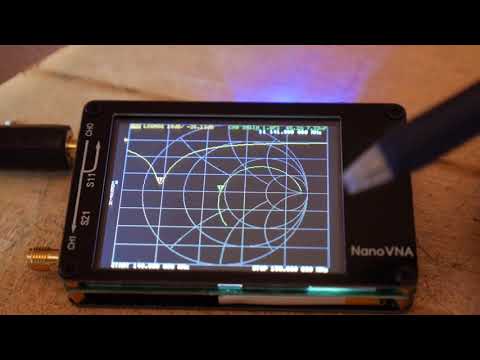
Over on YouTube several hams and radio enthusiasts have recently uploaded videos demonstrating and reviewing the NanoVNA. The overall consensus is that the unit is accurate and works well. For additional support there is forum available at Groups.IO.
Below YouTube user IMSAI Guy reviews the NanoVNA. Check out IMSAI Guy's other videos too as he has several where he tests the NanoVNA on difference filters and antennas, and checks the accuracy.
#350 NanoVNA Vector Network analyzer 900MHz VNA for $50
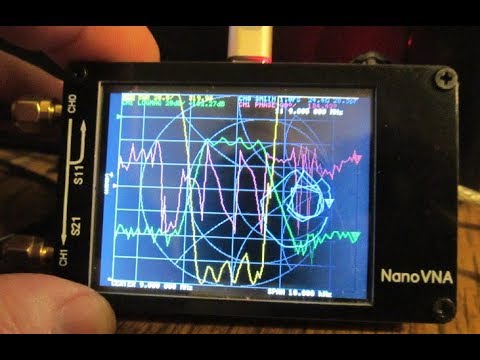
Below is YouTube user joe smith's review. He also has two other NanoVNA videos on his channel where he shows how to use the NanoVNA to measure antenna impedance, and how to use the NanoVNA to create SPICE models for simulation.
The NanoVNA, a beginners guide to the Vector Network Analyzer
Finally YouTube user Oli gives another overview. Please note that the following video is in Polish, but YouTube captions can be set to English.
NanoVNA - omówienie, kalibracja, pomiar anteny i filtra [english subtitles]
We've also seen several recent text reviews:
NanoVNA - A short review. In this review nuclearrambo shows off the calibration kit, and shows a practical measurements of a directional coupler and 137 MHz QFH antenna.
The NanoVNA, a real VNA at less than 48 €!. A review written in French, but Google Translate can be used. In this review David Alloza compares the NanoVNA against an Agilent E5062A benchtop VNA, and results look comparable.
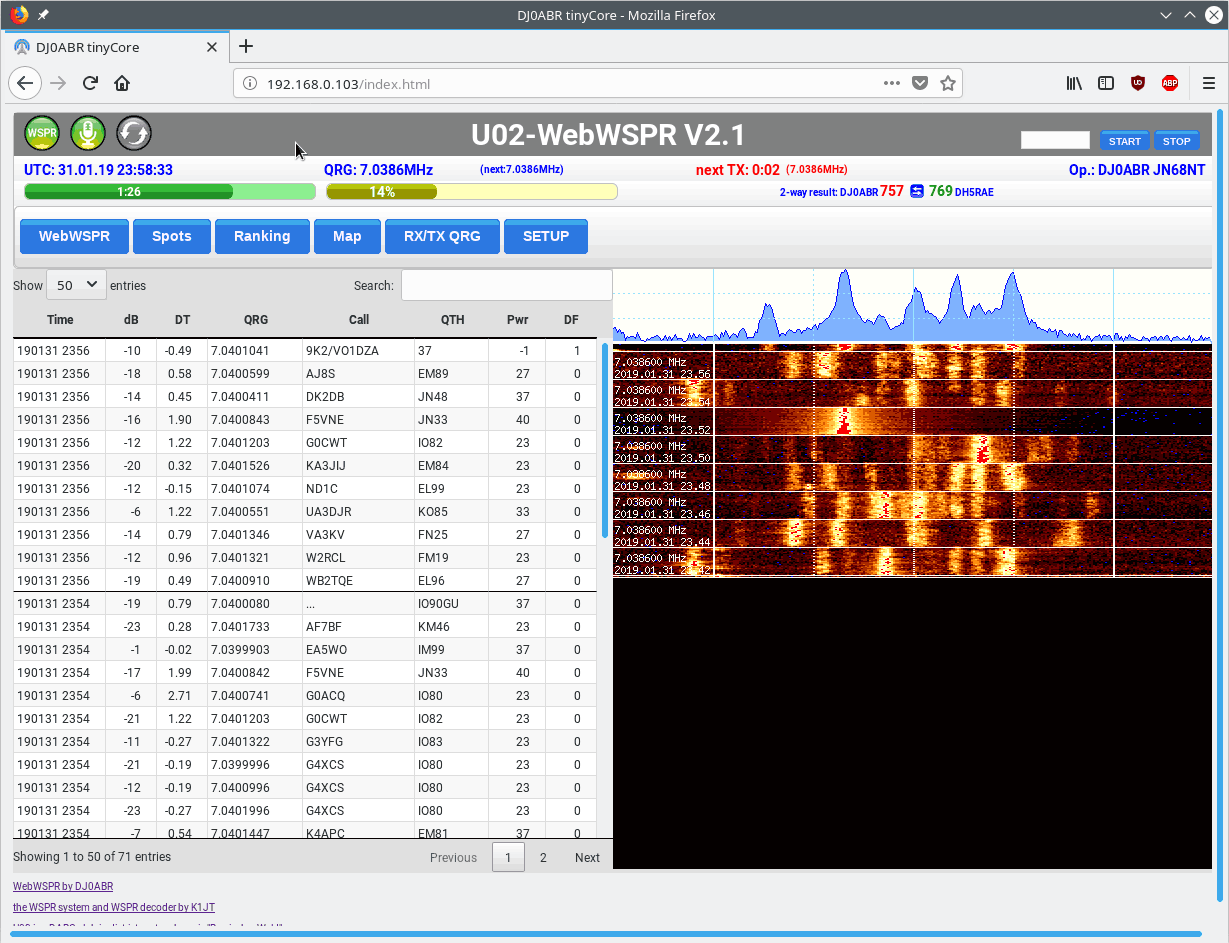
A few days ago we posted about [dj0abr / Radio Electronics'] WebSDR software for QO-100. Having looked through his GitHub we've seen that he also has an a similar browser based server tool called WebWSPR for WSPR decoding and visualization (click with WebWSPR link) which was released earlier this year.
WSPR is an amateur radio digital HF mode designed to be decodable even if the signal is transmitted with very low power and is very weak. It can be used to help determine HF radio propagation conditions as WSPR reception reports are typically automatically uploaded to wsprnet. In the past we have been able to receive WSPR and similar modes like FT8 with our RTL-SDR V3 running in direct sampling mode.
Like his QO-100 WebSDR software, WebWSPR is designed to run on a single board computer like a Raspberry Pi or any Linux machine. It serves a web page that shows the WSPR waterfall, decoded data and has various WSPR related control options. The web page can be accessed remotely from any machine on the same network as the server, or could be put on the internet with port forwarding and a hostname service like noip.
A ready to use Raspberry Pi image for WebWSPR is available here (does not seem to support the latest Pi4 or 3B+ however). Manual installation instructions can be found here. The code is all open source and available on GitHub.
The software appears to take input from the soundcard for standard hardware receivers, but it should be possible to pipe audio from an RTL-SDR into pulseaudio, which the software can then use. The instructions from our RTL-SDR V3 WSJT-X tutorial may help.
The Airspy HF+ Discovery is a smaller, lighter and improved version of the Airspy HF+ which is an HF and VHF SDR with very high dynamic range. The Discovery builds on the HF+ by adding low loss preselectors. This increases the dynamic range even further, and allows the Discovery to compete with some very high end (and much more expensive) SDRs.
Currently the Airspy HF+ Discovery is available for preorder for USD$169. There have been a few delays in getting the unit out, but it appears that the Airspy team will begin shipping very soon.
In the review Fenu-Radio compares the Discovery against the G33DDC and finds absolutely no difference in performance between the two. In the review he's also uploaded several audio comparison samples so that you can hear for yourself how identical the two radios are.
Over on YouTube Corrosive from the SignalsEverywhere channel has uploaded a new video showing us how you can make a DIY upconverter using a HackRF as a signal source and a cheap $10 RF Mixer. An upconverter converts lower frequencies into higher frequencies. For example, an upconverter is commonly used to convert HF signals into VHF, so that VHF/UHF only SDRs can receive HF.
In the video he uses the HackRF as a local oscillator source, a cheap RF mixer on a breakout board, and an Airspy as the receiver. In most circumstances if you needed and upconverter you'd just purchase one like the Ham-it-up, or the Spyverter for ~$40. However the interesting advantage of using a versatile signal generator like the HackRF is that it results in an upconverter that can upconvert HF to almost any frequency. Even without any filtering (which is recommended to remove signal images), Corrosive fings that he has excellent HF reception.
This video is an excellent way to learn about how upconverters work.
HackRF and RF Mixer = DIY RTL SDR Up-converter | Basics of the Passive ADE Mixer
The LimeRFE is a power amplifier and filter bank solution designed for the low cost TX capable LimeSDR software defined radios. It has multiple bands from HF all the way up to 3.5 GHz, and is capable of putting out about 2W on the HF bands. Currently LimeRFE is crowdfunding over on CrowdSupply with a cost of US$599 or alternatively there is now a cheaper unit for US$449 without support for the cellular bands. The campaign is active for 4 more days from the time of this post, and after that the price is due to rise by another US$100.
The team at LimeMicro sent a unit to Daniel Estévez (EA4GPZ) for testing, and he has recently posted about his results and thoughts when using the LimeRFE for WSPR transmission with a 15m long wire antenna. Daniel connected his LimeRFE to his LimeSDR and used WSJT-X piped into SDRAngel via Pulseaudio to transmit WSPR on the 10m band. He notes that for lower bands, the LimeRFE will still need additional low pass filtering to attenuate harmonics. SDRAngel cannot yet control the LimeRFE so he also created a simple Python script for this purpose.
Unfortunately Daniel's unit only achieved 25dBm instead of the advertised 33dB, but in LimeMicro's post they note that they believe that this is due to shipping damage. However, even with only 0.3W power, Daniel's transmissions from Madrid were able to be picked up in the Canary Islands, Netherlands and Northern England.

![NanoVNA - omówienie, kalibracja, pomiar anteny i filtra [english subtitles]](https://www.rtl-sdr.com/wp-content/plugins/wp-youtube-lyte/lyteCache.php?origThumbUrl=https%3A%2F%2Fi.ytimg.com%2Fvi%2FLbQDIMavIDc%2F0.jpg)