Category: HF

An Active Low Cost HF Loop Antenna Made in the UK

Cross Country Wireless is a UK based company that has created an active HF loop antenna for only $70 USD including international shipping. The loop appears to have already been for sale for a while now, but recently they've created a new version that can be easily powered by a 5V bias tee with at least a 67 mA current capacity. This makes it very easy to use with radios that have built in bias tee's such as our RTL-SDR Blog V3 and SDRplay and Airspy units. The page reads:

The Loop Antenna Amplifier contains all the electronics needed for home DIY construction of an active loop (magnetic loop) low noise receiving antenna.

The amplifier consists of two units, a weatherproofed outdoor unit for connection to a suitable loop and a base unit to further amplify the signal and to provide DC power up the coaxial cable to the outdoor unit.

The outdoor unit is housed in a polycarbonate box with stainless steel antenna connections and a BNC socket. The indoor unit is a PCB with two BNC connectors and a USB socket to take 5V from a USB socket on a PC or phone charger.

Like our other active antenna products it has RF overload protection to allow it to be used very close to transmit antennas without damaging the amplifier or the attached receiver.

The loop depends on what the user has available. We have tested it with simple wire loops or deltas, coax loops and an alloy loop made from a bicycle wheel rim. We supply a 3m (10 ft) length of wire as a simple loop to make a first loop for testing.

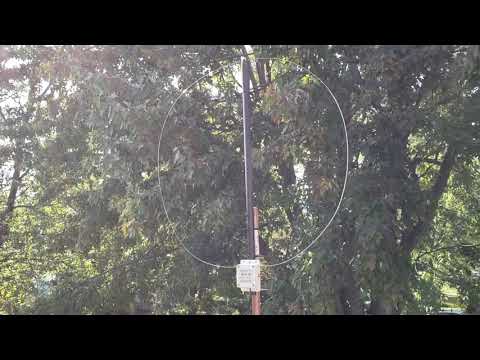
The photograph on the right shows the prototype with a 1m diameter loop of LDF4-50 coax cable as a test loop.

With a simple wire loop or delta and a small USB powerbank it makes a very compact and portable receiving antenna for holiday listening or covert use.

The latest version can now have the head unit powered directly from receivers with a 5V bias-tee such as the SDRplay receivers or some RTL-SDR dongle receivers with a bias-tee option.

Specifications:

  • Frequency range: 10 kHz to 30 MHz
  • Loop amplifier input impedance: 0.3 ohms
  • Output impedance: 50 ohms
  • Supply voltage: 5 V from USB socket or charger
  • Supply current (head and base unit): 112 mA
  • Supply current (head unit fed with 5V bias-tee): 67 mA
  • Loop antenna outdoor unit connectors: Two M6 stainless steel threaded studs and BNC female (RF out 50 ohms)

There is no comparison yet that we've seen on how this loop compares against the cheaper US$45 Chinese made MLA-30 loop. In a previous post Martin (G8JNJ) reviewed the MLA-30 and noted several design flaws after reverse engineering the circuit. He has let us know that he will also be reviewing the Cross Country Wireless Active Loop and will let us know his thoughts in the future.
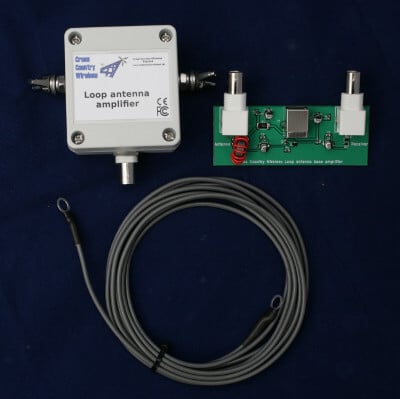
Cross Country Wireless Loop
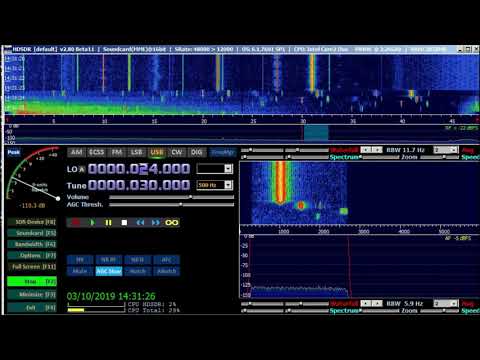
Cross Country Wireless Loop Antenna Amplifier VLF test with 1m diameter coax loop

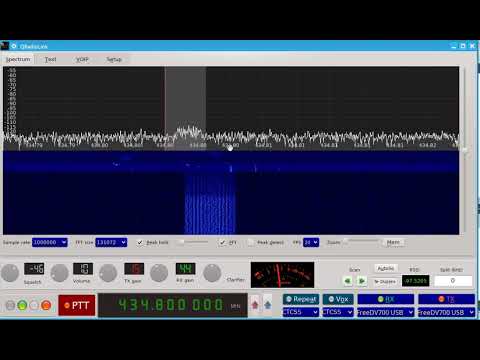
Using a PlutoSDR to compare FreeDV Digital Voice with other Modes

Over on YouTube user Adrian M has uploaded a video where he compares the HF amateur radio digital voice mode known as FreeDV against other common voice modes such as USB, AM, FM and QPSK. To perform the test he uses a PlutoSDR, a GNU Radio program and a GUI called qradiolink.

FreeDV is an open source amateur radio digital voice mode that uses Codec2 compression. It's designed to compress human voice and works with narrow bandwidths and with weak signal power.

In the demonstration Adrian reduces the TX power slowly for each mode, so you can see what the voice sounds like at high and low signal power. The FreeDV mode is not high fidelity in terms of audio quality, but the voice remains able to be copied at low power when the other modes could not.

Transmit and receive FreeDV 1600 and 700C with SDR hardware

G8JNJ Reverse Engineers and Reviews the MLA-30 HF Loop Antenna

Last month we posted a collection of reviews about the MLA-30 which is a budget magnetic loop antenna designed for receiving HF signals. The overall consensus from the reviews was that it worked decently for the price, but of course could never live up to the high end loops that cost hundreds of dollars.

Recently Martin (G8JNJ) reverse engineered the active circuit used on the loop from photos taken by M0LMK and has made some observations on it's performance, noting that it's design isn't very good. First he notes that the amplifier chip is a Texas TL592B two stage video amplifier which isn't that great for this application. His measurements show an OIP3 of 20dBm, a P1 saturation of -3dBm and a noise figure of 12dB.

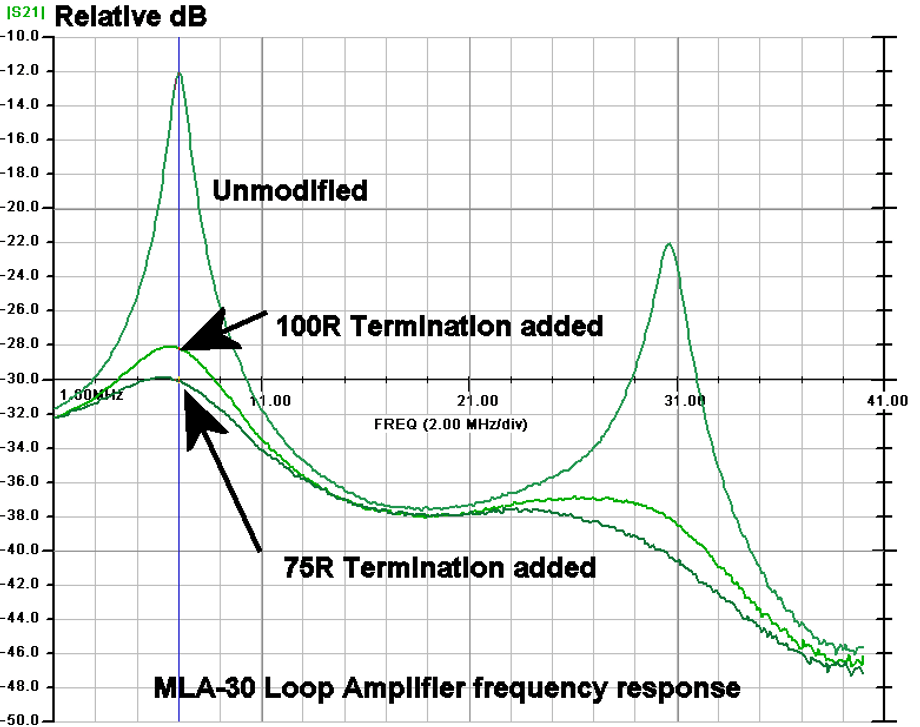
Of interest, he explains that the creator of this loop has designed it poorly as the impedance match of the loop to low pass filter is very wrong, resulting in a very poor amplitude/frequency response. He shows how the response can be improved with a few termination resistors, but is still not great.

MLA-30 Frequency Response. Ideally should be flat.

If you're interested in a cheap magnetic loop antenna, Martin suggests DIYing the M0AYF design which he says works a lot better.

We note that the "YouLoop" design is also in the works as a product that will apparently sell at close to manufacturing cost. The YouLoop is a passive loop idea by the creator of the Airspy that consists only of a simple 1:1 transformer and coax cable as the loop. It works best with high sensitivity radios like the HF+ Discovery.

Reviews of the Low Cost MLA-30 Wide Band HF Magnetic Loop Antenna

Recently Chinese manufacturers have begun producing a low cost wide band (100 kHz - 30 MHz) magnetic loop HF antenna known as the MLA-30. The loop can be found on eBay for under US$45 with free shipping. In the past wide band HF loop antennas have not been cheap, normally costing $300+ dollars from manufacturers like Wellbrook.

RF signals are electromagnetic waves that consist of an electric and magnetic component.  A magnetic loop antenna mostly receives the magnetic portion of the wave. This is useful as most unwanted interference from modern electronic devices is generated in the electric component only.  So, a magnetic loop antenna may be preferable in city and suburban environments over other antennas like wires and miniwhips. Magnetic loops are also directional, and can be rotated to avoid interference.

One of the biggest costs to a magnetic loop antenna is the shipping, because a large hula hoop sized piece of metal needs to be sent. The MLA-30 cuts costs on shipping by providing a folded up thin loop wire and no physical support for the loop. You are expected to provide your own support, or simply hang the loop wire on something. If you like you can also replace the included loop wire with a larger loop.

The MLA-30 comes with 10m of RG174 coax, is bias tee powered, and comes as a set with a bias tee injector that is powered over 5V USB. We tested our own unit with the RTL-SDR Blog V3, Airspy and SDRplay bias tee's and found that they all worked well instead of the included bias tee. So if you have one of those SDRs using the loop is as simple and neat as plugging it in and turning on the bias tee.

In terms of build quality, the unit is sturdy and the PCB is fully potted and protected against rain/weather. It is yet to be seen how the external screw terminals holding on the loop will age over a longer period of time however.

So how does the very cheap MLA-30 compare to higher end magnetic loop antennas? Below are some reviews by various hams and SWLs. The general consensus is that it works well for the price, but as you'd expect, falters on handling very strong signals and produces a higher noise floor compared to the more expensive loops, especially in the higher HF bands. But overall we'd say that it's probably still better than using a miniwhip, especially in suburban/city environments, and is probably the best compact HF antenna that you can get on a budget.

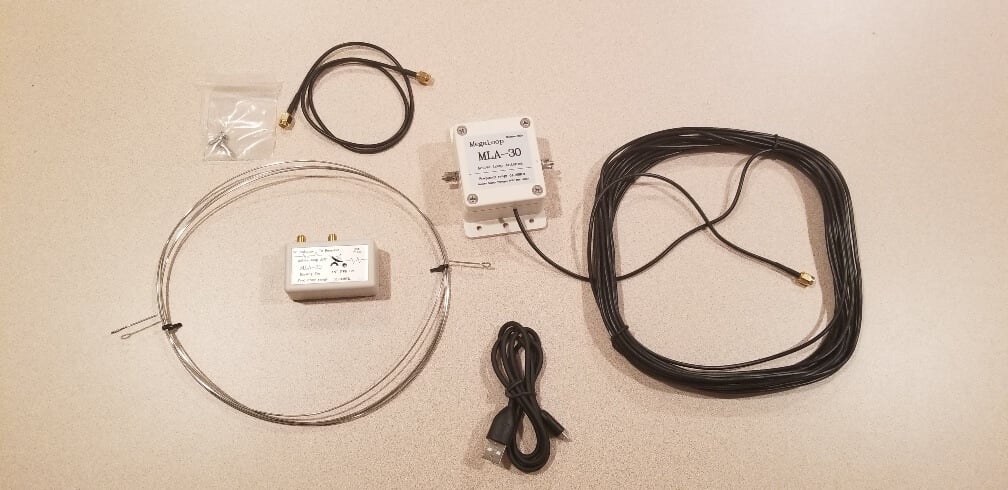
What's included in the MLA-30 set. Photo from David Day's Review.

MLA-30 Magnetic Loop Antenna Review and Comparison by David Day (N1DAY)

In this review David compares the MLA-30 against a 30-ft ground loop and a Wellbrook ALA1530-LF. His results show that while the loop is capable of receiving the same signals that the two comparison loops can, the SNR is much lower. He also notes that the much thinner loop wire used on the MLA-30 seems to result in a much deeper null, and that IMD was a problem for him.

Inside the MLA-30 Active Loop Antenna by Matt (M0LMK)

This post is a complete teardown of the antenna. As the PCB is fully potted Matt had to boil down the epoxy in order to get to the actual PCB. He notes that the PCB is a simple single amplifier design with the exposed pot working as a gain control.

Cheap Chinese Magnetic Loop Antenna (MegaLoop aka MAGALoop) MLA-30 by John

In this review John compares the MLA-30 against a $345 W6LVP and Wellbrook ALA1530LN. His findings are very favorable concluding that it is an adequate performer, perfect for cash strapped SWLs.

First hour battle of the antennas W6LVP loop VS MLA 30 loop test by OfficialSWLchannel

This is a YouTube video where OfficialSWLchannel compares his MLA-30 against a W6LVP loop. He notes that his initial testing shows that the MLA-30 performs as well as the W6LVP loop.

First hour battle of the antennas W6LVP loop VS MLA 30 loop test

MLA-30 Loop vs 80M EFHW by Matthew Payne

In this YouTube video Matthew compares his MLA-30 against a 80M end fed halfwave antenna with an SDRplay RSP1a. 

MLA-30 Magnetic Loop Modifications by Scanner and Sdr Radio

In this video the Scanner and Sdr Radio YouTube channel uses an RSPduo to compare the MLA-30 against a Wellbrook loop. His results show that the MLA-30 definitely has a higher noise floor compared to the Wellbrook, but still receives signals decently although chasing weak signals it's not good enough. He also shows how to improve the MLA-30 by replacing the cheap coax that it comes with, noting that the modification reduced his noise.

MLA-30 Magnetic Loop Modifications


WWV and WWVH Special Messages to Broadcast!

Starting from Monday September 16th and continuing through to October 1st, both WWV and WWVH shortwave time signal transmission stations will broadcast a special message from the Department of Defense to mark the centennial of WWV. These messages will be heard on 2.5, 5, 10, and 15 MHz. In addition from September 28 to October 2 a special WWV event will occur:

The world’s oldest radio station, WWV, turns 100 years on October 1, 2019, and we are celebrating!

From September 28 through October 2, 2019, the Northern Colorado ARC and WWV ARC, along with help from RMHam, FCCW, and operators from across the country, are planning 24-hour operations of special event station WW0WWV on CW, SSB and digital modes. Operations will shift between HF bands following normal propagation changes and will include 160m and 6m meteor scatter. We will be operating right at the WWV site and face a challenging RF environment.

WWV is a [NIST] operated HF station based in Fort Collins, Colorado. It continuously broadcasts a continuous Universal Coordinated Time signal in addition to occasional voice announcements. It has been on the air since 1919 but began continuous broadcasts in 1945 from it’s final site in Fort Collins, Colorado. WWVH is a similar time signal, but based in Hawaii.

The WWV Transmit Building

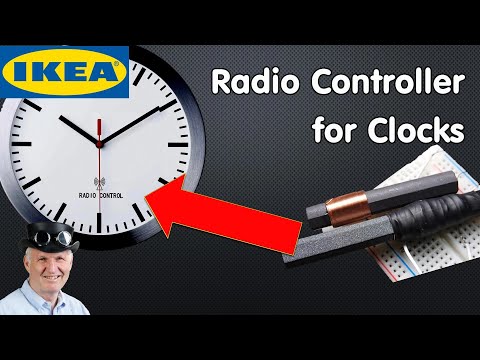
The WWV time signal can be used to automatically set RF enabled clocks to the correct time. [Andreas Spiess] on YouTube recently uploaded a video where he emulates this signal in order to control clocks within his home. This is a great watch if you’d like to learn more about how these time signals work.

The time format itself is actually pretty simple and it’s possible to emulate with a number of devices from an Arduino to Raspberry Pi and of course Software Defined Radio.

#287 Remote Controller for Clocks (IKEA and others, DCF77, WWVB, MSF, JJY)

Testing Version Two of the NooElec Balun One Nine

Over on YouTube two reviewers have just uploaded videos showing off version two of the NooElec Balun One Nine. Version one of the Balun One Nine is a balun transformer that can be used with long wire and untuned dipole HF antennas to match the impedance with a 50 Ohm SDR. Matching the impedance results in better HF reception and less noise. While it is a balun and hence designed for balanced antennas like a dipole, it is possible to convert it into an unun for long wire antennas by cutting a trace.

In the first video Corrosive from SignalsEverywhere compares version one with version two. He notes that the new Balun uses a higher quality Coilcraft component, a more sturdy terminal connector and includes mounting holes. He notes that the power rating of the balun should also allow for low power transmission. However, when comparing the two in reception there is little difference in actual results between version one and two. 

In the second video TechMinds provides a similar video and also shows the enclosure that they will be providing in a premium version.

Nooelec 9:1 HF Balun Version 2?

9:1 Balun Version 2 From NooElec

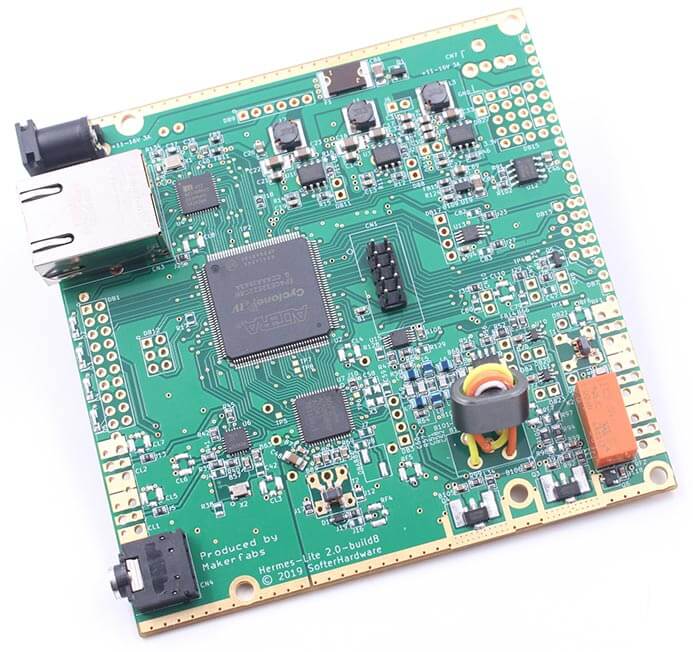
Hermes Lite 2 HF Amateur Radio SDR Group Buy Now Active

The Hermes Lite 2 (HL2) amateur radio direct sampling HF SDR transceiver board is now active for a group buy over on Makerfabs. The price is $225.70, and there need to be 25 orders before the group buy is confirmed. If confirmed, production will begin on 23 September, with production estimated to take about one month. More information about the group buy available on the Hermes Lite 2 Wiki. The N2ADR filter board for transmitting with the HL2 is also available on Makerfabs for $52.70.

The HPSDR Hermes SDR is an open source amateur radio SDR transceiver project that was released as far back as 2011. More recently Steve Haynal has been working on a Hermes-Lite project which is intended to be an opensource open hardware low cost amateur radio HF transceiver that is based on the HPSDR Hermes SDR project software and FPGA DSP implementation.

The Hermes-Lite is able to be very low cost because at it's core is the AD9866 chip which is a mass produced RF front end (LNA + ADC & DAC) that is commonly used in cable modems. Because it is a mass produced commodity, the chip only costs approx. US$35-$25 on Mouser depending on quantity. The chip has a 12-bit 80 MHz ADC and DAC, meaning that if used without any analog mixer front end (like in the Hermes-Lite) it can receive the entire spectrum between 0.1 to 38 MHz all at once.

The Hermes-Lite is also a lot more than just the RF chip, as it contains a set of switched RF filters and a 5W power amplifier for TX. It also interfaces with a PC via Ethernet and has a built in FPGA for DSP processing.

The Hermes Lite 2 PCB

Cleanly Embedding an RTL-SDR in an FT-991A With No Extra Cables

GPIO Pins Used on the RTL-SDR Blog V3

Thank you to Rodrigo Freire (PY2RAF) for submitting his project that has cleanly turned a standard Yaesu FT-991A ham radio into an RTL-SDR based software defined radio panadapter with no external wires, hubs or dongles.

Rodrigo's system consists of an IF tap amplifier+filter board that is connected to an internally mounted RTL-SDR. The RTL-SDR is internally connected to the FT-991A's USB hub which had to be upgraded from a 2-port hub to a 4-port hub as the 2-ports were already in use by the CAT and Audio features. This required the stock USB hub IC to be replaced with a hot air rework station.

Everything is mounted inside the radio chassis itself, and the end result is a neat solution with no external wires, hubs or dongles that has essentially turned the FT-991A into an SDR. Plugging in the single stock USB cable from the FT-991A results in the standard CAT and Audio interfaces showing up, as well as the RTL-SDR.

What's also interesting is that Rodrigo makes use of the GPIO pins on our RTL-SDR Blog V3 to enable the RX_EN, BPF and BYPASS switches on the IF tap board. This allows for a cleaner solution as no external switches need to be installed.

The entire project is open source with schematics and the BOM provided over on the GitHub, and excellent documentation is available on the project's Wiki.

FT991A Converted into an SDR.
Turning FT-991A to a REAL SDR: Embedding a SDR Panadapter INSIDE the radio, no extra wires!