Category: HF

NooElec Releases the Ham-It-Up Nano HF Upconverter

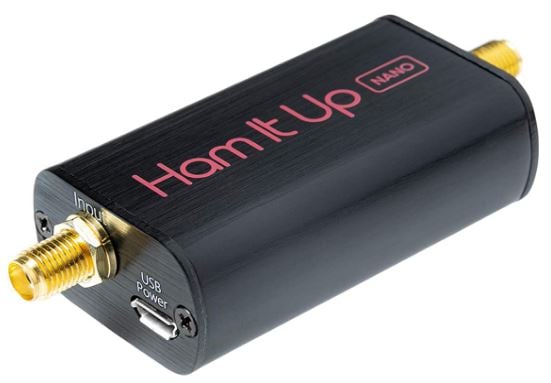
Today NooElec have released a new product called the "Ham-it-up Nano" for US$49.95 on their store and Amazon. The original Ham-it-up is an HF upconverter that enables reception of the HF bands with SDRs that do not natively support HF. Upconverters work by shifting these low HF frequencies "up" into a range receivable by most VHF/UHF capable SDRs.

The new nano version is much smaller than the original design and about $15 cheaper if you compare against the version with metal case. The nano can also be powered directly via bias tee capable SDRs, so no external power source is required. Compared to the original version the nano misses out on the pass through switch and bonus noise source circuit.

The Ham-it-up Nano probably most directly competes with the SpyVerter from Airspy, which is another small form factor and bias tee powered upconverter for US$49.00. Spec-wise, the SpyVerter appears to remain superior with better LF/VLF support, less conversion loss and it's ability to use a 10 MHz external reference clock for advanced users. But the Ham-It-Up Nano is designed and made in the USA vs designed in France and made in China for the SpyVerter. The nano may also be a little cheaper and faster in terms of shipping to obtain via Amazon.

Below is a table comparing the advertised specifications with specs taken from the Ham-it-up Nano datasheet and SpyVerter sales page. Overall, most HF dabblers probably won't notice a major difference between the two unless you are truly setting up HF DX antennas. And as always our advice is if you are heavily interested in HF and DX, then it may be wiser to spend a little more and get yourself an Airspy HF+ Discovery (US$169) or an SDRplay RSP1A (US$109) or RSPdx (US$199.95) instead of an RTL-SDR + upconverter (US$20 + US$50 = $70).

Spec Ham-It-Up Nano SpyVerter
Frequency Range 100 kHz - 65 MHz 1 kHz - 60 MHz
Conversion Loss 10dB (typ) 5.2 dB (typ)
LO Frequency 125 MHz 120 MHz
IIP3 Not Specified 35 dBm
Max Input Power 1 dBm 10 dBm
Operating Voltage 4 V - 5.5 V 4.2 V - 5.5 V
Current Consumption 65 mA (typ) 10 mA (typ)
Power Methods Bias Tee, microUSB, Pin Header Bias Tee, microUSB
LO Stability 0.5 PPM 0.5 PPM
10 MHz External LO Capable? No Yes
Input Return Loss -10 dB (max) -10 dB (max)
Output Return Loss -10 dB (max) -10 dB (max)
Phase Noise @ 10kHz Not Specified -122 dBc/Hz
Dimensions 2.0" x 1.2" x 0.75" (50 x 30 x 18mm) 2.1" x 1.6" x 1" (53 x 40 x 25 mm)
Weight 45g 108g
Design & Manufacture Country Designed and Made USA & Canada Designed in France, Made in China
Price US$49.95 + shipping (free US shipping on Amazon) US$49.00 + shipping (~US$5 to US, or US$10 via US reseller)
The Ham-it-up Nano
The Ham-it-up Nano

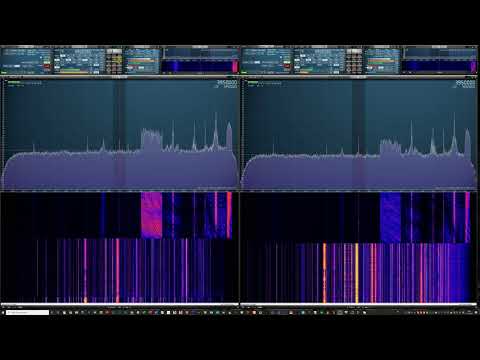
Demonstrating Solar Inverter Noise Cancelling with a Timewave ANC-4 and Airspy HF+

At his house W1VLF found that his solar inverter was causing huge amounts of interference on the HF bands, essentially making any hope at receiving shortwave or amateur radio signals impossible on his Airspy HF+ Discovery . However, over on his YouTube channel he's demonstrated a solution that allows him to almost completely cancel the noise.

The solution involves using a Timewave ANC-4 noise canceler, which is as analog noise cancelling device available from the manufacturer for US$209.95. To use the device you also need a noise probe which can be a small loop antenna. The noise probe is connected to the ANC-4 and placed near the source of the noise, which in W1VLF's case was just on the solar inverter enclosure mounted on the outside of his house. Then by tuning the gain and phase knobs on the ANC-4 the noise can be cancelled out of the signals received by the main antenna. 

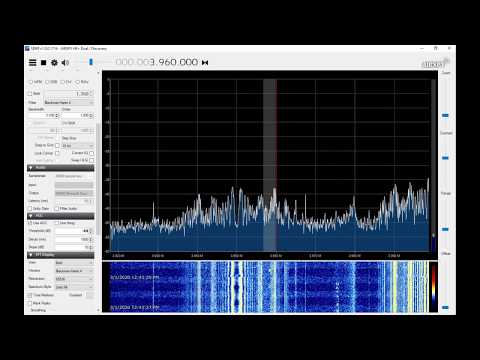
In the video W1VLF demonstrates how effective noise cancelling with the ANC-4 can be by showing the before and after results with his Airspy HF+ Discovery.

Kicking Solar inverter noise in the A$$ with noise cancelling

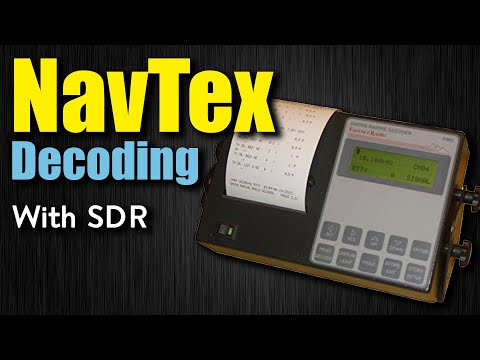
Decoding NavTex with an SDRplay RSPDx, SDRUno and YanD

Over on YouTube TechMinds has uploaded a new video explaining NavTex and showing how to decode it with an HF capable SDR like the SDRplay RSPDx. NavTex is a marine digital data radio service designed for transmitting information like navigational and meteorological warnings, weather forecasts and maritime safety information. It is broadcast in either the MW frequency band at 490 kHz and 518 kHz or in the HF band at 4209.5 kHz.

In the video TechMinds uses a guide put out by Mike Ladd from SDRplay (pdf warning). The guide explains how to connect SDRuno to a NavTex decoder called YanD via a virtual audio cable. The rest of the video shows a NavTex message being decoded, some sample messages, and a closer look at YanD. 

Even if you don't use an SDRplay, the guide could be adapted for other SDRs too.

Decoding NavTex with Software Defined Radio - SDRuno RSPdx

Using an RTL-SDR Blog V3 in Direct Sampling Mode to Receive HF DRM on an Android Phone

Over on the SWLing blog contributor Dan Van Hoy wrote in and shared a report on how he's successfully been able to receive HF DRM 30 digital audio with an RTL-SDR Blog V3 dongle running in direct sampling mode on an Android phone.

To do this he used an Android app called "DRM+SDR Receiver" which is available for US$4.99 on the Play store. The app supports RTL-SDR and HackRF devices. So all you need to do is set the RTL-SDR Android driver to run in Q-branch direct sampling mode, then tune to a DRM signal for it to begin decoding.

A demonstration video uploaded to his Google drive account shows clean decoding of the DRM AAC audio, as well as the app displaying Journaline and live metadata. He notes that his signal was very strong, so he only required a short wire, but DXers would need an appropriate antenna.

DRM Received on an Android phone with an RTL-SDR Blog V3 running in direct sampling mode.

KiwiSDR Now Supports DRM Decoding

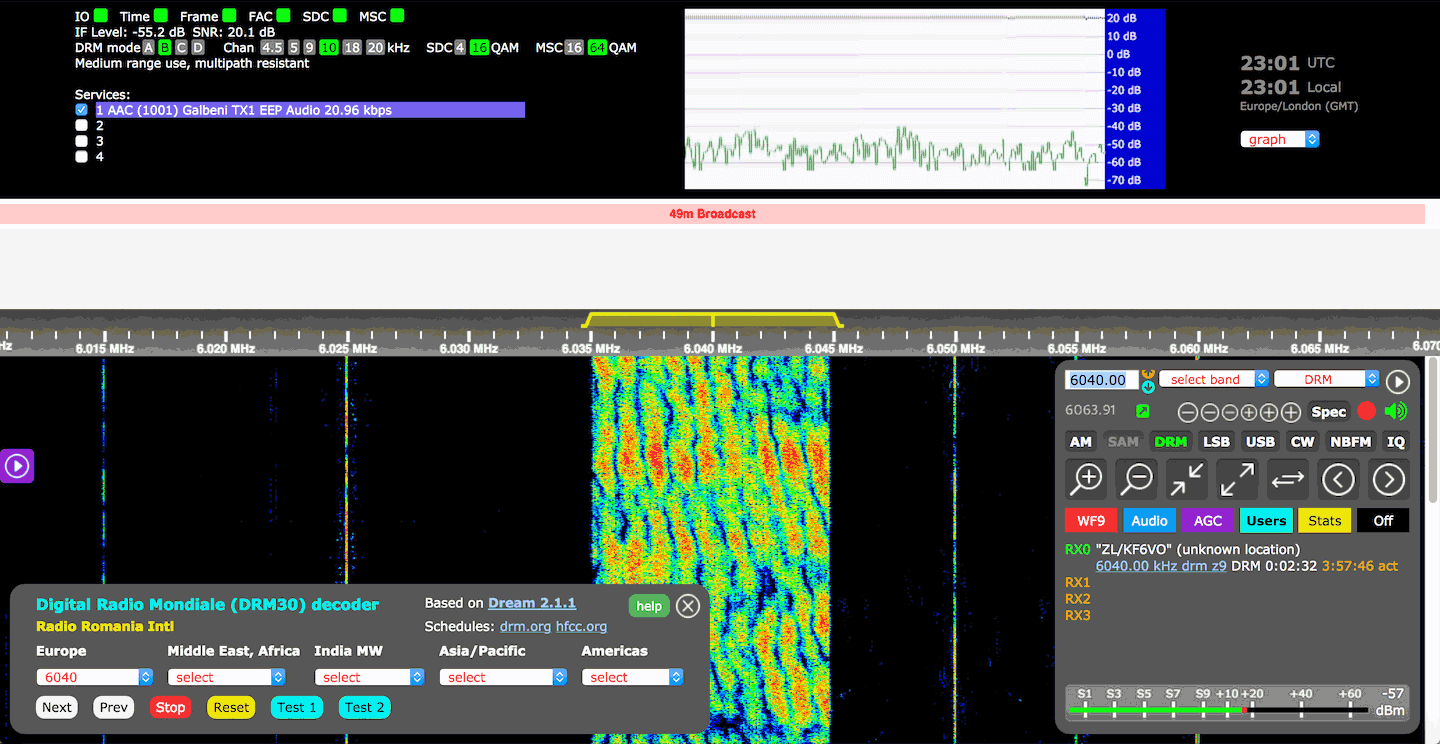
KiwiSDR have recently implemented DRM decoding into their OpenWebRX implementation. Digital Radio Mondiale (DRM) is a type of digital shortwave radio signal that is used by some international shortwave radio broadcasters. It provides superior audio quality compared to AM stations thanks to digital audio encoding.

The KiwiSDR is a US$299 HF SDR that can monitor the entire 0 - 30 MHz band at once. It is designed to be web-based and shared, meaning that the KiwiSDR owner, or anyone that they've given access to can tune and listen to it via a web browser over the internet. Many public KiwiSDRs can be found and browsed from the list at sdr.hu.

The new DRM implementation is based on DREAM 2.1.1 which is an opensource DRM decoder that can be used with any HF capable SDR. Due to computational limits of the BeagleBone singleboard computer which the KiwiSDR runs on, only one DRM channel can be decoded at any one time, restricting this capability to only one user at a time. However, if the KiwiSDR is running on the newer BeagleBone AI, it can support up to four DRM channels. KiwiSDR write that work is still ongoing to improve the code, so this situation may improve in the future.

KiwiSDR Decoding DRM

Decoding Differential GPS (DGPS) with an RSPdx and MultiPSK

Over on YouTube the TechMinds channel has uploaded a new video about decoding Differential GPS (DGPS) using an SDRplay RSPdx SDR. DGPS is a terrestrially transmitted long wave signal that is used to help correct and improve GPS position data calculations which may have timing errors due to atmospheric propagation delays. It works by broadcasting correction data calculated by the difference in received GPS location and the known location of the DGPS transmission site. DGPS is typically transmitted on longwave between 285 kHz and 315 kHz, but in Argentina there are two stations at 2570 and 2950 kHz.

In the video TechMinds explains how DGPS works, and some location around the world from where it is transmitted from. Later in the video he shows a DGPS signal being received by a SDRplay RSPdx SDR, and then show a demo of how it can be decoded with MultiPSK.

We note that there also various other DGPS decoders available including decoders for Android and iOS. A list of decoders can be found on the DGPS sigidwiki page.

DGPS Differential GPS Decoding With RSPdx And MultiPSK

Comparing Four Wideband Magnetic Loop Antennas on HF with an SDRplay RSPduo

Over on YouTube the Scanner and Sdr Radio channel has uploaded a video comparing four different brands of HF wideband loop antennas using an SDRplay RSPduo. The loops he tested include the cheap Chinese MLA-30 (~$40), the Cross Country Wireless (CCW) loop ($70), Bonito ML200 (~$442) and the Wellbrook 1530LN (~$305).

The MLA-30 was slightly modified with the cheap coax removed and a BNC connector added. Each of the antennas used a wire loop with diameter of approximately 1.6m, except for the Wellbrook which has a fixed size solid loop of 1m.

The tests compare each loop against the Wellbrook which is used as the reference antenna. In each test he checks each HF band with real signals on the RSPduo and compares SNR between the two antennas.

The results show that the two expensive antennas, the Bonito and Wellbrook, do generally perform the best with the lowest noise floors, but surprisingly the MLA-30 actually performs very well for it's price point, even outperforming the Wellbrook reference on SNR in some bands. We note that some of the improvement may be due to the larger 1.6m loop size used on the MLA-30, compared to the 1m loop on the Wellbrook.

Also we note that it can be hard to compare antennas in single tests, because the differences in antenna radiation patterns could be favorable for some signals, and less so for others, depending on the location.

Comparing 4 magnetic loops for hf

The Malachite-DSP: A $195 Russian Made Portable Wideband SDR Receiver with Touch Screen

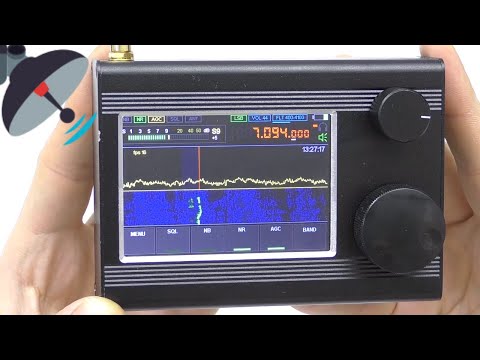
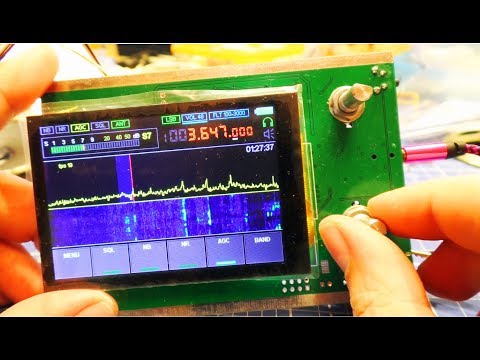
Over on the SWLing.com blog we've seen news about the release of a new Russian designed and made portable software defined radio called the "Malachite-DSP". The Malachite-DSP is an "all-in-one" portable SDR that is controlled via a touch screen and two control knobs. It covers 0.1 MHz to 1000 MHz with a bandwidth of up to 160 kHz, and the custom software supports all common modulation types. The whole device consumes 300mA and is powered by a Li-ion cell. It's marketed as a modern DEGEN and TECSUN replacement, so it appears to be targeting the HF short wave listening (SWL) customer.

Production appears to be small, with purchasing currently done by contacting RX9CIM, one of the project creators, directly at his email address (details on this forum post). The cost for a fully assembled unit is 12500 Russian Rubles which is 195 USD (not including international shipping). You can also purchase just the PCB without components for 1100 Rubles (17 USD). Importantly the forum post notes to watch out for scammers, who appear to be trying to take fake preorders for the device.

From the components list we can see that this SDR runs on the MSI001 tuner chip, which is the same tuner chip used in the SDRplay line of units. However, unlike the SDRplay units which use a wideband MSi2500 ADC, the Malachite-DSP uses an audio chip as the RF ADC. This provides a 16-bit ADC, resulting in high dynamic range, but at the expense of the available bandwidth which is only 160 kHz. A STM32H743VIT6 with ARM Cortex A7 processor runs what appears to be custom DSP and GUI software. The software doesn't seem to support DRM, but AM, WFM, NFM, LSB, USB are all supported.

The main place for news and discussion on the Malachite-DSP appears to be on a Russian ham radio forum thread. Judging by the fact that the schematic, software and BOM is all freely released, the project appears to be open source. There is also a group on the Russian Facebook clone vk.com where some discussion is occurring.

The YouTube videos below are by a Russian reviewers. Be sure to turn on the YouTube closed captioning and auto translation feature if you want to follow along in English.

😲ПРИЕМНИК КОТОРЫЙ ЛОВИТ ВСЁ!!!💥🔝 ЭТО ВАМ НЕ Degen и Tecsun ВСТРЕЧАЙТЕ НОВЫЙ МАЛАХИТ DSP V2💯🆕

SDR приемник МАЛАХИТ DSP

The Malachite-DSP reminds us a bit of the unreleased PantronX Titus II SDR, which is supposed to be a low cost (aiming for less than $100 USD) 100 kHz - 2 GHz tablet screen based SDR that was supposed to make DRM reception more popular. However the Titus II hardware has never eventuated since it's initial news in 2016, and at this time appears to be a dead project.