Category: HF

Building an Underground Earth Probe Antenna for 0 – 14 MHz TX/RX

Thank you to Jean-Marie Polard (F5VLB) for letting us know about his work in creating underground "earth probe" antennas that work for both RX and TX between 0 - 14 MHz, and are especially good at VLF and below. He writes:

Can't install an antenna at home? Madame refuses the masts, taut son? One solution, The Earth probes antenna.

Our group (https://www.facebook.com/groups/earthprobes/) started in January 2019. At first everyone made fun of me, the professionals called me crazy and today with more than seven hundred members, we installed underground antenna systems and the results are there.

Between 0 and 14MHz, in transmission and reception, it works!

This system dates from 1914/1918 but has been brought up to date.

It doesn't take much to get started, just the urge to try.

Mad of vlf - elf - ulf ? come here https://www.facebook.com/groups/VLF.ULF.ELF/ nearly 1000 members are waiting for you.

So when? Welcome everyone.

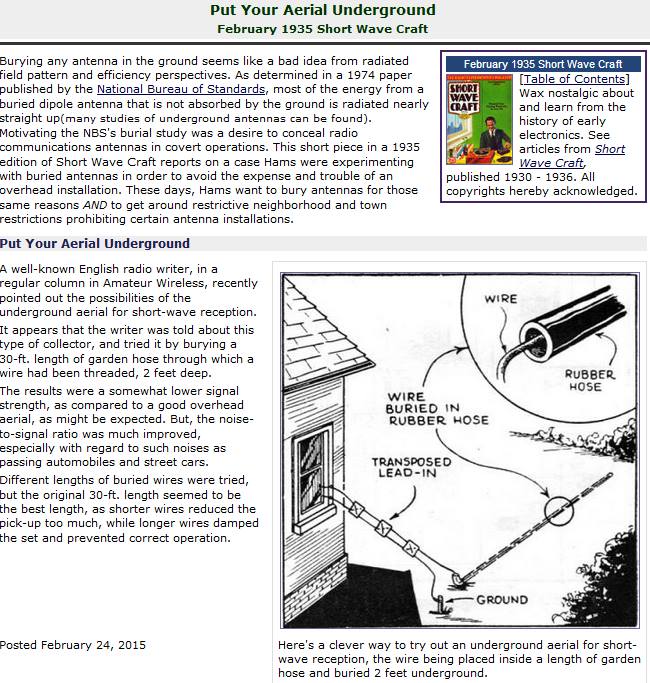
To access the Earth Probes and VLF.ULF.ELF groups you'll need a Facebook account. The groups contain a number of research papers documenting the concept, and the photos section. From the photos, an earth probe antenna appears to consist of two long grounding rods spread over a distance, or a grounding rod and long buried wire, combined with a balun.

An example of an underground antenna setup from a 1935 shortwave magazine.

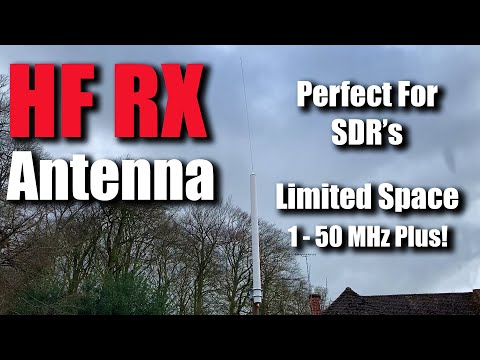
Techminds Reviews a HF RX SWL Antenna for Small Spaces and Apartments

Over on his YouTube channel TechMinds has uploaded a video reviewing the X1-HF 1 - 50 MHz Trapped Coil Receiving antenna from Moonraker.eu which goes for £69.95. This is a small electrically short antenna for HF reception which is easy to setup and install, requiring no radials. However, like all short HF antennas it is a compromise.

In the review he uses an SDRplay RSP2 SDR to test HF reception with the antenna. Later in the video he also tests it outside the advertised 1 - 50 MHz range. He concludes that the antenna works very well for it's small size.

HF RX SWL Antenna For Small Spaces And Apartments RTL SDR

NooElec Releases the Ham-It-Up Nano HF Upconverter

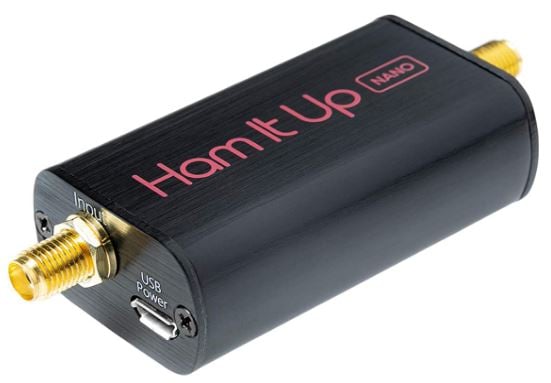
Today NooElec have released a new product called the "Ham-it-up Nano" for US$49.95 on their store and Amazon. The original Ham-it-up is an HF upconverter that enables reception of the HF bands with SDRs that do not natively support HF. Upconverters work by shifting these low HF frequencies "up" into a range receivable by most VHF/UHF capable SDRs.

The new nano version is much smaller than the original design and about $15 cheaper if you compare against the version with metal case. The nano can also be powered directly via bias tee capable SDRs, so no external power source is required. Compared to the original version the nano misses out on the pass through switch and bonus noise source circuit.

The Ham-it-up Nano probably most directly competes with the SpyVerter from Airspy, which is another small form factor and bias tee powered upconverter for US$49.00. Spec-wise, the SpyVerter appears to remain superior with better LF/VLF support, less conversion loss and it's ability to use a 10 MHz external reference clock for advanced users. But the Ham-It-Up Nano is designed and made in the USA vs designed in France and made in China for the SpyVerter. The nano may also be a little cheaper and faster in terms of shipping to obtain via Amazon.

Below is a table comparing the advertised specifications with specs taken from the Ham-it-up Nano datasheet and SpyVerter sales page. Overall, most HF dabblers probably won't notice a major difference between the two unless you are truly setting up HF DX antennas. And as always our advice is if you are heavily interested in HF and DX, then it may be wiser to spend a little more and get yourself an Airspy HF+ Discovery (US$169) or an SDRplay RSP1A (US$109) or RSPdx (US$199.95) instead of an RTL-SDR + upconverter (US$20 + US$50 = $70).

Spec Ham-It-Up Nano SpyVerter
Frequency Range 100 kHz - 65 MHz 1 kHz - 60 MHz
Conversion Loss 10dB (typ) 5.2 dB (typ)
LO Frequency 125 MHz 120 MHz
IIP3 Not Specified 35 dBm
Max Input Power 1 dBm 10 dBm
Operating Voltage 4 V - 5.5 V 4.2 V - 5.5 V
Current Consumption 65 mA (typ) 10 mA (typ)
Power Methods Bias Tee, microUSB, Pin Header Bias Tee, microUSB
LO Stability 0.5 PPM 0.5 PPM
10 MHz External LO Capable? No Yes
Input Return Loss -10 dB (max) -10 dB (max)
Output Return Loss -10 dB (max) -10 dB (max)
Phase Noise @ 10kHz Not Specified -122 dBc/Hz
Dimensions 2.0" x 1.2" x 0.75" (50 x 30 x 18mm) 2.1" x 1.6" x 1" (53 x 40 x 25 mm)
Weight 45g 108g
Design & Manufacture Country Designed and Made USA & Canada Designed in France, Made in China
Price US$49.95 + shipping (free US shipping on Amazon) US$49.00 + shipping (~US$5 to US, or US$10 via US reseller)
The Ham-it-up Nano
The Ham-it-up Nano

Demonstrating Solar Inverter Noise Cancelling with a Timewave ANC-4 and Airspy HF+

At his house W1VLF found that his solar inverter was causing huge amounts of interference on the HF bands, essentially making any hope at receiving shortwave or amateur radio signals impossible on his Airspy HF+ Discovery . However, over on his YouTube channel he's demonstrated a solution that allows him to almost completely cancel the noise.

The solution involves using a Timewave ANC-4 noise canceler, which is as analog noise cancelling device available from the manufacturer for US$209.95. To use the device you also need a noise probe which can be a small loop antenna. The noise probe is connected to the ANC-4 and placed near the source of the noise, which in W1VLF's case was just on the solar inverter enclosure mounted on the outside of his house. Then by tuning the gain and phase knobs on the ANC-4 the noise can be cancelled out of the signals received by the main antenna. 

In the video W1VLF demonstrates how effective noise cancelling with the ANC-4 can be by showing the before and after results with his Airspy HF+ Discovery.

Kicking Solar inverter noise in the A$$ with noise cancelling

Decoding NavTex with an SDRplay RSPDx, SDRUno and YanD

Over on YouTube TechMinds has uploaded a new video explaining NavTex and showing how to decode it with an HF capable SDR like the SDRplay RSPDx. NavTex is a marine digital data radio service designed for transmitting information like navigational and meteorological warnings, weather forecasts and maritime safety information. It is broadcast in either the MW frequency band at 490 kHz and 518 kHz or in the HF band at 4209.5 kHz.

In the video TechMinds uses a guide put out by Mike Ladd from SDRplay (pdf warning). The guide explains how to connect SDRuno to a NavTex decoder called YanD via a virtual audio cable. The rest of the video shows a NavTex message being decoded, some sample messages, and a closer look at YanD. 

Even if you don't use an SDRplay, the guide could be adapted for other SDRs too.

Decoding NavTex with Software Defined Radio - SDRuno RSPdx

Using an RTL-SDR Blog V3 in Direct Sampling Mode to Receive HF DRM on an Android Phone

Over on the SWLing blog contributor Dan Van Hoy wrote in and shared a report on how he's successfully been able to receive HF DRM 30 digital audio with an RTL-SDR Blog V3 dongle running in direct sampling mode on an Android phone.

To do this he used an Android app called "DRM+SDR Receiver" which is available for US$4.99 on the Play store. The app supports RTL-SDR and HackRF devices. So all you need to do is set the RTL-SDR Android driver to run in Q-branch direct sampling mode, then tune to a DRM signal for it to begin decoding.

A demonstration video uploaded to his Google drive account shows clean decoding of the DRM AAC audio, as well as the app displaying Journaline and live metadata. He notes that his signal was very strong, so he only required a short wire, but DXers would need an appropriate antenna.

DRM Received on an Android phone with an RTL-SDR Blog V3 running in direct sampling mode.

KiwiSDR Now Supports DRM Decoding

KiwiSDR have recently implemented DRM decoding into their OpenWebRX implementation. Digital Radio Mondiale (DRM) is a type of digital shortwave radio signal that is used by some international shortwave radio broadcasters. It provides superior audio quality compared to AM stations thanks to digital audio encoding.

The KiwiSDR is a US$299 HF SDR that can monitor the entire 0 - 30 MHz band at once. It is designed to be web-based and shared, meaning that the KiwiSDR owner, or anyone that they've given access to can tune and listen to it via a web browser over the internet. Many public KiwiSDRs can be found and browsed from the list at sdr.hu.

The new DRM implementation is based on DREAM 2.1.1 which is an opensource DRM decoder that can be used with any HF capable SDR. Due to computational limits of the BeagleBone singleboard computer which the KiwiSDR runs on, only one DRM channel can be decoded at any one time, restricting this capability to only one user at a time. However, if the KiwiSDR is running on the newer BeagleBone AI, it can support up to four DRM channels. KiwiSDR write that work is still ongoing to improve the code, so this situation may improve in the future.

KiwiSDR Decoding DRM

Decoding Differential GPS (DGPS) with an RSPdx and MultiPSK

Over on YouTube the TechMinds channel has uploaded a new video about decoding Differential GPS (DGPS) using an SDRplay RSPdx SDR. DGPS is a terrestrially transmitted long wave signal that is used to help correct and improve GPS position data calculations which may have timing errors due to atmospheric propagation delays. It works by broadcasting correction data calculated by the difference in received GPS location and the known location of the DGPS transmission site. DGPS is typically transmitted on longwave between 285 kHz and 315 kHz, but in Argentina there are two stations at 2570 and 2950 kHz.

In the video TechMinds explains how DGPS works, and some location around the world from where it is transmitted from. Later in the video he shows a DGPS signal being received by a SDRplay RSPdx SDR, and then show a demo of how it can be decoded with MultiPSK.

We note that there also various other DGPS decoders available including decoders for Android and iOS. A list of decoders can be found on the DGPS sigidwiki page.

DGPS Differential GPS Decoding With RSPdx And MultiPSK