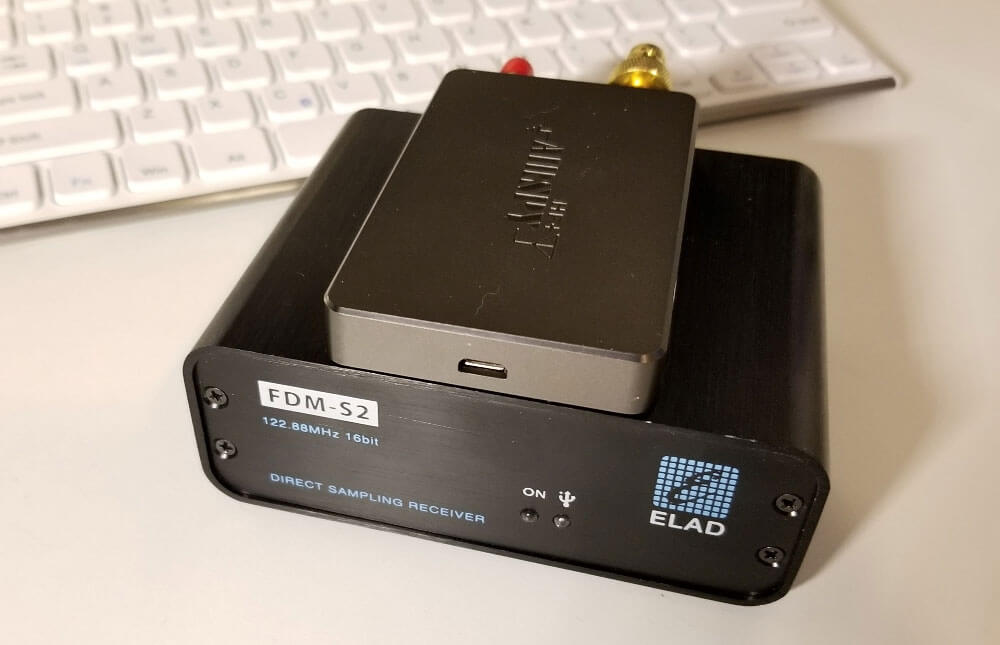
It appears that the Airspy HF+ even outperforms the FDM-S2 on one particular test where he tries to listen to 1540 kHz which is just 10 kHz away from a strong signal at 1550 kHz. He also writes:
It became apparent quickly that the upstart HF+ provides strong competition to the Elad SDR. Clearly, the AirSpy’s trade-off is bandwidth for raw performance at lower cost–approx. 660 kHz alias-free coverage versus about 6 MHz maximum for the Elad.
Also in a later post on the swling.com blog Guy makes an addendum where he swaps out his ALA1530S+ Wellbrook loop antenna for the ALA1530LN Pro which overloads his receivers less. He notes that with the new antenna 6 dB of attenuation is required for the FSM-S2 in order to prevent overloading. With the HF+ very little overloading apart from a weak image could be found, and that was removed by adding 3 dB of attenuation.
He also tests longwave reception with the two receivers, and this time finds that the HF+ seems to have additional MW spurs in the LW band, compared with the FDM-S2.
If you didn't know already Bitcoin is the top cryptocurrency which in 2017 has begun gaining traction with the general public and skyrocketing to a value of over $19,000 US per coin at one point. In addition to providing secure digital transactions, cryptocurrencies like Bitcoin are intended to help fight and avoid censorship. But despite this there is no real protection from the Bitcoin internet protocol being simply blocked and censored by governments with firewalls or by large ISP/telecoms companies.
One idea recently discussed by Nick Szabo and Elaine Ou at the "Scaling Bitcoin 2017" conference held at Stanford University is to use the something similar to WSPR (Weak Signal Propagation Reporting Network) to broadcast the Bitcoin network, thus helping to avoid internet censorship regimes. To test their ideas they set up a HackRF One as a transmitter and RTL-SDR and used GNU Radio to create a test system.
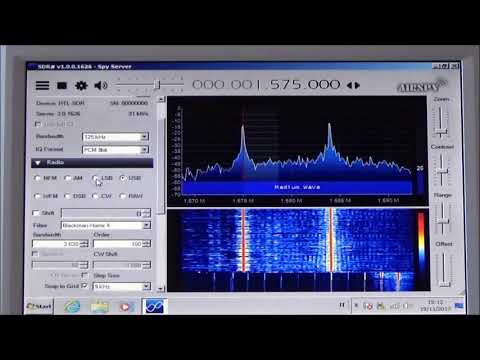
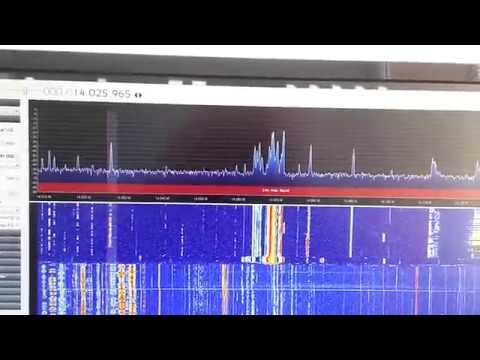
Over on YouTube user IW2DZX has uploaded a video showing him using an old EeePC 900 to receive HF with an RTL-SDR V3 running in direct sampling mode on a Raspberry Pi 3 which is running a SpyServer. An EeePC 900 is an old netbook that was released in 2008 which is lightweight, portable and was fairly cheap. Second hand Eeepc's can now be found on eBay for less than $60 US.
By running the RTL-SDR on a Raspberry Pi 3 with SpyServer the need to have the dongle connected to the netbook is eliminated. Instead the radio data from the RTL-SDR is efficiently sent over a network connection and received via the WiFi on the Eeepc.
Over on YouTube Adam 9A4QV has uploaded a video of him testing out his 'UP-64' upconverter together with an RTL-SDR. An upconverter moves low frequencies 'up' into a higher frequency. This is useful for HF reception, as normal reception on an RTL-SDR starts at about 24 MHz (without using direct sampling mode).
Adam previously manufactured and sold his UP-100 upconverter, which was an upconverter of his own design that utilized a 100 MHz oscillator. These days it has been accepted that using an upconversion frequency that avoids the broadcast FM band is generally better as it avoids the interference that can come from very strong FM signals. The 64 MHz oscillator on the UP-64 avoids the broadcast FM band for the most part unlike the older UP-100.
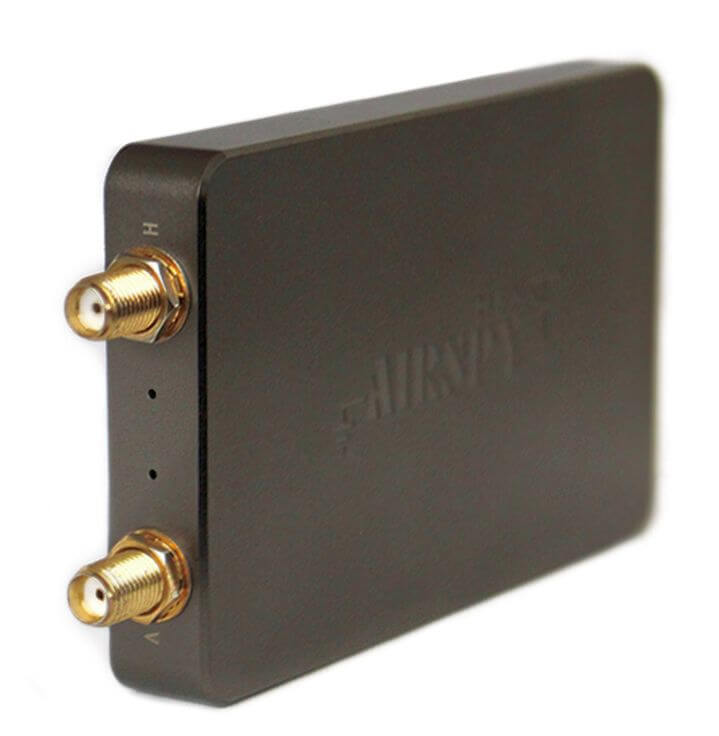
The Airspy HF+ on the other hand is based on a polyphase harmonic rejection mixer design with 18-bit DDC and has a frequency range of DC – 31 MHz and 60 – 260 MHz, with a maximum bandwidth of up to 660 kHZ. It is not yet released, but is expected to be about US $149 shipped from China.
Simon’s screenshots show that despite its low cost the HF+ seems to perform just as well as the more expensive NetSDR.
Over on YouTube Tom from Tom’s Radio Radio Room Show (TRRS) has uploaded a video showing the effectiveness of our broadcast AM (BCAM) filters for cleaning up HF reception. In the video he uses an RSP1 to receive the WWV time signal at 5 MHz and shows that there is some AM signals mixing into the audio. After connecting the BCAM filter the AM signal is gone and WWV comes in clearer.
TRRS #1305 - RTL-SDR.COM MW Filter for Shortwave - Works!
Over on the SWLing Post blog we’ve seen news of this new SDR based car radio called the Gospell GR-227. Gospell is a Chinese manufacturer of various broadcast consumer radio products including DRM receivers. It is intended to be an adapter for your car that lets you listen to digital broadcast stations such as DAB/DAB+ on VHF and DRM on UHF, but it can also be used for standard AM and FM reception. From the product sheet it looks like it will simply plug into you car USB port, and output audio through that port into your cars head unit. Control of the unit is through an Android app.
There doesn’t seem to be anything stopping someone from using this outside of a car though, so perhaps depending on the price and software hackability available it might make a good PC or Raspberry Pi based HF receiver for all modulation types too.
Over on the Gospell Facebook page are images showing the Gospell running at IBC 2017 and next to other upcoming SDR based digital broadcast receivers like the Titus II.
Gospell SDR Connected to a Car Radio Head Unit
No word yet on a release date or pricing. The press release reads:
Chengdu, China, September 04, 2017 – A new adaptor specifically designed for in-car use that simplifies digital radio on the road will be introduced at IBC by Gospell.
GR-227 is a small, low-cost adaptor that acts as an aftermarket add-on to car stereos receiving high-quality digital broadcast programs and data application, and serving it to the car audio system over a USB cable. Based on software defined radio technology, GR-227 is compatible with DAB, DAB+, DRM and is DRM+ ready. It is also powerful enough to support digital audio decoding such as extended HE-AAC (xHE-AAC).
GR-227 literally works with any kind of car stereos with a USB port. Our patent pending technology allows the adaptor to behave like a thumb drive when plug into a USB port and makes it compatible with most of the music players not only in car but also for home use.
To make the most of GR-227, the Gospell Smart Tune App for Android has been included to add more features. When partnered with an Android powered car stereo, the App not only allows for playback of the broadcast audio program but data application which brings much fun to car entertainment.
By connecting the supplied triple band active antenna which can be attached to the windscreen through the SMA antenna connector, the reception in DRM, FM and DAB bands can be significantly improved, offering maximum flexibility between different broadcasting standards.
Installing the plug-and-play GR-227 adaptor to your car is easy and doesn’t require changing your car stereo. It is one of the easiest ways to upgrade your car radio to digital without replacing anything.
The Gospell’s aftermarket car adaptor range starts with USB model but more will follow to support more car stereo types.
Haochun Liu, DRM director, Gospell, said: “By leveraging SDR, we can now combine multiple broadcasting standards together to offer flexibility and cost advantages, coupled with easy installation without the necessity of buying a new car stereo as in traditional solutions.”
For additional information, please visit www.goscas.com or contact Gospell sales at [email protected].
About Gospell
Founded in 1993, Gospell Digital Technology Co Ltd (GOSPELL). is a private hi-tech enterprise with R&D, manufacturing, business consultancy and planning, trade, delivery, project implementation and after sales service, acting as a complete DTV and triple-play solution provider for Digital TV/OTT related projects. Headquartered in GOSPELL INDUSTRIAL PARK at Chenzhou, Hunan Province for CPE related production manufacturing, GOSPELL also has its office in Shenzhen for business/marketing management and administration, in Chengdu for R&D and headend/transmitter system production/debugging and Customer Service Center, and in 12 cities in China as well as international offices in India, Africa and Mexico.
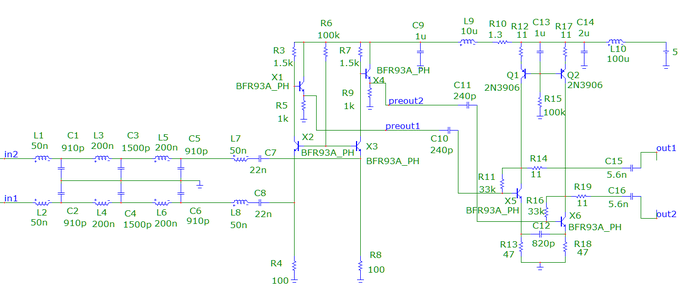
Qrp Gaijin’s post goes into some detail about his circuit and shows the schematic as well. He also shows the results with an active loop antenna, RTL-SDR and the upconverter in some videos. In the email to us he also notes that his upconverter is still a work in progress as the LO is quite noisy and he suspects that it may be too weak to drive the 1N4148 based diode ring mixer. There is also no filtering on the circuit yet, so there is some broadcast FM breakthrough.
Another project he worked on was attempting the direct sampling mod on a standard RTL-SDR. However, Qrp Gaijin’s method is slightly different to most attempts as instead of soldering the wires into the Q-branch holes he simply uses hot glue to hold them mechanically in place. This may be an idea to consider for those who want to attempt the mod on a standard RTL-SDR, but don’t have any soldering tools or experience.
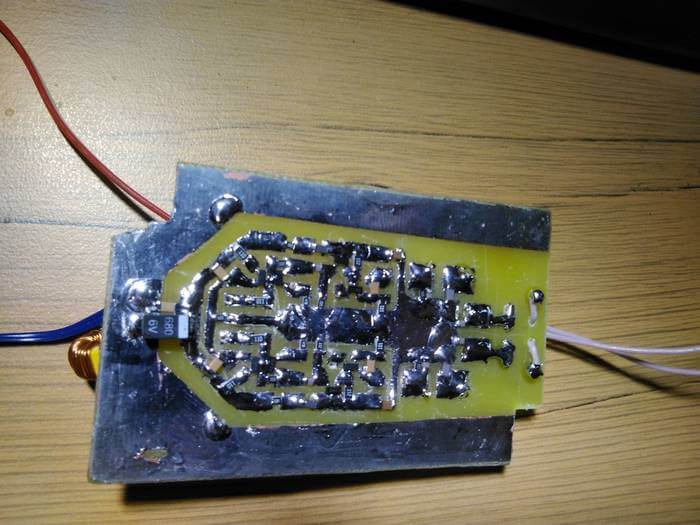
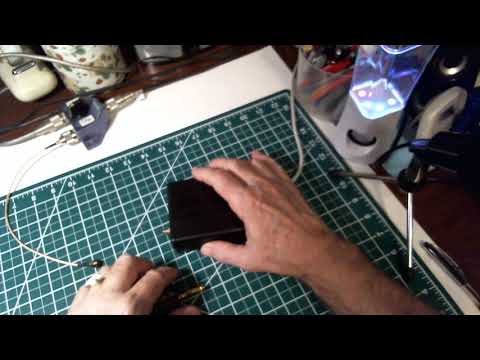
Homebrew RTL-SDR upconverter: physical construction