Category: HF

Gospell GR-227: New SDR Based Digital Broadcast Radio Adapter for Cars

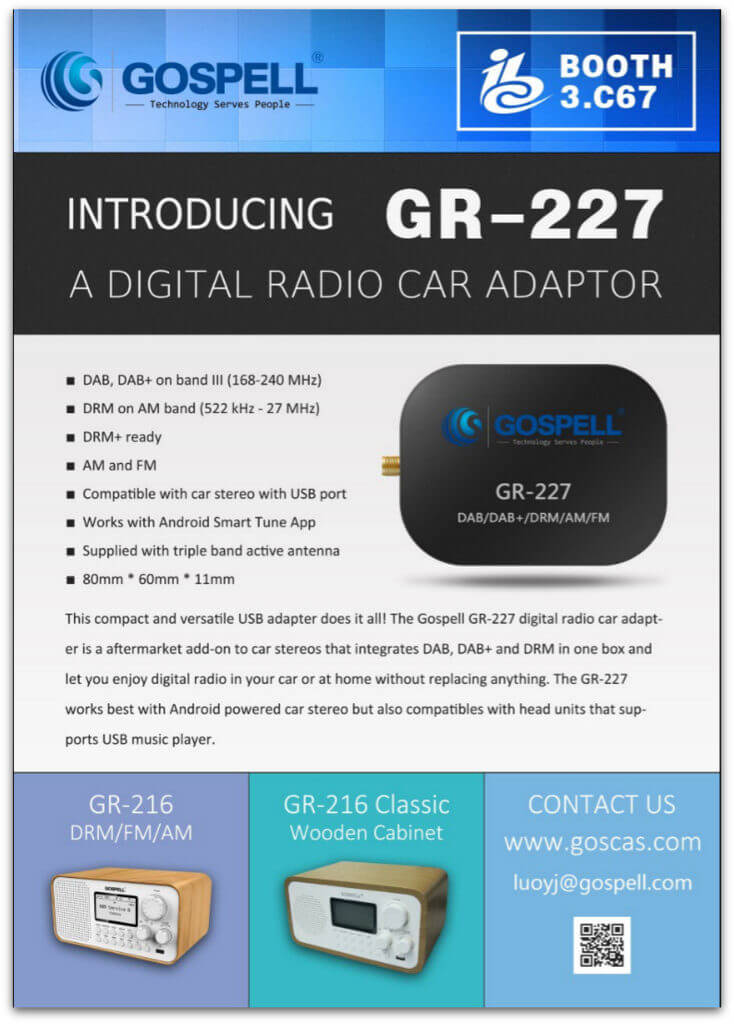
Over on the SWLing Post blog we’ve seen news of this new SDR based car radio called the Gospell GR-227. Gospell is a Chinese manufacturer of various broadcast consumer radio products including DRM receivers. It is intended to be an adapter for your car that lets you listen to digital broadcast stations such as DAB/DAB+ on VHF and DRM on UHF, but it can also be used for standard AM and FM reception. From the product sheet it looks like it will simply plug into you car USB port, and output audio through that port into your cars head unit. Control of the unit is through an Android app.

There doesn’t seem to be anything stopping someone from using this outside of a car though, so perhaps depending on the price and software hackability available it might make a good PC or Raspberry Pi based HF receiver for all modulation types too.

Over on the Gospell Facebook page are images showing the Gospell running at IBC 2017 and next to other upcoming SDR based digital broadcast receivers like the Titus II.
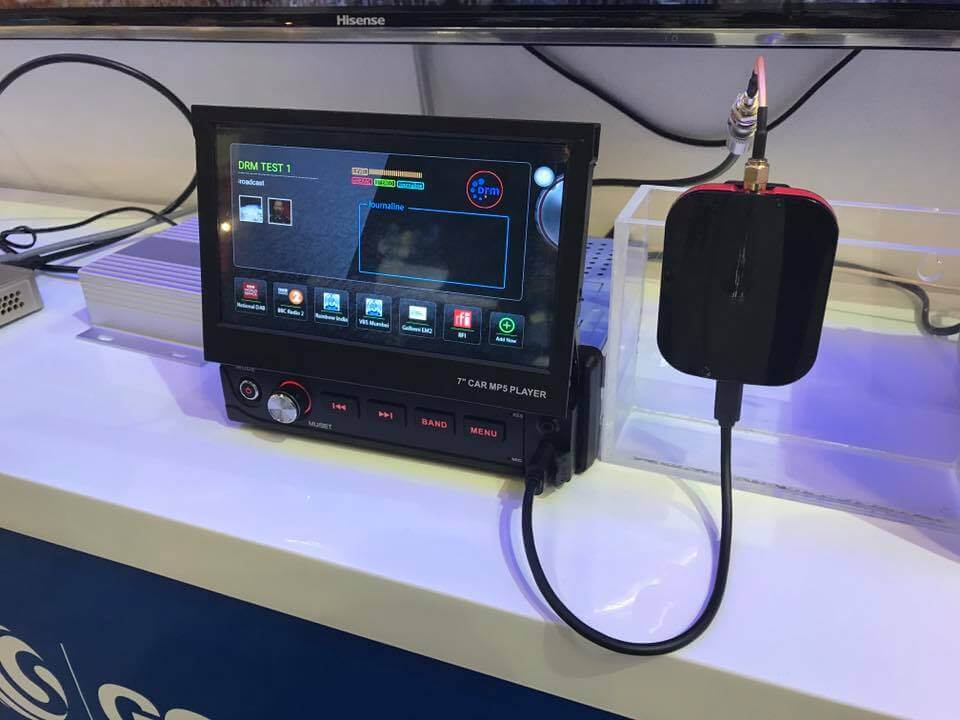
Gospell SDR Connected to a Car Radio Head Unit

No word yet on a release date or pricing. The press release reads:

Chengdu, China, September 04, 2017 – A new adaptor specifically designed for in-car use that simplifies digital radio on the road will be introduced at IBC by Gospell.

GR-227 is a small, low-cost adaptor that acts as an aftermarket add-on to car stereos receiving high-quality digital broadcast programs and data application, and serving it to the car audio system over a USB cable. Based on software defined radio technology, GR-227 is compatible with DAB, DAB+, DRM and is DRM+ ready. It is also powerful enough to support digital audio decoding such as extended HE-AAC (xHE-AAC).

GR-227 literally works with any kind of car stereos with a USB port. Our patent pending technology allows the adaptor to behave like a thumb drive when plug into a USB port and makes it compatible with most of the music players not only in car but also for home use.

To make the most of GR-227, the Gospell Smart Tune App for Android has been included to add more features. When partnered with an Android powered car stereo, the App not only allows for playback of the broadcast audio program but data application which brings much fun to car entertainment.

By connecting the supplied triple band active antenna which can be attached to the windscreen through the SMA antenna connector, the reception in DRM, FM and DAB bands can be significantly improved, offering maximum flexibility between different broadcasting standards.

Installing the plug-and-play GR-227 adaptor to your car is easy and doesn’t require changing your car stereo. It is one of the easiest ways to upgrade your car radio to digital without replacing anything.

The Gospell’s aftermarket car adaptor range starts with USB model but more will follow to support more car stereo types.

Haochun Liu, DRM director, Gospell, said: “By leveraging SDR, we can now combine multiple broadcasting standards together to offer flexibility and cost advantages, coupled with easy installation without the necessity of buying a new car stereo as in traditional solutions.”

For additional information, please visit www.goscas.com or contact Gospell sales at [email protected].

About Gospell

Founded in 1993, Gospell Digital Technology Co Ltd (GOSPELL). is a private hi-tech enterprise with R&D, manufacturing, business consultancy and planning, trade, delivery, project implementation and after sales service, acting as a complete DTV and triple-play solution provider for Digital TV/OTT related projects. Headquartered in GOSPELL INDUSTRIAL PARK at Chenzhou, Hunan Province for CPE related production manufacturing, GOSPELL also has its office in Shenzhen for business/marketing management and administration, in Chengdu for R&D and headend/transmitter system production/debugging and Customer Service Center, and in 12 cities in China as well as international offices in India, Africa and Mexico.
[First seen on swling.com/blog]

A Homebrew One Transistor Upconverter for the RTL-SDR

Recently Qrp Gaijin wrote in to us and wanted to share his experiences on building a one transistor diode-ring mixer upconverter for his RTL-SDR. An upconverter for the RTL-SDR translates low HF frequencies ‘up’ into ones that are receivable by the RTL-SDR. This is a different method to the direct sampling mode used in the V3 dongles to achieve HF reception.

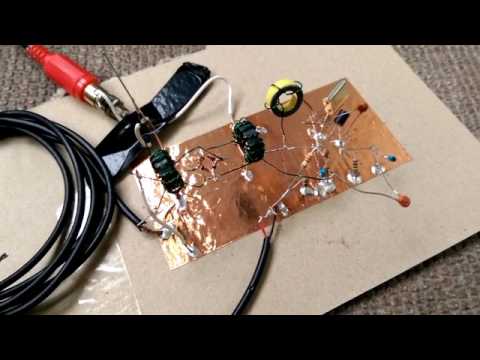
Qrp Gaijin’s post goes into some detail about his circuit and shows the schematic as well. He also shows the results with an active loop antenna, RTL-SDR and the upconverter in some videos. In the email to us he also notes that his upconverter is still a work in progress as the LO is quite noisy and he suspects that it may be too weak to drive the 1N4148 based diode ring mixer. There is also no filtering on the circuit yet, so there is some broadcast FM breakthrough.

Another project he worked on was attempting the direct sampling mod on a standard RTL-SDR. However, Qrp Gaijin’s method is slightly different to most attempts as instead of soldering the wires into the Q-branch holes he simply uses hot glue to hold them mechanically in place. This may be an idea to consider for those who want to attempt the mod on a standard RTL-SDR, but don’t have any soldering tools or experience.

Homebrew RTL-SDR upconverter: physical construction

A Review of the SpyVerter R2

The SpyVerter is a high performance upconverter that enables HF reception on SDR’s that aren’t able to tune directly to HF frequencies. Like any upconverter it works by converting those lower HF frequencies ‘up’ into a higher frequency range that is actually receivable by the SDR.

Back in December 2015 when the SpyVerter first came out we reviewed the unit and found that it was probably the best and highest value upconverter on the market. It was priced at a similar or cheaper price to competitors, came in a metal enclosure and had excellent performance. The main reason for its high performance is due to the architecture. While most upconverters on the market like the ham-it-up use an ADE-1 double balanced mixer component, the SpyVerter instead uses an H-mode mixer design. This design is harder to engineer, but it provides better dynamic range meaning that strong signals are less likely to overload the upconverter.

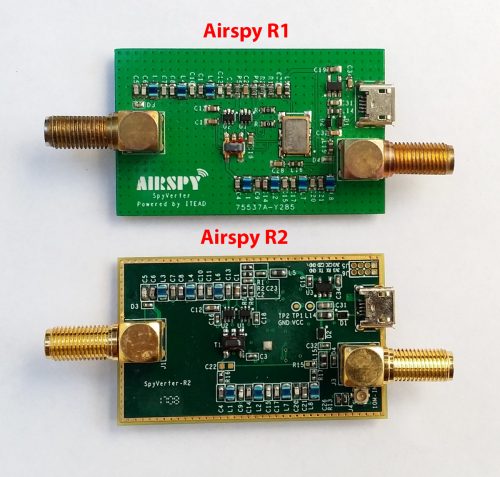
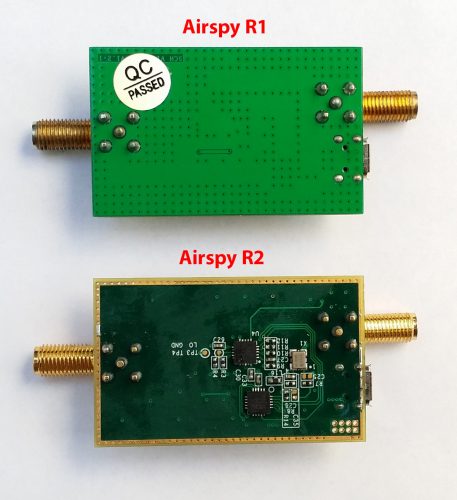
The SpyVerter was recently given a refresh, and the SpyVerter R2 is now available. The changes are small and are mostly centered around the clock. The oscillator is now a 24 MHz 0.5 PPM TCXO, run through a SI5351 clock generator to produce the 120 MHz upconversion frequency. A new onboard microcontroller programs the SI5351 on power up.

This change in clock design also now allows you to connect a 10 MHz reference frequency if ultra stable, or phase coherent frequency operation is required. A u.FL connector is provided next to the output SMA connector on the PCB for connecting a 10 MHz reference. Unfortunately there is no breakout hole in the metal enclosure, meaning that you’ll need to drill your own hole in the enclosure to get the u.FL clock cable out. Few people will need this feature however, as thanks to the 0.5 PPM TCXO stock frequency stability is now excellent.

The new design also uses less power, only drawing 10 mA of current compared to 47 mA in the SpyVerter R1. It also has 12 dB lower local oscillator leakage meaning that the gains might be able to be pushed slightly higher without overload. Once again, just like with the SpyVerter R1 the R2 is also powered via the bias tee on the Airspy, and so is compatible with the bias tee on our RTL-SDR V3 dongles.

There’s also an interesting mod that can be performed with the SpyVerter R2. The LO frequency can be modded to run at 58 MHz instead of 120 MHz. 58 MHz is just low enough to avoid the broadcast FM band, and the lower frequency allows the switches used in the H-mode design to run at a lower frequency. This results in an insertion loss better by about 3 dB’s and less LO leakage meaning that the RF gains can be pushed higher. The main disadvantage to this mod is that the lowest input frequency will only be 28 MHz.  The mod details don’t seem to be published yet, but we’ll update this post once they are.

The cost of the SpyVerter R2 remains the same as before at $49 USD. Compared to the Ham-It-Up v1.3 which costs $41.95 USD and does not come with an enclosure or TCXO, the SpyVerter still seems to be the best value. Currently you can buy one internationally from iTead who ship from China, at Airspy.us for US customers, and there are several European distributors linked on the Airspy website.

Disclaimer: The SpyVerter R2 was sent by the Airspy team to us for free in exchange for an honest review.

Gospell GR-227: New SDR Based Digital Broadcast Radio Adapter for Cars

Over on the SWLing Post blog we’ve seen news of this new SDR based car radio called the Gospell GR-227. Gospell is a Chinese manufacturer of various broadcast consumer radio products including DRM receivers. It is intended to be an adapter for your car that lets you listen to digital broadcast stations such as DAB/DAB+ on VHF and DRM on UHF, but it can also be used for standard AM and FM reception. From the product sheet it looks like it will simply plug into you car USB port, and output audio through that port into your cars head unit. Control of the unit is through an Android app.

There doesn’t seem to be anything stopping someone from using this outside of a car though, so perhaps depending on the price and software hackability available it might make a good PC or Raspberry Pi based HF receiver for all modulation types too.

Over on the Gospell Facebook page are images showing the Gospell running at IBC 2017 and next to other upcoming SDR based digital broadcast receivers like the Titus II.

Gospell SDR Connected to a Car Radio Head Unit

No word yet on a release date or pricing. The press release reads:

Chengdu, China, September 04, 2017 – A new adaptor specifically designed for in-car use that simplifies digital radio on the road will be introduced at IBC by Gospell.

GR-227 is a small, low-cost adaptor that acts as an aftermarket add-on to car stereos receiving high-quality digital broadcast programs and data application, and serving it to the car audio system over a USB cable. Based on software defined radio technology, GR-227 is compatible with DAB, DAB+, DRM and is DRM+ ready. It is also powerful enough to support digital audio decoding such as extended HE-AAC (xHE-AAC).

GR-227 literally works with any kind of car stereos with a USB port. Our patent pending technology allows the adaptor to behave like a thumb drive when plug into a USB port and makes it compatible with most of the music players not only in car but also for home use.

To make the most of GR-227, the Gospell Smart Tune App for Android has been included to add more features. When partnered with an Android powered car stereo, the App not only allows for playback of the broadcast audio program but data application which brings much fun to car entertainment.

By connecting the supplied triple band active antenna which can be attached to the windscreen through the SMA antenna connector, the reception in DRM, FM and DAB bands can be significantly improved, offering maximum flexibility between different broadcasting standards.

Installing the plug-and-play GR-227 adaptor to your car is easy and doesn’t require changing your car stereo. It is one of the easiest ways to upgrade your car radio to digital without replacing anything.

The Gospell’s aftermarket car adaptor range starts with USB model but more will follow to support more car stereo types.

Haochun Liu, DRM director, Gospell, said: “By leveraging SDR, we can now combine multiple broadcasting standards together to offer flexibility and cost advantages, coupled with easy installation without the necessity of buying a new car stereo as in traditional solutions.”

For additional information, please visit www.goscas.com or contact Gospell sales at [email protected].

About Gospell

Founded in 1993, Gospell Digital Technology Co Ltd (GOSPELL). is a private hi-tech enterprise with R&D, manufacturing, business consultancy and planning, trade, delivery, project implementation and after sales service, acting as a complete DTV and triple-play solution provider for Digital TV/OTT related projects. Headquartered in GOSPELL INDUSTRIAL PARK at Chenzhou, Hunan Province for CPE related production manufacturing, GOSPELL also has its office in Shenzhen for business/marketing management and administration, in Chengdu for R&D and headend/transmitter system production/debugging and Customer Service Center, and in 12 cities in China as well as international offices in India, Africa and Mexico.

[First seen on swling.com/blog]

A Homebrew One Transistor Upconverter for the RTL-SDR

Recently Qrp Gaijin wrote in to us and wanted to share his experiences on building a one transistor diode-ring mixer upconverter for his RTL-SDR. An upconverter for the RTL-SDR translates low HF frequencies ‘up’ into ones that are receivable by the RTL-SDR. This is a different method to the direct sampling mode used in the V3 dongles to achieve HF reception.

Qrp Gaijin’s post goes into some detail about his circuit and shows the schematic as well. He also shows the results with an active loop antenna, RTL-SDR and the upconverter in some videos. In the email to us he also notes that his upconverter is still a work in progress as the LO is quite noisy and he suspects that it may be too weak to drive the 1N4148 based diode ring mixer. There is also no filtering on the circuit yet, so there is some broadcast FM breakthrough.

Another project he worked on was attempting the direct sampling mod on a standard RTL-SDR. However, Qrp Gaijin’s method is slightly different to most attempts as instead of soldering the wires into the Q-branch holes he simply uses hot glue to hold them mechanically in place. This may be an idea to consider for those who want to attempt the mod on a standard RTL-SDR, but don’t have any soldering tools or experience.

Homebrew RTL-SDR upconverter: physical construction

A Review of the SpyVerter R2

The SpyVerter is a high performance upconverter that enables HF reception on SDR’s that aren’t able to tune directly to HF frequencies. Like any upconverter it works by converting those lower HF frequencies ‘up’ into a higher frequency range that is actually receivable by the SDR.

Back in December 2015 when the SpyVerter first came out we reviewed the unit and found that it was probably the best and highest value upconverter on the market. It was priced at a similar or cheaper price to competitors, came in a metal enclosure and had excellent performance. The main reason for its high performance is due to the architecture. While most upconverters on the market like the ham-it-up use an ADE-1 double balanced mixer component, the SpyVerter instead uses an H-mode mixer design. This design is harder to engineer, but it provides better dynamic range meaning that strong signals are less likely to overload the upconverter.

The SpyVerter was recently given a refresh, and the SpyVerter R2 is now available. The changes are small and are mostly centered around the clock. The oscillator is now a 24 MHz 0.5 PPM TCXO, run through a SI5351 clock generator to produce the 120 MHz upconversion frequency. A new onboard microcontroller programs the SI5351 on power up.

This change in clock design also now allows you to connect a 10 MHz reference frequency if ultra stable, or phase coherent frequency operation is required. A u.FL connector is provided next to the output SMA connector on the PCB for connecting a 10 MHz reference. Unfortunately there is no breakout hole in the metal enclosure, meaning that you’ll need to drill your own hole in the enclosure to get the u.FL clock cable out. Few people will need this feature however, as thanks to the 0.5 PPM TCXO stock frequency stability is now excellent.

The new design also uses less power, only drawing 10 mA of current compared to 47 mA in the SpyVerter R1. It also has 12 dB lower local oscillator leakage meaning that the gains might be able to be pushed slightly higher without overload. Once again, just like with the SpyVerter R1 the R2 is also powered via the bias tee on the Airspy, and so is compatible with the bias tee on our RTL-SDR V3 dongles.

There’s also an interesting mod that can be performed with the SpyVerter R2. The LO frequency can be modded to run at 58 MHz instead of 120 MHz. 58 MHz is just low enough to avoid the broadcast FM band, and the lower frequency allows the switches used in the H-mode design to run at a lower frequency. This results in an insertion loss better by about 3 dB’s and less LO leakage meaning that the RF gains can be pushed higher. The main disadvantage to this mod is that the lowest input frequency will only be 28 MHz.  The mod details don’t seem to be published yet, but we’ll update this post once they are.

The cost of the SpyVerter R2 remains the same as before at $49 USD. Compared to the Ham-It-Up v1.3 which costs $41.95 USD and does not come with an enclosure or TCXO, the SpyVerter still seems to be the best value. Currently you can buy one internationally from iTead who ship from China, at Airspy.us for US customers, and there are several European distributors linked on the Airspy website.

Disclaimer: The SpyVerter R2 was sent by the Airspy team to us for free in exchange for an honest review.

Using the SDRplay with a W4OP Loop

Over on YouTube user SignalSearch has uploaded a video showing and explaining the use of a W4OP magnetic loop antenna on a SDRplay SDR. On the video he explains what the W4OP loop is, and demonstrates it’s operation in SDR-Console with his SDRplay. The video description reads:

Experiment: Hookup the SDRPlay RSP 1 (SDR receiver) to the W4OP (Small Transmitting Loop). I’ve always wanted to try hooking up a loop to my SDRPlay. Though different from an active receive loop (one that has a Low Noise Amplifier), this loop can be used for transmitting @ QRP levels – but works great for shortwave listening too! For more info. please visit my website @ www.k5acl.net!

New Cross Country Wireless HF Preselector

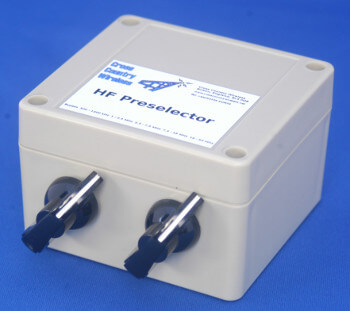
A new reasonably priced 5-band HF preselector has been released by the company Cross Country Wireless, and it looks perfect for use with SDRs. The price is $56.95 GBP, which right now is about $72 USD. They write:

This can be used to provide additional front end selectivity for HF and medium wave receivers protecting the receiver from strong out of band transmissions, wideband noise and other transmitters on multi-station field days.

As the sunspot cycle declines and more listening is done on the lower HF bands with long wire antennas and strong NVIS signals then the HF Preselector is an ideal accessory to aid receiver performance.

It is invaluable when using simple conventional superhet or SDR receivers such as RTL-SDR dongles with upconverters or SDRPlay with large HF antennas.

It is an ideal tool to reduce ADC overload on the Icom IC-7300 with the new second receiver socket modification kit.

It can also be used with other transceivers that have sockets for a separate receiver input and receive antenna output.

It also covers the medium wave broadcast band for MW DXers.

The Preselector is a passive high Q design that does not use an additional amplifier or require external power.

  • Frequency tuning range: 0.5 to 52 MHz in five bands
  • Input impedance: 50 ohms
  • Output impedance: 50 ohms
  • Bypass option on switch
  • Galvanic isolation between input and output
  • Insertion loss: 2 dB
  • Selectivity: See HP network analyser plots below
  • Connectors: BNC female (RF in 50 ohms), BNC female (RF out)
  • Tough polycarbonate case
  • CCW Z Match
    Overall dimensions: 125 mm (L) x 85 mm (W) x 55 mm (H)
  • Weight: 192 g
The Cross Country Wireless HF Preselecter
The Cross Country Wireless HF Preselector

Titus II SDR Updates

Over on the swling.com blog we’ve seen news of an update regarding the PantronX Titus II SDR. The last update we had was in January. Swling.com contributor Richard Langley writes:

There was a segment on the latest episode of AWR’s Wavescan (9 April 2017) about the Titus II DRM receiver recorded during the recent HFCC meeting in Jordan. In it, it was stated that the shipment of the first 1500 units was expected at the end of March or by the first half of April. Included some discussion of added shielding to prevent digital noise and the high-sensitivity of the receiver compared to other DRM units. 

Head over to the swling.com post to listen to the Wavescan podcast announcement,

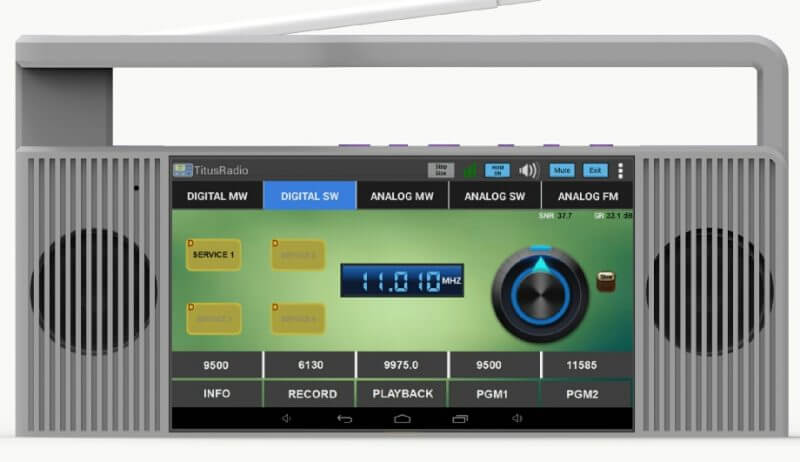
The Titus II is an Android Tablet + SDR combination that is due to be released in the near future. Its main purpose is for reception of Digital Radio Mondiale (DRM) which is a digital broadcasting medium used on the HF frequencies, which somewhat replaces standard short wave AM radio. The Titus II hopes to be one of the first low cost receiver solutions for this market and as a wideband SDR it should work for many other applications too. From the advertised frequency range of 100 kHz – 2 GHz we speculate that it will be using the Mirics SDR chipset, which is the same chipset as used in the SDRplay. The target price is under $100 USD.

The Titus II Portable SDR

DK8OK Review of the Airspy and SpyVerter

Recently DK8OK wrote in to us and wanted to share his latest review of the Airspy and SpyVerter combo (pdf). His review focuses on HF usage and he shows various examples of HF signals that he has received with the Airspy+SV such as the CHU time station, STANAG, DRM, ALE, HFFAX, VOLMET and HFDL. He also shows some tricks for optimizing HF reception, a tutorial on performing multi-channel audio recording and decoding in SDR-Console, a tutorial on playing and analyzing recorded files as well as some examples of weak signal reception.

Overall DK8OK praises the Airspy+SV combo citing it’s excellent dynamic range as one of the reasons it performs so well.

We should note that for prospective buyers, the Airspy team is currently working on a new complimentary solution for HF monitoring called the Airspy HF+. This will have extremely high dynamic range (even higher than the Airspy+SV combo), but it will have a smaller bandwidth. So the Airspy+SV combo will still be the best for monitoring a wide 9 MHz chunk of the HF band, whilst the HF+ will be the best for getting into those very hard to receive signals.

Update: The paper is now also available in French.

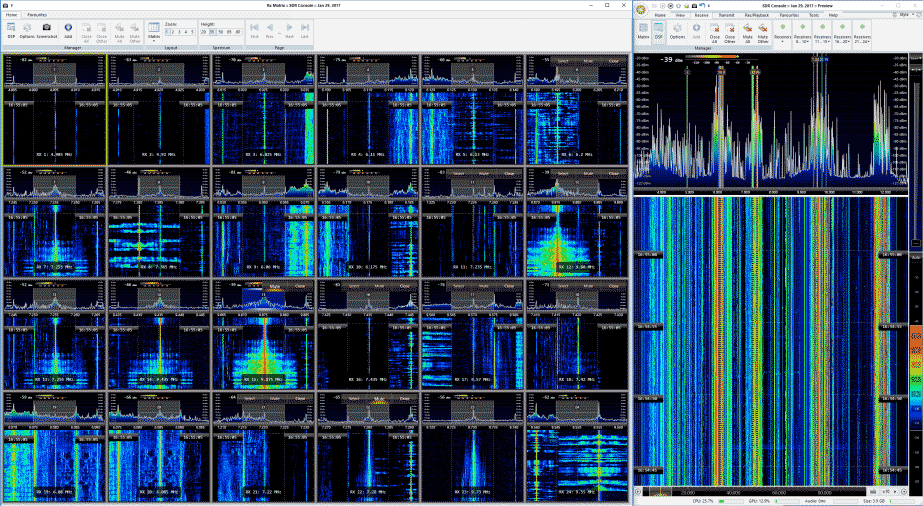
Multi-channel decoding in SDR-Console with the Airspy+SypVerter
Multi-channel decoding in SDR-Console with the Airspy+SpyVerter

ColibriNANO: A New 10 kHz to 500 MHz Direct Sampling Receiver

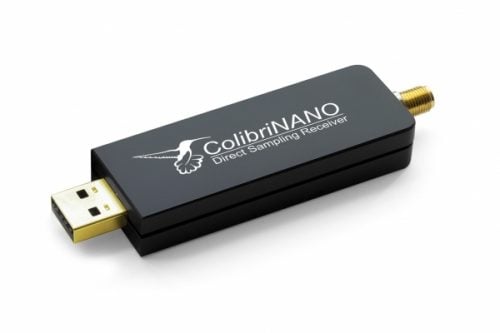
The ColibriNANO is a new software defined radio that is currently available for pre-order and is expected to be ready for delivery by the end of April 2017. The specs show that it is a direct sampling receiver (no tuner), which can receive from 10 kHz to 500 MHz in oversampling mode, and from 10 kHz to 55 MHz in standard mode. It uses a 14 Bit ADC which provides up to 110 dB’s of blocking dynamic range, and can run with a sampling rate of up to 3 MHz. The press release given to us reads:

New ColibriNANO SDR USB Receiver with a 14-bit ADC .01-500MHz

Kirkland, WA, USA —March 27 th , 2017 –

Vasily Vasiliev, Chief Hardware Engineer of Expert Electronics is pleased to announce availability of new ColibriNANO 0.01-500 MHz receiver in late April, 2017.

Notable features include the blocking dynamic range (BDR) ~110dB, native .01-55 MHz coverage with up to 500 MHz in oversampling mode, low pass filter (LPF) <60 MHz, full compatibility with HDSDR, legacy SDR#, and ExpertSDR2 software.

Supported platforms are Windows® XP-10, Linux and Web-client for HTML5 browsers.

No existing USB SDR receivers combine high sensitivity and broad dynamic range. Remote operation (TCP/IP) interface is built-in and offers plug-and- play solutions for Amateur, Commercial and Government applications.

For further information call (800)977-0448 or email [email protected]

https://www.nsiradio.com

Currently we see that the ColibriNANO is selling for $249.95 USD on the nsiradio.com website. We’ve also seen the following description on the sunsdr.eu website:

With the new ColibriNANO you will be able to enjoy LF, MW and Shortwave listening in many different ways. For example you can record the entire medium wave band using 1.5 MHz sampling rate, decode CW using CW skimmer, remote control the ColibriNANO by plugging it into our RPI server. There are an endless range of applications for this small SDR. All this in a tiny USB stick!

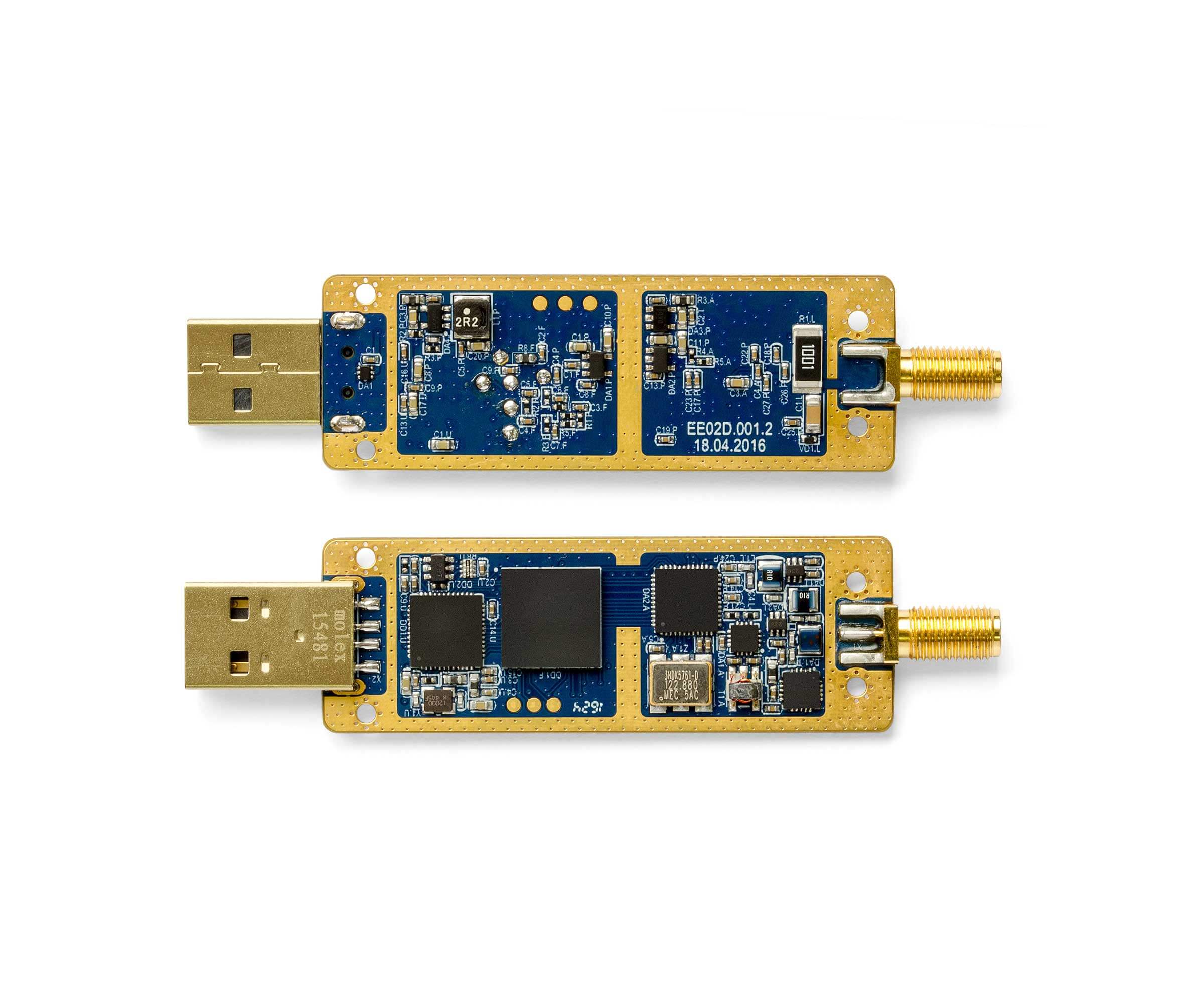
The ColibriNANO features a Texas Instruments ADS4145 14 bit direct sampling ADC and a built in low 55 MHz pass filter that can be bypassed to receive signals up to 500 MHz (external filters  like the our 2m filtered preamp recommended).

CW skimmer and Skimmer With the external ExtIO library the ColibriNANO can be used with third party software like HDSDR etc.

This is not a cheap USB dongle found on Ebay, this high quality SDR receiver is developed by Expert Electronics and features a sturdy aluminium chassis, ESD protection, USB 2.0 interface and a quality SMA antenna connector.

Best of all, the ColibriNANO travels in your pocket and only needs your computer and an antenna! Its the ultimate portable SDR receiver!

Software support

  • ExpertSDR2
  • CW Skimmer
  • Skimmer Server
  • Third party software using ExtIO library

Specifications

  • Receiving bandwidth: 0.1 – 55 MHz
  • Oversampling receiving: 0.1 – 500 MHz
  • Blocking Dynamic Range (BDR): 110 dB
  • Sensitivity: 0.05 uV at 20M band, preamp = 0
  • IMD3 Dynamic Range: 95 dB
  • ADC resolution: 14-bit @ 122.88 MHz
  • Sample rate: 48, 96, 192, 384, 768 kHz and 1.5, 3.0 MHz
  • IQ resolution: 24 bit (16 bit at 1.5 and 3 MHz sample rates)
  • RF Input: (SMA connector, up to 15kV ESD protection)
  • Preamp range: from 31.5 up to +6 dB with 0.5 dB steps
  • Operating temperature: -10°C to 60°C
  • Dimensions: 90х25х17mm
  • Weight: 0.043kg

It looks like that this receiver may compete somewhat with the also upcoming Airspy HF+. The Airspy HF+ claims similar specs including a frequency range of 0 – 270 MHz, 14 Bit ADC and 108 dB blocking dynamic range. But the target price for the HF+ is below $200 USD.