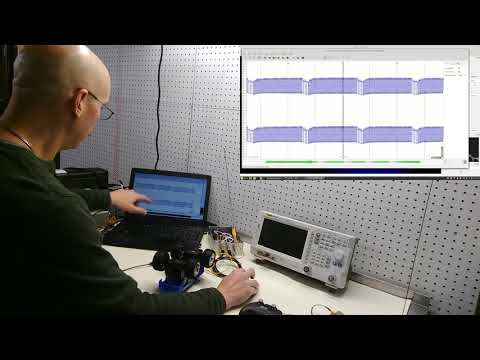
Over on YouTube user aonomus has uploaded a video showing how he's used an RTL-SDR to observe and listen to the radio signal generated via a chemistry lab's nuclear magnetic resonance machine. To do this he simply taps the RF output of the NMR machine which allows the RTL-SDR to listen to the signal and play it as audio. In the video he shows the sound of a sample of chloroform in acetone-d6. The demo has no real scientific purpose other than to hear the sound of the molecule. Normally the RF output goes straight into a spectrum analyzer for visual analysis.
Nuclear magnetic resonance is a technique used in chemistry for the analysis of chemicals, as well as in MRI medical imaging machines. Very basically, it works by applying a chemical sample to a strong magnetic field, exciting it with a strong pulse of RF, and listening to the echo. An echo will only occur when the radio waves are transmitted at the chemicals resonant frequency. The frequencies used are typically between 60 to 800 MHz.
A few years ago I came up with a demonstration for some high school students interested in chemistry. This demo is a modern take on a classic NMR experiment, using a low cost software defined radio to observe the FID signal as audio. In short, this demo allows you to hear the proton FID echo from the liquid sample inside the NMR magnet.
Nuclear Magnetic Resonance Demonstration Using Software Defined Radio
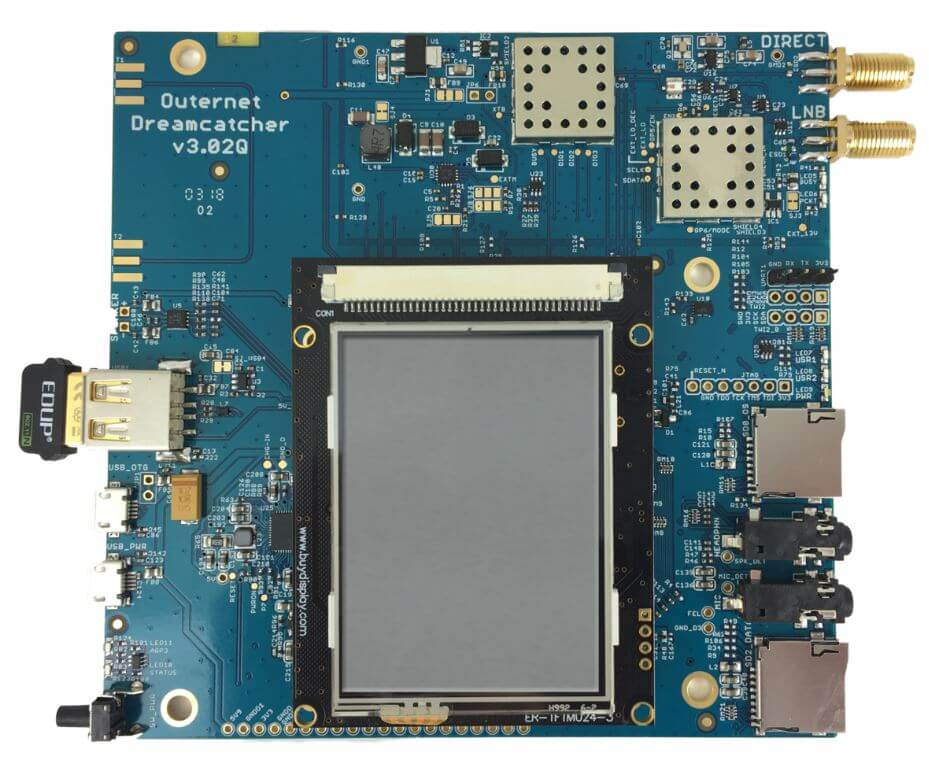
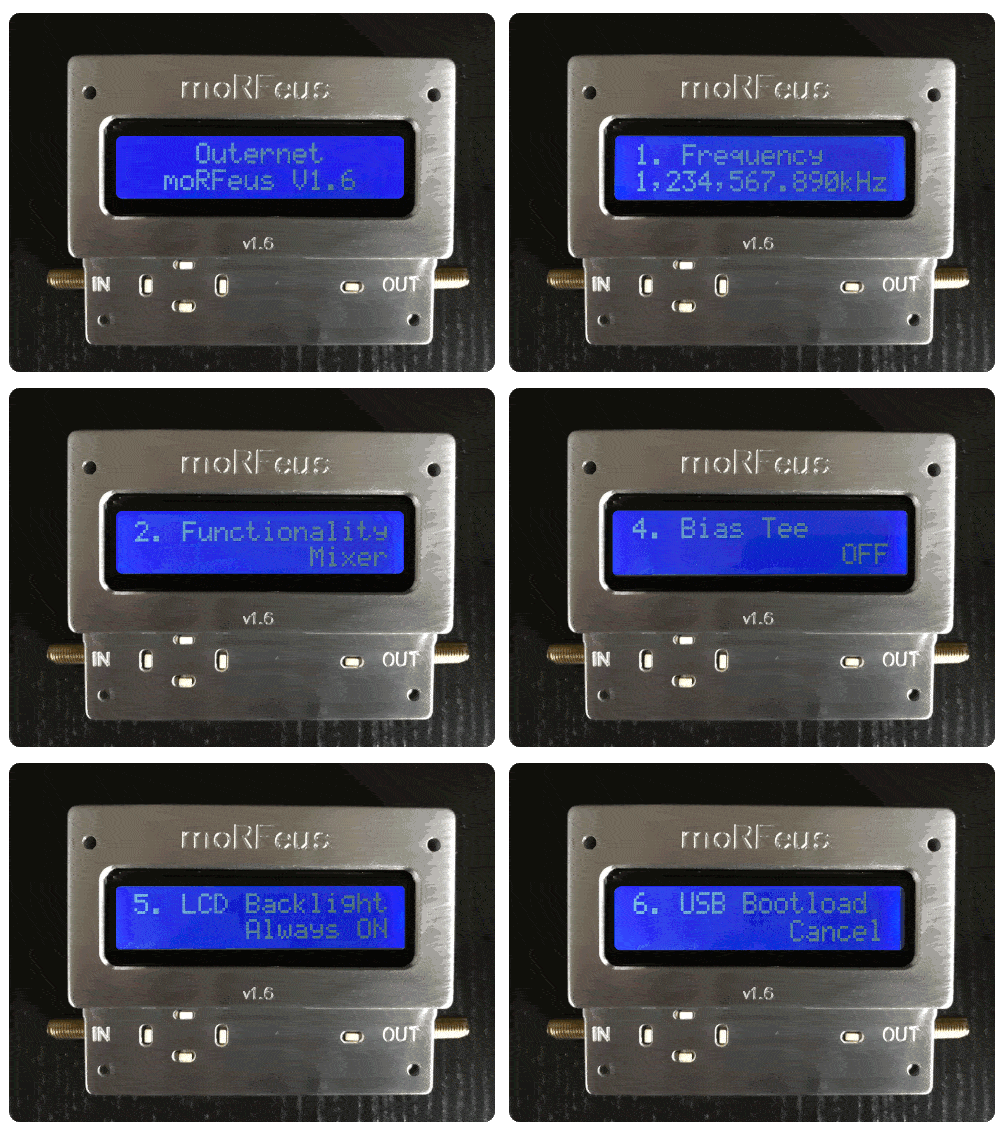
Othernet (formerly known as Outernet) are a providers of a free data service broadcast from satellites. They hope to build a system and low cost satellite receiver products where people can easily stream free daily data such as news, videos, books, and live audio down to a computer or phone from anywhere in the world via a device called a Lantern. It is a one way download only service, but may be useful for those in areas with limited internet, disaster preppers, or people in countries with internet censorship. The describe their mission as:
Othernet's mission is to build a universal information service; a truly pervasive multi-media service that operates in the most remote places and functions even when nothing else does.
In the past they ran a trial service on L-band satellite frequencies and used RTL-SDR dongles as the receiver. They have since discontinued that service in favor of a new Ku-band LoRa based service which can provide much more data - up to 200MB a day. The update released today was sent to Lantern backers, which was the receiver they crowdfunded for in their Kickstarter back in 2014. The update notes that the final iteration of the Lantern is close to being ready.
Broadcasting Khan Academy 24/7
Hello Backers,
Yes, we are still here. It’s been a long while since the last update, but that does not mean we have stopped–or even slowed–working on Lantern. We have been making progress, though it has been much, much slower than what everyone wants. Fortunately, we are in the final stage of development.
The last update described the new network technology we had developed. Our original goal was to broadcast 20 MB of content per day, which is what we were doing with our previous network. The new system is operating at 10-times that speed, which is a little over 20kbps and 200 MB of content per day. Some of the work we’ve been doing over the past few months is related to tripling our current download speeds. Our target is 60kbps, which results in over 600 MB per day. The size of the device will be similar to a standard flashlight.
At our current download speed of 20kbps, we are broadcasting both data and a 24/7 audio stream. I know many of you were interested in the educational applications that were highlighted during the campaign, which is why I’m very pleased to share that we are currently broadcasting the entirety of Khan Academy as a 24/7 audio stream. The Khan Academy library consists of over 900 separate lectures, which we’ve turned into a giant audio playlist. Now we just need to get Lanterns into everyone’s hands.
The next update will include a picture of our final antenna design. The antenna that is currently included in our DIY kit is 2-inches/5-cm across and the shape of a cone. We are trying to flatten the cone and also increase the size to about 4-inches/10-cm, which is what allows for greater download speeds. Since we are operating at microwave frequencies (12 GHz), both the design of the antenna and the parts to convert the high frequency to a lower one are pretty tricky. Microwave engineering is widely considered black magic, which is the main reason for the long break since the last update. We are close to turning the corner and are targeting the end of the year for our initial production run.
Unrelated to our technical work is our recent name change. We had been fighting a trademark issue for the past four years. We recently decided that it made more financial sense to change our name, rather than continue spending legal fees to defend our position. We are now Othernet (http://othernet.is). This name change does not mean we are going away, nor does it mean we are not delivering Lanterns. It’s just a legal hiccup.
Thanks for your patience and support while we get through the final stage of building what you all backed several years ago. I know it’s been a long time and we are making every possible effort to deliver something that exceeds everyone’s original expectations. Although it’s taking three times longer to develop and ship the product, what we now have will be ten-times more useful.
Over on Hackaday and Hackaday.io we've seen an interesting project by David Scholten called "Grid-2-Audio". The project's goal is to build a safe device for monitoring the mains electrical grid waveform via a power jack and PC soundcard. This is essentially an SDR, with the soundcard acting as the ADC for the 50Hz grid signal, and Grid-2-Audio acting as a safety isolator and signal preconditioner. About why you might want to monitor the mains power signal, David writes:
There is a lot to be observed from the waveform of the electrical mains. Harmonics, transient changes, periodic fluctuations, frequency shifts, impedance, power line communications - These all give clues as to the state of the country's electrical transmission system (or what loads your neighbour has connected). Platforms like MATLAB allow for the easy analysis of waveforms through powerful software tools, but only once the signal has been acquired.
The final product will be a black box with mains plug and a 3.5mm audio jack ready to plug into your soundcard. In order to make the device safe, mains isolation transformers are used as well as good PCB design practices that isolate live and safe areas on the PCB. In the design care is also taken to maintain signal integrity and to not introduce noise by ensuring that the power supply draws minimal sinusoidal current, and is in phase with the voltage.
In his tests he's been creating 100bit/s 2FSK test frames, transmitting them at 7.177 MHz, and receiving and decoding them on another PC with a hardware radio. The results show that the transmission is working perfectly, with only minor artefacts caused by RPiTX. Rowetel also notes that the narrow band spectral purity of the RPiTX output is remarkably clean. The only worry is the wide band harmonics which can easily be removed with filtering.
This shows that RPiTX could easily be used as a transmitter for amateur radio purposes, assuming proper external filtering is applied. Rowetel also mentions that he hopes that cheap radio technologies like RPiTX could one day be used to help reduce the cost and difficulty in covering the 'last 100 miles' of communications in the developing world.
RPiTX 2FSK apectrum analyzer measurement showing good narrow band spectral purity.
Helium is a cryptocurrency being designed for internet of things (IoT) sensors which will be based on low cost software defined radio (SDR) technology - that's a lot of buzzwords!. The idea is to design a system that will pay people to run an internet connected gateway which will receive data from wireless sensors, and put that data onto the internet. A use case that Helium has already developed is providing services to track and monitor medicine and food supplies. The linked article gives a good example of this use case:
...let’s say you have a gateway in your house: if a vial of medicine were to enter your coverage zone, it would send its location and temperature data to your gateway, which would then send it to its proper destination in return for a previously agreed upon cryptocurrency fee. These steps would then be cryptographically verified and recorded in the distributed ledger.
In terms of IoT network competition, LoraWan and SigFox IoT networks are already popular and established in several places in the world, but wireless coverage isn't great because these networks rely on companies to build gateway infrastructure. Helium crowd sources this infrastructure instead, which could result in greater coverage.
Most cryptocurrencies base the security of their network on the 'proof of work' process, which is a way to ensure that the miners get rewarded for the heavy cryptographic computations that they do in order to secure the network. Instead of proof of work, Heliums idea is to use a 'proof of coverage' system, where other gateways will confirm if a gateway is providing coverage and is in the correct location. Helium cryptocurrency 'miners' will be the people running the internet connected gateways, and they will be paid for any devices that use their wireless coverage.
According to one of their latest blog posts, the wireless gateway radio system is to be based on a software defined radio architecture. The reasoning behind using SDR is that they need to support potentially thousands of wireless sensor channels, require the sensors to be able to be geolocated, and require the radio to be low cost and energy efficient. For geolocation of sensors they are considering the use of radio direction finding techniques that we assume will be based on pseudo-doppler, or alternatively they will use the time difference of arrival (TDoA) technique which requires the signal to be received by multiple gateways. The SDR will be developed on a dual core TI SoC, with four programmable realtime units (PRU), which they'll use to interface with the RF chips.
At the moment Helium is just a whitepaper, and we haven't seen any concrete evidence of a working SDR design yet, but according to their website they plan to launch gateway hardware in Q4 2018 for a cost of $495.
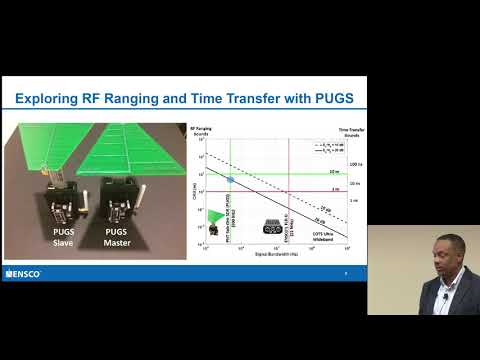
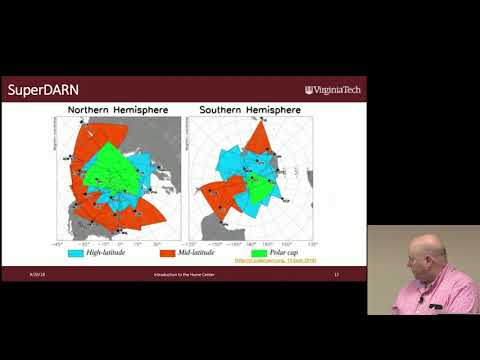
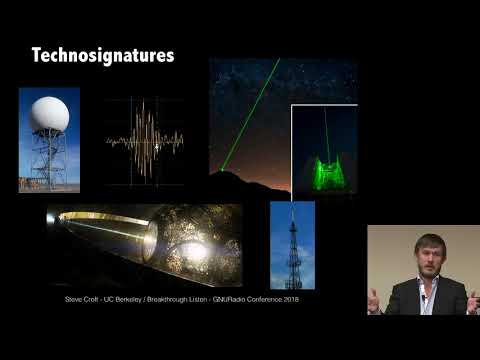
The New England Workshop on Software Defined Radio (NEWSDR) was held in May this year, and there have been several talks now uploaded to YouTube. These are typically fairly technical in nature, and discuss cutting edge research being performed with software defined radios. Below we post a few selected talks, and the rest can be viewed in this WPI playlist.
Remote Sensing of the Space Environment Using Software Defined Radio
From studies of the ionosphere to astronomical measurements with arrays of radio telescopes the manipulation and analysis of RF signals has been key to new instrumentation and many resulting discoveries. Software radio technology has been a core component of remote sensing of the space environment for several decades now. The flexibility of combining computing and radio was adopted very early on in scientific applications. This enabled new classes of scientific experiments which would otherwise have been impossible. The capability and adaptability of software radio instrumentation and systems has been growing consistently with the exponential increase in available computing power. The recent surge of low cost software radio hardware technology has enabled a new generation of instrumentation. These instruments are increasingly blurring the line between traditionally separate scientific disciplines as well as practical applications. I will discuss the science and the instrumentation enabled by software radio with highlights from studies of the ionosphere and radio astronomy. My overview will focus on the relationship to work underway at MIT Haystack Observatory. I will highlight the core architectural patterns of scientific software radio and discuss the evolution of our systems over several decades of rapid technological change. I will also look forward to the possibilities for discovery offered by the next generation of software radio and radar instrumentation.
NEWSDR 2018: Invited Presentation by Frank Lind (MIT Haystack)
Reinventing Wireless with Deep Learning
While wireless communications technology has advanced considerably since its invention in the 1890s, the fundamental design methodology has remained unchanged throughout its history – expert engineers hand-designing radio systems for specific applications. Deep learning enables a new, radically different approach, where systems are learned from wireless channel data. This talk will provide a high-level overview of deep learning applied to wireless communications, discuss the current state of the technology and research, and present a vision for the future of wireless engineering using a data-centric approach.
NEWSDR 2018: Invited Presentation by Nathan West (DeepSig)
Multi-objective SDR Optimization for Wireless Access, Actuation and Attacks
Software defined radios (SDRs) have become the foundational block of agile wireless communications. The first part of the talk presents an overview of how the same SDR can alternate between multiple different and non-traditional actuation functions, such as aerial distributed beamforming and wireless energy transfer. Furthermore, as SDR technology becomes more pervasive assuming roles beyond communication, there is a growing risk of security concerns of ID spoofing and malicious hardware attacks. The second part of this talk describes our efforts of fingerprinting individual SDRs using machine learning, where we only analyze the I/Q samples collected at the receiver. We demonstrate the feasibility of achieving 90-95% classification accuracy through experiments conducted with 12 radios, at separation distances of beyond 50 feet. The talk concludes with a summary of the challenges ahead and identifies other emerging application areas of SDRs that will impact the next decade.
NEWSDR 2018: Invited Presentation by Kaushik Chowdhury (Northeastern University)
Over on YouTube user Jan de Jong has uploaded a few screenshots and sounds on a video which shows that he was able to receive the ultrasonic sound of bats by connecting a small piezo speaker to an SDRplay RSP1A.
The piezo speaker used in reverse as a microphone appears to pickup bat echolocation sound waves which are typically between 20 to 200 kHz. The piezo is resonant in the 40 - 55 kHz range and converts sounds from that range into electric pulses that can be received directly by the RSP1A.
Last month we posted that the website for the popular NOAA APT weather satellite decoding software known as WxtoImg went down. Since then we've been in contact with the developer of the software, and he did indicate that he may restore the site at some time in the future, but is currently busy with other projects so doesn't have much time to devote to his old software at the moment.
In the meantime (or perhaps permanently) a WXtoImg fan has created a clone of the original website which he's called "WXtoImg Restored". The site contains most of the downloads as well as a professional edition update key, which was released for free by the original author before. If you don't trust the third party site, some downloads are also still available from the internet archival project's copies of the original WXtoImg website.
There are still some files missing on WXtoImg Restored, and these are outlined on the new website's homepage, so if you have them please contribute them to the site email.