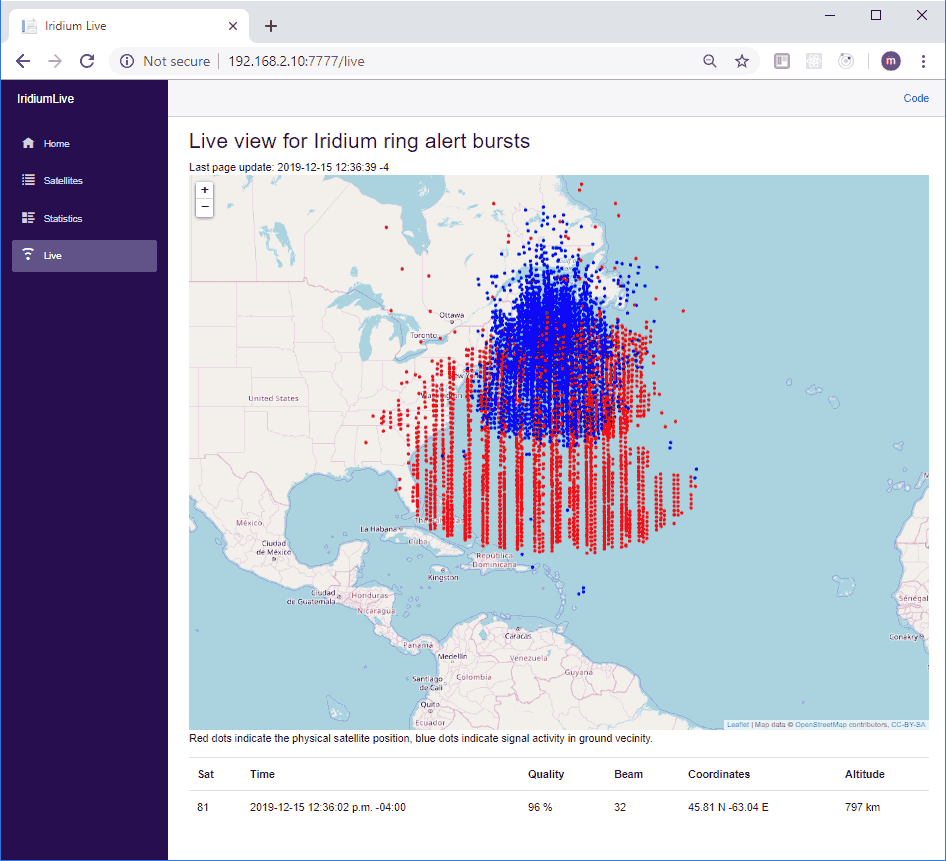
Over on YouTube Tech Minds has uploaded a video of him demonstrating Iridium Live plotting Iridium satellite tracks in real time. We just posted about Iridium Live yesterday. It is a new program by microp11, who is also the author of Scytale-C, a useful Inmarsat STD-C decoder. The software works with gr-iridium to visualize Iridium satellite tracks as they pass overhead.
In the video Tech Minds runs the software on a Raspberry Pi with an Airspy. The current video is only a demonstration, but in the near future he promises to upload a full tutorial
IridiumLIVE - Real Time Visualization Of Iridium Satellites - Raspberry Pi
Over on GitHub, microp11, the author of Scytale-C has released a new browser based program called IridiumLive which allows you to visualize the live positions of Iridium satellites as they pass overhead. Iridium is a satellite constellation that provides services such as global paging, satellite phones, tracking and fleet management services, as well as services for emergency, aircraft, maritime and covert operations too.
The software uses gr-iridium as the data source, which is an RTL-SDR and other SDR compatible Iridium satellite decoder. See this very interesting talk by the gr-iridium authors for more information, and this video by Techminds which shows how to install and run gr-iridium.
Also in order to receive Iridium satellites in the first place, you'll need an appropriate antenna such as our "RTL-SDR Blog Active L-Band 1525 - 1637 Inmarsat to Iridium Patch Antenna Set" which is currently available on our store.
Instructions for installing and running IridiumLive are available on the Git readme. Once installed you can browse to the IridiumLive web page on your local network, and view the tracks of the Iridium satellite fleet as they pass overhead, as well as the locations of Iridium signal activity from the ground.
Back in the middle of last year we posted about Othernet's Dreamcatcher hardware and the LoRa chat application. The Dreamcatcher is Othernet's receiver and computing platform that is designed for receiving their satellite data broadcast. It is currently available for US$79.
Although the Othernet datacast is one way receive only, the Dreamcatcher board uses a LoRa radio chipset that has TX capabilities that can be leveraged for experimental purposes. One experimental piece of software that they developed is a chat application that works with two Dreamcatcher boards. It allows you to initiate a text based chat between two boards using the on board LoRa radio chips.
The TechMinds YouTube channel has recently released a video demonstrating the chat application in action, and the video shows how to set up, install and use it too. We note that since our post last year, the Dreamcatcher board has gone through a revision and no longer includes an LCD screen. The company name has also changed from "Outernet" to "Othernet".
What can you do with two Othernet Dreamcatcher Boards?
FossaSat-1 is a recently launched open source "picosatellite" with an onboard LoRa repeater designed for Internet of Things (IoT) communications. It was launched via the Electron Rocket in New Zealand on December 6. At only 5 x 5 x 5cm in size and 250g in weight, a picosatellite is a tiny satellite that fits in your hand and can be affordably built and launched for around US$40k.
Since the launch, it has been confirmed that FossaSat-1 was successfully launched, and is working correctly. However, the antennas have not properly deployed yet resulting in a weak signal that cannot be received by small ground stations. The team are currently working on getting the antenna manually deployed from earth and the latest updates can be found on their Twitter @FossaSys. They note that if the antennas cannot be deployed, then there is still the future launches of FossaSat-1B and FossaSat-2 to look forward to.
While waiting for the antennas to deploy you can watch Andreas Speiss' YouTube video where he explains the satellite in more detail, and shows how to build a FossaSat-1 ground station that can receive the FossaSat-1 LoRa transmission and upload it to the internet. While not SDR-related as it uses a hardware based LoRa chip, this is still an interesting project that some readers may be interested in.
#302 We build a 20 Dollars LoRa Satellite Ground Station and we follow the FossaSat-1 launch
Over on YouTube Jan de Jong who is based in Germany has posted a short slide show video showing that he received reflections of the GRAVES space radar from the new Starlink satellites.
Starlink is a SpaceX run satellite constellation that is slowly being launched in order to provide worldwide satellite internet access. The last launch was on 11 November 2019. Typically multiple satellites are launched at once, and they follow each other closely in a line, slowly spreading out.
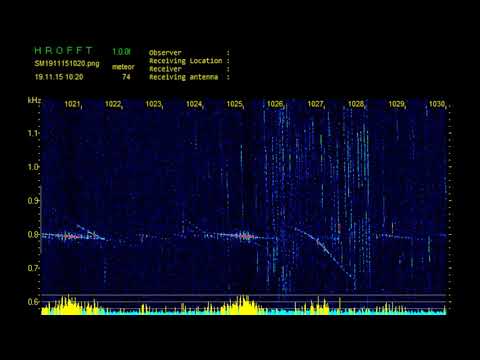
The GRAVES space radar is a powerful radar based in France that is used to track satellites. If you are not too far away from France and within the GRAVES radar footprint you can point an antenna at the sky, and tune to the GRAVES radar frequency of 143.05 MHz with an RTL-SDR or any other SDR. You might then receive the reflections of this radar signal coming from satellites passing overhead. GRAVES has also been used for meteor scatter detection.
As the 60 and more satellites from Starlink 2 pass over the Graves radar signal they reflect a vertical track on the HROFFT radar image from the 143.05Mhz signal. In the first images the satellites are all still very close together, in current passes they have spread already and the display looks almost like rain in the sky on the 1 second radar plot from HROFFT. Signal received with SDR RTL (SDRuno RSP1A) and 3 element Yagi at 45 degrees towards south
If you've been following our blog over the years, you'll know that we've mentioned the "Outernet" (now known as "Othernet") service a few times. Othernet is a satellite service that wants to provide one way data such as news, weather, audio, books and Wikipedia articles to those in areas with poor, censored or no internet connection. Previous iterations made use of home satellite TV equipment, then L-band (with RTL-SDR receivers) and now the Ku-band with LoRa receivers. Currently it's only available in North America and Europe.
However, thanks to a reader we were recently informed about an interesting and long running Othernet-like service for the Middle East called "Toosheh" (aka Knapsack) which makes use of satellite TV dishes and receivers that are very common in the Middle East. While not specifically related to SDRs, this is an interesting RF related project and situation that we wanted to post about.
After two rough weeks of no internet access at all, finally, we're gaining access again and getting back online slowly. As you may know (if you are following the news) a complete internet shutdown conducted by the I.R. of Iran due to some intense protests across the whole country against the government because of a 200% sudden and unannounced gas price increment. The internet is censored in my country anyhow but this time it was a big one. We only had access to a few domestic websites and NOT even Google services! That was tough!
I know it may be irrelevant to the subject of your blog but it's good for your audience to understand and know the people who have worked hard way before the OUTERNET project to develop a satellite offline broadcast with almost no special devices to receive and use and bring free and uncensored information to the people in Iran.
The major role of the Toosheh project occurred in the Iran 2012 presidential election protests which there were no major broadband internet services all over the country and it a lot to bring daily updates of news and TV programs. The Toosheh is a one-way receive only from the satellite but the tricky part is that Toosheh is not just like a simple satellite data link but it appears as a TV channel in all satellite TV receivers which are very common in Iran, so the blockage of it is hard for the government. However, some trials were arranged by the government back in that time to collect the satellite dishes or jam the signals or mass destruction (!) of the satellite receivers which they currently no longer common in most parts of the country. (at least without unnecessary violence. check out this link: بجستان نیوز » معدوم سازی تجهیزات ماهوارهای در بجستان+عکس(Admin note: Article is in Perisian, use Google Translate to translate Persian to English)
The procedure to use this service is freaking simple. Set your dish to Yahsat and search for the channels on 11766 Mhz. Select the Toosheh channel, plug a flash drive to your receiver and record the blank screen in.TS format using the PVR capability. After several hours of recording unplug your flash drive and connect it to your phone, tablet or laptop. Then open the Toosheh app and you are good to go. Now you have access to dozens of free podcasts, music, books, movies, news, webpages, TV shows and much more that will be updated every single day and if you need something specifically just send them an email. Exactly as same as the OUTERNET but without any special equipment and only with ordinary receivers that are available in almost every home nowadays.
Also if you see their website at toosheh.org and search some other press blogs about Toosheh you can gain more info about the topic.
Toosheh Website Image
We also note that this appears to be the English language version of Toosheh project which provides some more information about coverage and the technology used: https://knapsackforhope.org. Coverage is only available in the middle east.
Over on YouTube the TechMinds channel has uploaded a new video about decoding Differential GPS (DGPS) using an SDRplay RSPdx SDR. DGPS is a terrestrially transmitted long wave signal that is used to help correct and improve GPS position data calculations which may have timing errors due to atmospheric propagation delays. It works by broadcasting correction data calculated by the difference in received GPS location and the known location of the DGPS transmission site. DGPS is typically transmitted on longwave between 285 kHz and 315 kHz, but in Argentina there are two stations at 2570 and 2950 kHz.
In the video TechMinds explains how DGPS works, and some location around the world from where it is transmitted from. Later in the video he shows a DGPS signal being received by a SDRplay RSPdx SDR, and then show a demo of how it can be decoded with MultiPSK.
We note that there also various other DGPS decoders available including decoders for Android and iOS. A list of decoders can be found on the DGPS sigidwiki page.
DGPS Differential GPS Decoding With RSPdx And MultiPSK
Over on YouTube the TechMinds YouTube channel has uploaded a review of our RTL-SDR Blog L-Band patch antenna which we recently released. TechMinds tests the antenna on a STD-C Inmarsat channel with the Scytale-C decoder, and on various AERO ACARS transmissions with JAERO. Later in the video he also tests the patch antenna on Iridium reception using the Iridium Toolkit software. In all tests the patch is able to suitably receive the signal with either an RTL-SDR or Airspy SDR.
We also wanted to make a note about an additional tip regarding polarization that many people using the antenna seem to have missed. As Inmarsat signals are LHCP polarized, it is important to not only point the antenna towards the satellite, but also to rotate the antenna to match the polarization until maximum SNR is achieved. The rotation can make the difference between strong signals and nothing received at all.
RTL-SDR Active L-Band Patch Antenna For Inmarsat / Iridium / GPS
We've also recently seen a user 'Bert' who has needed to boost the signal strength as he was running the patch inside and at a location in northern Europe with poor reception of Inmarsat. To boost it he simply added a metal horn over the patch made from an old aluminum box, and also a back plate reflector. He notes that this improved his SNR on AERO 10500 from 8 - 9 dB, up to 12 - 14 dB. He also tested using the patch on a dish antenna, and found very good results too.
Aluminum Horn Added to L-Band PatchL-Band Patch Antenna on Dish