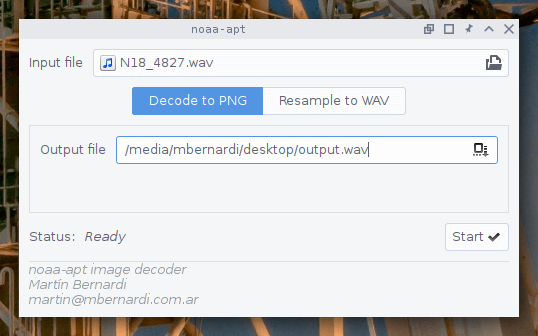
Over on GitHub user martinber has released a new NOAA APT image decoder that can run on both Linux and Windows. The decoder is called noaa-apt and takes a .WAV file of a NOAA satellite pass, and turns it into an image file. The .WAV file can be recorded in any SDR program like SDR#, HDSDR, GQRX etc. The program is programmed in Rust, and has ready to run binaries available for both Linux and Windows available on it's GitHub Releases page.
Compared to the features found in WXtoIMG the software is fairly basic, but as WXtoIMG has been abandoned it's good to see new APT decoders still being worked on. The software can also be used to simply resample the .WAV file into a sample rate required by other more featured decoders like aptdec.
NOAA weather satellites broadcast an Automatic Picture Transmission (APT) signal, which contains a live weather image of your area. With an RTL-SDR and antenna they can be received and downloaded every time one of the satellite's passes overhead. We have a tutorial on using an RTL-SDR with WXtoIMG available here.
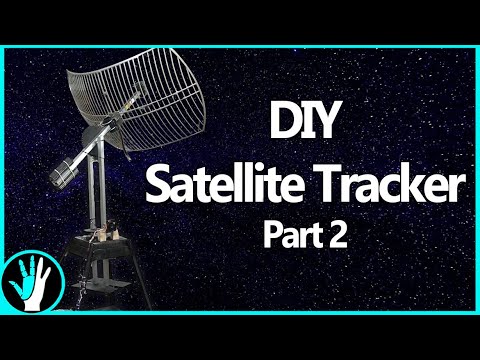
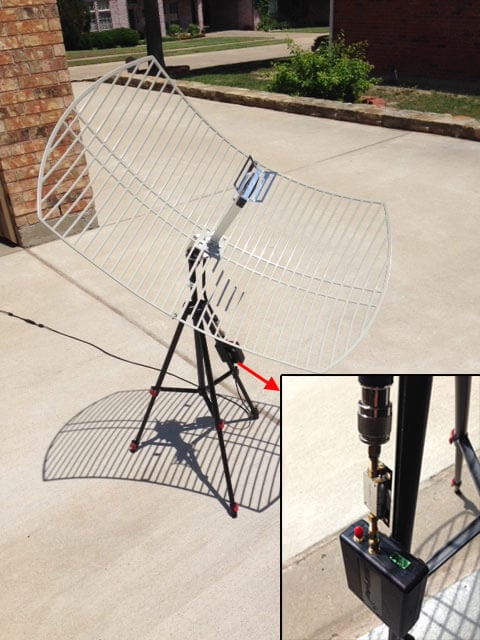
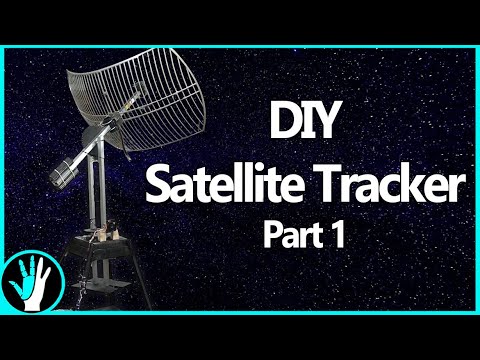
Earlier this month we posted about The Thought Emporium who uploaded a video to YouTube where they documented the first steps of their construction of a tracking mount for a 2.4 GHz grid WiFi dish which they intend to use for HRPT weather satellite reception.
If you didn't already know, receiving HRPT weather satellite signals is a little different to the more commonly received NOAA APT or Meteor M2 LRPT images which most readers may already be familiar with. HRPT is broadcast by the same NOAA satellites that provide the APT signal at 137 MHz, but is found in the L-band at around 1.7 GHz. The signal is much weaker, so a high gain dish antenna with motorized tracking mount, LNA and high bandwidth SDR like an Airspy is required. The payoff is that HRPT images are much higher in resolution compared to APT.
In this video they document the steps required to finish the physical build and add the electronics and motors required to control and move the dish. The final product is a working tracking mount that should be able to track the NOAA satellites as they pass over. In the next video which is not yet released they plan to actually test reception.
Thanks to IU2EFA (William) for writing in and letting us know about his success in decoding telemetry from the moon orbiting satellite known as DSLWP-B / LONGJIANG-2. LONJIANG-2 is a Chinese lunar microsatellite (45kg) that was launched in May 2018. It is designed to perform ultra long-wave radio astronomy observations. It also has an on board camera and took some nice photos of the Earth back in June.
While the satellite is still being tested, William notes that it is transmitting telemetry data to Earth during it's scheduled days at 435.4 MHz and 436.4 MHz, and the signal can be received with an RTL-SDR and Yagi antenna. William writes:
[LONJIAN-2] transmits with a little linear antenna and a little power of just 2 Watts.
In other sessions, I used a professional radio to have the maximum performance.
But this morning I wanted to test the reception, just using my RTLSDR V3 and my antenna yagi 15 elements pointed to the Moon. No other options (as filters, pre aplifiers, or other stuffs. Zero of these)
Well, the result was great. I received the signals and also i could decode them!
So I think people can be happy to know, that with a very little setup, they can receive incredible little signals from great distances.
When I received these signals, the Moon distance was about 378500 km.
LONGJIAN-2 transmits telemetry with GMSK and JT4G, and JT4G can be decoded with WSJT-X or WSJT 10. There is also a GNU Radio program called gr-dslwp that can be used to decode the telemetry. JT4G is a weak signal coding that can be decoded with signal levels down to -17 dB. Therefore anyone with modest hardware can decode the satellite. More information about the coding can be found on this post by Daniel Estevez.
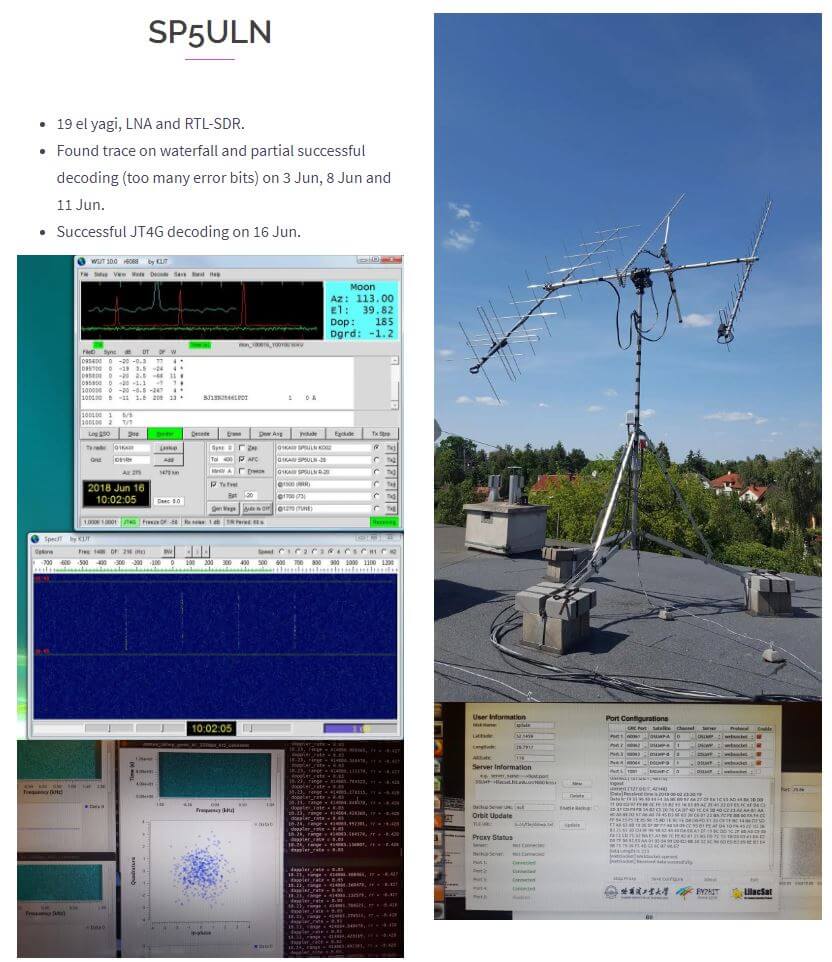
On the Lilacsat page for LONGJIANG-2 if you scroll down you can also see reports from several other amateur radio operators who have managed to receive the satellite with RTL-SDR dongles and other radios. Below is an image of an example for SP5ULN who was able to receive and decode the JT4G signal with an RTL-SDR, LNA, and 19-element Yagi.
Example of LONJIAN-2 being received with an RTL-SDR by SP5ULN as noted on the LilacSat website.
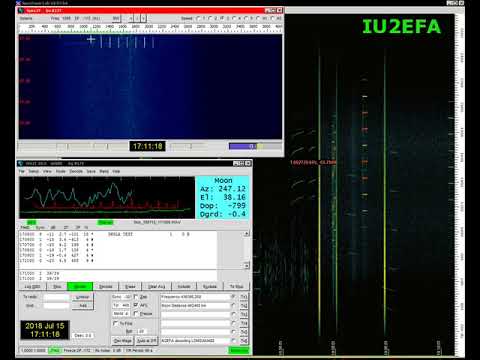
Ho Decodificato Segnali dalla LUNA! | Decoding a Satellite Orbiting the Moon (JT4G)
GOES 15/16/17 are geosynchronous weather satellites that beam back high resolution weather images and data. In particular they send beautiful high resolution 'full disk' images which show one side of the entire earth. As the satellites are in geosynchronous orbit, they are quite a bit further away from the earth. So compared to the more easily receivable low earth orbit satellites such as the NOAA APT and Meteor M2 LRPT satellites, a dish antenna, good LNA and possibly a filter is required to receive them. However fortunately, as they are in a geosynchronous orbit, the satellite is in the same position in the sky all the time, so no tracking hardware is required.
In the tutorial RSP2user notes that he's been using a $16 2.4 GHz WiFi grid dish antenna and the NooElec SAWbird LNA. In the past we've also seen GOES reception from Pieter Noordhuis who used a 1.9 GHz grid antenna from L-Com which seems to be a better match to the 1.7 GHz GOES frequency. However, 2.4 GHz WiFi grid antennas are much more common and therefore much cheaper. In the past there has been debate on whether or not these cheaper WiFi antennas would be good enough for GOES, so it's good to see that the cheaper option is confirmed to work, at least for the satellite elevations found in the RSP2user's part of the USA.
The SAWBird is a 1.7 GHz LNA which is required to improve SNR by reducing system noise figure, and to filter any interfering out of band signals. The SAWbird is currently not available for public sale, but NooElec have noted that it is due to be released soon. RSP2user also notes that the polarization of the dish is important, so the dish may need to be rotated, and also that flipping the secondary reflector significantly increases the gain at 1.69 GHz.
For software the XRIT demodulator from USA-Satcom for a small fee is used together with the SDRplay RSP2. As seen by Pieter Noordhuis' results, it's also possible to receive these signals with an RTL-SDR and Pieters free software. So it may be possible to reduce the costs of a GOES reception system by using an RTL-SDR, SAWBird and 2.4 GHZ WiFi grid antenna. With those components the total cost would be well under $100.
As a bonus, in later posts on his forum thread, RSP2user shows that the system can also be used to receive HRPT images from the low earth orbit NOAA 19 satellite by hand tracking the antenna as the satellite passes over.
Over on YouTube channel The Thought Emporium recently released a new video where they show the first steps they've taken towards building a home made satellite tracking mount for receiving HRIT and HRPT low earth orbit weather satellites. In their build they use a 2.4 GHz WiFi parabolic grid antenna, gears and mounts made from milled wood, and some metal supports. The build is not yet finished, but they intend to show their progress in future videos. Note that we're not confident that the 2.4 GHz grid antenna will actually work for them. In the past people have had success with 1.9 GHz Grid antennas however.
If you didn't already know, receiving HRPT weather satellite signals is a little different to the more commonly received NOAA APT or Meteor M2 LRPT images which most readers may already be familiar with. HRPT is broadcast by the same NOAA satellites that provide the APT signal at 137 MHz, but is found in the L-band at around 1.7 GHz. The signal is much weaker, so a high gain dish antenna with motorized tracking mount, LNA and high bandwidth SDR like an Airspy is required. The payoff is that HRPT images are much higher in resolution compared to APT.
Actually, it's not entirely true that a tracking mount is required, although it certainly makes things easier. We've seen in the past that 'Tysonpower' was able to receive HRPT by tracking his dish by hand.
The Thought Emporium also note that they hope to use their tracking mount in the future for other purposes like amateur radio astronomy. In one of their previous experiments they've build a smaller version which was able to create a heat map of WiFi signal strengths in their area.
Over on his YouTube channel Crazy Danish Hacker has posted a new video that shows how to pick up amateur radio voice signals from the International Space Station (ISS).
Often astronauts on the ISS will schedule times to chat with schools via amateur radio frequencies. This provides an opportunity to learn about radio whilst at the same time allowing kids to talk directly to an astronaut.
If you live in an area that can 'see' the ISS at the same time as the school then you can easily pick up the downlink (astronaut to ground) portion of the conversation while the ISS passes over. The downlink signal is fairly strong, so only a simple antenna is required. In his video Crazy Danish Hacker uses a telescopic whip attached directly to his RTL-SDR which is placed outside with a view of the sky.
International Space Station - Software Defined Radio Series #29
Last month we posted that the website for the popular NOAA APT weather satellite decoding software known as WxtoImg went down. Since then we've been in contact with the developer of the software, and he did indicate that he may restore the site at some time in the future, but is currently busy with other projects so doesn't have much time to devote to his old software at the moment.
In the meantime (or perhaps permanently) a WXtoImg fan has created a clone of the original website which he's called "WXtoImg Restored". The site contains most of the downloads as well as a professional edition update key, which was released for free by the original author before. If you don't trust the third party site, some downloads are also still available from the internet archival project's copies of the original WXtoImg website.
There are still some files missing on WXtoImg Restored, and these are outlined on the new website's homepage, so if you have them please contribute them to the site email.
Thank you to Reiichiro Nakano for submitting news about his work on converting the Pascal based meteor_decoder software into a C++ GNU Radio block. meteor_decoder is a decoder for the Meteor M2 weather image satellite. Meteor M2 is a Russian weather satellite that transmits images down in the digital LRPT format. This provides much higher resolution images compared to the NOAA APT signals. With an RTL-SDR, appropriate satellite antenna and decoding software it is possible to receive these images.
Reiichiro works for Infostellar, which appears to be a Japanese company aiming to connect satellites to the internet via distributed and shared ground stations. It appears to be somewhat similar to the SatNOGs project. Reiichiro writes:
Just wanted to share a simple project I built for my company Infostellar, in the past week. I converted https://github.com/artlav/meteor_decoder to C++ and placed it within a GNURadio block for direct decoding of Meteor M2 images. It's a sink that expects soft QPSK demodulated signed bytes. Once the flowgraph stops running, it parses out received packets and dumps the received Meteor images in a specified location.