Updates to a Month of RTL-SDR by Keenerd

Back in August of this year RTL-SDR code contributer Keenerd aka Kyle Keen ran an Indiegogo campaign to raise funds to pay for him to work on upgrading RTL-SDR related code for one month. As Kyle only counts the days he manages to put a good effort in towards the upgrades, the coding is still ongoing. He recently put out an update which we quote below.

Programming Report – Week 3

Hey all, sorry about dropping off the radar there.  There were several large unexpected events in recent months, but nothing bad.  I’ve still been hacking on the project.  An anonymous donor gave me a Lyons DSP textbook, which I’ve been working through for more solid foundations.  But studying doesn’t generate any new code for you to play with, so hasn’t been counted towards the project.

I’ve also been working on a very ambitious ADS-B related side project.  It is something no one has ever done before with the RTL-SDR, but mathematically it is feasible and progress is steady.  Not anywhere near for a release (and might yet be impossible in practice), and thus also hasn’t been counted towards the project.

So what has been completed since the last report?

* Automatic audio gain.  Crucial for AM/SSB listening.

* Audio padding (constant rate audio).  If you are streaming rtl_fm, this will prevent stutters when the tuner is busy hopping.

* Heatmap fixes.  The font is downloaded automatically and image slicing is completed.  Run rtl_power 24×7 but render a heatmap of only the last hour, for example.

* Rtl_power fixes.  Including one tricky corner case that caused crashes.

Also a big thank you to Kacper Michajłow who fixed and fleshed out a couple of Windows issues that were giving me trouble.

25 days remain.  As always, if you have comments or suggestions you can reach me by email or in ##rtlsdr.

The latest feature requests and links to the GitHub repositories and Windows builds can be found at http://igg.kmkeen.com/.
monthrtlsdr

Airspy Second Batch of Preorders Available

The Airspy software defined radio recently completed its first round of 400 pre-orders. Now the second round of pre-orders has become available over on the manufacturers web store. It is priced at $199 USD and they expect the orders to be shipped around the middle of December.

If you were unaware the Airspy is an RX only SDR developed by the author of the SDR# software. It has a tuning range of 24 MHz to 1.7 GHz, up to 10 MHz of instantaneous bandwidth and a 12-bit ADC. The full list of features is shown below.

  • Continuous 24 – 1750 MHz RX range with no gaps
  • 3.5 dB NF between 42 and 1002 MHz
  • Tracking RF filters
  • 35dBm IIP3 RF front end
  • 12bit ADC @ 20 MSPS (80dB Dynamic Range, 64dB SNR, 10.4 ENOB) – Yeah, size does matter.
  • Up to 80 MSPS for custom applications
  • Cortex M4F @ up to 204MHz with Multi Core support (dual M0)
  • 1.5 ppm high precision, low phase noise clock
  • 1 RTC clock (for packet time-stamping)
  • External clock input (10 MHz to 100 MHz via MCX connector) – Ideal for phase coherent radios
  • 10 MHz panoramic spectrum view with 9MHz alias/image free
  • IQ or Real, 16bit fixed or 32bit float output streams
  • No IQ imbalance, DC offset or 1/F noise at the center of the spectrum that plagues all the other SDRs
  • Extension ports: 16 x SGPIO
  • 1 x RF Input (SMA)
  • 1 x RF Output (Loopthrough, U-FL)
  • 2 x High Speed ADC inputs (up to 80 MSPS, U-FL)
  • 4.5v software switched Bias-Tee to power LNA’s and up/down-converters

The Airspy was recently reviewed in two videos by W9RAN, the second video showing some sensitivity measurements. There are also various other videos of the Airspy in action now on YouTube.

Airspy Software Defined Radio

HackRF Blue: A Lower Cost HackRF

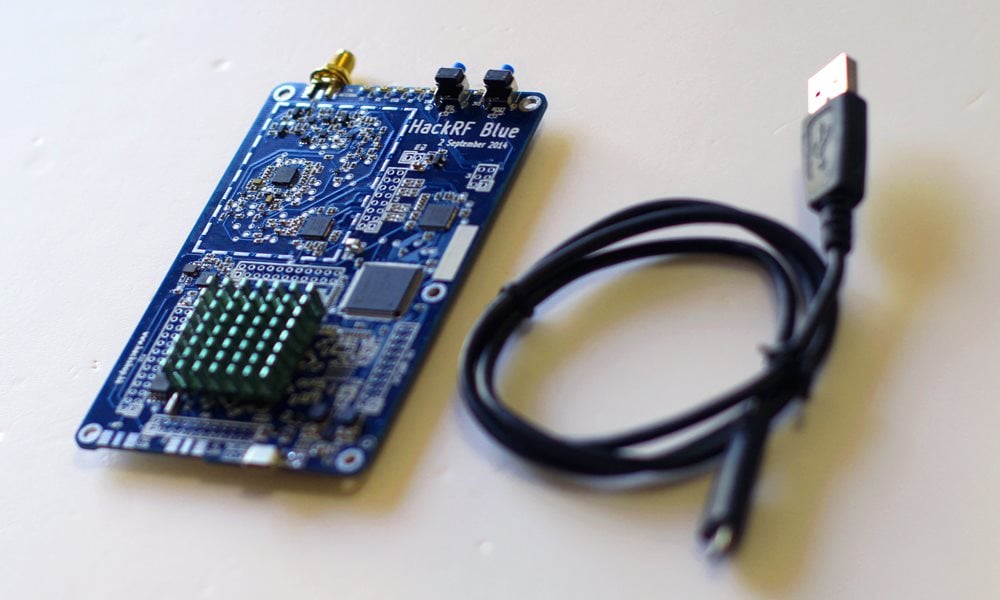
Earlier in the year the HackRF One was released by Micheal Ossmann. It is a transmit and receive capable software defined radio with a 10 MHz to 6 GHz range which currently sells for around $300 USD. Since the HackRF is open source hardware, anyone can make changes to the design and build and sell their own version.

The HackRF Blue is a HackRF clone that aims to sell at a lower cost. By sourcing lower cost parts that still work well in the HackRF circuit, the team behind the HackRF Blue were able to reduce the price of the HackRF down to $200 USD. They claim that the HackRF Blue has the same performance as the HackRF One and is fully compatible with the HackRF software. They are currently seeking funding through an IndieGoGo campaign.

Their main goal through the funding is to help provide underprivileged hackerspaces with a free HackRF.

The HackRF Blue
The HackRF Blue

Airspy Sensitivity Measurements and HF Performance

Over on YouTube user ranickel (aka W9RAN) has uploaded a video discussing and reviewing the sensitivity of the Airspy software defined radio. In the video he uses a signal generator to generate a reference signal and shows what the effect of software decimation has on the signal to noise ratio. His results show that the Airspy is a very sensitive and low noise receiver that is comparable to some very expensive hardware.

Airspy Sensitivity Measurement by W9RAN

In another new video W9RAN shows a quick sneak peak at the performance of the Airspy on the 20 meter CW band when using a prototype HF upconverter that he is developing.

Airspy HF Converter Sneak Peek by W9RAN

Sniffing and Analyzing GSM Signals with GR-GSM

Over a year ago we wrote a tutorial on how to analyze GSM cellular phone signals using a RTL-SDR, a Linux computer with GNU Radio, Wireshark and a GSM decoder called Airprobe. With this combination it is possible to easily decode GSM system messages. Setting up Airprobe is can be difficult as it is unmaintained and incompatible with the new version of GNU Radio without patches.

Now a new software package called gr-gsm has been released on GitHub which seems to be a newer and improved version of Airprobe. The gr-gsm software is also much easier to install, uses the newer GNU Radio 3.7 and seems to decode the system data with much less trouble than Airprobe did. We will soon update our tutorial to use gr-gsm, but the instructions on the GitHub are already quite good. The author of gr-gsm also appears to be actively adding new features to the software as well. The video below shows gr-gsm in action.

Sniffing GSM data with gr-gsm and cheap RTL-SDR receivers

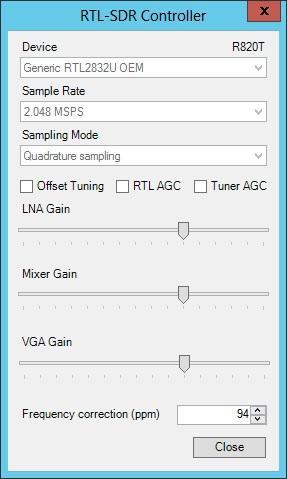
New R820T Driver with LNA/Mixer/VGA Gain Settings

A few weeks ago we posted about an unreleased modified RTL-SDR driver for SDR# by mm6dos which had controls for the three separate gain stages available in the R820T and some extra controls for controlling software decimation and the IF filter. While that particular driver has not yet been released, a modified driver from randaller, another driver coder has been released. His modified driver enables the LNA/Mixer/VGA gain controls, but does not enable any IF filter or decimation settings.

In the standard R820T driver one of the gain stages is locked to a pre-specified value and the the gain slider is a function of the other two gain values. Having full manual control over all three gain stages may help with optimizing signal SNR levels and reducing noise.

To install the driver simply extract the contents of the zip file from the sourceforge download into the sdrsharp folder. Then open the SDRSharp.exe.Config file in a text editor and add the line  in the section. Then in SDR# you can choose “RTL-SDR / GUSB” from the source menu to use the new driver.

Modded Driver with Extra Gain Controls

Recording Video of Passing Aircraft with A Raspberry Pi and RTL-SDR

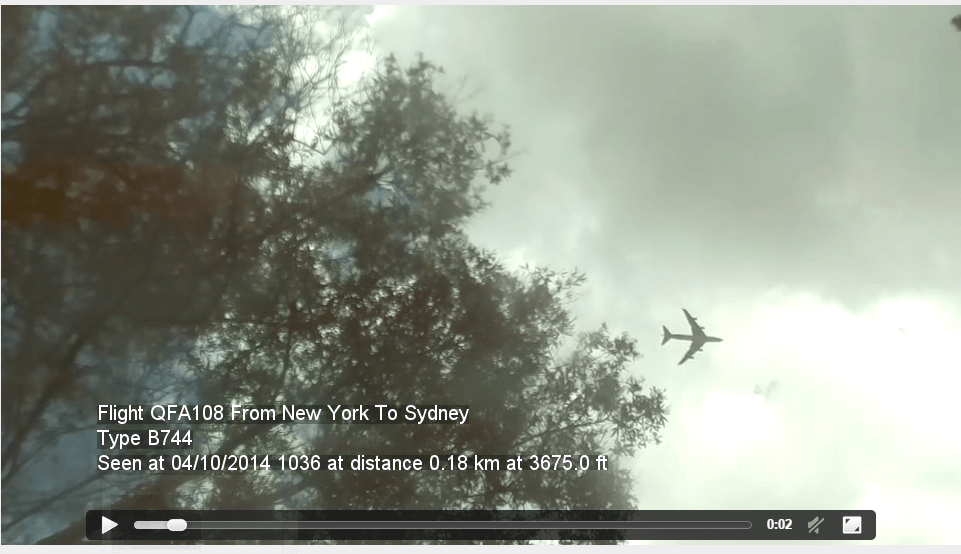
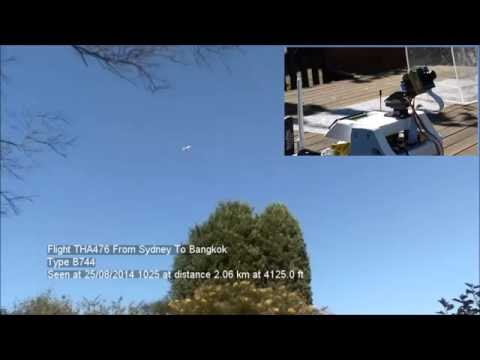
Electronics experimenter Simon Aubury has recently made a write up on his blog about a project he has been working on. His project is the use of a Raspberry Pi with servo mounted video camera and RTL-SDR to automatically track and record video of passing aircraft.

Simon’s project works by using the RTL-SDR connected to the Raspberry Pi as an ADS-B receiver. From the ADS-B signals the current coordinates of nearby aircraft can be determined. Then by using some coordinate math, the Raspberry Pi can be told to point its camera in the direction of the aircraft. As well as videoing the passing aircraft, the Raspberry Pi also overlays text on to the video showing information such as flight number, source and destination airports, aircraft type, elevation and distance and date of observation.

In addition to all that, his software also automatically uploads the recorded videos onto his website. Here you can see the latest and closest video captures his system has performed.

[Discovered on Hackaday]

Raspberry Pi RTL-SDR Plane Tracker Video Capture

Comparisons between the R820T and R820T2 RTL-SDR Tuners

Over on the hamradioscience blog the author has uploaded a post showing a comparison between the R820T and the R820T2 tuners.

Recently Nooelec began selling RTL-SDR dongles with the R820T2 tuner chip in them. The R820T2 tuner has been anecdotally reported as having slightly better sensitivity (~2-6 dB better). It also works much better with Oliver Jowetts experimental RTL-SDR driver which enables HF reception without any hardware modifications.

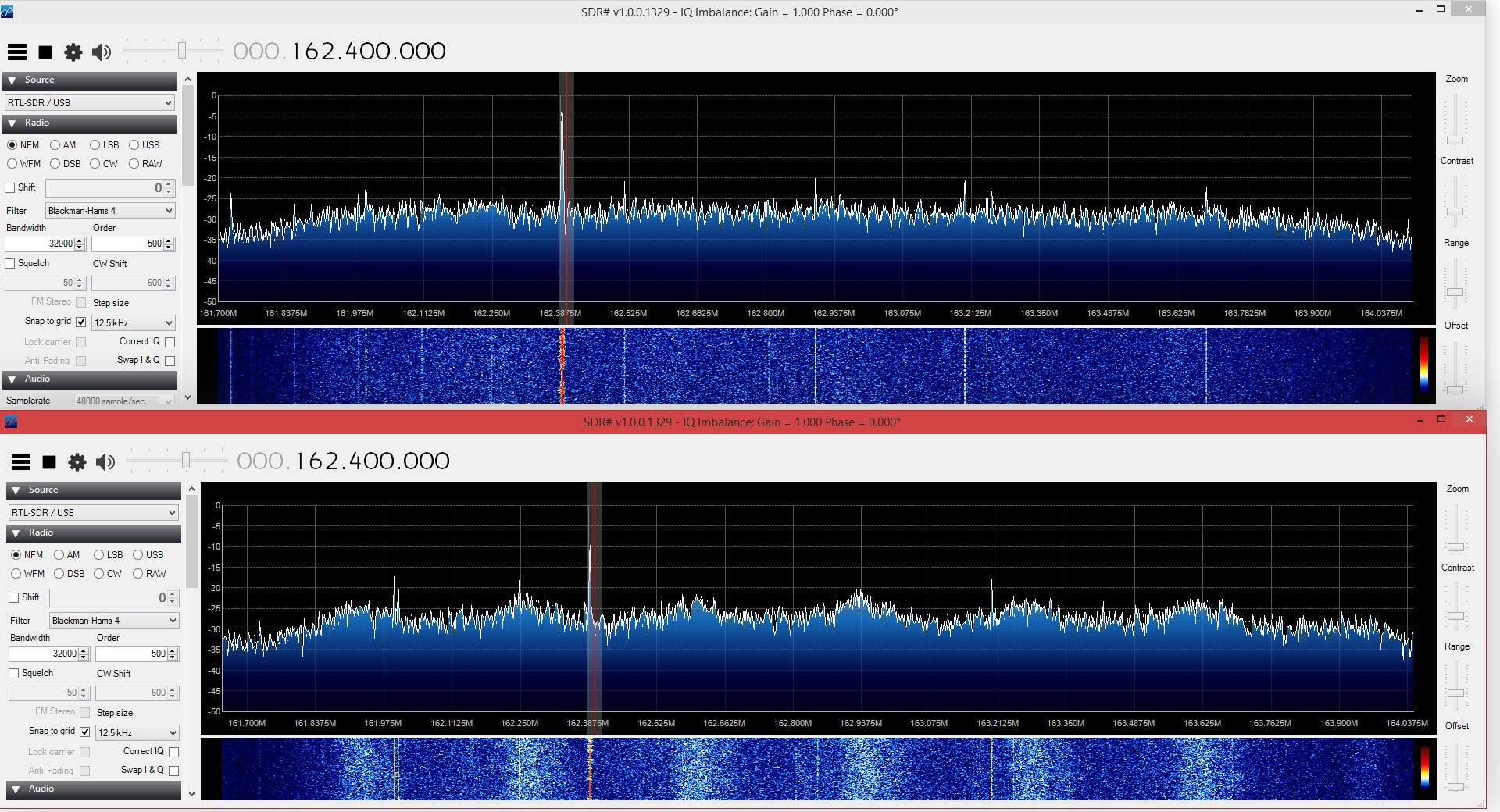
In the post the author compares the two tuners by simultaneously running both with SDR# and the same antenna type and comparing the results. From his results the author writes that although not night and day, there is a noticeable difference in sensitivity between the two tuners. He also writes that for ADS-B the R820T2 performed much better, reporting significantly more packets and further distances compared to the R820T.

Comparison between the R820T2 and R820T on a NOAA weather station. (R820T2 Top, R820T Bottom)