Tagged: hackrf

HackRF Decoding PICO High Altitude Balloons (HAB)

Blogger g0hww shows us how he used his HackRF to decode Pico high altitude balloon (HAB) transmissions using gqrx and dl-fldigi. Pico balloons are small party sized high altitude balloons, typically launched by hobbyists. They have enough lift to carry a small sized ~60g payload. Since they are so small, they are usually exempt from requiring permission from the authorities, unlike full sized weather balloons.

The cheaper RTL-SDR could also be used to track these balloons.

PICO High Altitude Ballo0n Recevied with HackRF

RTL-SDR/HackRF Live DVD

If you’ve been wanting to use your RTL-SDR or HackRF on Linux, but didn’t know how to or couldn’t be bothered installing all the software, there is now a live DVD downloadable thanks to Reddit user rtl_sdr_is_fun. With a live DVD you can boot into an Ubuntu OS (with many pre-installed SDR related programs) directly from the DVD without the need to install anything.

The Live DVD is only available for 64-bit CPUs.

See more information about the Live CD and the software it contains in this release note, and see the Reddit thread here.

Direct Download:

http://files.persona.cc/linux/ubuntu/ubuntu-12.04.2-custom-sdr-amd64.iso

Torrent: (seeded by server and supports webseed)

http://files.persona.cc/linux/ubuntu/ubuntu-12.04.2-custom-sdr-amd64.iso.torrent

New Software Defined Radio “Matchstiq” by Epiq Solutions Announced

A new high-end small form factor software defined radio (SDR) transceiver called the Matchstiq has been announced by engineering firm Epiq Solutions. Pricing starts at a costly $4500 USD, as it seems to be aimed more at the professional market. It’s key features are

  • Single RF transceiver covering 300 MHz to 3.8 GHz
  • Supports RF channel bandwidths up to 28 MHz
  • Integrated CPU/FPGA for signal processing applications
  • Integrated GPS receiver with 1PPS
  • Run time loadable/executable software applications
  • Full suite of specialty applications available
  • SDK available for custom application development uSD provides up to 32 GB of onboard data and application storage
  • USB interface to host for system access
  • Size: 2.2” x 4.6” x 0.9” Power: <3 W (typical)
  • Optional external battery pack

It also has the ability to wirelessly interface with and Android host

With this and the BladeRF and HackRF, 2013 is looking like a good year for SDR.

Matchstiq

HackRF SDR Giveaway

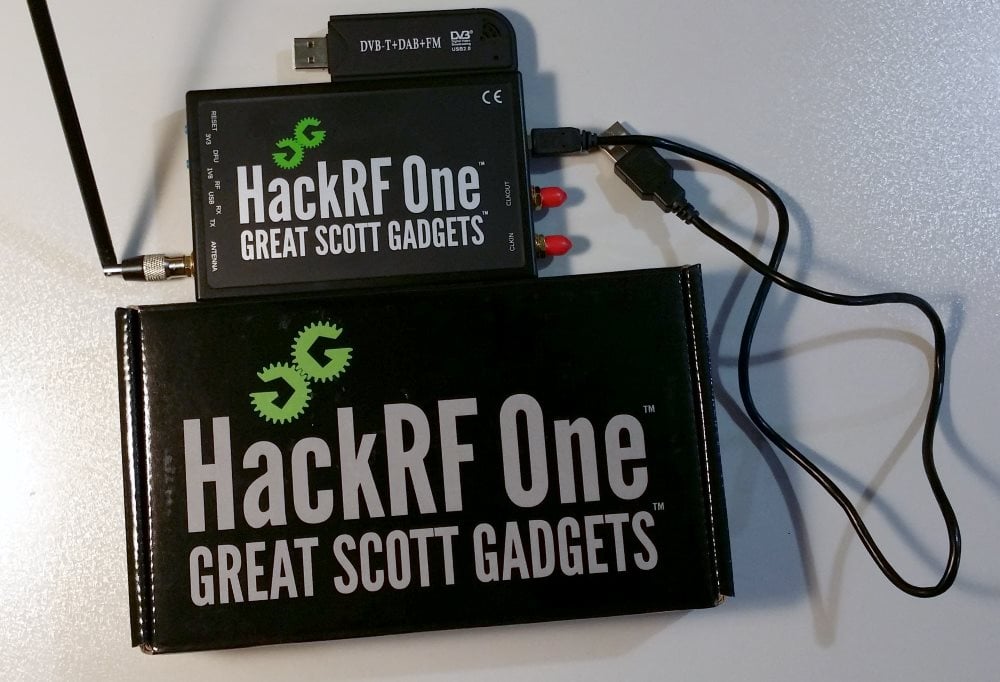
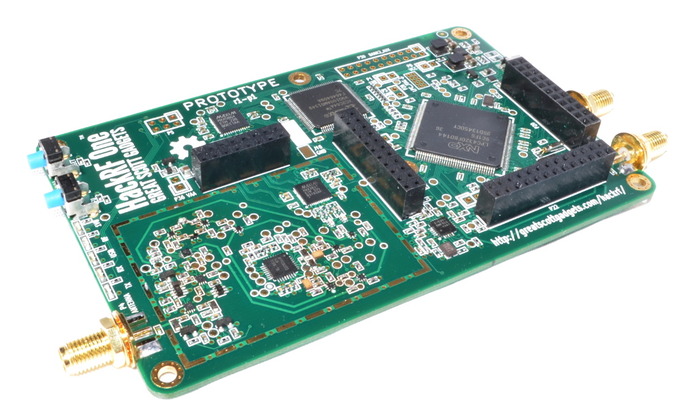
HackRF is an upcoming open source DARPA funded ~$300 software defined radio that has both transmit and receive capabilities. It has a 100 MHz to 6 GHz range, 20 Msps sample rate, 8-bit resolution, and 500 beta units are about to be given away for free by greatscottgadgets. A good introduction to the HackRF can be found here, and on this wiki here.

Register here for a chance at receiving a free beta unit.

HackRF Jawbreaker Board with Enclosure

RTL-SDR Tutorial: Receiving NOAA Weather Satellite Images

----------------------------------------------------------------

2025 Update:

***NOTE*** Unfortunately, the NOAA 15/18/19 satellites have now all been decommissioned as of August 2025. Therefore, it is no longer possible to receive them.

We will leave this tutorial post up for archival and historical reasons.

2024 Update:

***PLEASE NOTE THAT THIS TUTORIAL IS OUTDATED.***

Currently, we recommend using the SatDump software instead. A modern tutorial for SatDump can be found at https://www.a-centauri.com/articoli/noaa-poes-satellites-reception.

----------------------------------------------------------------

Everyday multiple NOAA weather satellites pass above you. Each NOAA weather satellite broadcasts an Automatic Picture Transmission (APT) signal, which contains a live weather image of your area. The RTL-SDR dongle combined with a good antenna, SDRSharp and a decoding program can be used to download and display these live images several times a day.

This tutorial will show you how to set up a NOAA weather satellite receiving station, which will allow you to gather several live weather satellite images each day. Most parts of this tutorial are also applicable to other software radios, such as the Funcube dongle and HackRF and Airspy, but the RTL-SDR is the cheapest option. Hardware radio scanners can also work, provided the radio has a large IF bandwidth (30 kHz +) and a discriminator tap.

Note that if you have success with this tutorial, you may also be interested in decoding Meteor M N2 weather satellites which provide much higher resolution images. Also, an alternative tutorial for decoding NOAA satellites that uses rtl_fm can be found here.

NOAA Weather Satellite Image

Examples

YouTube user GaitUutLiern shows an example of receiving NOAA satellite weather images with a RTL-SDR, SDRSharp, a decoding program called WXtoImg and a QFH antenna.

Receiving NOAA weather satellite using SDR# and WXtoImg

Continue reading

RTL-SDR Tutorial: Cheap AIS Ship Tracking

Large ships and passenger boats are required to broadcast an identification signal containing position, course, speed, destination, and vessel dimension information to help prevent sea collisions. This system is known as the "Automatic Identification System" or AIS for short. There are dedicated AIS receivers intended to be used on boats, or by hobbyists, but they can be expensive. A radio scanner, or the cheap RTL-SDR software defined radio (or a more advanced SDR such an Airspy) can be used to receive these signals, and with the help of decoding software, ship positions can be plotted on a map.

This tutorial will show you how to set up an AIS receiver with the RTL-SDR. Most parts of this tutorial are also applicable to other software radios, such as the Funcube dongle, Airspy and HackRF, or even regular hardware scanners if a discriminator tap is used, but the RTL-SDR is the cheapest option.

Safety Warning: This probably should not be used a navigational aid on a boat as the field reliability of the RTL-SDR or other software radios is not proven. This guide is intended for land based scanner hobbyists.

Note, tracking ships with AIS is very similar to tracking aircraft with ADS-B, which is another project that may interest you.

Examples of AIS received with RTL-SDR

An AIS radar example is shown by YouTube user Vinicius Lenci who uses an RTL-SDR, SDRSharp and ShipPlotter. This video also shows what a strong AIS signal sounds like.

Recebendo sinais (AIS) com RTL-SDR

Continue reading

RTL-SDR Tutorial: Decoding Digital Voice (P25, DMR, NXDN, D-STAR) with DSD

The RTL-SDR software defined radio combined with SDRSharp and a program called “digital speech decoder” (DSD) can be used as a radio scanner to easily and cheaply listen to unencrypted digital radio voice conversations.

Digital radio voice communications are becoming more commonly used in the radio spectrum. This is due to the various improvements offered over traditional analogue voice radio systems. Unfortunately for radio scanner hobbyists, digital radio is difficult to receive, as special radio scanners which can be expensive are required to decode the digital signal. Additionally, digital radio systems can be encrypted making it impossible for communications to be decoded by a hobbyist. However, most users of digital radio do not bother to encrypt their systems as it can introduce lag, monetary expense and extra battery drain in portable radios.

The most common digital speech codec is APCO P25, which DSD is able to decode. DSD is also capable of decoding other common digital codecs such as DMR/MOTOTRBO, NXDN, D-STAR and ProVoice.

Super cheap software defined radios such as the RTL-SDR can be used to decode these digital voice communication signals instead of expensive radio scanners. While this tutorial is aimed at the RTL-SDR, other software radios such as the Funcube dongle, Airspy, HackRF and BladeRF will also work. Hardware radios with discriminator taps connected to a PC may also work.

Examples of DSD Decoding Digital Voice with RTL-SDR as a Radio Scanner

YouTube user Geoff Wolf shows a video where he uses RTL-SDR as a police scanner to listen to public safety P25 digital radio using DSD, SDRSharp and virtual audio cable.

RTL-SDR: Decoding P25 Phase I QPSK with DSD and SDR#

Continue reading