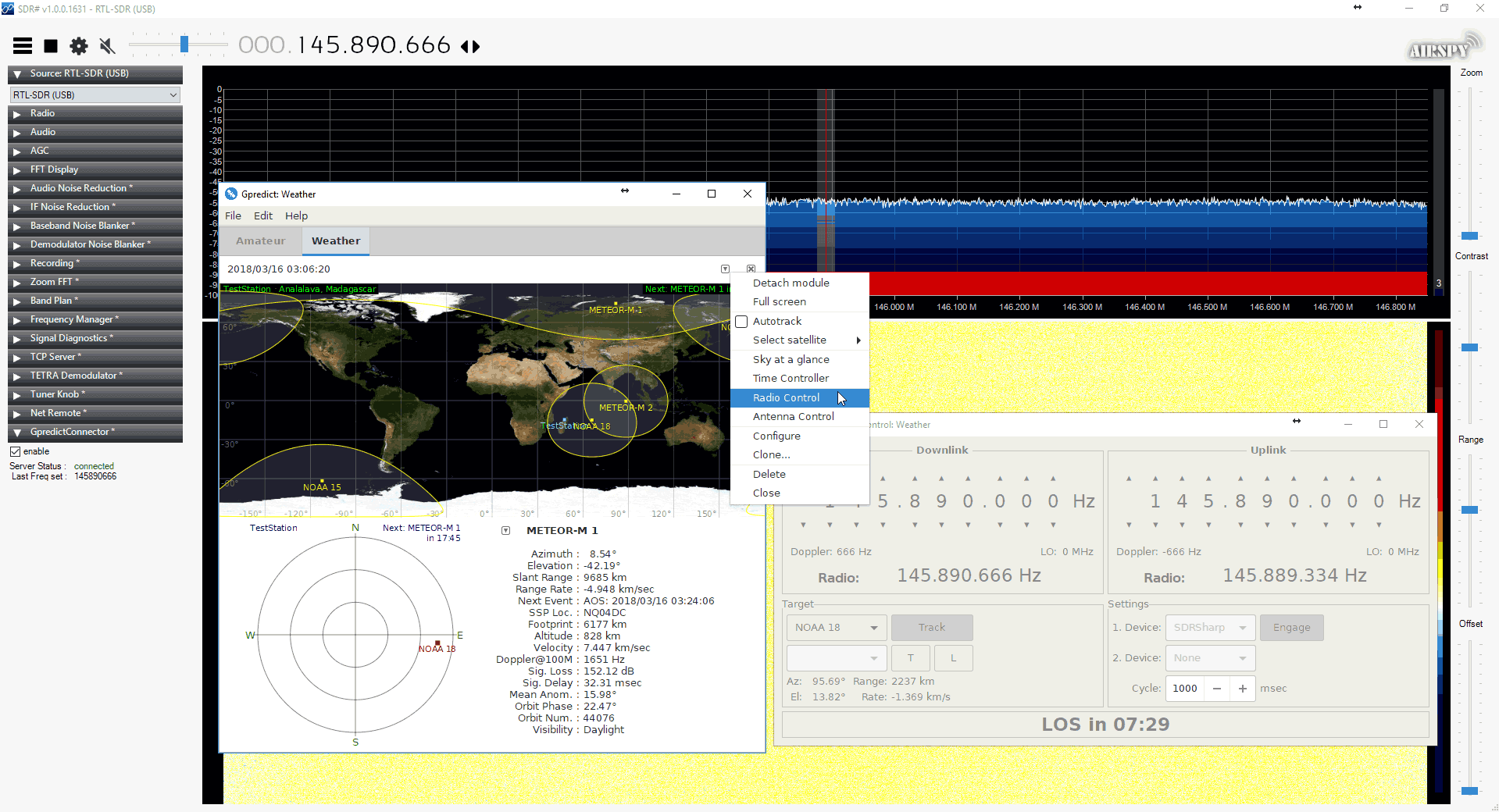
Thanks to Alex for submitting news about his new SDR# plugin called "SDRSharp.GpredictConnector". This plugin allows SDR# to interface with GPredict which is a tool used for tracking the orbit of satellites. Just like with the DDE Tracking plugin and the Orbitron satellite tracking program this plugin could be used to automatically tune SDR# to the frequency of a passing satellite using GPredict. It should also be able to compensate for any doppler shift frequency offset.
To use with SDR# simply download the zip file and move the .dll file into the SDR# folder. Then add the 'magicline' to the plugins.xml file using a text editor. In GPredict you can then add a radio interface from the preferences, and then use the 'Radio Connect' interface to connect to the plugin.
Connecting to GPredict using the GPredictConnector SDR# Plugin
To begin with Nexmon SDR you'll need a development environment set up on a Nexus 5 smartphone. Then it's a matter of downloading the dependencies, installing the Android NDK, and compiling Nexmon. IQ data can then be transmitted in code using from special system commands.
The Nexmon team have indicated on Twitter that they plan to present a paper with more information on Nexmon SDR at the MobiSys 2018 conference which will be held in June.
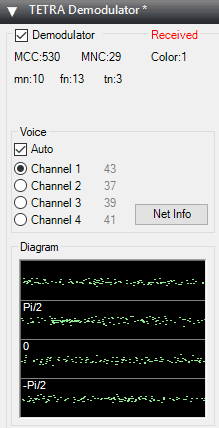
Last week we posted about the release of a new TETRA decoder plugin for SDR#. The plugin made setting up a TETRA decoder significantly easier compared to previous methods, but it still required the installation and use of the MSYS2 environment on Windows.
Thanks to reader Zlati for letting us know that the TETRA plugin has recently been updated once again and now no longer requires MSYS2 to be installed first. Now it is as easy to install as any other plugin, just drop the .dlls into the SDR# folder and add the magicline to the plugins.xml file. We tested it out and decoding worked fine. At the moment the "Net info" button is not working however.
In the future news and download lines for newer versions will probably be available on the programmers radioscanner.ru forum thread which is available here (use Google Translate to read): http://www.radioscanner.ru/forum/topic50051-9.html
The IcoBoard is an FPGA IO board that is compatible with the Raspberry Pi. An FPGA (Field Programmable Gate Array) is a silicon chip that can implement custom digital circuits (such as DSP processors) and be reconfigured with different circuits many times. Other silicon chips are ASICs (application specific integrated circuit) which have circuits that are set in stone.
Over on YouTube OpenTechLab has been trying to create a software defined radio with his IcoBoard FPGA. To do this he's combined it with an audio A2D/D2A (analog-to-digital/digital-to-analog) converter board and a Raspberry Pi. The video goes through the entire design process, including A2D/D2A selection and purchasing, PCB adapter design in KiCad, soldering the PCB, as well as 3D printing a frame.
In the last part of the video he does a simple test where a signal is input into the A2D converter, converted to digital and processed by the FPGA. The circuitry programmed into the FPGA then simply outputs the received data to the D2A which converts it back into an analog signal. In the next steps of the project OpenTechLab hopes to work on the software and turn it into a full SDR. Show notes for the video are available here.
[014] IcoBoard Software Defined Radio Project - Hardware
Recently we've posted about Eddie MacDonald's several releases of new plugins for the popular SDR# software. Recently he's released a tuner knob plugin which provides a visual frequency tuning knob that is useful for those running on touchscreen hardware, a 'dark mode' plugin which reduces the brightness of SDR# and compresses the UI a little, and an FFT grabber plugin which allows for easy screenshots of the FFT and waterfall spectrum's to be taken.
Eddie notes that all his plugins now have an actual home website at https://sdrplugins.com. This is where he will release updates and new plugins from now on.
If you are interested in discovering more SDR# plugins, we have a large list available here.
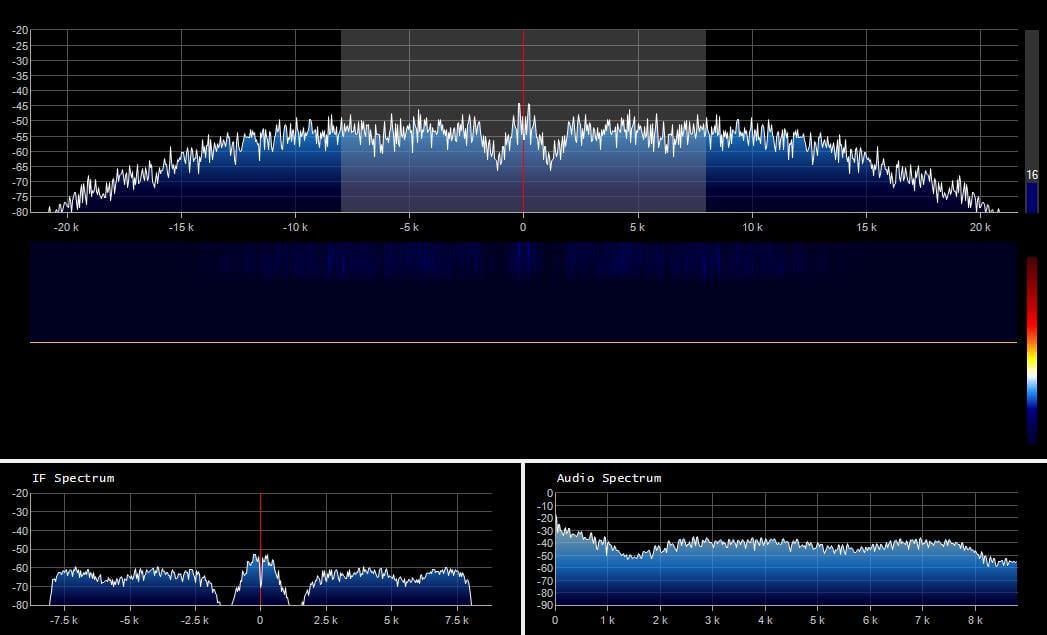
Recently Eddie MacDonald has been pumping out simple but useful plugins for SDR# including the SDR# Dark Mode and Visual Tuner Knob plugins. Recently he released a new plugin called "FFT Window Screen Grabber". This plugin simply helps you to easily take a screenshot of the FFT and waterfall displays in SDR#. It could be a useful plugin if you are constantly finding interesting signals that you want to document, or upload to sigidwiki.com.
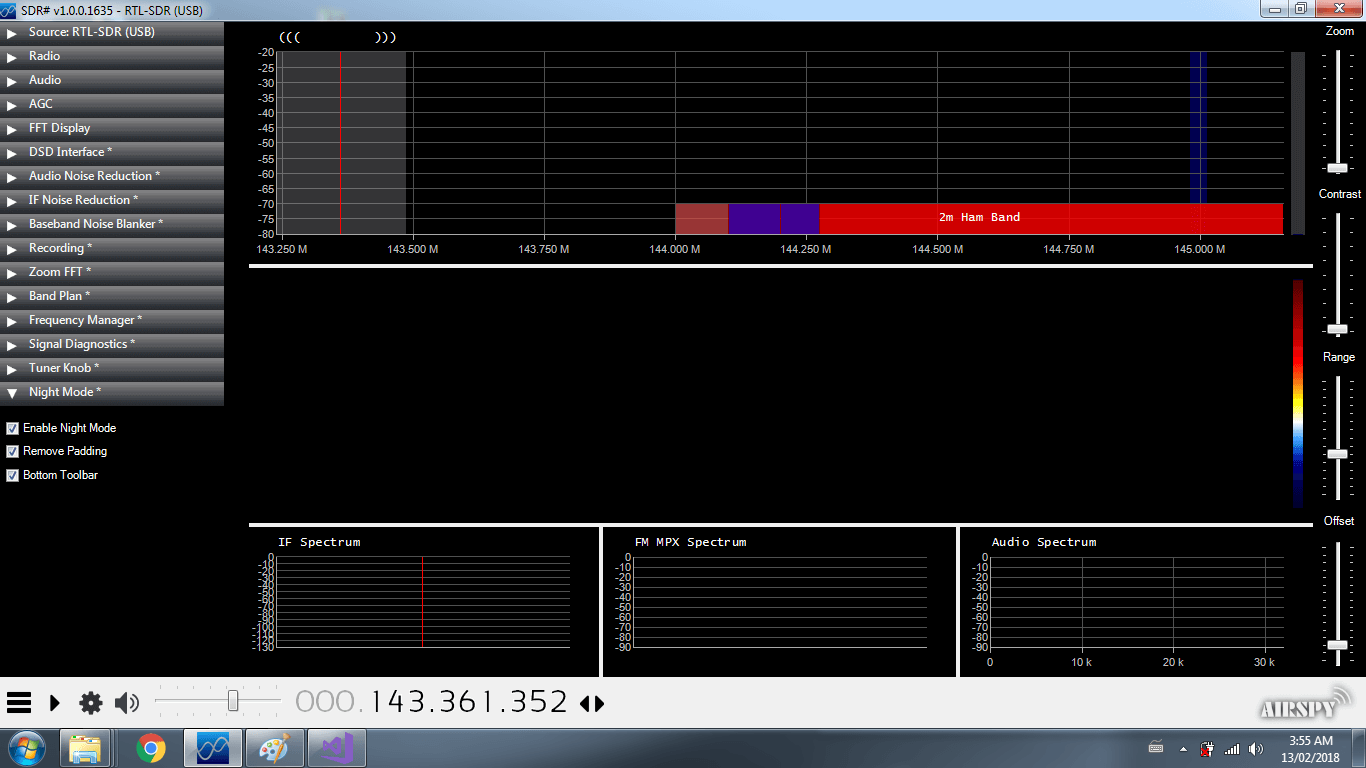
A few days ago Eddie MacDonald released his Tuner Knob plugin for SDR#. Today he's released a new plugin called "SDR# Dark Mode" over on our forums. This plugin is very simple in that is just makes the SDR# interface black, which should be better on the eyes those using the app at night. The plugin also adds two other options which allow you move the tuning toolbar to the bottom of the screen and remove all padding to save some screen space. The three options in the plugin are:
"Night Mode" or "Regular Mode" - allowing the app to be black or not "Bottom Tool Bar" - allows you to place the radio control tool bar on the top or bottom of the app "Remove Padding" - remove the 10px border around all the controls giving you a tiny amount of more workable space.
Thanks to Alex for submitting news about his new SDR# plugin called "SDRSharp.GpredictConnector". This plugin allows SDR# to interface with GPredict which is a tool used for tracking the orbit of satellites. Just like with the DDE Tracking plugin and the Orbitron satellite tracking program this plugin could be used to automatically tune SDR# to the frequency of a passing satellite using GPredict. It should also be able to compensate for any doppler shift frequency offset.
To use with SDR# simply download the zip file and move the .dll file into the SDR# folder. Then add the 'magicline' to the plugins.xml file using a text editor. In GPredict you can then add a radio interface from the preferences, and then use the 'Radio Connect' interface to connect to the plugin.
Connecting to GPredict using the GPredictConnector SDR# Plugin
To begin with Nexmon SDR you'll need a development environment set up on a Nexus 5 smartphone. Then it's a matter of downloading the dependencies, installing the Android NDK, and compiling Nexmon. IQ data can then be transmitted in code using from special system commands.
The Nexmon team have indicated on Twitter that they plan to present a paper with more information on Nexmon SDR at the MobiSys 2018 conference which will be held in June.
Last week we posted about the release of a new TETRA decoder plugin for SDR#. The plugin made setting up a TETRA decoder significantly easier compared to previous methods, but it still required the installation and use of the MSYS2 environment on Windows.
Thanks to reader Zlati for letting us know that the TETRA plugin has recently been updated once again and now no longer requires MSYS2 to be installed first. Now it is as easy to install as any other plugin, just drop the .dlls into the SDR# folder and add the magicline to the plugins.xml file. We tested it out and decoding worked fine. At the moment the "Net info" button is not working however.
In the future news and download lines for newer versions will probably be available on the programmers radioscanner.ru forum thread which is available here (use Google Translate to read): http://www.radioscanner.ru/forum/topic50051-9.html
The IcoBoard is an FPGA IO board that is compatible with the Raspberry Pi. An FPGA (Field Programmable Gate Array) is a silicon chip that can implement custom digital circuits (such as DSP processors) and be reconfigured with different circuits many times. Other silicon chips are ASICs (application specific integrated circuit) which have circuits that are set in stone.
Over on YouTube OpenTechLab has been trying to create a software defined radio with his IcoBoard FPGA. To do this he's combined it with an audio A2D/D2A (analog-to-digital/digital-to-analog) converter board and a Raspberry Pi. The video goes through the entire design process, including A2D/D2A selection and purchasing, PCB adapter design in KiCad, soldering the PCB, as well as 3D printing a frame.
In the last part of the video he does a simple test where a signal is input into the A2D converter, converted to digital and processed by the FPGA. The circuitry programmed into the FPGA then simply outputs the received data to the D2A which converts it back into an analog signal. In the next steps of the project OpenTechLab hopes to work on the software and turn it into a full SDR. Show notes for the video are available here.
[014] IcoBoard Software Defined Radio Project - Hardware
Recently we've posted about Eddie MacDonald's several releases of new plugins for the popular SDR# software. Recently he's released a tuner knob plugin which provides a visual frequency tuning knob that is useful for those running on touchscreen hardware, a 'dark mode' plugin which reduces the brightness of SDR# and compresses the UI a little, and an FFT grabber plugin which allows for easy screenshots of the FFT and waterfall spectrum's to be taken.
Eddie notes that all his plugins now have an actual home website at https://sdrplugins.com. This is where he will release updates and new plugins from now on.
If you are interested in discovering more SDR# plugins, we have a large list available here.
Recently Eddie MacDonald has been pumping out simple but useful plugins for SDR# including the SDR# Dark Mode and Visual Tuner Knob plugins. Recently he released a new plugin called "FFT Window Screen Grabber". This plugin simply helps you to easily take a screenshot of the FFT and waterfall displays in SDR#. It could be a useful plugin if you are constantly finding interesting signals that you want to document, or upload to sigidwiki.com.
A few days ago Eddie MacDonald released his Tuner Knob plugin for SDR#. Today he's released a new plugin called "SDR# Dark Mode" over on our forums. This plugin is very simple in that is just makes the SDR# interface black, which should be better on the eyes those using the app at night. The plugin also adds two other options which allow you move the tuning toolbar to the bottom of the screen and remove all padding to save some screen space. The three options in the plugin are:
"Night Mode" or "Regular Mode" - allowing the app to be black or not "Bottom Tool Bar" - allows you to place the radio control tool bar on the top or bottom of the app "Remove Padding" - remove the 10px border around all the controls giving you a tiny amount of more workable space.
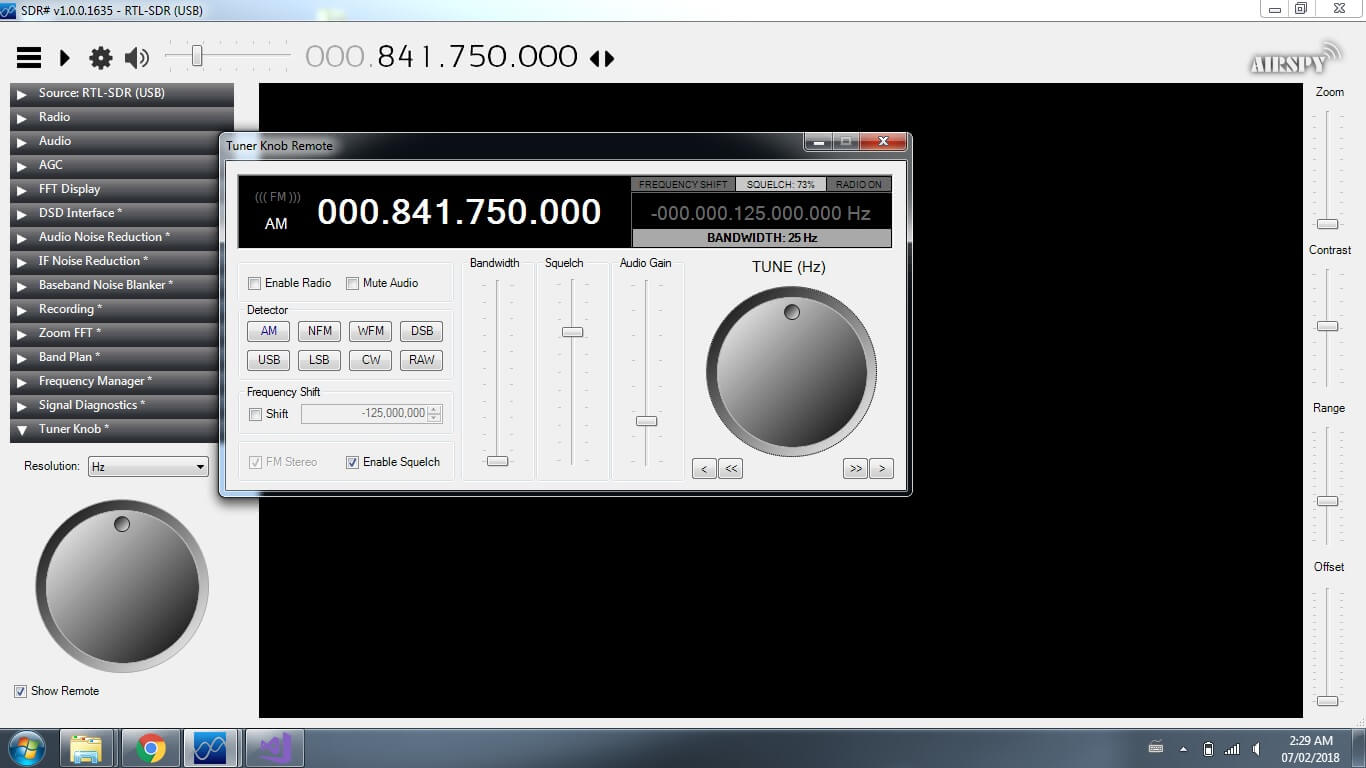
Thank you to Eddie MacDonald for submitting his new SDR# plugin to us via our forums. Eddie's plugin is called the 'Tuner Knob Plugin', and simply enables a visual tuner knob on the screen for adjusting the frequency. This plugin could be useful especially for those running SDR# on touchscreen tablets or laptops. To install the plugin copy the .dll file to the SDR# directory and copy and paste the magicline.txt into the plugins.xml file. We tested the plugin on our PC and found it to run well.
Programming the plugins is not so easy considering their is very little documentation and few examples on the net. There may be a few bugs I have not caught (but i hope i have caught them all.)
This DLL was compiled and tested on a Windows 7 x64 machine and the DLL is compiled for both x86 and x64 platforms. I have tested it on SDR# Version v1.0.0.1635
I am not certain which previous versions it may or may not run on. However, being built on the 4.6 .Net framework it should work with Win7 on.
I built this plugin because i got tired of holding down buttons and waiting for the frequency changes. I figured this was a simpler method (even though some people hate rotary style controls on windows) It works exceptionally well with a touch screen.
As previously mentioned in the forum post I created the 'remote' to test my programming for future plugins for DSP
While some may not find a use for the remote I made it this way for my wife who like to cruise the dial and just see what she can pick up.

![[014] IcoBoard Software Defined Radio Project - Hardware](https://www.rtl-sdr.com/wp-content/plugins/wp-youtube-lyte/lyteCache.php?origThumbUrl=https%3A%2F%2Fi.ytimg.com%2Fvi%2FseHwp0WN1oU%2F0.jpg)