Category: Amateur Radio

Shiva DX Cluster For SWL/BCL with SDR-Console V3

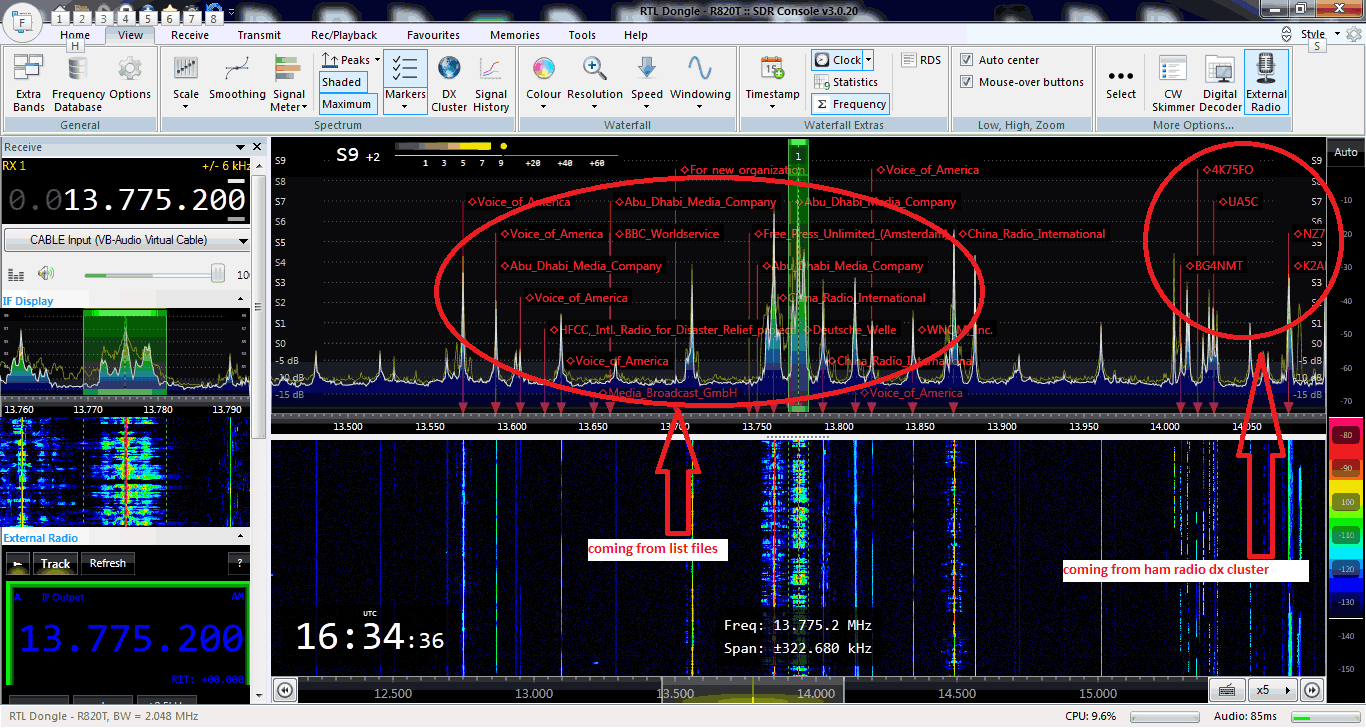
Thank you to Walter Panella (IU2MEH) for submitting information about his Shiva DX Cluster software which is designed to be used with SDR-Console V3. A DX Cluster is a type of distributed network of software that is used to to advertise that long-distance amateur radio DX stations are transmitting. Walter writes:

Shiva DX Cluster connects to a ham radio dx cluster and repeat the dx spot to shiva clients while adding spots based on list files.

It doesn't send to ham radio dx cluster any spot nor it can receive any spot.

It is intended to use with SDR Console for SWL/BCL ( see screenshots folder ) so they are able to see broadcasting stations, for example, based on scheduling day and time.

Ham radio dx cluster spots are repeated to shiva clients immediately, broadcasting stations and other lists are sent to shiva clients every 10 minutes (default,configurable).

The software is available on Walter's GitHub.

Shiva DX Cluster running on SDR-Console V3

QO-100 Bullseye TCXO Ultra Stable LNB Now Available in our Store for $29.95 with Free Shipping

Back in March we posted about Othernet's release of their "Bullseye" TCXO ultra stable LNB for receiving QO-100 and other Ku-Band satellites. We have decided to now offer these for sale on our store as well.

They cost US$29.95 with free shipping to most countries. We are currently selling it over on our blog store and on our Aliexpress store. The Aliexpress store uses Aliexpress Standard Shipping which may be better for some countries like Poland, Ukraine, etc. As usual, please expect that there could be shipping delays at the moment due to the ongoing global pandemic. Since the US is not covered by QO-100 we will not be stocking Amazon USA.

QO-100 / Es'hail-2 is a geostationary satellite at at 25.5°E (covering Africa, Europe, the Middle East, India, eastern Brazil and the west half of Russia/Asia) providing broadcasting services. However, as a bonus it has allowed amateur radio operators to use a spare transponder. Uplink is at 2.4 GHz and downlink is at 10.5 GHz. Most SDRs do not tune all the way up to 10.5 GHz, so an LNB (low noise block) is typically used, which contains the feed, an LNA, and a downconverter which converts the 10.5 GHz frequency into a much lower one that can be received by most SDRs.

In order to properly monitor signals on QO-100 an LNB with a Temperature Compensated Oscillator (TCXO) or other stabilization method is required. Most LNBs have non-stabilized crystals which will drift over time with temperature changes.  This means that the narrowband signals used on QO-100 can easily drift out of the receive band or cause distorted reception. It is possible to hand modify a standard Ku-band LNB by soldering on a replacement TCXO or hacking in connections to a GPSDO, but the Bullseye LNB is ready to use and cheap.

The Othernet TCXO Ultra Stable LNB for QO-100 and Ku-Band Satellites

The official product details read:

The Bullseye LNB is the world's most precise and stable DTH/consumer Ku-band down converter. Even a VSAT LNBF costing hundreds of dollars more is no match for the performance of the Bullseye 10K LNB. Each unit is calibrated at the factory to within 1 kHz of absolute precision against a GPS-locked spectrum analyzer. Under outdoor conditions, the stability of the LNB is well within 10 kHz of offset. As a bonus feature, the  Bullseye 10K provides access to its internal 25 MHz TCXO through the secondary F-connector. This reference output can be used to directly monitor the performance of the TCXO over time. 

Features

  • Bullseye 10 kHz BE01
  • Universal single output LNB
  • Frequency stability within 10 kHz in normal outdoor environment
  • Phase locked loop with 2 PPM TCXO
  • Factory calibration within 1 kHz utilizing GPS-locked spectrum analyzers
  • Ultra high precision PLL employing proprietary frequency control system (patent pending)
  • Digitally controlled carrier offset with optional programmer
  • 25 MHz output reference available on secondary F-connector (red)

Specifications 

  • Input frequency: 10489 - 12750 MHz
  • LO frequency 9750/10600 MHz
  • LO frequency stability at 23C: +/- 10 kHz
  • LO frequency stability -20 - 60C: +/- 30 kHz
  • Gain: 50 - 66 dB
  • Output frequency: 739 - 1950 MHz (low band) and 1100 - 2150 (high band)
  • Return loss of 8 dB (739 - 1950 MHz) and 10 dB (1100 - 2150 MHz)
  • Noise figure: 0.5 dB

We note that an external bias tee power injector is required to power the LNB as it requires 11.5V - 14V to operate in vertical polarization and 16V - 19V to operate with horizontal polarization. The bias tee on the RTL-SDR Blog V3 outputs 4.5V so it is not suitable.

There has also been an excellent review by @F4DAV and a video review by Techminds which we show below.

Ultra Stable Bullseye LNB For QO-100 Es Hail2 10 kHz

Understanding PLLs and their Importance when Receiving/Transmitting on QO-100

Over on YouTube Andreas Speiss has uploaded a video that explains what the geostationary QO-100 satellite is, and explains about the parts needed to receive and transmit to it. In particular Andreas goes into depth explaining the low noise block (LNB), and the PLL inside it. A PLL or phase locked loop is a common design used in RF electronics as it allows us to increase the frequency of crystal oscillators.

This PLL explanation ties into the fact that most commercial LNBs available do not have a stable enough crystal oscillator to properly receive or transmit the narrowband amateur radio signals used on QO-100. A PLL can increase the frequency of a crystal, but it will also increase the frequency drift and jitter/phase noise of the crystal. He notes that in later videos he'll show how to modify the LNB to improve these factors. We note that a commercially available stable LNB is the Bullseye LNB which we have posted about previously.

#331 QO-100 Satellite Receiving Technology. And Explanation of a PLL

Creating an APRS I-Gate and Digipeater with Baofeng and RTL-SDR

Over on YouTube ModernHam has uploaded a video showing how to create an APRS I-Gate and Digipeater with Baofeng and RTL-SDR. He also makes use of a Raspberry Pi as the computing module and an audio cable to connect the Baofeng to the audio jack of the Pi. The tutorial then consists of a walk through of the various software setup steps, and finally how to connect the Baofeng and RTL-SDR to the Pi.

If you weren't already aware, Automatic Packet Reporting System (APRS) is a digital VHF mode used in amateur radio. It allows for packets of data to be sent to receiving nodes over a local area via RF. Typical uses for it are vehicle tracking, weather station telemetry, text messages, announcements and other wireless device telemetry like high altitude balloons. An I-Gate is an internet connected node which receives local APRS RF signals and uploads them to the internet, to be seen on sites like aprs.fi. TX capable I-Gates may also broadcast to the local RF network messages from APRS transmitters on the other side of the world.

APRS I-Gate and Digipeater with Baofeng and RTL-SDR

Coronavirus: Hamvention Cancelled & Other Updates

Hamvention, the largest yearly amateur radio event has been cancelled this year due to concerns over the spread of the Coronavirus (COVID-19). It was due to be held during May 15 - May 18, 2020. Chairman Jack Gerbs writes:

The Hamvention Executive Committee has been monitoring the COVID19 pandemic. We have worked very closely with our local and state health Departments.

It is with a very heavy heart the Hamvention Executive Committee has decided to cancel Hamvention for this year.
This decision is extremely difficult for us but with around two months until the Great Gathering we felt this action necessary.
More specific details regarding the closure will soon be posted here.

Thank you for your understanding in this time of International Crisis.

Jack Gerbs
General Chairman HV2020
[email protected]

According to the ARRL cancelled events tracker, a number of other amateur radio events across the USA have also been cancelled, and we're seeing similar reports for most other countries too. At this stage we expect that most events will be cancelled over the next few months.

RTL-SDR Blog V3 Stock & Shipments

Due to manufacturing delays and slowdowns related to the Coronavirus our multipurpose dipole antenna set, and set including antenna and dongle is currently out of stock on our international webstore. We expect to be able to restock by the end of the month. There remains sufficient stock of the dongle itself. Our wideband LNA will also be back in stock next month.

Amazon USA is still stocked with all products, however there may be a short out of stock period within 1-2 weeks as we await for the arrival of replenishing stock in the USA.

In regards to international shipments please expect that there could be delays. At the moment we are seeing most mail still getting through in a timely manner, however this could change over the coming weeks as more travel restrictions come into play.

It is expected that other radio related products could also soon be out of stock, or delayed due to the situation.

Other Coronavirus Posts

N0SSC has provided a good post outlining the risks to the amateur radio population and why amateur radio event cancellations are a good idea. 

SolderSmoke, a popular podcast about radio homebrewers has put out a special Coronavirus crisis podcast.

We thought it would be nice to put out a special edition of the podcast to help listeners keep up their morale during this difficult time. So we’ll do our regular kind of show, but we’ll try to emphasize things you can do to stay busy and keep up morale while stuck at home.

Over on The SWLing Blog Thomas has put out a post about social distancing and how to keep occupied without leaving the house, and another post about how shortwave broadcasters are now adding regular Coronavirus information and news to their broadcasts.

The Othernet Bullseye TCXO LNB for QO-100 Reception

Othernet have recently released their new "Bullseye" 10 kHz Ultra High Stability Universal LNB. It is currently on sale and available for US$39.95 + shipping on their store.

The LNB is designed for receiving QO-100 which is a popular geostationary amateur radio satellite positioned at 25.5°E which covers Africa, Europe, the Middle East, India, eastern Brazil and the west half of Russia/Asia. In the past we've seen several posts about people using RTL-SDRs to set up ground station monitors for this satellite, as well as special WebSDR software designed for QO-100 monitoring.

Typically an LNB with small satellite dish is used to receive QO-100 which downlinks at 10.489550 GHz. These LNB's have a built in LNA, and downconvert the signal into a frequency range receivable by an RTL-SDR. One problem is that most commercial LNBs were intended for satellite TV reception, and hence they do not need to use a very stable local oscillator. So reception of the narrowband signals on QO-100 can become a challenge if they are continuously drifting in frequency as temperature changes.

Othernet's new Bullsye LNB uses a 2PPM TCXO as the local oscillator which gives it high stability in the face of changing temperatures. To power it you'll need a bias tee or LNB power source capable of injecting 13 - 18v onto the coax line. The product description reads:

The Bullseye LNB is the world's most precise and stable Ku-band down converter. Even a VSAT LNBF costing hundreds of dollars more is no match for the performance of the Bullseye 10K LNB. Each unit is calibrated at the factory to within 1 kHz of absolute precision against a GPS-locked spectrum analyzer. As a bonus feature, the Bullseye 10K provides access to its internal 25 MHz TCXO through the secondary F-connector. This reference output can be used to directly monitor the performance of the TCXO over time.

  • Bullseye 10 kHz BE01
  • Phase locked loop with 2 PPM TCXO
  • Factory calibration within 1 kHz utilizing GPS-locked spectrum analyzers
  • Ultra high precision PLL employing proprietary frequency control system (patent pending)
  • Digitally controlled carrier offset with optional programmer
  • 25 MHz output reference available on secondary F-connector (red)
     
  • Input frequency: 10489 - 12750 MHz
  • LO frequency 9750/10600 MHz
  • LO frequency stability at 23C: +/- 10 kHz
  • LO frequency stability -20 - 60C: +/- 30 kHz
  • Gain: 50 - 66 dB
  • Output frequency: 739 - 1950 MHz (low band) and 1100 - 2150 (high band)
  • Return loss of 8 dB (739 - 1950 MHz) and 10 dB (1100 - 2150 MHz)
  • Noise figure: 0.5 dB

Over on his blog @F4DAV has uploaded a comprehensive review of the Othernet LNB which goes over the specs, construction and testing of the LNB. The review is an excellent read and he concludes with the statement:

As far as I know the BE01 is the first affordable mass-produced Ku-band TCXO LNB. Specifications are not entirely clear but these early tests suggest that it can be a game changer for amateur radio and other narrowband applications in the 10 GHz band. The stability and ability to recalibrate should allow even unsophisticated analog stations to tune to a 5 kHz channel and remain there for hours at a time. For SDR stations with beacon-based frequency correction, the absolute accuracy removes the need to oversample by several hundred kHz or to scan for the initial frequency offset.

The Othernet Bulleye High Stability LNB
The Othernet Bullseye High Stability LNB

IGate2: An RTL-SDR Compatible APRS iGate for Android

Thank you to Agrosi Luciano for submitting news about his new RTL-SDR compatible Android App called "IGate2". IGate2 is a receive only APRS IGate written for Android devices. There is a free and paid version of the app. The free version is limited to 100 packets forwarded per session. The paid version costs US$3.49 and has unlimited packet forwards. The description of the app is pasted below:

The RTL-SDR dongle tuner (cost starting from 10 €) and its antenna, receives the information contained in APRS packets transmitted from HAM radio stations, and then a phone device, with IGate2, forwards them to the world wide web using its internet connection (WiFi or 3G).

IGate2 acts as a Software Defined Radio Demodulator, a TNC Modem and an Internet Gate.

It needs the installation of a driver (Martin Marinov’s driver) for the SDR dongle that you can find in: https://play.google.com/store/apps/developer?id=Martin+Marinov.

If you already own an unused cellular phone or tablet, IGate2 represents a very cheap, compact and easy-to-use solution for suppling an IGATE service to radio amateur community.

Raw data contained in radio packets are visible on the phone screen and may be routed (if you check this option) to the APRS-IS network. All data convoyed and shared in APRS-IS network can be seen in maps and bulletins on particular websites, for example: http://aprs.fi/ .

To be authorized to send data to APRS-IS you must have a HAM CallSign and a PassCode. See aprs-is.net. If you are not a radio amateur, you may only use your equipment in receive only mode.
The app has an audio monitor useful for tuning the parameters of the Sdr receiver (it may not work well in old devices with low memory). In the main page there is a frequency switch, a hub with the text of received packets, two indicator lights: one for the Sdr connection and one for the Aprs-Is connection, three counters reporting the number of: received, forwardable and forwarded packets. When you leave the main page while the IGate is running, the app service will continue working in the background, you can recall the main page by tapping the service icon in the android status bar.

Since the device and the Sdr dongle drains much power from the phone battery, it is recommended to use the phone charger or a power bank. You will need an OTG power cable. It is not easy to find a working cable, maybe you can do it yourself. The reception quality of the IGate depends, above all, on the antenna connected to the Sdr dongle. With very strong FM broadcasts in your area, it may be helpful to manually adjust the gain of the receiver or use a band-stop filter.

If you weren't already aware, Automatic Packet Reporting System (APRS) is a digital VHF mode used in amateur radio. It allows for packets of data to be sent to receiving nodes over a local area via RF. Typical uses for it are vehicle tracking, weather station telemetry, text messages, announcements and other wireless device telemetry like high altitude balloons. An IGate is an internet connected node which receives local APRS RF signals and uploads them to the internet, to be seen on sites like aprs.fi. TX capable IGates may also broadcast to the local RF network messages from APRS transmitters on the other side of the world.

IGate2: Android App that turns your phone and RTL-SDR into an APRS IGate.


Look4Sat: An Android App for Tracking and Predicting Amateur Radio and Weather Satellite Passes

Thank you to Arty Bishop for submitting news about his recently released Android App called Look4Sat. Look4Sat is a satellite tracker and pass predictor with a focus on amateur radio and weather satellites. The app is free, ad free, and open source on GitHub.  Arty writes that he's programmed this as a learning exercise and notes:

I always wanted to have an offline and not bloated satellite tracker on my phone, as carrying the laptop at all times is kinda not too handy.

The app uses predict4java library under the hood and is written in Kotlin. The TLE files are from Celestrak and the transmitters info is from SatNOGS and once they are  ownloaded the app doesn't need an internet connection.

The app creation and design is hugely inspired by Gpredict which is an absolutely brilliant piece of software. Thank you, Alexandru!

Obviously there is no ads and it's totally free. Hope more people find Look4Sat useful.

The features include:

  • Calculating satellite passes for up to one week (168 hours)
  • Calculating passes for the current or manually entered location
  • Showing the list of currently active and upcoming satellite passes
  • Showing the active pass progress, polar trajectory and transceivers info
  • Showing the satellite positional data, footprint and ground track on a map
  • Offline first: pass prediction is done offline. It's up to you to decide when
    to update the TLE file and the transceivers DB. (Updates once a week are recommended)
Look4Sat Android App Screenshots