Category: Amateur Radio

TechMinds: Building a 3D Printed 2.4 GHz Dual Feed Helix for QO-100

The Bullseye LNB that we have in our store is great for receiving the QO-100 amateur geostationary radio satellite which is available in some parts of the world. However it cannot be used to transmit to the satellite. Over on his YouTube channel Tech Minds shows us how to build a transmit helix antenna that connects to the Bullseye or other suitable LNB, resulting in a dual feed antenna.

The antenna that was built is based on DO8PAT's "Ice Cone Feed" design. The design requires some 3D printed parts for the mount and housing, as well as a copper wire helix, metal reflector and copper matching strip. The Bullseye fits onto the back of the helix mount. Once mounted on a dish Tech Minds shows that he was able to make contact with a friend via the QO-100 satellite with good signal strength.

2.4 GHz Dual Feed Helix Antenna For QO100

Step-by-step Guide to Creating a GNU Radio Based QO-100 SSB Receiver

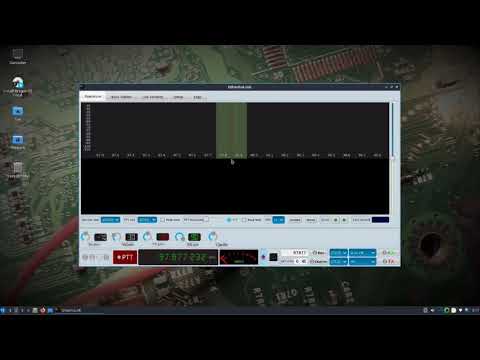
Thank you to M Khanfar for submitting his video that shows a step-by-step tutorial on building your own SSB receiver in Windows GNU Radio for QO-100 satellite reception.  His tutorial includes adding several tuning sliders in the GNU Radio GUI as well.

QO-100 / Es'hail-2 is a geostationary satellite at at 25.5°E (covering Africa, Europe, the Middle East, India, eastern Brazil and the west half of Russia/Asia) providing broadcasting services. However, as a bonus it has allowed amateur radio operators to use a spare transponder. Uplink is at 2.4 GHz and downlink is at 10.5 GHz. We note that we are selling a "bullseye" LNB in our store which allows most SDR dongles to be able to receive the signal with high frequency accuracy.

GNU-RADIO QO-100 SSB Receiver

Tech Minds: Testing the OpenEar DMR TETRA ADSB POCSAG Decoder for RTL-SDR

Back in March we posted about the release of OpenEar, a standalone TETRA decoder for the RTL-SDR. Since then OpenEar has undergone massive developments, not only improving upon the TETRA decoder, but adding DMR, ADS-B and POCSAG decoders as well as a waterfall display.

Recently Tech Minds reviewed this software on his YouTube channel. In the video he shows how to download the software, install the rtlsdr.dll file, and run and use the software. He then demonstrates reception of an amateur radio DMR repeater, reception of POCSAG pager messages and finally reception of ADS-B aircraft messages.

OpenEar Digital Decoder - DMR TETRA P25 ADSB POCSAG RTL-SDR

Building a Remote SSB Receiver with an RTL-SDR, OrangePi and GNU Radio

Over on his blog F1ATB has uploaded a post explaining how he created an RTL-SDR or HackRF based remote SSB receiver controllable with an internet browser. To set this up he uses an Orange Pi One Plus single board computer which runs several GNU Radio based digital signal processing flow graphs. Then a Python server serves a custom HTML and Javascript based web interface with waterfall that can be controlled remotely over the internet. In the post he explains the GNU Radio DSP flowgraphs that he's built, and notes that he will explain the HTML and Javascript side in another future article.

The SSB receiver block diagram

Talks from the 2020 HamSCI Convention (Held Online)

HamSCI is an organization dedicated citizen radio science and specifically the "publicity and promotion of projects that advance scientific research and understanding through amateur radio activities". Recently they held their HamSCI 2020 workshop online, and the videos are now available on the Ham Radio 2.0 YouTube channel. Several of the projects mentioned in the talks involve the use of software defined radios.

Come join HamSCI at its third annual workshop! Due to restrictions caused by the COVID-19 Coronavirus, this year's workshop will he held as a virtual, eletronic workshop. The meeting will take place March 20-21, 2020 using Zoom Webinar Services hosted by The University of Scranton in Scranton, PA . The primary objective of the HamSCI workshop is to bring together the amateur radio community and professional scientists. The theme of the 2020 HamSCI Workshop is "The Auroral Connection: How does the aurora affect amateur radio, and what can we learn about the aurora from radio techniques?" Invited speakers include Dr. Elizabeth MacDonald, NASA Scientist and founder of Aurorasaurus, Dr. James LaBelle, Dartmouth Space Scientist and expert on radio aurora, and Dave Hallidy K2DH, an expert in ham radio auroral communication.

One talk discusses the HamSCI personal weather station project, which is an SDR and Raspberry Pi based solution that monitors HF signals like WSPR, as well as characterizing HF noise, detecting lightning and ionospheric disturbances.

HamSCI 2020 Overview of the Personal Space Weather Station and Project Update

Another talk discusses the TangerineSDR, which is an open source SDR currently in development by TAPR. The goal of the TangerineSDR is to be a sub $500 SDR with a focus on space science, academic research as well as general amateur use. 

HamSCI 2020 TangerineSDR Data Engine and Overall Architecture

The rest of the talks can be found on the Ham Radio 2.0 YouTube playlist.

Shiva DX Cluster For SWL/BCL with SDR-Console V3

Thank you to Walter Panella (IU2MEH) for submitting information about his Shiva DX Cluster software which is designed to be used with SDR-Console V3. A DX Cluster is a type of distributed network of software that is used to to advertise that long-distance amateur radio DX stations are transmitting. Walter writes:

Shiva DX Cluster connects to a ham radio dx cluster and repeat the dx spot to shiva clients while adding spots based on list files.

It doesn't send to ham radio dx cluster any spot nor it can receive any spot.

It is intended to use with SDR Console for SWL/BCL ( see screenshots folder ) so they are able to see broadcasting stations, for example, based on scheduling day and time.

Ham radio dx cluster spots are repeated to shiva clients immediately, broadcasting stations and other lists are sent to shiva clients every 10 minutes (default,configurable).

The software is available on Walter's GitHub.

Shiva DX Cluster running on SDR-Console V3

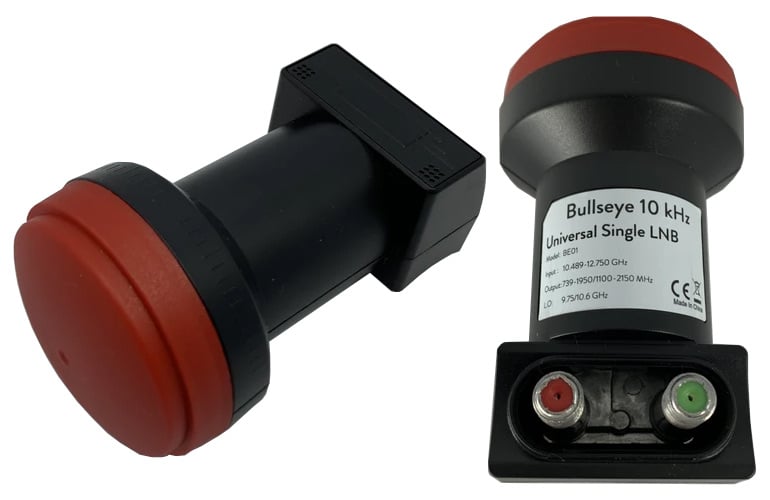
QO-100 Bullseye TCXO Ultra Stable LNB Now Available in our Store for $29.95 with Free Shipping

Back in March we posted about Othernet's release of their "Bullseye" TCXO ultra stable LNB for receiving QO-100 and other Ku-Band satellites. We have decided to now offer these for sale on our store as well.

They cost US$29.95 with free shipping to most countries. We are currently selling it over on our blog store and on our Aliexpress store. The Aliexpress store uses Aliexpress Standard Shipping which may be better for some countries like Poland, Ukraine, etc. As usual, please expect that there could be shipping delays at the moment due to the ongoing global pandemic. Since the US is not covered by QO-100 we will not be stocking Amazon USA.

QO-100 / Es'hail-2 is a geostationary satellite at at 25.5°E (covering Africa, Europe, the Middle East, India, eastern Brazil and the west half of Russia/Asia) providing broadcasting services. However, as a bonus it has allowed amateur radio operators to use a spare transponder. Uplink is at 2.4 GHz and downlink is at 10.5 GHz. Most SDRs do not tune all the way up to 10.5 GHz, so an LNB (low noise block) is typically used, which contains the feed, an LNA, and a downconverter which converts the 10.5 GHz frequency into a much lower one that can be received by most SDRs.

In order to properly monitor signals on QO-100 an LNB with a Temperature Compensated Oscillator (TCXO) or other stabilization method is required. Most LNBs have non-stabilized crystals which will drift over time with temperature changes.  This means that the narrowband signals used on QO-100 can easily drift out of the receive band or cause distorted reception. It is possible to hand modify a standard Ku-band LNB by soldering on a replacement TCXO or hacking in connections to a GPSDO, but the Bullseye LNB is ready to use and cheap.

The Othernet TCXO Ultra Stable LNB for QO-100 and Ku-Band Satellites

The official product details read:

The Bullseye LNB is the world's most precise and stable DTH/consumer Ku-band down converter. Even a VSAT LNBF costing hundreds of dollars more is no match for the performance of the Bullseye 10K LNB. Each unit is calibrated at the factory to within 1 kHz of absolute precision against a GPS-locked spectrum analyzer. Under outdoor conditions, the stability of the LNB is well within 10 kHz of offset. As a bonus feature, the  Bullseye 10K provides access to its internal 25 MHz TCXO through the secondary F-connector. This reference output can be used to directly monitor the performance of the TCXO over time. 

Features

  • Bullseye 10 kHz BE01
  • Universal single output LNB
  • Frequency stability within 10 kHz in normal outdoor environment
  • Phase locked loop with 2 PPM TCXO
  • Factory calibration within 1 kHz utilizing GPS-locked spectrum analyzers
  • Ultra high precision PLL employing proprietary frequency control system (patent pending)
  • Digitally controlled carrier offset with optional programmer
  • 25 MHz output reference available on secondary F-connector (red)

Specifications 

  • Input frequency: 10489 - 12750 MHz
  • LO frequency 9750/10600 MHz
  • LO frequency stability at 23C: +/- 10 kHz
  • LO frequency stability -20 - 60C: +/- 30 kHz
  • Gain: 50 - 66 dB
  • Output frequency: 739 - 1950 MHz (low band) and 1100 - 2150 (high band)
  • Return loss of 8 dB (739 - 1950 MHz) and 10 dB (1100 - 2150 MHz)
  • Noise figure: 0.5 dB

We note that an external bias tee power injector is required to power the LNB as it requires 11.5V - 14V to operate in vertical polarization and 16V - 19V to operate with horizontal polarization. The bias tee on the RTL-SDR Blog V3 outputs 4.5V so it is not suitable.
There has also been an excellent review by @F4DAV and a video review by Techminds which we show below.

Ultra Stable Bullseye LNB For QO-100 Es Hail2 10 kHz

Understanding PLLs and their Importance when Receiving/Transmitting on QO-100

Over on YouTube Andreas Speiss has uploaded a video that explains what the geostationary QO-100 satellite is, and explains about the parts needed to receive and transmit to it. In particular Andreas goes into depth explaining the low noise block (LNB), and the PLL inside it. A PLL or phase locked loop is a common design used in RF electronics as it allows us to increase the frequency of crystal oscillators.

This PLL explanation ties into the fact that most commercial LNBs available do not have a stable enough crystal oscillator to properly receive or transmit the narrowband amateur radio signals used on QO-100. A PLL can increase the frequency of a crystal, but it will also increase the frequency drift and jitter/phase noise of the crystal. He notes that in later videos he'll show how to modify the LNB to improve these factors. We note that a commercially available stable LNB is the Bullseye LNB which we have posted about previously.

#331 QO-100 Satellite Receiving Technology. And Explanation of a PLL