Category: Antennas

Receiving Analog TV from Turkmenistan Unintentionally Bouncing off a Russian Military Satellite

Over on Twitter @dereksgc has been monitoring the 'Meridian' communications satellites, which are Russian owned and used for civilian and military purposes. The satellites are simple unsecure repeaters, meaning that actually anyone with the hardware can transmit to them, and have their signal automatically rebroadcast over a wide area. This has been taken advantage of recently by anti-Russian invasion war activists who have been trolling the satellite with SSTV images of the Ukrainian flag, as well as audio.  

Apart from intentional abuse, a side effect of being an open repeater is that sometimes the satellite can pick up powerful terrestrial signals unintentionally, such as analogue broadcast TV from Turkmenistan. Over on his blog, @dereksgc has written up an excellent post documenting the background behind this finding, his entire setup involving the hardware he's using and how he's aligning with the satellite, and what software he is using to decode the TV signal. In his hardware setup he notes that he uses a HackRF, but that a RTL-SDR would suffice.

Troubleshooting TV Reception with Spektrum and an RTL-SDR

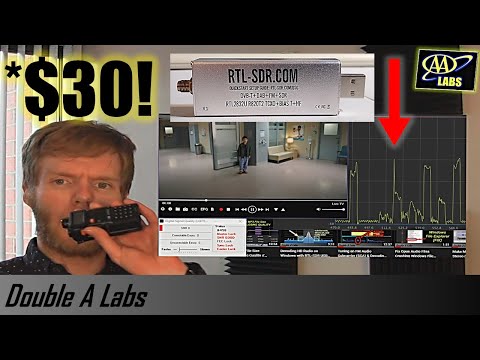
Thank you to "Double A" for submitting his latest YouTube tutorial video that shows how to use an RTL-SDR together with the Spektrum software to optimize TV reception by comparing TV antennas, repositioning antennas and detecting interference.

Double A's video first shows how to setup the RTL-SDR and how to install and use the Spektrum analyzer software. He then compares a popular highly rated phased array TV antenna against cheaper log periodic TV antenna, with the results showing that the phased array works a lot better at most TV frequencies even with accurate positioning. He goes on to show how he scans for FM, 5G and local electronics interference and the effect of an FM filter can help.

Improve Antenna TV Reception and Detect Interference using the RTL-SDR USB as a Spectrum Analyzer

Frugal Radio: Testing a Loop on Ground Antenna with an Airspy HF+ Discovery

The KK5JY Loop on Ground (LoG) antenna is a 15 feet per side square loop designed for reception of HF and lower. It simply consists of an isolation transformer and wire that as the name implies is placed somewhere on the ground in a square loop like shape. It is cheap and easy to build and compact in that it does not take up any usable space. 

In his latest video Rob from the Frugal Radio YouTube channel tests out this antenna with his Airspy HF+ Discovery SDR. He uses a bit of wire lying around, and a low cost 9:1 Balun from NooElec as the isolation transformer. With this antenna he was able to pick up signals in the USA and all the way over to Australia from his home in Canada. NDB signals were also receivable.

2022 LoG (Loop on Ground antenna) for SDR radio tested on Airspy HF+ Discovery SDR KK5JY HAM radio

Receiving X-Band Images from the Arktika-M1 Arctic Monitoring Satellite

Recently on Twitter @arvedviehweger (Arved) has tweeted that he has successfully received images from the Russian Arctic monitoring satellite known as ARKTIKA-M1, via it's X-band downlink at 7865 MHz. We've reached out to Arved and he's provided the following information on his setup and how he's receiving and decoding the images.


The Arktika-M1 satellite is a Russian weather satellite which operates in a HEO orbit. It was launched in February 2021 and has downlinks on multiple bands. The main payload downlink for the imagery is on 7865 MHz (which is also known as the lower X-Band). The satellite only transmits imagery on the X-Band at the moment, it is currently unknown whether it will ever transmit any image data on L-Band.

For Amateur reception that means having access to X-Band RF gear. It usually consists of a low noise pre-amplifier and a downconverter to convert 7865 MHz down to a lower frequency for easier reception with a high bandwidth SDR such as the LimeSDR, a USRP etc.

In my personal setup I use a surplus pre-amplifier made by MITEQ (around 36dB of gain, 1dB NF), my own self-made DK5AV compact X-Band downconverter and a LimeSDR-USB.

The L-Band gear is mounted on top (helix and the pre-amp behind it) and the X-Band gear is right below. From left to right you can see the feed, the downconverter (silver box) and the LNA (mounted to a heatsink and a fan). Recording is done with a LimeSDR-USB running at a sample rate of 50 MSPS. The satellite transmits every 15 minutes once it reaches its apogee, each transmission including the idle period lasts for about 10 minutes. Some pictures of the idle transmission and the actual data transmission can be found in this Tweet, [noting that Idle = more spikes, actual data looks weaker]:

Depending on the geographical location a rather large satellite dish is also required for Arktika-M1. Reception reports all over Europe clearly show that the satellite has a beamed antenna (similar to ELEKTRO-L2).

In my setup I can get away with a 2.4m prime focus dish (made by Channel Master) in North Eastern Germany. It produces around 9 - 10 dB of SNR in the demod of @aang254’s excellent SatDump software. Anything above 5dB will usually result in a decode but since the satellite does not have any FEC you will need more than that for a clean picture. (Image of SNR in Satdump)

A Comprehensive Beginners Guide to HRPT Weather Satellite Reception

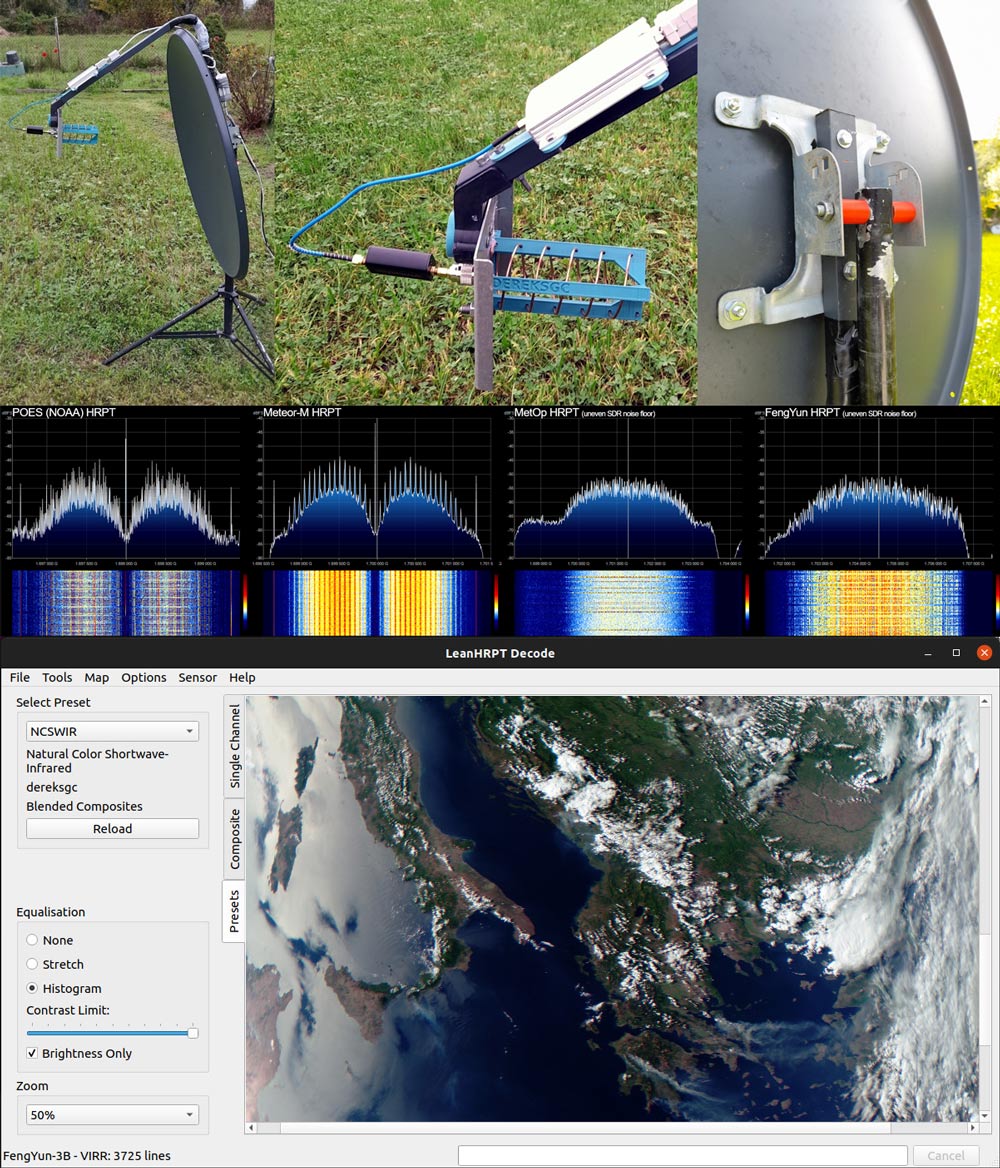
Over on his blog Derek (OK9SGC) has recently uploaded a very comprehensive beginners guide to receiving HRPT weather satellite images. HRPT reception can be a little daunting as it requires a good L-Band dish setup which involves choosing and building a feed, and importantly, a way to track the satellite with the dish as it moves across the sky. Tracking can be achieved manually by hand, but that can be very difficult and so a motorized tracking mount is recommended.  

This is unlike the much easier to receive NOAA APT or Meteor LRPT satellite signals in the VHF band which can be received by a V-dipole antenna, or the geostationary GOES HRIT satellites that can be received with a WiFi grid dish and LNA. Both of which do not require tracking.

The advantage of HRPT however, is that you end up with high resolution, close-up, and uncompressed images of the earth. For example Derek notes that NOAA APT gives 4km/px resolution, and Meteor LRPT gives much better 1km/px resolution but it is heavily compressed. Whereas HRPT gives peak resolutions of 1km/px uncompressed. There are also nine satellites in operation sending HRPT, so there are more opportunities to receive.

Derek has created a very comprehensive beginners guide that covers almost everything from purchasing and building the hardware, to finding and tracking the satellites, to setting up the software and decoding images. He notes that an RTL-SDR can be used as the receiver, and that a WiFi dish with GOES SAWBird LNA can work, although the difficult tracking requirements are still there so a smaller offset dish with custom helix feed might be preferred. Derek also provides useful tips, like the fact that the NOAA15 HRPT signal is quite a lot weaker than others.

Images from Dereks HRPT Guide

TechMinds: Testing the GA-450 Portable HF Active Loop Antenna

Over on the Techminds YouTube channel, Matt has uploaded his latest video which is a review of the GA-450 portable HF active loop antenna. The antenna costs between US$60-$80 + shipping and is available on Chinese market sites like Aliexpress and Banggood. It's advertised as covering 2.3 - 30 MHz, and uses a very portable and sturdy 20cm stainless steel loop. The active base amplifier is powered via a USB-C connector, and it even has a built in lithium battery for portable field use.

In his review Matt shows the antenna in action, noting that it's performance is quite a lot better than expected for it's small size, but it can't compare to his large half-wave end fed antenna. He notes that it appears to work best from 7 - 21 MHz, but not so well below 7 MHz. Overall he recommends it if you're looking for a small sized loop antenna.

GA-450 Portable Active Small Loop HF Antenna

Nils Reviews our RTL-SDR Blog L-Band Active Patch Antenna

Over on his blog Nils Schiffhauer (DK8OK) has recently uploaded a review of our RTL-SDR Blog Active L-Band Patch Antenna (original site is down - archive.org link). This is a satellite patch antenna designed for experimenters who want to receive Inmarsat, Iridium, GPS and other GNSS signals. It covers 1525 - 1660 MHz. (Please note it does not cover GOES or other L-band weather satellites as these are much weaker signals that require a dish). The antenna comes as a set with mounting hardware and extension cable and can be purchased on our store for $49.95 including free worldwide shipping to most countries.

In his review Nils tests the patch antenna with his wideband BladeRF software defined radio showing a wide 60 MHz of bandwidth being received. He then goes on to show it being used to receive AERO, via the JAERO decoder, and STD-C via the Tekmanoid decoder.

We want to take this opportunity to pre-announce that due to rising shipping costs the price of this antenna set will be going up by $10 in early 2022. Before the price raise we will put out another post, but if you are interested in one we'd recommend picking one up soon.

Nils tests the water resistance of the antenna.

SignalsEverywhere: Spectrum Analyzer and Tracking Generator with Pluto SDR

In the latest video on the Signals Everywhere YouTube channel, Sarah investigates how a PlutoSDR can be used as a Spectrum Analyzer with the SATSAGEN software. The SATSAGEN software is able to work as a spectrum analyzer by rapidly sweeping over multiple frequencies and stitching the spectrum slices together. It support SDRs like the HackRF, PlutoSDR and RTL-SDR (in receive mode only). The PlutoSDR can transmit, so it is able to work as a full spectrum analyzer with tracking generator, allowing users to measure RF devices such as filters, tune antennas, and work as a frequency generator.

In the video Sarah demonstrates how to use the PlutoSDR and SATSAGEN to measure our RTL-SDR Blog Broadcast FM filter, and to tune our multipurpose dipole antenna.

Spectrum Analyzer and Tracking Generator with Pluto SDR