Category: Antennas

IEEE Spectrum: Chasing Weather Balloons with Software Defined Radio

Electrical engineering magazine IEEE Spectrum has recently shared a story about how RTL-SDRs can be used for chasing weather balloons. With an RTL-SDR, antenna and appropriate decoding software, it is possible to decode the telemetry signal from weather balloons radiosondes, and track their live GPS location.

The author, Dave Schneider explains how chasing and hunting weather balloons can be a fun sport. To help with his hunt Dave uses an RTL-SDR, a directional antenna and the Sondehub Tracker website.

First Dave logged onto Sondehub Tracker which aggregates multiple weather balloon signals received by volunteer ground stations. One feature of Sondehub is that it can predict an approximate landing position of a balloon. It however cannot track a balloon right to its final landing spot as usually the ground station will loose signal when the balloon gets too low.

Knowing the approximate landing position, Dave drove out to the indicated location and then took out his RTL-SDR and directional antenna and was able to track and find the radiosonde by decoding the telemetry signal with Sonde Monitor

IEEE Spectrum Weather Balloon hunting graphic (Image Credit: JAMES PROVOST)

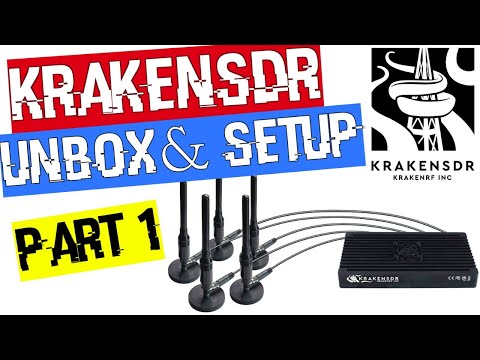
Frugal Radio KrakenSDR Part 1 – Unboxing, Antennas and Initial Setup

Over on the Frugal Radio YouTube channel Rob has uploaded part one of his two part series on the KrakenSDR. The KrakenSDR is our 5-channel coherent radio based on RTL-SDRs, and it can be used for applications like radio direction finding and passive radar. We successfully crowd funded the device on Crowd Supply.  

In the video Rob unboxes his KrakenSDR, and explains how he will use it for radio direction finding. He shows his setup including the other required parts, like the Pi 4, and power supply, and then goes on to show the software installation process which involves burning an SD card and downloading an Android app. Next he sets up his antenna array by printing the antenna spacer and using the Excel antenna array calculator sheet.

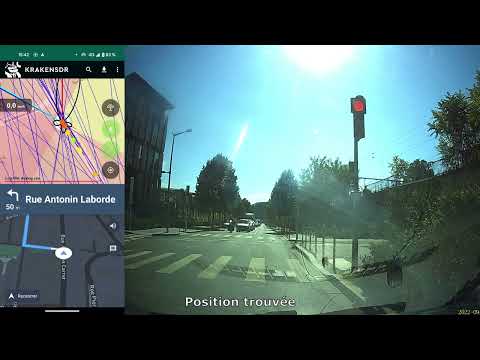
Rob notes that Part 2 is coming in one to two weeks and will show him using the KrakenSDR in his vehicle to locate the source of a transmission.

KrakenSDR Unboxing / Prep & Setup device & antennas : Part 1

Decoding Inmarsat STD-C with Command Line Decoder STDCDEC and SigDigger

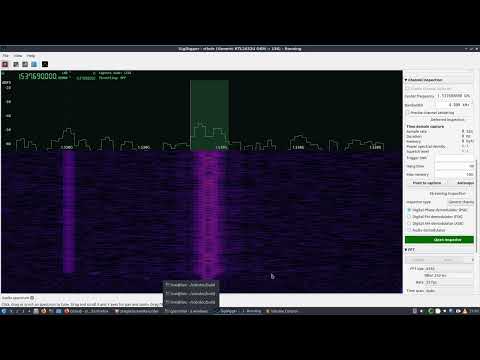
Over on his YouTube channel Aaron has uploaded a video showing how to use SigDigger and a C based command line Inmarsat STD-C decoder called 'stdcdec' together on his DragonOS SDR based Linux OS image.

STD-C is a marine satellite service that broadcasts messages that typically contain text information such as search and rescue (SAR) and coast guard messages as well as news, weather and incident reports. With the right software, an RTL-SDR and an appropriate L-Band satellite antenna like our 'Active L-Band 1525 - 1660 Inmarsat to Iridium Patch Antenna Set' these signals can be received and decoded.

The stdcdec software provides a way for command line only systems to receive and view STD-C data. In his video Aaron shows an example setup that uses SigDigger to determine the audio frequency offset, and receive the audio which is then passed to the stdcdec software. We note that SigDigger is a GUI based program but could probably be replaced with another CLI based program, in order to run on a headless system (as long as the tuning and audio center freq is determined before hand). Aaron is hoping to explore solutions for this in the future.

DragonOS Focal Rx and Decode Inmarsat-C Messages w/ SigDigger + STDCDEC (RTLSDR)

SelfieStick: Combining noisy signals from multiple NOAA APT satellites for clean imagery

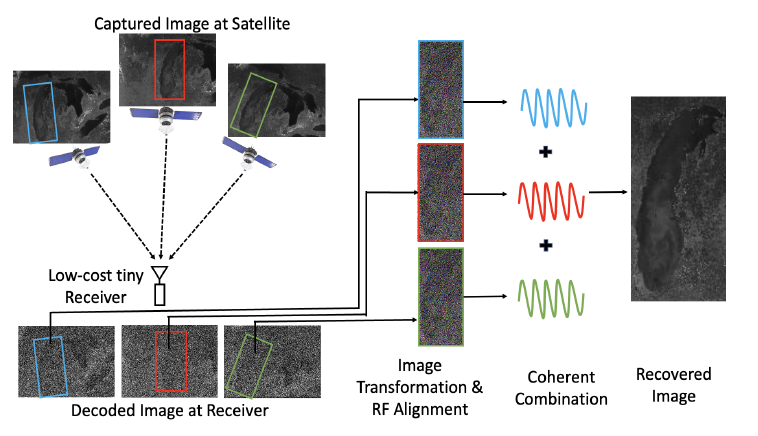
Researchers from Carnegie Mellon University have recently presented a paper detailing how they combined noisy signals from multiple passes of low earth orbit (LEO) satellites NOAA 15, NOAA 18 and NOAA 19 in order to create a higher quality image. For a receiver they used a low cost RTL-SDR Blog V3 mounted indoors with a whip antenna.

In a normal setup, weather satellite images from NOAA LEO weather satellites can be received with an RTL-SDR, computing device and an appropriate outdoor mounted antenna that has a good view of the sky. If the antenna is not suited for satellite reception, and/or is mounted indoors, at best only poor quality very noisy images can be received.  

The researchers demonstrate that it is possible to combine noisy images received over time, and from different satellites in order to generate a higher quality image. The challenge is that the different satellites and different receiving times will all produce different images, because the satellites will be at a different location in the sky each pass. They note that simply transforming the images in the image domain would not work very well for highly noisy images, so instead they have devised a method to transform the images in the RF domain. The RF signals are then coherently combined before being demodulated into an image.

The results show that 10 noisy satellite images from the indoor system are comparable to one from a comparison outdoor system. However, they note some limitations in that the system assumes unchanging cloud cover during passes. In the future they hope to extend the system to cover other modulation schemes used by other low earth orbit satellites in order to increase the number of usable satellites.

Selfiestick: Combining noisy images from multiple NOAA satellites received by an indoor RTL-SDR system.

Financial Times Story about Ukraine Radio Monitoring with WebSDRs

The Financial Times has recently run a video story on how hobbyist WebSDR setups are being use to record Russian radio communications during the war on Ukraine.

In these modern times, we would expect the Russian military to be making full use of encrypted radio communications on the battlefield. But early on in the invasion it came to be clear that much of the Russian forces are much less advanced than first thought, and are using cheap civilian unencrypted radios that anyone nearby can listen to with an RTL-SDR or via a web connected SDR.

The FT story focuses on how open source contributors from all over the world are helping to monitor internet connected WebSDRs that are close enough to receive Russian radio communications. And how volunteers are helping translate, confirm authenticity, and collect information about possible war crimes. 

If you are interested, previously we posted about a similar video story from the New York Times, and have covered various bits of radio related news from the war in two previous posts [1][2].

Ukraine's battle of the airwaves | FT

Frugal Radio: Testing the YouLoop on VHF & UHF

On this weeks episode over on the Frugal Radio YouTube channel, Rob investigates if the YouLoop antenna works well at VHF and UHF frequencies. The YouLoop is a popular portable passive loop receiving antenna that can be used with sensitive radios like the Airspy HF+ Discovery. It is mostly used for HF reception, but advertised to work up to the VHF band as well.

In his video Rob describes how the YouLoop can receive on VHF frequencies by acting as a folded dipole. To test this capability he connects an indoor YouLoop to an RTL-SDR Blog V3 unit, and confirms that he is able to strongly receive VHF airband ATIS, airband communications and various VHF digital and analogue voice signals.

Rob then goes on to check if the YouLoop works in the UHF bands, which it is not advertised as being capable of receiving. However, Rob does find that the YouLoop worked well on relatively strong UHF signals up to around 800 MHz.

Does the Airspy Youloop work on VHF? What about UHF and 700/800 MHz?

Receiving Analog TV from Turkmenistan Unintentionally Bouncing off a Russian Military Satellite

Over on Twitter @dereksgc has been monitoring the 'Meridian' communications satellites, which are Russian owned and used for civilian and military purposes. The satellites are simple unsecure repeaters, meaning that actually anyone with the hardware can transmit to them, and have their signal automatically rebroadcast over a wide area. This has been taken advantage of recently by anti-Russian invasion war activists who have been trolling the satellite with SSTV images of the Ukrainian flag, as well as audio.  

Apart from intentional abuse, a side effect of being an open repeater is that sometimes the satellite can pick up powerful terrestrial signals unintentionally, such as analogue broadcast TV from Turkmenistan. Over on his blog, @dereksgc has written up an excellent post documenting the background behind this finding, his entire setup involving the hardware he's using and how he's aligning with the satellite, and what software he is using to decode the TV signal. In his hardware setup he notes that he uses a HackRF, but that a RTL-SDR would suffice.

Troubleshooting TV Reception with Spektrum and an RTL-SDR

Thank you to "Double A" for submitting his latest YouTube tutorial video that shows how to use an RTL-SDR together with the Spektrum software to optimize TV reception by comparing TV antennas, repositioning antennas and detecting interference.

Double A's video first shows how to setup the RTL-SDR and how to install and use the Spektrum analyzer software. He then compares a popular highly rated phased array TV antenna against cheaper log periodic TV antenna, with the results showing that the phased array works a lot better at most TV frequencies even with accurate positioning. He goes on to show how he scans for FM, 5G and local electronics interference and the effect of an FM filter can help.

Improve Antenna TV Reception and Detect Interference using the RTL-SDR USB as a Spectrum Analyzer