Category: Applications

SDR# Updates: RTL-SDR Enhanced Mode, AM Co-Channel Canceller for MW DX

Over the past few days SDR# has been updated again adding several new great features. The first is an "RTL-SDR Enhanced" front end driver, which is actually Vasili's front end driver that was released a few years ago. This front end enhances the capabilities of the RTL-SDR as it exposes features like decimation and individual gain control. We note that the current version appears to have a bug preventing enhanced mode from starting, but we expect that it will be fixed again soon. Vasili's File Player has also been added, and this allows for easy playback of RTL-SDR IQ files.

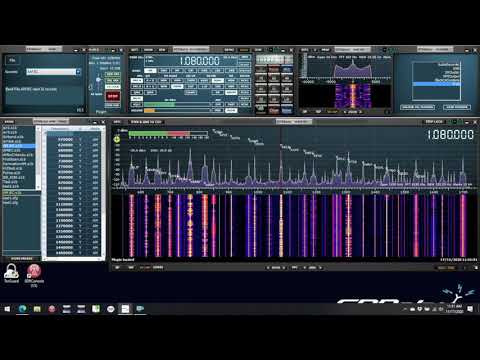
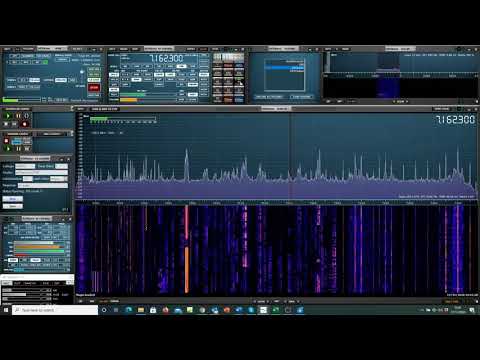
The second feature added recently is an AM Co-Channel Canceller which is could be quite a big feature for medium wave (MW)/broadcast AM DXers. When DXing MW a problem is that you'll often encounter is two stations that are on or almost on the same frequency. This is either due to neighbouring countries not agreeing on frequencies, long range DX antennas picking up further than the intended broadcast range, or from malicious jamming as with the Chinese Firedrake. With a standard radio or demodulation algorithm such a situation makes either both stations impossible to listen to, or only the strongest station will be heard. However, the new AM Co-Channel Canceller plugin in SDR# uses clever DSP algorithms to allow one of those channels to be effectively removed, allowing you to listen to the other station clearly.

Over on the SWLing blog Guy Atkins has written up a comprehensive review and tutorial of the Co-Channel canceller plugin. We've also seen a few examples up on YouTube already, and the video posted below shows user "SDR-radio" in Japan experiencing a South Korean station blocking out a weak local Japanese station. Enabling the plugin allows the weaker station to be heard.

SDR# (SDRSharp): AM Co-Channel Canceller plugin

Notes on Observing Pulsars with an SDR from CCERA

A pulsar is a rotating neutron star that emits a beam of electromagnetic radiation. If this beam points towards the earth, it can then be observed with a large dish or directional antenna and a software defined radio. In the past we've posted a few times about Pulsars, and how the HawkRAO amateur radio telescope run by Steve Olney in Australia has observed Pulsar "Glitches" with his RTL-SDR based radio telescope.

Over in Canada, Marcus Leech has also set up a Pulsar radio telescope at the Canadian Centre for Experimental Radio Astronomy (CCERA). Marcus has been featured several times on this blog for his various amateur radio experiments involving SDRs like the RTL-SDR. In one of his latest memos Marcus documents his Pulsar observing capabilities at CCERA (pdf). His memo describes what Pulsars are and how observations are performed, explaining important concepts for observation like de-dispersion and epoch folding.

The rest of the memo shows the antenna dish and feed, the SDR hardware which is a USRP B210 SDR, the reference clock which is a laboratory 0.01PPB rubidium atomic clock and the GNU Radio software created called "stupid_simple_pulsar". The software DSP process is then explained in greater detail. If you're thinking about getting involved in more advanced amateur radio astronomy this document is a good starting point.

Dish Antenna + Feed used for receiving Pulsars

Sanchez Scripting Examples For Post-Processing GOES, GK2A, Himawari, Elektro Satellite Images

Recently we posted about new updates to the Sanchez software. The updates allow users to combine images received from multiple geostationary weather satellites such as GOES 16/17, Himawari-8, GK-2A and Electro. The images can also be reprojected into a flat equirectangular image, and then optionally reprojected back into a disk view at any location on earth. Sanchez's original function is also still there which allows users to add a false color underlay image to grayscale infrared images received from the satellites.

Sanchez is a command line tool, so scripts are required to do anything interesting. Over on his page Carl Reinemann has uploaded a page with a number of Sanchez command line examples available. The page shows examples like how to stitch together multiple images, and how to create a stitched time lapse animation. The YouTube video below shows an example of an animation Carl created with Sanchez and GOES 16 and 17 images stitched together.

GOES 16-17 Composite imagery

And the image below is an example of an image of Himawari 8, GOES 16 and 17 he stitched together with Sanchez.

GOES 16 and 17 composite created by Carl Reinemann via Sanchez

Tech Minds: Portable RTL-SDR on Android

Over on his YouTube channel Tech Minds has recently released a new video demonstrating how to use an RTL-SDR portably via an Android tablet and an OTG cable. In the video he goes through the various Android software options available including general receiver software such as RF Analyzer (free) and SDR Touch (£5.99) as well as AVARE ADSB for ADS-B aircraft reception. He goes on to demonstrate each program in action.

Portable RTL - SDR Software Defined Radio with Android

Testing VOR Navigation in the Stratosphere with an SDRplay RSP1 and High Altitude Balloon

Over on the SDRplay blog Jon has posted about the STRATONAV experiment which makes use of the SDRplay RSP1 software defined radio. The STRATONAV experiment uses high altitude balloons to carry the RSP1 as well and a commercial portable receiver. The two receivers were configured to receive aircraft VOR navigation signals in order to test the effectiveness of VOR when used at extreme altitudes of up to 28 km. The VOR navigational data was then compared against GPS tracks, resulting in a measure of how well VOR worked at those altitudes. 

VOR (aka VHF Omnidirectional Range) is a navigational beacon that is transmitted between 108 MHz and 117.95 MHz from a site usually at an airport. In the past we have posted about VOR a few times as it can also be decoded with an RTL-SDR, or used for passive doppler aircraft radar. 

The results showed that VOR navigation does indeed continue to function at extreme altitudes, proving that it can be used as a back up navigation system for stratospheric platforms. They also note that VOR navigation could also be used as a primary navigation system on smaller stratospheric platforms due to its low cost and low complexity to implement.

The full academic paper is available on sciencedirect, or for free via Sci-Hub.

SDRplay RSP1 (seen bottom right behind the metal mount) Flying on a High Altitude Balloon

Using an RTL-SDR to Measure the Basis for the Dark Matter Hypothesis

From calculations depending on the distribution of visible star mass in our galaxy, a certain galactic rotational velocity vs distance from center curve is expected. However, when scientists actually measure the galactic rotation, another curve is found - a curve which should result in the galaxy flying apart. This mismatch in expected vs measured data has given rise to the theory of "dark matter". The theory essentially states that in order to get the measured curve, the galaxy must have more mass, and that this mass must come from non-luminous matter scattered amongst the galaxy which is difficult or impossible to observe.

In the past we have posted about Job Geheniau's radio astronomy projects a few times on this blog. So far he has used an RTL-SDR and radio telescope dish to generate a full radio image of the galaxy at the Hydrogen Line frequency of 1.42 GHz. This project worked by pointing the telescope at one section of the galaxy, measuring the total Hydrogen line power with the RTL-SDR over a number of minutes, then moving the telescope to the next section.

Job's Radio Telescope + Laptop and RTL-SDR Setup

Using the same hardware and techniques to observe the Hydrogen Line frequency, he was now able to measure the rotational curve of our galaxy. When the telescope points to different arms of the galaxy, the Hydrogen line measurement will be doppler shifted differently. The measured doppler shift can be used to figure out the rotational velocity of that particular arm of the galaxy. By measuring the rotational velocity from the center of the galaxy to the outer edges, a curve is created. Job's measured curve matches that seen by professional radio astronomers, confirming the mismatch in expected vs measured data.

Job's document explaining his setup and measurement procedure can be found here (pdf file).

Job's Measured vs Expected Curve

If you'd like to get started with Hydrogen line radio astronomy with an RTL-SDR, we have a tutorial over here.

Simple APCO P25 Phase 1 Decoder Plugin Released for SDR#

Vasili, author of several SDR# plugins has recently released a new APCO P25 plugin for SDR#. The plugin is easy to use, simply tune to a P25 voice signal, and it will automatically decode it into voice audio assuming that the signal is not encrypted. If the P25 signal is encrypted, you will hear garbled unintelligible voice. The plugin does not support trunking or any advanced talk group filtering features that you might find with DSD+, Unitrunker, SDR Trunk etc.

To install the plugin, simply download the zip file from rtl-sdr.ru and extra the .dll's into the SDR# folder. Then copy the text in magicline.txt file into the plugins.xml file inside the SDR# folder. The plugin should work with any SDR supported by SDR#, including the RTL-SDR.

The simple APCO P25 decoder for SDR#

Conference Talk on PICTOR A Free-to-Use Open Source Radio Telescope based on RTL-SDR

At this years FOSDEM 2020 conference Apostolos Spanakis-Misirlis has presented a talk on his PICTOR open source radio telescope project. We have posted about PICTOR in the past [1, 2] as it makes use of an RTL-SDR dongle for the radio observations. The PICTOR website and GitHub page provide all the information you need to build your own Hydrogen line radio telescope, and you can also access their free to use observation platform, where you can make an observation using Apostolos' own 3.2m dish radio telescope in Greece.

The PICTOR radio telescope allows a user to measure hydrogen line emissions from our galaxy. Neutral Hydrogen atoms randomly emit photons at a wavelength of 21cm (1420.4058 MHz). The emissions themselves are very rare, but since our galaxy is full of hydrogen atoms the aggregate effect is that a radio telescope can detect a power spike at 21cm. If the telescope points to within the plane of our galaxy (the milky way), the spike becomes significantly more powerful since our galaxy contains more hydrogen than the space between galaxies. Radio astronomers are able to use this information to determine the shape and rotational speed of our own galaxy.

PICTOR: A free-to-use open source radio telescope