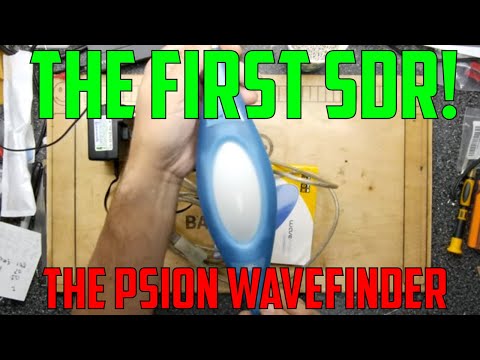
The Psion Wavefinder was one of the first applications of SDR technology in consumer electronics. It was a Windows PC based USD DAB SDR radio receiver that released in the UK in October of the year 2000, for an initial price of £299. (In comparison RTL-SDR wasn't discovered until 2012).
Digital Audio Broadcast (DAB) is a digital replacement for analog broadcast FM. It provides high quality digital audio at the expense of higher cost receivers, and possibly greater difficulty with reception in weak or challenging RF environments. DAB is mostly only used in Europe and Asia Pacific regions, and is not found in the USA.
Due to the lack of popularity of DAB, combined with show stopping bugs in the official software (as seen in reviews), the Psion Wavefinder flopped as a product, and was promptly reduced to £49.99, and out of production by the year 2002.
Over on his YouTube channel backofficeshow, Andrew claims the Wavefinder as the first SDR Radio device and has filmed a teardown, and demonstration of the device working in a Windows XP virtual machine.
The main chips on the device consist of a CPLD DSP, RISC based USB controller, RAM and a fixed point DSP processor. According to some further information from a compatible third party Linux program called dabtools, the Wavefinder performs the COFDM demodulation in hardware on the DSP chips and then transfers the samples over USB for further SDR processing on the host computer.
An RTL-SDR Blog V3 dongle and multipurpose dipole antenna set has been spotted in action on the popular TV Show "The Secret of Skinwalker Ranch" in Season 3 Episode 7. Skinwalker Ranch is a History channel conspiracy theory reality TV series where a team of scientists and researchers are sent to look for various explanations for "otherworldly" activities supposedly occurring on the ranch. In the past we have also seen an SDRplay RSP software defined radio with SDRuno software featured in a previous episode.
In this episode the team are drilling into a mysterious mesa rock formation on the ranch, and are monitoring the RF spectrum with an RTL-SDR during the drill. They take note of a mysterious signal at 1.6 GHz that appears during the drilling.
Screenshots from "The Secret of Skinwalker Ranch" Season 3 Ep 7
Thank you to Balaji for writing in and sharing news about the growing South Indian SDR Users Group. The group have already held several virtual events where a variety of speakers have presented various topics on SDRs and related research. The recorded talks are available on their YouTube channel and include a variety of local Indian and international presenters.
About Us: The South Indian SDR User Group (SI-SDR-UG) was founded in January 2021, and is a community of people, from novices to experts, spanning industry, academia, and government, who are interested in the design and implementation of Software-Defined Radio (SDR) technology and systems. This includes such diverse areas such as RF, digital signal processing (DSP), wireless communications, operating systems, computer networking, software development and optimization, machine learning, and radio hardware. The mission of our community is to facilitate the exchange of ideas and enable greater collaboration within the SDR community in India. We host a regular technical workshops and gatherings, and we also run a dedicated Slack workspace for the community. We have a YouTube channel for recordings of past events, and a GitHub page for any relevant code. Our Twitter feed contains announcements about events and other news relevant to the community. We are not focused or tied to any one single software tool, hardware platform, commercial vendor, or specific technology. The SI-SDR-UG is non-profit, and the people on the organizing committee are all volunteers. We are based in Bangalore, but we invite people from all throughout India, as well as from outside India, to join our community. Please reach out to us on Slack or by email if you have any questions or comments. Thank you!
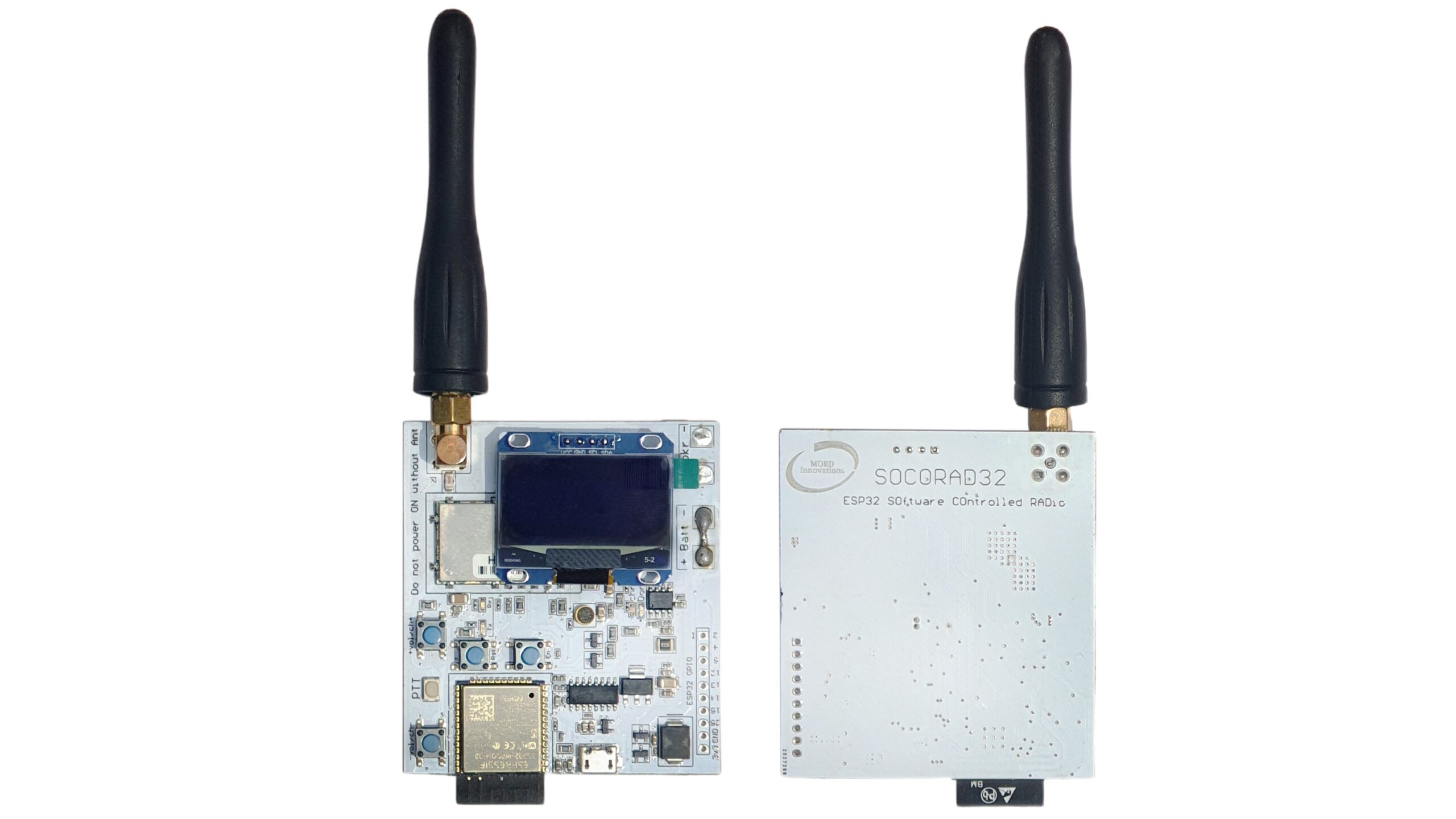
Over on Crowd Supply the SOCORAD32 project has been pre-announced for crowd funding in the future. The project is described as a "hackable, open source, ESP32 amateur radio board with walkie-talkie functionality and data communication". We note that this is not a software defined radio, rather it's a highly customizable software controlled radio.
Because it covers 400 - 470 MHz the device can be used without a license in the license free bands available in most countries. It's able to connect with a standard smartphone over Bluetooth, and can transmit and receive voice, supports voice encryption and compression, and can also transmit and receive SMS data.
SOCORAD32, aka the ESP32Software Controlled Radio, is a professional-grade hackable walkie-talkie for amateur radio exploration, voice, and data communication using simple AT commands. Just add a speaker and a battery and you get a fully functional walkie-talkie radio. With the onboard dedicated Push To Talk (PTT) button, SOCORAD32 can be used straight out of the box without touching a single line of code!
Unlike using complicated SDR for amateur radio operation, SOCORAD32 is an amateur radio-tailored device that makes things simpler. Using uncomplicated AT commands, users can configure the audio volume, tone squelching, CTCSS, CDSS codes, etc. SOCORAD32’s frequency range covers the license-free bands for most countries.
SOCORAD32 also features all of the operations of a standard walkie-talkie. It employs a proprietary RF design featuring the RDA1846 IC. This is the same IC used in commercial walkie-talkies such as in Baofeng, Motorola and Hytera. Because of this, SOCORAD32 can communicate with commercial walkie-talkies with ease.
In addition to all of this, SOCORAD32 utilizes powerful ESP32 Bluetooth functionality. All SOCORAD32 settings can be adjusted via a connected mobile device using a serial Bluetooth app of any choice, while also being adjustable via the dedicated physical buttons. You can store as many channels as you would like in the onboard memory of the ESP32. SOCORAD32 can also communicate data, so you can explore the amateur radio frequencys for IoT or send texts. Texts can be read via the onboard OLED screen or via a Bluetooth connected mobile device.
Beyond communication SOCORAD32 is fully open source and hackable. For high level enthusiasts the RF module can be opened and tinkered with, allowing features like upgrading the power amplifier, among other adaptations.
Overall, SOCORAD32 makes it fun and interesting to explore the intricacies of amateur radio, portable two-way radio walkie-talkies, and long distance audio or data communications similar to LoRa. All done using easy to understand AT commands and the power of the ESP32 module.
Thank you to Apostolos for sharing with us his educational video that introduces "scattering parameters" (aka S-Parameters), and how these parameters relate to antennas and RF networks. S-Parameters are a matrix of values that can be used to describe an electrical network. Apostolos' video explains these parameters in detail, giving good visual examples. Apostolos writes:
For some time now there has been chatter about the possibility of using WSPR logs to help track the mysterious disappearance of flight MH370. WSPR or the "Weak Signal Propagation Reporter" is a protocol typically used on the HF bands by amateur radio operators. The properties of the protocol allow WSPR signals to be received almost globally despite using low transmit power. Amateur radio operators use it for making contacts, or for checking HF radio propagation conditions. MH370 is a flight that infamously vanished without a trace back in 2014.
The theory proposed by aerospace engineer Richard Godfrey is to use logs of sent and received WSPR transmissions that may have intersected the potential flight path of MH370, and to look for potential reflections or 'scatter' in the signal from the metal aircraft hull. From the reflections an approximate track of the aircraft could be calculated much in the same way that bistatic over the horizon radar systems work.
While it is an exciting theory, it is unfortunately considered by most experts as highly unlikely to yield any suitable results with the main problems being WSPR transmission power too weak to detect reflections from an aircraft, and the effect of the ionosphere too difficult to account for.
Over on his blog Nils Schiffhauer (DK8OK) has posted a thorough critique of the idea, explaining the theory, technical details and difficulties in depth, ultimately coming to the conclusion that the idea is based more in wishful thinking than in fact. Nils summarizes:
Time and again, there are news stories in the professional and popular press about the fact that log data from the WSPR data network can help locate aircraft. In particular, the effort is to determine the actual crash site of flight MH370. This effort essentially amounts to detecting "unusual" level jumps and frequency changes ("drift") in the archived WSPR log data and attributing them to reflections from specific aircraft ("aircraft scatter").
In a blog entry, Nils Schiffhauer, DK8OK, for the first time critically evaluates this theory. On the one hand, this is based on years of observation of aircraft scatter on shortwave as well as an investigation of about 30 Doppler tracks. The results of this complex analysis of more than 10,000 data in one example alone are sobering: The effects of aircraft scatter on the overall signal are almost always well below 0.3 dB.
To prove a correlation between level changes of the overall signal and aircraft scatter seems hardly possible on the basis of the WSPR data material. The reasons are manifold, but lie mainly in shortwave propagation, where level changes of 30 dB within a few seconds are the rule rather than the exception.
However, since the local and temporal state of the ionosphere is not known in previous investigations on the WSPR data material - it is recorded in parallel in professional OTH radar systems and calculated out of the received signal - level jumps can hardly be clearly assigned from the sum signal alone. This finding is supported by further arguments in the blog: https://t1p.de/t5kr
Nils demonstrates aircraft scatter on China Radio International, a 500kW transmitter.
Low cost ESP32 based LoRa capable boards have been available from marketplaces like Aliexpress for some time now. They typically include features such as LoRa, WiFi or Bluetooth and GPS all on a PCB board with small screen and battery holder for mobile use. LoRa is a modern IoT communications protocol that is designed to be operated with low power, and in a networked mesh-way for extended range. One application of this hardware is to use it as a mesh based text messaging system, using the Meshtastic firmware. This might be useful for teams of hikers, pilots, or skiiers who operate in remote areas without cell phone reception.
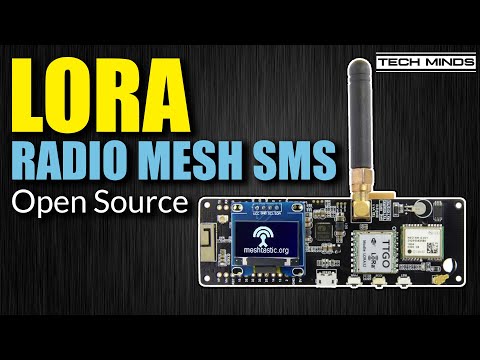
In his latest video Matthew from the Tech Minds YouTube channel shows how to install and use the Meshtastic firmware on a TTGO board. He uses the alpha firmware which has a web app, allowing users to send text messages through a web based GUI that users can connect to locally via WiFi.
OFF-GRID LORA Radio Mesh Text Messaging - Meshtastic
The GNU Radio conference talks are generally about cutting edge SDR research topics and the YouTube playlist contains 67 videos covering a gambit between what changes have been made in new releases of GNU Radio to presentations and demonstrations focusing on topics such as reverse engineering smart power meters and 5G cell detection among many others.
Some of the talks from this years conference that we found most interesting include: