Category: Other

Videos from the Software Defined Radio Academy 2024 Conference Now On YouTube

Videos of talks from the Software Defined Radio Academy 2024 (SDRA'24) conference have recently been uploaded to YouTube. SDRA'24 was hosted primarily as an online conference but was also held physically at the German Friedrichshafen HAMRADIO conference in June 2024.

The talks are slowly being released on YouTube with eight talks released so far on their SDRA'24 playlist. Make sure you subscribe to their YouTube channel to be notified when more talks are released.

Some of the talks of interest that are released include:

  • FobosSDR by RigExpert
  • CW Bandwidth Optimization
  • DMR Tier III base station - TRX in software defined radio
  • High Res Propagation Measurements

You can find the titles of talks of videos that haven't been released yet on the SDRA'24 programme page. Some interesting yet to be released talks include:

  • High Resolution Propagation Measurements Using a WSPRSONDE-8 beacon and a RX888 SDR
  • GNU Radio Project Update
SDRA'24 - 01 - Welcome and Introduction

WarDragon: Real-Time Drone Remote ID Tracking with Snifflee, TAR1090 and ATAK

Over on YouTube Aaron, creator of DragonOS and the WarDragon kit has uploaded a video showing how he was able to detect drone Remote ID with a Bluetooth dongle and plot it on a TAK map. Remote ID is an RF system regulated in many countries that broadcasts drone information, including GPS position, often over Bluetooth Long Range or Wi-Fi. Note that the Bluetooth dongle is not an SDR, but this story may still be interesting for many readers.

The setup uses Sniffle, which is an open-source Bluetooth sniffer program for TI CC1352/CC26x2 based Bluetooth hardware. Sniffle passes sniffed data packets into SniffleToTak which is open-source software that relays the drone ID packets into a TAK server, which can then be viewed in TAK software like ATAK.

Aaron tests the setup with his DJI drone flying nearby, and shows that the drone is successfully detected and plotted on the TAK map. He also plots the positions of nearby aircraft received via a second ADS-B receiver to show that drones and aircraft can be plotted on the same map.

WarDragon Enhancing Drone Remote ID Real-Time Tracking + ADS-B w/ ATAK (TAR1090, Sniffle) Part 3

TechMinds: A Review of the RigExpert FobosSDR

Earlier this year the Ukrainian company RigExpert released the FobosSDR, and only recently has it become available to most people in the world via global resellers. FobosSDR is an RX-only USB 3.0 device, with a 100 kHz to 6 GHz tuning range, 50 MHz of bandwidth, and 14-bit ADC resolution. Current pricing from US resellers is US$395 and from EU resellers around 495,00 €.

Recently Matt from the TechMinds YouTube channel reviewed the FobosSDR, showing an unboxing, description and review of the hardware. Unfortunately, while the specs on paper look good, Matt notes that the FobosSDR does not perform well.

In the video, Matt starts by testing around the broadcast FM band and shows how the FobosSDR suffers from multiple mirrored signals, even with the gain settings turned right down. He notes that other similarly priced SDRs perform a lot better and that even an RTL-SDR performs better.

Matt then goes on to test the HF bands, noting that there is no gain control available on these bands and that there are also extreme levels of signal mirroring all across the HF band.

Unfortunately, we are starting to see other similar reports about poor performance from the FobosSDR. For example, on arcticdx's blog he also does not recommend the SDR [1][2],

RigExpert Fobos SDR 100KHz To 6GHz SDR Receiver

A Video Review of FobosSDR

Back in April of this year, we posted about the FobosSDR, an upcoming software defined radio product from the Ukrainian company RigExpert. FobosSDR is an RX-only USB 3.0 device, with a 100 kHz to 6 GHz tuning range, 50 MHz of bandwidth, and 14-bit ADC resolution. At the time of the previous post, FobosSDR was not yet for sale, but now we see that it is available from some European distributors with a price of 495,00 € (~US$544).

Recently 'Radio Bunker' has uploaded a video review of the FobosSDR on his YouTube channel. Note that the video is in Spanish, however, you can use the YouTube auto-translate function.

In the video, Radio Bunker unboxes the FobosSDR and explains its specs and features, then goes on to show how to install the drivers and get it up and running with SDR#. He then shows the SDR receiving some signals like broadcast AM, FM, shortwave, DAB, and WiFi in SDR# with 50 MHz bandwidth.

▶️ REVIEW: FOBOS SDR ◀️ UN RECEPTOR SDR DE GAMA ALTA

Pi Pico Rx: A Breadboard Software Defined Radio Based on the RP2040 Raspberry Pi Pico

Over on hackster.io we've seen a story about how maker Jon Dawson designed a self-contained software-defined radio based on the Raspberry Pi Pico that can receive 0 - 30 MHz, with up to 250 kHz of bandwidth. The Raspberry Pi Pico is a microcontroller board based on the Raspberry Pi Foundation's own RP2040 chip.

The Pi Pico Rx's front end consists of a Tayloe Quadrature Sampling Detector (QSD) mixer which makes use of the PIO (Programmable Input/Output) feature on the RP2040. The circuit also has an encoder knob for tuning and a small OLED screen.

Jon had originally created the Pi Pico Rx on a custom PCB, however, his latest work brings the cost down by showing that it can just as easily be implemented on a breadboard with through-hole components.

The full writeup can be found on Jon's blog "101 Things", as can the open source firmware. He has also uploaded a YouTube video explaining and demonstrating the project which we've embedded below.

Software Defined Radio with Pi-Pico

Tech Minds: A Beginners Guide to the Radioberry HF SDR Transceiver Pi Hat

Recently on the Tech Minds YouTube channel, Matt uploaded a video explaining how to set up and use the Radioberry HF SDR Transceiver Pi Hat. The Radioberry is an HF SDR transceiver based on the AD9866 chip. It has an operating frequency between 0 - 30 MHz, a 12-bit ADC, a maximum bandwidth of up to 384 kHz, and one RX and one TX channel. It is designed as a 'Pi hat' which means that it needs to be connected and sit on top of a Raspberry Pi single-board computer.

In his video Matt shows how to set up the Radioberry Raspberry Pi software. The process begins with installing the Raspbian OS, logging into SSH, and running the Radioberry installation script. He then shows how to connect to the Radioberry over a local network using SDR-Console V3. Later he shows how to install the pihpsdr software which gives the Radioberry a desktop control app that can be used with a LCD screen connected to the Raspberry Pi.

Matt goes on to show how he was also able to use the Radioberry TX function to make WSPR contacts across Europe from with his home location in the UK, despite its very low 150 mW output power.

The Beginners Guide To The Radioberry HF SDR Transceiver Pi Hat

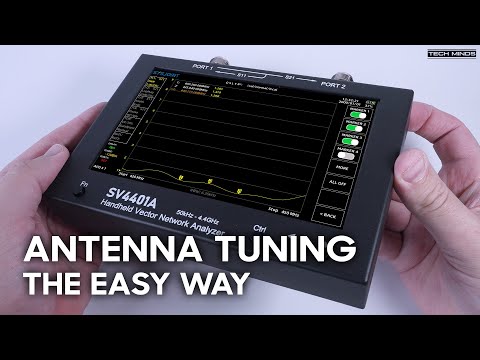
Tech Minds: Review of the SV4401A Vector Network Analyzer

In one of his recent videos, Matt from the Tech Minds YouTube channel reviews the SV4401A Vector Network Analyzer (VNA).  A VNA is a powerful tool that can be used for analyzing and tuning antennas, as well as other RF components such as filters and cables.

Typically we recommend the NanoVNA V2 and Nano V2 Plus 4 as low-cost VNA's that most hobbyist users will be happy with. However, the SV4401A comes with a much larger 7-inch touch screen, a nicer UI, built-in signal generator, and large frequency range spanning from 50 kHz - 4400 MHz. The price is similar to that of the Nano V2 Plus4, coming in at US$322, versus $299 for the NanoVNA V2 Plus4.

The ONLY Vector Network Analyzer I Will EVER Need - SV4401A

Tech Minds: Using the RK888 MK2 to Receive the Entire HF Band

In one of his latest videos Matt from the Tech Minds YouTube channel tests out the RX888 MK2 software defined radio at HF frequencies. Matt notes that while the bandwidth of this SDR is limited to 10 MHz at VHF/UHF, you can actually use it in direct sampling mode to achieve a massive bandwidth of 64 MHz, allowing you to receive the entire HF band at simultaneously.  

In his video, Matt uses SDR-Console V3 and he shows the entire HF band being received at once. He also shows the SDR-Console V3 matrix bands organizer, which allows you to create multiple windows of zoomed-in spectrum. That combined with the multi-receiver feature could allow you to have multiple audio outputs for digital decoding across the HF band.

Amazing! ALL HF Bands at the SAME time with the RX888 Mk2