Over on YouTube Corrosive from the SignalsEverywhere channel has uploaded a new video showing us how you can make a DIY upconverter using a HackRF as a signal source and a cheap $10 RF Mixer. An upconverter converts lower frequencies into higher frequencies. For example, an upconverter is commonly used to convert HF signals into VHF, so that VHF/UHF only SDRs can receive HF.
In the video he uses the HackRF as a local oscillator source, a cheap RF mixer on a breakout board, and an Airspy as the receiver. In most circumstances if you needed and upconverter you'd just purchase one like the Ham-it-up, or the Spyverter for ~$40. However the interesting advantage of using a versatile signal generator like the HackRF is that it results in an upconverter that can upconvert HF to almost any frequency. Even without any filtering (which is recommended to remove signal images), Corrosive fings that he has excellent HF reception.
This video is an excellent way to learn about how upconverters work.
HackRF and RF Mixer = DIY RTL SDR Up-converter | Basics of the Passive ADE Mixer
The process to install an RTL-SDR dongle on Windows involves the simple step of running Zadig and installing the generic WinUSB drivers to the RTL-SDR, which shows up as "Bulk-In, Interface (Interface 0)" in Zadig.
However we find that people sometimes accidentally use Zadig to install WinUSB to "Bulk-In, Interface (Interface 1)" by mistake. Installing WinUSB to this interface can break your installation, and it can cause the RTL-SDR to display a "usb_open error -12" on command line software, and can cause problems connecting to the device on GUI software like SDR#.
Over on YouTube Corrosive from the SignalsEverywhere YouTube channel uploaded a very useful video that shows how to fix this problem.
With so many independent people receiving weather satellite images from the NOAA satellites daily, an interesting collaborative task is to stitch these images together to create a wide area composite image. Fortunately the WXtoIMG software already has stitching as a feature.
NOAA Weather Satellite Composite created with images from Jeff Kelly (New Jersey, US), Mike Kimzey (Philadelphia, US), David Kunz (San Francisco, US), Cornelius Danielsen (Norway), Alan Hinton (UK), Michael Sørensen (Denmark), and Hans-Juergen Luethje (Germany).
Weather Satellite Failure Updates
We also wanted to provide a brief update on some weather satellites that we RTL-SDR users often receive.
NOAA 15: About two weeks ago NOAA 15 failed and was producing glitched images. However after a few days it came right again, only to have failed again at the end of last month. It appears that the camera scanning motor is getting stuck due to being low on lubricant as the satellite is now well past it's intended life cycle at 11 years old. If you're interested, some info on how the camera on these satellites works can be found here. There is currently no plan for a fix, the only hope is to wait and see if the motor unsticks.
Meteor M2-1: Meteor M2-1 has also recently suffered problems yet again with it's orientation control, and we're regularly seeing off-axis or distorted images that show the curvature of the earth. Over the weekend it was turned off, and should be reset this week. This problem seems to occur and be fixed often, so hopefully it will be back online soon.
Meteor M2-2: The recently launched Meteor M2-2 is functional, but it is still in the testing phase, so is sometimes being turned off. Do not be alarmed if no signal is received sometimes.
GOES-17: GOES-17 is reported to be experiencing problems with it's infrared camera due to a blocked heatpipe, however it appears that they are able to work around this issue and obtain 97% uptime.
Every device that transmits radio waves has a unique and identifiable RF fingerprint which occurs due to the very slightly variations in the hardware manufacturing process. This means that devices using identical transmitters of the same make and model can still be differentiated from one another.
Nihal Pasham has been using this knowledge as a way to securely identify IoT sensors and other RF devices like car keyfobs. The idea is that these unique RF fingerprints are immune to authentication spoofing which could be used to create a fake transmitter with fake data. He suggests that RF fingerprinting could be used as an additional authentication check for low cost IoT devices with only basic security.
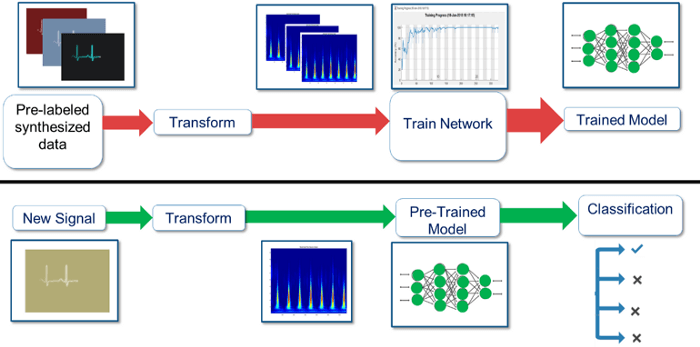
In order to recognize the minute differences in the RF fingerprints of different devices Nihal notes that a good pattern detection algorithm is required, and that a deep learning neural network fits the bill. Using neural network software Tensorflow, and an RTL-SDR for signal acquisition, he was able to train a proof of concept neural model that was able to classify two test transmitters with 97% accuracy.
Training a Deep Learning Neural Network with an RTL-SDR for RF Fingerprinting
In the past we've seen similar experiments by Oona Räisänen who used an RTL-SDR to fingerprint several hand held radios heard on the air via small variances in the power and frequencies of each radio's CTCSS tone. Using simple clustering techniques she was able to determine exactly who was transmitting based upon the unique CTCSS.
Thank you to Happysat for submitting the following information about the updated LRPT decoder for Meteor M-N2-2. He has also provided a link to his very useful Meteor Satellite reception tutorial.
Today the official LRPT-Decoder V42 ready for release :)
Before we did use a older internal debug version from 2014, because this one was still in development.
This version 42 of LRPTDecoder will work with both Meteor M-N2 and Meteor M-N2-2.
Example ini configuration files for other modes are attached in the archive.
Over on YouTube Nick Black has uploaded a video where he does a good introduction to software defined radio (SDR), SDR history, how SDR works, various SDR concepts like sampling and bandwidth, different SDR hardware, the SDR Linux stack and reverse engineering wireless signals.
The information is presented fast and densely, so it may be a bit hard to follow for newbies, but if you already have some experience with SDR it may be a good video that helps tie everything together and fill in some gaps. Nick also has a Wiki where he's documented some of what is said in the video.
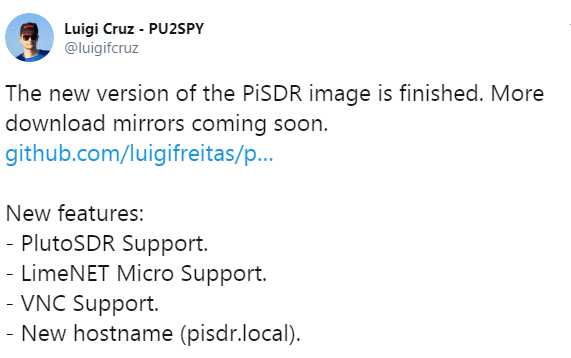
[@Lugigi Cruz] has announced on twitter that his latest PiSDR image now includes full PlutoSDR support. PiSDR is a pre-built Raspberry Pi distribution that supports several SDRs including the RTL-SDR. It comes with many applications and libraries ready for you to use some of which include GQRX and GNURadio Companion. PiSDR is available on [GitHub] and just needs to be burned to an SD card to be used. The PlutoSDR is a low cost (typically priced anywhere between $99 – $149 depending on sales) RX/TX capable SDR with up to 56 MHz of bandwidth and a 70 MHz to 6 GHz frequency range.
With this update support for the PlutoSDR has been added. This should allow for a host of new interesting uses for the image as it includes SDRAngel, an SDR application that works with transmit capable SDRs. While I’ve not yet tested the image myself, this should in theory mean that the PiSDR image could be used with a transmit capable SDR like a PlutoSDR or Lime/Mini SDR to both transmit and receive anything from DATV to voice and more.
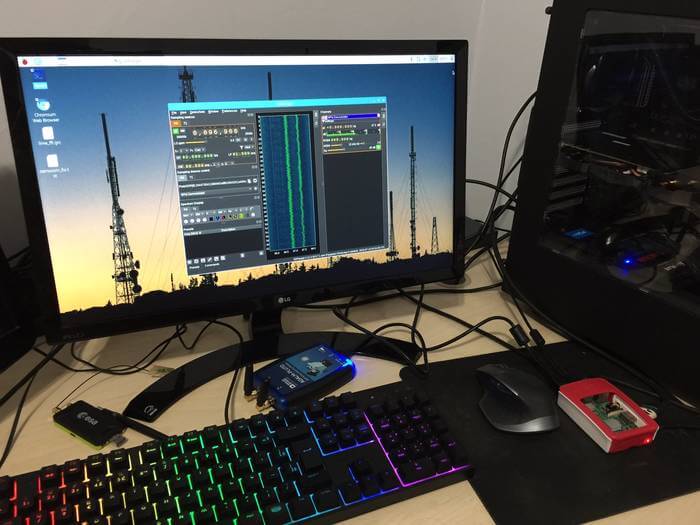
Below you can see the image running the Raspbian desktop with the SDRAngel software connected to the PlutoSDR. Those with a keen eye may also see the LimeSDR mini laying on the desk s well. The concept of SDR on a small microcomputer such as the Raspberry Pi isn’t a new one, but the existence of this distribution makes it much easier for people to jump in and start using it without having to configure and install software from scratch which can sometimes be a daunting task.
Hackaday is a very popular blog that summarizes and aggregates all sorts of content related to hardware, electronics and software projects (just like we do with SDR content). Over the years Hackaday have featured RTL-SDR related projects several times, and in their latest post Tom Nardi reminisces on the seven years since RTL-SDRs became a thing.
Tom talks about how RTL-SDR has evolved since 2012, and how they've kicked off a revolution in the SDR world. He goes on to mention how the hardware and software has improved, mentioning our RTL-SDR Blog V3 units and software like GQRX and Universal Radio Hacker.
At RTL-SDR.COM we're looking forward to where the next seven years of low cost SDR takes us!