Category: Security

Medtronic Minimed Insulin Pumps Recalled due to Wireless Security Vulnerabilities
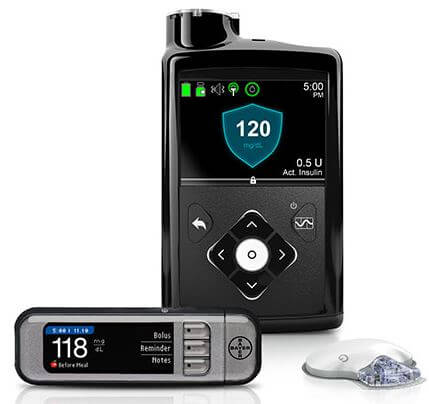
A MiniMed Insulin Pump

Back at the 2018 Black Hat conference it was revealed by security researchers Billy Rios and Jonathan Butts that a HackRF could be used to take control of a Medtronic insulin pump. Back then FDA advisories were issued, but recently a new warning noting that Medtronic MiniMed 508 and Paradigm series insulin pumps could be vulnerable to wireless attacks was again issued. The vulnerabilities could allow hackers to wireless cause the device to deliver excessive amounts of insulin or stop insulin delivery. 

Apparently the vulnerabilities cannot be fixed with a software update, so Medtronic have issued a voluntary recall, asking customers to contact their healthcare providers so that they can upgrade to their newer units which are more secure (although these newer units are not available everywhere outside the USA). We also note that Medtronic implantable cardiac defibrillators (ICDs) which appear to share the same vulnerability do not appear to have been recalled. For both the insulin pumps and ICDs, the issues stem from the fact that the "Conexus" wireless protocol used in the products do not use encryption, authentication or authorization.

A newspaper article at theregister.co.uk writes:

Security researchers Billy Rios, Jonathan Butts, and Jesse Young found that the wireless radio communications used between a vulnerable MiniMed pump uses and its CareLink controller device was insecure. An attacker who was in close enough physical proximity to the pump could masquerade as a CareLink unit, and send potentially life-threatening commands to the insulin pump over the air using a software-defined radio or similar kit.

"The vulnerabilities affect the radio features," Rios told The Register. "They use a custom radio protocol and the vulnerabilities were exploited through the use of software-defined radios."

Previously we also posted about how an RTL-SDR could be used to sniff RF data packets from a Minimed Insulin pump using the rtlmm software, and back in 2016 we posted how data could be sniffed from an implanted defibrillator.

Hak5: Hacking Ford Key Fobs with a HackRF and Portapack

This weeks episode of Hak5 (an information security themed YouTube channel) features Dale Wooden (@TB69RR) who joins hosts Shannon and Darren to demonstrate a zero day vulnerability against Ford keyless entry/ignition. More details about the vulnerability will be presented at this years DEF CON 27 conference, which is due to be held on August 8 - 11.

In the video Dale first demonstrates how he uses a HackRF with Portapack to capture and then replay the signal from a Ford vehicle's keyfob. The result is that the original keyfob no longer functions, locking the owner out from the car. After performing a second process with another keyfob, Dale is now able to fully replicate a keyfob, and unlock the car from his HackRF.

Dale explains that unlike the well known jam-and-replay methods, his requires no jamming, and instead uses a vulnerability to trick the car into resetting the rolling code counter back to zero, allowing him to capture rolling codes that are always valid. Dale also notes that he could use any RX capable SDR like an RTL-SDR to automatically capture signals from over 100m away.

The vulnerability has been disclosed to Ford, and the full details and code to do the attack will only be released at DEF CON 27, giving Ford enough time to fix the vulnerability. It is known to affect 2019 Ford F-150 Raptors, Mustangs and 2017 Ford Expeditions, but other models are also likely to be vulnerable.

The video is split into three parts. In part 1 Dale demonstrates the vulnerability on a real vehicle and in part 2 he explains the story behind his discovery, how he responsibly disclosed the vulnerability to Ford and how to reset the keyfob yourself. Finally in part 3 Darren interviews Dale about his experiences in the RF security field.

Dales discovery has also been written up in an article by The Parallex which explains the exploit in more detail.

Hacking Ford Key Fobs Pt. 1 - SDR Attacks with @TB69RR - Hak5 2523 [Cyber Security Education]

Hacking Ford Key Fobs Pt. 2 - SDR Attacks with @TB69RR - Hak5 2524 [Cyber Security Education]

Hacking Ford Key Fobs Pt. 3 - SDR Attacks with @TB69RR - Hak5 2525 [Cyber Security Education]

Using a Software Defined Radio to Send Fake Presidential Alerts over LTE

Modern cell phones in the USA are all required to support the Wireless Emergency Alert (WEA) program, which allows citizens to receive urgent messages like AMBER (child abduction) alerts, severe weather warnings and Presidential Alerts.

In January 2018 an incoming missile alert was accidentally issued to residents in Hawaii, resulting in panic and disruption. More recently an unblockable Presidential Alert test message was sent to all US phones. These events have prompted researchers at the University of Colorado Boulder to investigate concerns over how this alert system could be hacked, potentially allowing bad actors to cause mass panic on demand (SciHub Paper).

Their research showed that four low cost USRP or bladeRF TX capable software defined radios (SDR) with 1 watt output power each, combined with open source LTE base station software could be used to send a fake Presidential Alert to a stadium of 50,000 people (note that this was only simulated - real world tests were performed responsibly in a controlled environment). The attack works by creating a fake and malicious LTE cell tower on the SDR that nearby cell phones connect to. Once connected an alert can easily be crafted and sent to all connected phones. There is no way to verify that an alert is legitimate.

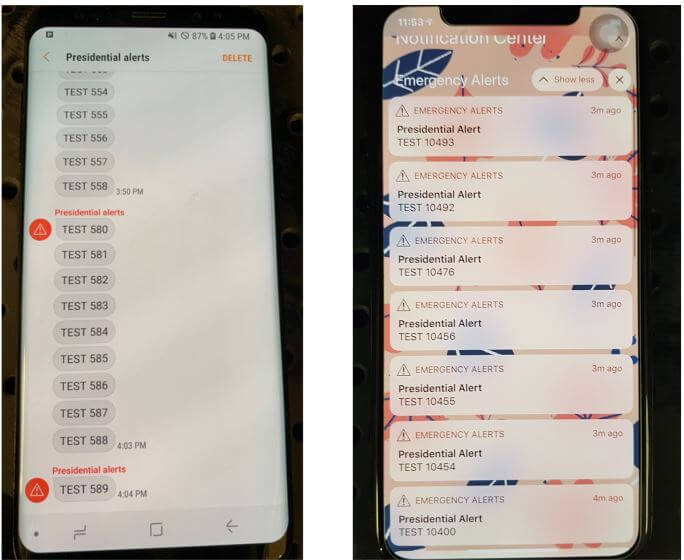
Spoofed Presidential Alerts Received on a Galaxy S8 and iPhone X.

Reverse Engineering and Controlling a Wireless Doorbell with an RTL-SDR and Arduino

Thank you to Shreyas Ubale for submitting his blog post about reverse engineering a wireless doorbell, and then performing a replay attack. Shreyas had purchased a wireless doorbell set containing one button transmitter and two bell receivers. However, his situation required two transmitters, one for visitors at the door, and one to be used by family within his house.

In order to create a second transmitter he decided to reverse engineer the doorbells wireless signal, and use that information to create an Arduino based transmitter. His process involves first using an RTL-SDR to determine the transmission frequency, then using the rtl_433 software to capture the raw waveform which he then analyzes manually using Audacity. Once the binary string, length and pulse width is known he is able to program an Arduino connected to a 433 MHz transmitter to replicate the signal.

In future posts Shreyas hopes to explore other ways to transmit the signal, and eventually design a simple but configurable 433 MHz push button that supports RF, WiFi, and can support the IFTTT web service.

If you're interested, check out some of our previous posts that highlight many other successful reverse engineering experiments with RF devices and SDR.

Doorbell Signal Analysis in Audacity. Captured with an RTL-SDR.

SignalsEverywhere Podcast: Satcom Piracy Interview

Corrosive from the SignalsEverywhere YouTube channel has released a new episode of his podcast. In this episode Corrosive interviews an anonymous informant who has an interesting story about his involvement with the UHF Military SATCOM pirate radio scene in Brazil. Corrosive also explains a bit further about what SATCOM is and why it's so susceptible to piracy. He also notes that piracy on Inmarsat L-band frequencies is also becoming more common.

The UHF-SATCOM band is anywhere between 243 - 270 MHz and contains fairly strong signals from many several US satellites that can be received with a simple antenna and any UHF radio/SDR. Many of the satellites are simple repeaters without security, and pirates from Mexico and South America often hijack the satellite for their own personal use. In the past, and possibly even still today hijackers involved in drug trafficking and other illegal activities made use of these insecure military satellites for long range communications. Reception of these satellites is generally available in Canada, US, Mexico, South America, Europe and Africa.

Satcom Crackdown; Satellite Piracy on After The Show Podcast

The RadioInstigator: A $150 Signals Intelligence Platform Consisting of a Raspberry Pi, RPiTX, 2.4 GHz Crazyradio and an RTL-SDR

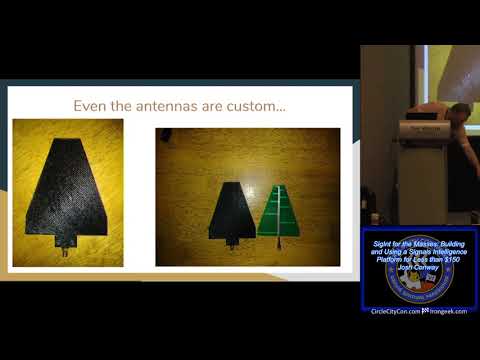
Circle City Con is a yearly conference that focuses on information security talks. At this years conference Josh Conway presented an interesting talk titled "SigInt for the Masses Building and Using a Signals Intelligence Platform for Less than $150". Josh's talk introduces his "RadioInstigator" hardware which is a combination of a Raspberry Pi, CrazyRadio and an RTL-SDR all packaged into a 3D printed enclosure with LCD screen. The idea behind the RadioInstigator is to create a portable and low cost Signals Intelligence (SIGINT) device that can be used to investigate and manipulate the security of radio signals.

The RadioInstigator makes use of the RPiTX software which allows a Raspberry Pi to transmit an arbitrary radio signal from 5 kHz up to 1500 MHz without the use of any additional transmitting hardware - just connect an antenna directly to a GPIO pin. Connected to the Pi is a CrazyRadio, which is a nRF24LU1+ based radio that can be used to receive and transmit 2.4 GHz. And of course there is an RTL-SDR for receiving every other signal. Josh has made the plans for the RadioInstigator fully open source over on GitLab.

In his talk Josh introduces the RadioInstigator, then goes on to discuss other SDR hardware, antenna concepts and software installed on the RadioInstrigator like RPiTX, GNU Radio, Universal Radio Hacker, Salamandra, TempestSDR and more.

[First seen on Hackaday]

Track 3 07 SigInt for the Masses Building and Using a Signals Intelligence Platform for Less than 15

Using an RTL-SDR to Monitor A Tire Pressure Sensor used in Home Brewing

Over on YouTube Andreas Spiess has been helping his friend create a pressure monitoring system for his home brew beer bottles. In order to do this, Andreas uses an externally mounted after market wireless tire pressure sensor whose data can be received with an RTL-SDR and the rtl_433 decoder software. Modern vehicle tires contain a TPMS (tire pressure monitoring system) sensor, which keeps track of tire pressure, temperature and acceleration. The data is wirelessly transmitted via 433 or 315 MHz to the cars dashboard and computer for safety monitoring.

In the first video Andreas discusses tire pressure monitors and how they could be used for other non-tire applications, talks a bit about the wireless protocol used, and how to reverse engineer it. He notes that the author of rtl_433 was able to implement his particular tire pressure sensor brand's protocol into the rtl_433 database, so now anyone can decode them. Finally in this video he also shows that he can easily spoof a flat tire signal using a HackRF and GNU Radio which might cause a modern high end car to refuse to move.

The second video shows how to continuously monitor that TPMS data for the home brew set up. Andreas uses an RTL-SDR and Raspberry Pi running rtl_433, which outputs it's data into Mosquitto, Node-Red, InfluxDB and the Grafana. These programs help to read, manage, log and graph the data. The rtl_433 program is also monitored by Supervisord which automatically restarts rtl_433 if the program crashes.

If you are interested, there is a related video that was uploaded in between the two shown below which shows how he created a 3D printed cap to mount the valve and tire pressure sensor on the beer bottles.

#261 Measure Pressure Remotely (including TPMS Hacking / Attack) for Beer Brewing

#270 Safely Monitor and Alarm with Supervisord and Telegram

Using a HackRF to Reverse Engineer and Control Restaurant Pagers

Several years ago back in 2013 and 2014 we uploaded two posts showing how it was possible to use an SDR to listen in to restaurant pagers and collect data from them, and also to spoof their signal and activate them on demand. If you were unaware, restaurant pagers (aka burger pagers), are small RF controlled discs that some restaurants hand out to customers who are waiting for food. When the food is ready, the pager is remotely activated by the staff, and then flashes and buzzes, letting the customer know that their order can be picked up.

Over on YouTube user Tony Tiger has uploaded a video that shows an overview on how to reverse engineer the signal coming from a particular brand of restaurant pagers. The tools he uses include a HackRF SDR and the Inspectrum and Universal Radio Hacker software packages. If you're interested in reverse engineering signals, this is a good overview. Later in the video he shows a GNU Radio and Python program that he's created to control the pagers.

Hacking Restaurant Pagers with HackRF