UFO Tracking Network using RTL-SDRs to Rule out False Positives from Commercial Aircraft

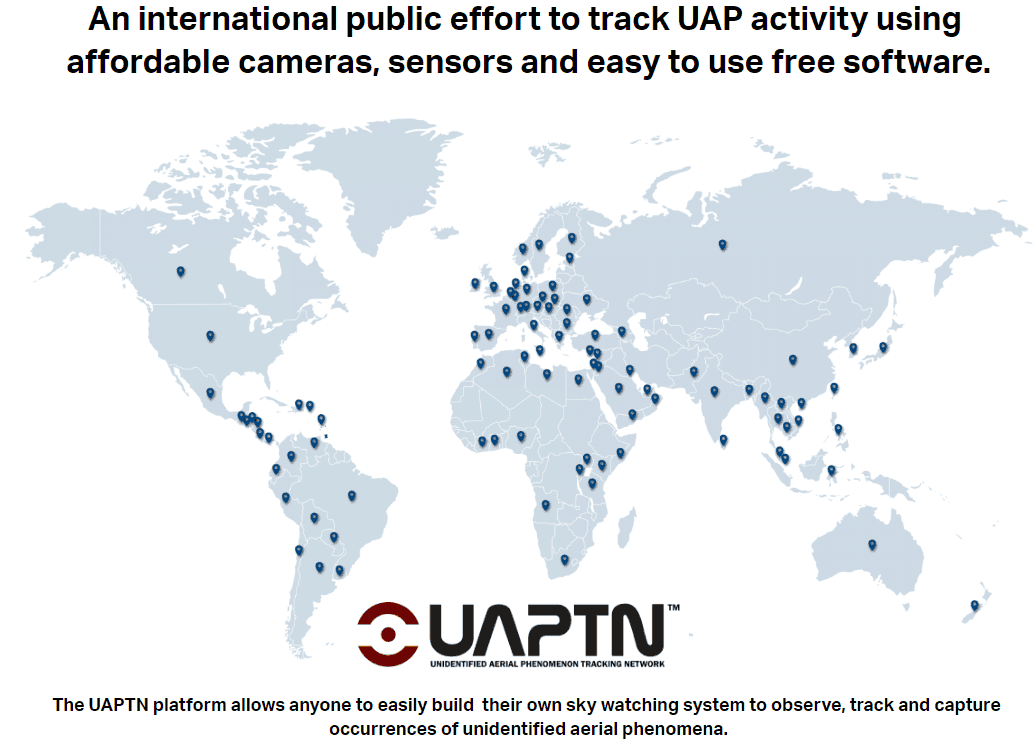
The Unidentified Aerial Phenomenon Tracking Network (UAPTN) is an effort to set up crowd sourced Raspberry Pi powered cameras all over the world in order to record videos of "unidentified aerial phenomena" AKA UFOs. In order to rule out false positives from known aircraft, they are recommending that contributors install a FlightAware RTL-SDR in their system for aircraft tracking. 

For this purpose doing your own ADS-B flight tracking would be required as most commercial flight tracking sites censor military and private jets. The only site that does not censor data is ADS-B Exchange. However, of course military aircraft conducting operations are always able to turn ADS-B off if required for the mission which is what the UAP network will probably detect the most. 

If UFO tracking does not interest you, then you might instead be interested in creating a RTL-SDR based GhostBox to talk to spirits!

Techminds Reviews the Ham-It-Up Nano Upconverter

A few days ago we posted about the release of the new NooElec Ham-It-Up Nano upconverter which sells for US$49.95 on their store and Amazon. Upconverters enable SDRs that cannot tune in the HF bands to receive HF by shifting the low HF frequencies "up" into a range receivable by most VHF/UHF capable SDRs.

In his latest video Techminds reviews the Nano together with an E4000 tuner based RTL-SDR with built in bias tee. In the video he demonstrates it working with the SDR# software, and shows how to set the Shift parameter to ensure that the correct frequency offset it set. He goes on to demonstrate reception through the various HF bands confirming that the unit works as expected.

Nooelec Ham It Up NANO - HF Upconverter

Building an Underground Earth Probe Antenna for 0 – 14 MHz TX/RX

Thank you to Jean-Marie Polard (F5VLB) for letting us know about his work in creating underground "earth probe" antennas that work for both RX and TX between 0 - 14 MHz, and are especially good at VLF and below. He writes:

Can't install an antenna at home? Madame refuses the masts, taut son? One solution, The Earth probes antenna.

Our group (https://www.facebook.com/groups/earthprobes/) started in January 2019. At first everyone made fun of me, the professionals called me crazy and today with more than seven hundred members, we installed underground antenna systems and the results are there.

Between 0 and 14MHz, in transmission and reception, it works!

This system dates from 1914/1918 but has been brought up to date.

It doesn't take much to get started, just the urge to try.

Mad of vlf - elf - ulf ? come here https://www.facebook.com/groups/VLF.ULF.ELF/ nearly 1000 members are waiting for you.

So when? Welcome everyone.

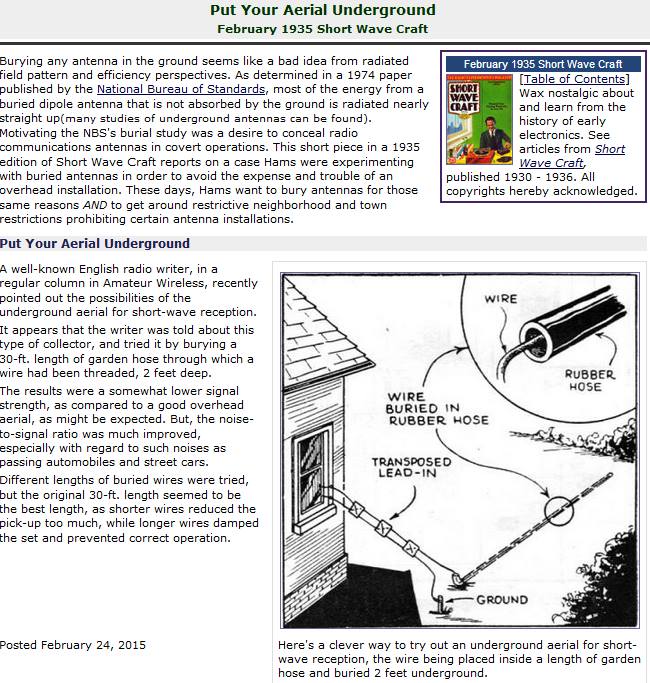
To access the Earth Probes and VLF.ULF.ELF groups you'll need a Facebook account. The groups contain a number of research papers documenting the concept, and the photos section. From the photos, an earth probe antenna appears to consist of two long grounding rods spread over a distance, or a grounding rod and long buried wire, combined with a balun.

An example of an underground antenna setup from a 1935 shortwave magazine.

Sign up to be an Early Beta Tester of CENOS Antenna Design and Simulation Software

CENOS are a company specializing in 3D modelling and simulation software for induction heating applications. However, they are now branching out and are creating software for antenna design and simulation. Final pricing of the software is not yet advertised, but they write that it has been made affordable thanks to "open source algorithms". Hopefully it will be affordable to hobbyists, but judging by the heat simulation software pricing it may not be (although they offer to software free to students, researchers and teachers).

However, it appears that they will soon be running a beta testing program that should hopefully be free to use during the testing phase. You can sign up to their email list and wait for their announcement on their website.

CENOS Antenna Design Program Screenshots

Coronavirus: Hamvention Cancelled & Other Updates

Hamvention, the largest yearly amateur radio event has been cancelled this year due to concerns over the spread of the Coronavirus (COVID-19). It was due to be held during May 15 - May 18, 2020. Chairman Jack Gerbs writes:

The Hamvention Executive Committee has been monitoring the COVID19 pandemic. We have worked very closely with our local and state health Departments.

It is with a very heavy heart the Hamvention Executive Committee has decided to cancel Hamvention for this year.
This decision is extremely difficult for us but with around two months until the Great Gathering we felt this action necessary.
More specific details regarding the closure will soon be posted here.

Thank you for your understanding in this time of International Crisis.

Jack Gerbs
General Chairman HV2020
[email protected]

According to the ARRL cancelled events tracker, a number of other amateur radio events across the USA have also been cancelled, and we're seeing similar reports for most other countries too. At this stage we expect that most events will be cancelled over the next few months.

RTL-SDR Blog V3 Stock & Shipments

Due to manufacturing delays and slowdowns related to the Coronavirus our multipurpose dipole antenna set, and set including antenna and dongle is currently out of stock on our international webstore. We expect to be able to restock by the end of the month. There remains sufficient stock of the dongle itself. Our wideband LNA will also be back in stock next month.

Amazon USA is still stocked with all products, however there may be a short out of stock period within 1-2 weeks as we await for the arrival of replenishing stock in the USA.

In regards to international shipments please expect that there could be delays. At the moment we are seeing most mail still getting through in a timely manner, however this could change over the coming weeks as more travel restrictions come into play.

It is expected that other radio related products could also soon be out of stock, or delayed due to the situation.

Other Coronavirus Posts

N0SSC has provided a good post outlining the risks to the amateur radio population and why amateur radio event cancellations are a good idea. 

SolderSmoke, a popular podcast about radio homebrewers has put out a special Coronavirus crisis podcast.

We thought it would be nice to put out a special edition of the podcast to help listeners keep up their morale during this difficult time. So we’ll do our regular kind of show, but we’ll try to emphasize things you can do to stay busy and keep up morale while stuck at home.

Over on The SWLing Blog Thomas has put out a post about social distancing and how to keep occupied without leaving the house, and another post about how shortwave broadcasters are now adding regular Coronavirus information and news to their broadcasts.
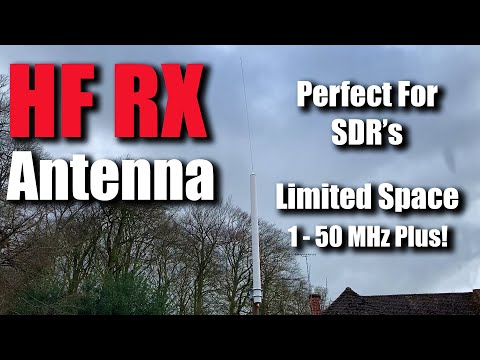
Techminds Reviews a HF RX SWL Antenna for Small Spaces and Apartments

Over on his YouTube channel TechMinds has uploaded a video reviewing the X1-HF 1 - 50 MHz Trapped Coil Receiving antenna from Moonraker.eu which goes for £69.95. This is a small electrically short antenna for HF reception which is easy to setup and install, requiring no radials. However, like all short HF antennas it is a compromise.

In the review he uses an SDRplay RSP2 SDR to test HF reception with the antenna. Later in the video he also tests it outside the advertised 1 - 50 MHz range. He concludes that the antenna works very well for it's small size.

HF RX SWL Antenna For Small Spaces And Apartments RTL SDR

SATSAGEN: Software to use a PlutoSDR as a Tracking Spectrum Analyzer

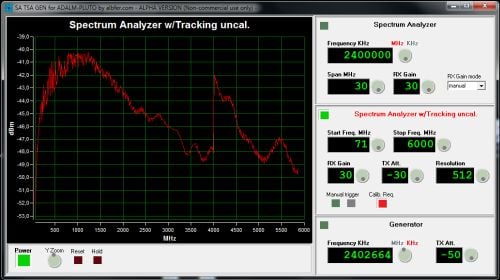
Thank you to Frank, HB9FXQ for submitting news about a new Windows program called SATSAGEN which allows you to use a PlutoSDR as a wideband spectrum analyzer. SATSAGEN was created by Alberto IU1KVL and is entirely free to use. This makes it possible to get wideband scans of RF components like filters and attenuators. Together with a directional coupler it could also be used to measure the SWR of antennas as HB9FXQ demonstrates in his Twitter post.

The PlutoSDR is a low cost RX/TX capable SDR with up to 56 MHz of bandwidth and 70 MHz to 6 GHz frequency range. It is typically priced anywhere between US$99 - US$149 depending on sales.

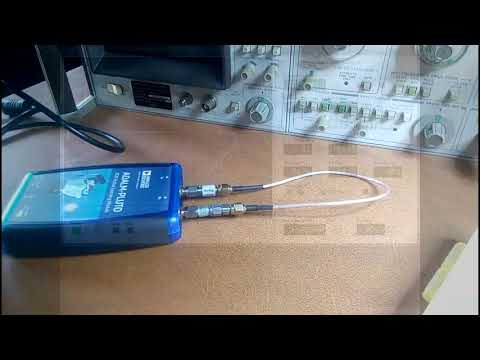
In the video below Alberto demonstrates SATSAGEN performing some wideband scans, and he shows the various features of the software. He writes that the system has a scan range from 70 MHz to 6 GHz and can show results in dBm. The spectrum analyzer works with the TX part of the PlutoSDR to provide a tracking generator with resolution of up to 1024 points. The software can also use the PlutoSDR as a frequency generator with 1 kHz of resolution.

There is also a support group available at groups.io/g/satsagen.

SATSAGEN Screenshot
SATSAGEN Screenshot

OpenEar: An Easy to Use Windows TETRA Voice Decoder

A new TETRA voice decoder called "OpenEar" has just been released. The program is a standalone Windows app that directly connects to an RTL-SDR. Decoding a TETRA voice signal is as simple as opening the program, tuning to the TETRA frequency and clicking on the signal. With good signal strength voice comes through very clearly. CPU usage on our PC is also minimal. 

The program source is currently not available as the author notes that he only intends to release it as open source in the future once the project is completed, and right now this is only the first early release. Right now the program is just an .exe with a few .dlls. You'll need to first install the Microsoft Visual C++ Redistributable Package linked in the Git readme. Just in case, we virus scanned the exe and tested the program in Sandboxie. It appears to be clean, and it works as intended.

In the future the author hopes to support many more protocols such as DMR, MPT1327, ACARS, AIR, GSM and more. In order to support his work he is asking for Bitcoin donations, and the donations link can be found on the Git readme.

UPDATE 1: If you're getting missing dll errors and you already installed the Visual C++ Redistributable, try downloading the missing dll's from dll-files.com. There should only be about 5 missing.

UPDATE 2: As pointed out in the comments by Steve M. from Osmocom, this software may be in violation of several GPL licences as no source code has been released and it appears to rely on GPL code and libraries. Please take this into account.

UPDATE 3: As per update 2, the author has decided to temporarily disable the TETRA functionality pending a rewrite of the code that he will complete within one to two months). Instead he has added DMR decoding.

OpenEar TETRA Voice Decoder Screenshot