Video Comparison of the Airspy HF+, SDRplay RSP1A and ColibriNANO on VLF to MF

Over on his YouTube Channel Mile Kokotov has uploaded a video that compares three mid priced SDRs: the Airspy HF+, the SDRplay RSP1A and the ColibriNANO. Each SDR is compared on several ALPHA and NBD morse code stations which exist in his tests from between 14 kHz to 474 kHz. He writes:

In this video I am comparing three SDR-Receivers. I have made few recordings with every receiver with the same antenna and choose the best one (one with the best SNR = signal-to-noise ratio). My intention was to ensure the same conditions for all three SDR`s in order to make as fair as possible comparison. For example, I was set the frequency span displayed on the window to be as same as possible for all three receivers. The vertical axis for the signal stregth, was set to be equal (in decibels) too.Airspy HF+ and ColibriNANO was set to their minimum sample rate (48 kHz). RSP1A was set to minimum sample rate (2 MHz and 8 decimation).

No DSP enhancing on the SDR`s was used except APF (Audio peak filter) on ColibriNANO (I forgot to swith off).

The differences between each receiver as very difficult to detect as only really challenging signal conditions will really set them apart. Mile also added in a comment:

You should not expect the difference to be very obvious! If you compare one average transceiver (which cost about $ 1000 USD) and top class transceiver which cost ten times more, the difference in the receiving the average signals will be very small too. Almost negligible! But when you have difficult conditions, the very weak signal between many strong signals, than the better receiver will receive the weak signal readable enough, but cheaper receiver will not. Today it is not a problem to design and produce the sensitive receiver, but it is very difficult to design and produce high dynamic receiver for reasonable price! The Airspy HF+ and RSP1A are very very good SDR-receivers. They have different customers target and have strong and weak sides. For example Airspy HF+ has better dynamics in frequency range where it is designed for, but RSP1A, on the other hand, has broadband coverage...
SDR Receivers Comparison on VLF, LW and NDB band

Updates to the HF Performance of the XTRX SDR

Late last month we posted about the Fairwaves XTRX SDR which is a Mini PCIE TX/RX capable SDR with 10 MHz - 3.7 GHz tuning range and 120 MSPS sample rate that costs $199 US and is currently crowdfunding on CrowdSupply. At the time of this post the XTRX is currently 84% funded.

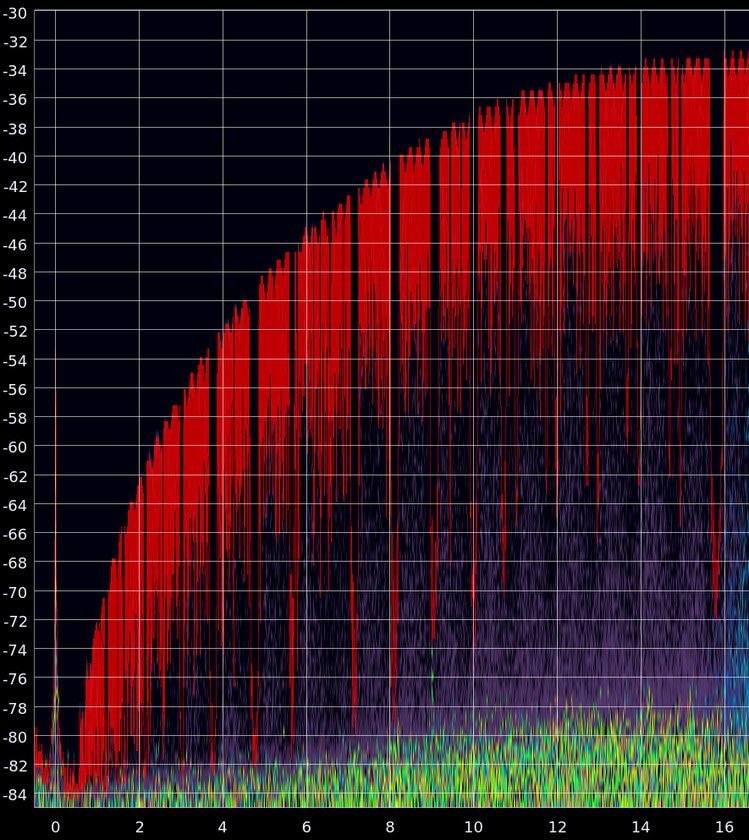
Recently the XTRX team released an update regarding the HF performance below 30 MHz. The update shows that signal attenuation starts to significantly reduce in the HF bands with the 3dB point being at 11 MHz. At 6 MHz the attenuation is at 13 dB, and at 2 MHz it's up to 29 dB. This attenuation may not be too bad though especially for strong HF signals, or perhaps a preamp like the LNA4HF could be used. They attempted to review their design to reduce the attenuation, but found that there is no easy fix especially with having such restricted space as in a PCIE card.

They also note that HF reception with the LMS7002 chip used on the XTRX can be problematic as the LO is fixed to a minimum of 30 MHz. So to receive below 30 MHz the receiving bandwidth needs to be increased which can cause saturation from any strong out of band signals. However, they tested with some very simple external bandpass filters for the 49m band (5.8 - 6.2 MHz) and had decent results.

The XTRX team also added a new breakout header to the board which provides direct connections to the LMS7002 chip ADCs for direct sampling. This could provide even better HF performance with an appropriate custom frontend.

XTRX HF Attenuation Graph

QIRX SDR: Experimenting with Phase-Coherent RTL-SDRs

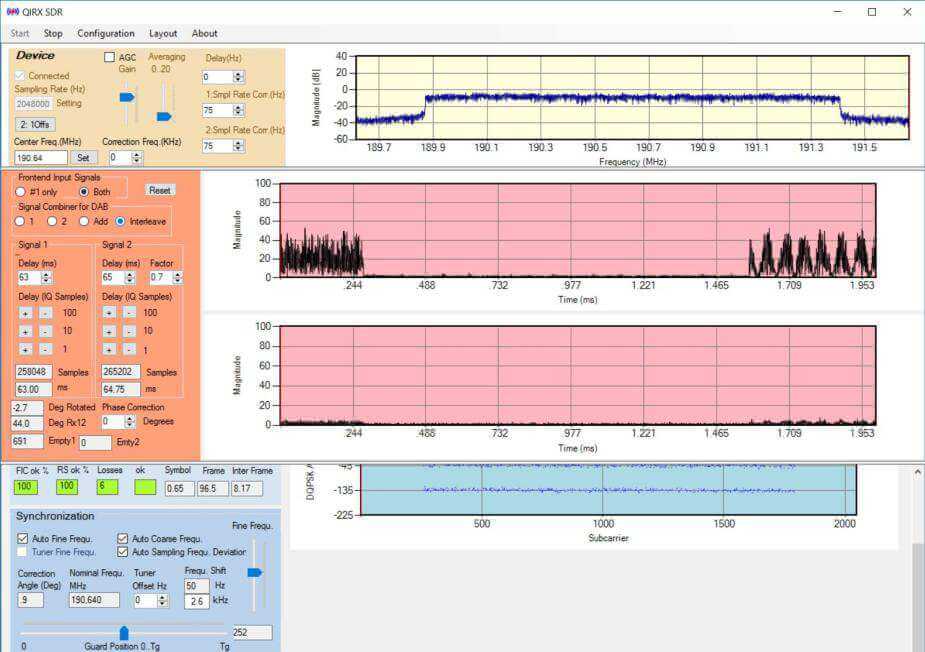
Over on their website the team behind the QIRX SDR software have written up an investigation into the feasibility of using RTL-SDR for phase coherent experiments. Phase coherent receivers can allow for experimenters such as interferometry, passive radar, direction finding, etc. In their experiment they connected the clocks of two RTL-SDR dongles together so that each dongle is running from a common clock. They then used their software to check if there was coherence on a DAB signal that they were receiving. To do this they used the null symbol present in DAB signal data to trigger the IQ display for each dongle. One display shows the difference in IQ data between the two dongles. If there is phase coherence then the graph should display zero. Their results found the following:

  • It has been possible to achieve phase-coherent operation of two I/Q data streams.
  • It has NOT been possible to achieve phase-coherent operation on every run of the system.
  • The system showed sub-sample time delay between the two receivers (if the interpretation of the observed behaviour is correct), varying randomly between different runs. A time delay of the two receivers sufficiently small for DAB demodulation of interleaved signals could only be achieved by pure chance. No attempts have been made to solve this problem during the experiments.
  • The system showed varying phase differences between the two receivers, changing at a constant rate. Three different changing rates have been observed during the experiments. A working solution has been found for this phenomenon, consisting in an continuous permanent correction of the phase angles of every sample. This imposes a considerable enhanced processing load. The occurrence of three different relative phase angle rotation speeds seemed strange. With the lack of documentation any attempt to interpret this behavior seems pure speculation.
QIRX SDR Coherent Experiments

A Video Tutorial about Receiving HRPT Weather Satellite Images

Over on YouTube 'Tysonpower' has recently uploaded a very informative video and blog post showing how he is able to receive HRPT weather satellite images. Note that the video is in German, but English subtitles are provided.

Most readers of this blog are probably familiar with the more commonly received APT images that are broadcast by the NOAA satellites at 137 MHz, or perhaps the LRPT images also broadcast at 137 MHz by the Russian Meteor M2 satellite. HRPT signals are a little different and more difficult to receive as they are broadcast in the L-band at about 1.7 GHz. Receiving them requires a dish antenna (or high gain Yagi antenna), L-band dish feed, LNA and a high bandwidth SDR such as an Airspy Mini. The result is a high resolution and uncompressed image with several more color channels compared to APT and LRPT images.

In his video Tysonpower shows how he receives the signal with his 3D printed L-band feed, a 80cm offset dish antenna (or 1.2m dish antenna), two SPF5189Z based LNAs and an Airspy Mini. As L-band signals are fairly directional Tysonpower points the dish antenna manually at the satellite as it passes over. He notes that a mechanised rotator would work a lot better though. For software he uses the commercial software available directly from USA-Satcom.com.

[EN subs] HRPT - Erste Bilder! und mein Setup

An Example HRPT Image Received by Tysonpower.

FM2TXT: Automatically Perform Speech to Text on FM Signals

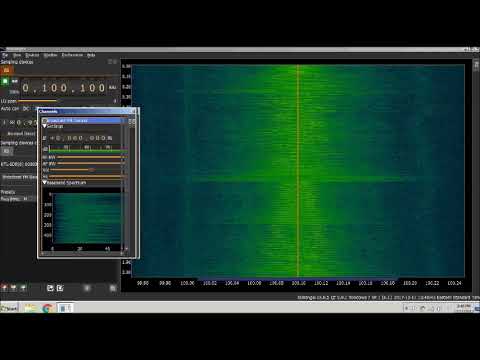
SourceForge user randaller has recently released a potentially useful Python program called FM2TXT. The FM2TXT program uses the Google speech recognition libraries and an RTL-SDR to listen to any broadcast FM station and automatically transcribe the speech into text. The code seems to be basically an interface for the Google speech recognition API, so is nothing fancy, but still may be of interest to some. Also at the moment it seems like it only works with broadcast FM (WFM), but as the code is open source and consists of a simple single Python file it shouldn't be too hard to adapt it for other NFM signals too. 

No word yet on the accuracy of the speech recognition or how well it works with poor reception. If you are interested there is also a Reddit thread discussing the software here

The Google Speech Recognition API

A Tutorial on using SDRAngel for DMR, D-Star and Fusion Reception with an RTL-SDR

At the end of last month we uploaded a post highlighting the SDRAngel software, which is a general purpose SDR program with some interesting features such as built in digital speech decoders for DMR, D-Star and Fusion. This avoids the need to pipe audio into a separate digital speech decoder program such as DSD+. SDRAngel also has transmit capabilities which makes it useful for SDRs such as the HackRF, PlutoSDR, LimeSDR etc.

Now over on YouTube and his blog K2GOG has uploaded a video tutorial about using SDRAngel. The tutorial starts with installing SDRAngel and explaining that you'll need a 64-bit system and OS to run it. He then goes on to show how to do FM reception and finally how to do digital speech decoding.

Deep Learning Neural Network Signal Identification Software for the RTL-SDR

Recently GitHub user randaller released a piece of software that utilizes the RTL-SDR and neural networks for RF signal identification. An artificial neural network is an machine learning technique that is based on approximate computational models of neurons in a brain. By training the neural network on various samples of signals it can learn them just like a human brain could. A neural network trained on signal classification can then be used by anyone to identify unknown signals. Randallers neural network software can learn either from raw IQ data, FFT processed samples, slightly demodulated data, or demodulated audio data. The tensorflow machine learning library is used as the base code, and the deep learning technique is used.

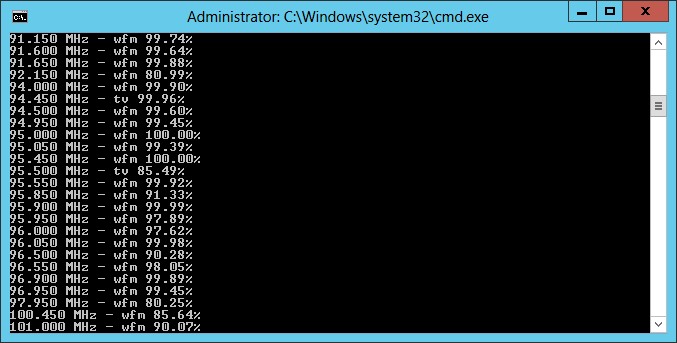
At the moment the software is only really proof of concept, and the currently trained model is only able to identify WFM, TV SECAM Carriers and TETRA. It should be possible to train the network further by providing your own samples too, but a good graphics card is required for this as the software makes use of GPU processing for training. The output of the software is a percentage which shows how confident the neural network is that it is identifying a signal correctly.

If you are interested, there is also a Reddit thread discussing this software here.

Artificial Neural Network being used to identify a WFM signal with an RTL-SDR

More Information on The Android RTL-SDR Direction Finding Implementation

Last week we posted about some interesting conference talk videos from GNU Radio Con 17. One of the videos was a talk by Sam Whiting who in conjunction with colleagues Dana Sorensen and Todd Moon from Utah State University have created an Android app that uses two coherent RTL-SDR dongles for direction finding. A coherent RTL-SDR can be created simply by removing the clock on one RTL-SDR and connecting the clock from another, so that they both share the same clock. The V3 RTL-SDR has a clock selector header which can be used to facilitate this as well.

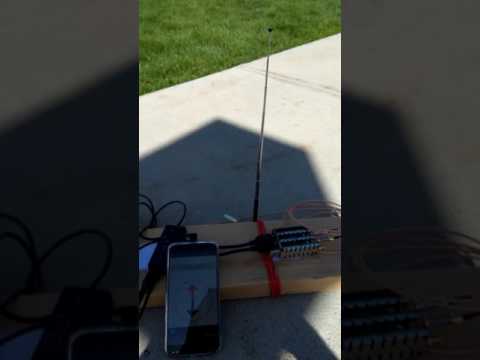
Over on his YouTube account Sam Whiting has uploaded two videos showing the app in action. The backend GNU Radio code for direction analysis is available on GitHub, but unfortunately the Android code/apk is not available to the public as the code is owned by the funders of the project.

In the videos the app shows two arrows, one of which points towards the source of a transmission at a frequency that is being monitored. The second arrow is simply there due to the direction ambiguity produced by the methods used.

The GRCon17 presentation video can be found here, and the slides here.