Reverse Engineering Radio Controlled Bus Stop Displays

Over on her blog www.windytan.com, Oona has shown how she was able to reverse engineer a radio controlled bus stop display using a receiver like the RTL-SDR. Radio bus stop displays are used by bus services to display GPS enhanced bus timetables and expected bus arrival times.

Oona discovered that the bus displays in her area use Data Radio Channel (DARC) encoding. Once she discovered that no DARC decoders exist online, she implemented the full five layer DARC protocol stack in Perl and was left with data packets that had some human readable strings containing information such as bus terminal stations. With some extra work she was able to also get more information such as expected waiting times and bus numbers as well.
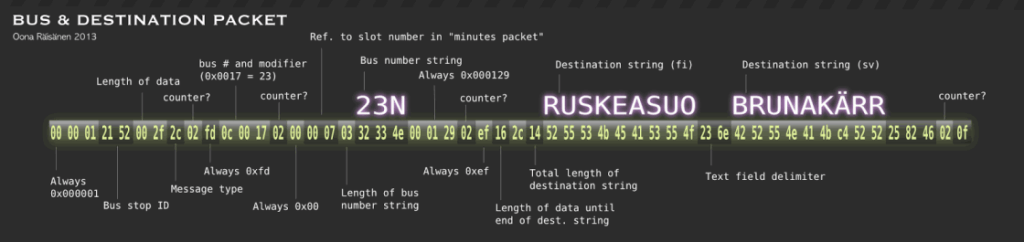
Bus Terminal Packet
Bus Terminal Packet

Using the RTL-SDR to listen to the Funcube Satellite

Recently, the FUNcube-1 satellite was successfully launched. The FUNcube is a CubeSat (a low cost miniature 10cm cube sized satellite) which is intended mainly for educating young people about radio, space, physics and electronics, but has also piqued the interest of amateur radio hobbyists.

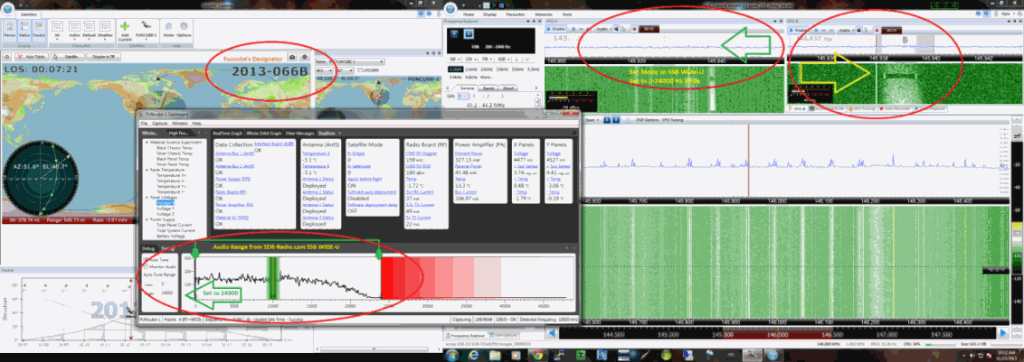
Amateur radio hobbyist N4JTC’s has shared on his blog his experiences with receiving the FUNcube-1’s telemetry using his RTL-SDR dongle. By using the RTL-SDR to receive the telemetry beacon as the satellite passes overhead, he was able to use the FUNcube Dashboard software to record and decode and view the satellites telemetry data.

Receiving the FUNcube-1 Satellite

Demo of Osmocoms ‘Phosphor’ Spectrum Visualizer

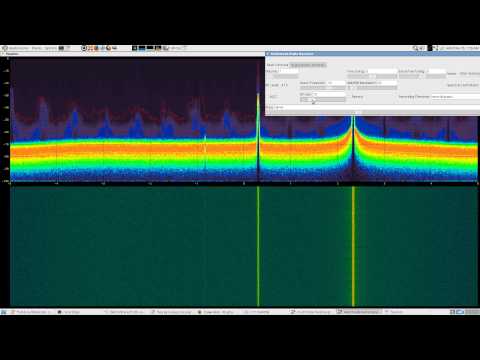
Over on YouTube, user superkuh2 has posted a video showing off osmocoms gr-fosphor GNU Radio block which shows a real time spectrum visualization using the GPU. He combines gr-fosphor with multimode for visualizing the ISM and pager bands with his RTL-SDR.

osmocom's fosphor with patchvonbraun's multimode looking at ISM + FLEX pager bands with rtlsdr

LNA4HF: Interest Check

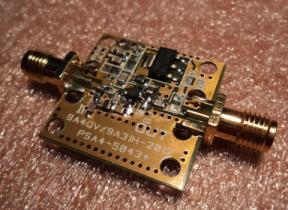
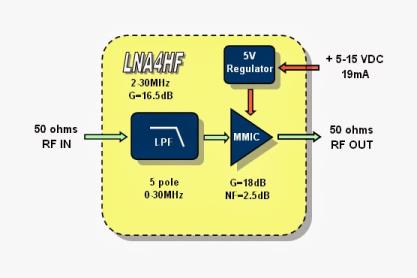
Adam, the manufacturer of the LNA4ALL low noise amplifier designed for use with the RTL-SDR, and similar software radios is putting out an interest check for an LNA4HF product. The LNA4HF will be a low noise amplifier with low pass filter designed to work with an existing RTL-SDR upconverter. It will amplify signals between 2 Mhz – 30 Mhz by 16.5dB.

Adam will make a batch once there is interest for at least 50.

lna4hf
LNA4HF
LNA4HF block diagram

Decoding Efergy Energy Monitor Signals with RTL-SDR

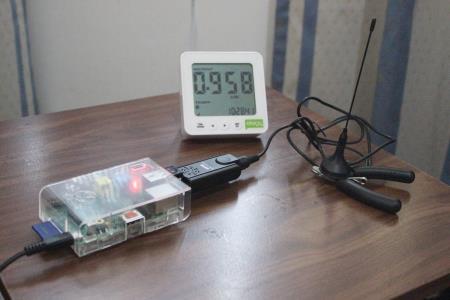
An Efergy energy monitor is a wireless device with an LCD screen that shows how much power your household is using. The device is useful for helping reduce power usage by determining what appliances cause the largest power draw.

Nathaniel Elijah has posted on his blog about how he was able to create an RTL-SDR based decoder for the FSK data transmissions sent out by the Efergy energy monitor. His program receives and decodes the transmissions, saving the data to an excel file for later analysis.

Gough Lui from the Goughs Techzone blog has also attempted decoding these energy monitors as well, and has written a large writeup on his experiences.

Update: Gough Lui has been working on extending Nathaniels software and now has it working in Windows, and sending broadcast UDP packets of the received data.

Decoding an Efergy Energy Meter with RTL-SDR
Decoding an Efergy Energy Meter with RTL-SDR and a Raspberry Pi

ShinySDR: A new SDR software package that supports RTL-SDR

ShinySDR is a new still in development SDR software package which supports the RTL-SDR. It is built on GNU Radio and has a web based user interface and a plugin system.

One of the main differentiating features of ShinySDR is that it has a persistent waterfall display. This means that as you browse through the frequency spectrum and zoom in and out on the waterfall, the displayed history will not be lost like on other SDR programs. Some other features are

  • Browser-based UI: The receiver can be listened to and remotely controlled over a network or the Internet, as well as from the same machine the actual hardware is connected to. (Required bandwidth: 3 Mb/s to 11 Mb/s, depending on selected spectrum frame rate. This may be improved in future versions by using more compact data formats.)
  • Modularity: plugin system allows adding support for new modes (types of modulation) and hardware devices.
  • “Hackability”: All server code is Python, and has no mandatory build or install step. Demodulators prototyped in GNU Radio Companion can be turned into plugins with very little additional code. Control UI can be automatically generated or customized and is based on a generic networking layer.
  • Frequency database: Jump to favorite stations; catalog signals you hear; import published tables of band, channel, and station info; take notes. (Note: Writing changes to disk is not yet implemented, unfortunately.)

The software also comes with an included VOR demodulator plugin.

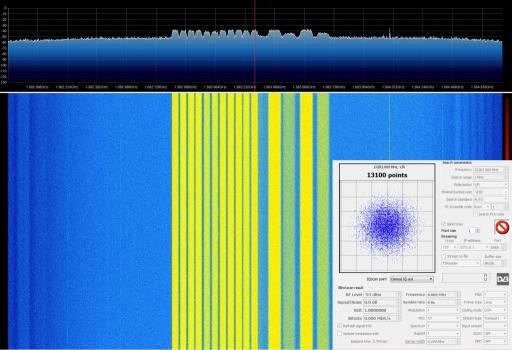
Visualizing Broadcast Satellite Signals with the RTL-SDR

Over on Gough’s Tech blog, Lui Gough has posted about his experiences with visualizing broadcast satellite signals with the RTL-SDR. In his post he shows how to receive broadcast satellite signals by using a LNB, or low noise block downconverter, which allows the RTL-SDR to receive satellite frequencies which are typically out of the range of the RTL-SDR.

Later in the post he also shows what several broadcast satellite signals look like on the waterfall, as well as some of their telemetry signals.

Visualizing Satellite Signals

True Random Numbers with RTL-Entropy

RTL-Entropy is a Linux based entropy generator which uses the RTL-SDR as the entropy source. It works by using the RTL-SDR to sample atmospheric noise and then using that noise to create randomly generated numbers.

This is useful as computers are only capable of generating pseudo-random numbers, which may look random, but are not truly random. For cryptography and security, it is desirable to use true random numbers, as pseudo-random numbers can possibly be predicted. Combining this RTL-SDR based entropy source with other entropy sources may help improve security.