Using the RTL-SDR as a Software GPS Receiver

Dr. Carles Fernandez-Prades, Dr. Javier Arribas and Dr. Pau Closas have published an academic paper showing how they were able to implement an RTL-SDR based GNSS (Global Navigation Satellite System) receiver in software.

What they have done is use their open source GNSS software receiver program with a RTL-SDR connected to an active GPS antenna. An active GPS antenna requires DC power to be passed to the LNA in the GPS antenna through the antenna connection, so a Bias-T network is required to ensure DC power does not enter the RTL-SDR dongle.

More information can be found on their webpage here.
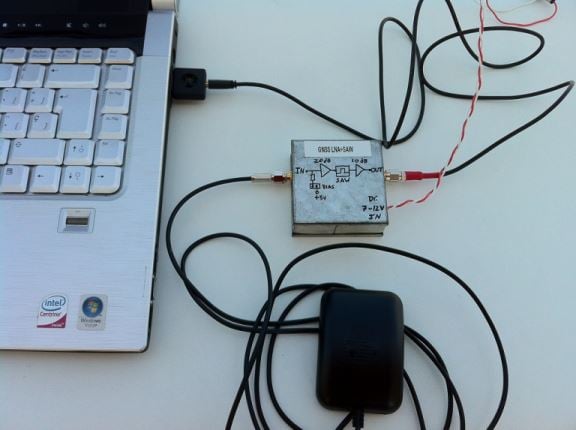
Rtlsdr_with_lna_patch_GA27

Decoding D-STAR Headers with the RTL-SDR

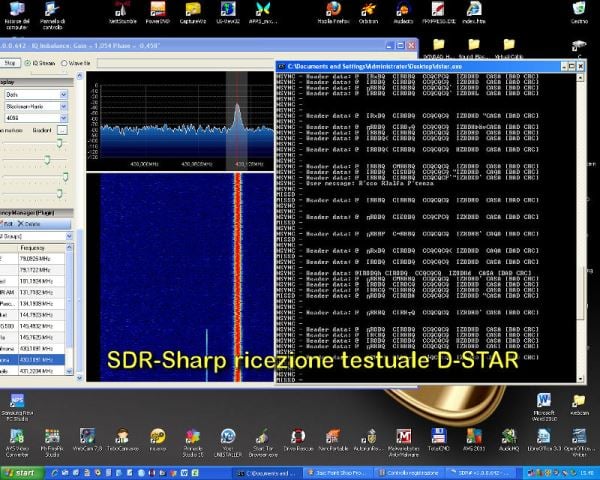
D-STAR or Digital Smart Technologies for Amateur Radio is a digital voice and data protocol used in amateur radio. I was tweeted a link earlier which shows how the RTL-SDR can decode D-STAR text messages and headers (link is in Italian but Google translate can help, and the pictures show more than enough information). By using SDRSharp and stereo mix you can tune to a D-STAR signal, and pass the audio to a command line based decoding program (dstar.exe) which can be downloaded from the above link, which will then decode D-STAR text messages.

dstar7

Here is also an older video showing D-STAR decoding with HDSDR in action.

Wavesink: New Android RTL-SDR App for FM/RDS/DAB/DRM+

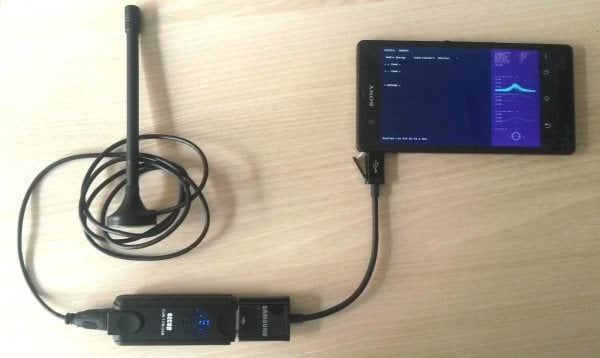
Wavesink is a new SDR Android App, which allows your RTL2832U based dongle to receive FM radio with RDS, Digital Audio Broadcast Radio (DAB) and VHF band Digital Radio Monodial (DRM+). DAB+ support is also to be released by next week, and a station memory will also be added in a future release.

The app is currently in beta development, and only the trial version is released, which will allow you to use the app for 5 minutes at a time. They indicate that the commercial version will be out soon.

To use this with your Android device, you will need a USB OTG (On the Go) cable, and your device must support USB host mode, which most Android devices above 3.1 should support.

I gave the app a quick spin in FM mode, and found that the interface was a little clunky, but the app worked fine, and the FM and RDS signals were decoded correctly.

wavesink

Listening in on Burger Pagers with the RTL-SDR

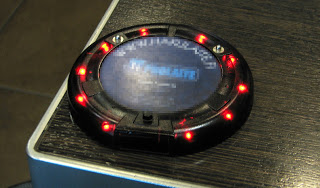
Oona has written on her blog www.windytan.com about how she used an RTL-SDR to listen in on those wireless devices that are given out at some restaurants and cafes to notify you when your food is ready.

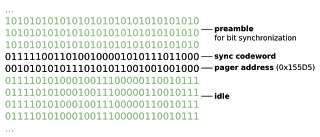
While at a local burger chain she found a label on the back of the device given to her which specified the radio frequency used by the device. By tuning to that frequency with her RTL-SDR, she discovered that the device uses the POCSAG protocol, which is the same protocol that is used by pagers. She then decoded the data packet and found that it contains the device address, which is used to notify the correct device.

burgerPagerpocsagBurger

Receiving 24 GHz with the RTL-SDR

Over on YouTube Adam Alicajic has uploaded two videos which show an experiment where he successfully receives a test 24 GHz carrier signal with an RTL-SDR dongle.

In the first video he uses mixer setup to convert the 24 GHz signal down to 432 MHz, which is within the tunable range of the RTL-SDR. In the second video he uses a salvaged downconverter unit from some sort of communications device to do the same.


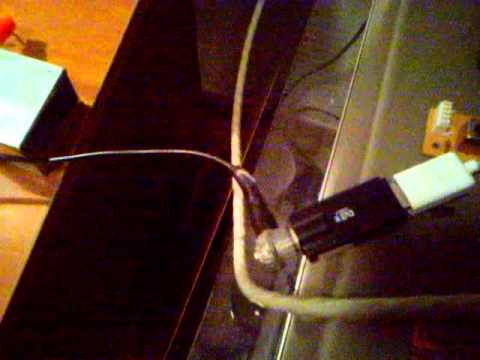
24GHz downconverter mod

Review of the SDR UP-100 Upconverter

Akos from the SDR for mariners blog has written a review on the SDR UP-100 upconverter. The SDR UP-100 is a 50 USD upconverter for the RTL-SDR and similar software defined radios which is made by the same person behind the LNA4ALL low noise amplifier. Upconverters allow the RTL-SDR to receive between 0 and 30 MHz, where ham radio, military, marine and many other interesting signals exist.

In the review Akos tests the SDR UP-100 with a 6 meter random wire antenna and an RTL-SDR. His results show that the upconverter works well as expected. In the future he hopes to compare the SDR UP-100 with the Ham-It-Up Upconverter from Nooelec.

SDR UP-100

2-Channel AIS Receiver with RTL-SDR and GNUAIS

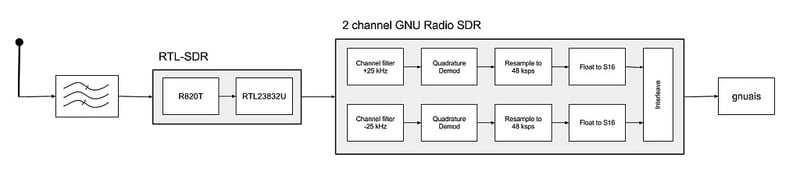
Blogger OZ9AEC has written a post on his blog showing how he made a 2-channel AIS receiver using the RTL-SDR, GNU Radio and GNUAis. AIS is a radio protocol used by boats to broadcast their position and speed which is then used to create a type of radar system to help avoid collisions. AIS signals are transmitted periodically on one of two channels. Two channels are used to improve capacity and help avoid interference if two signals from different boats are broadcast at the same time.

Before this, most AIS receiver implementations we’d seen that used the RTL-SDR received only on a single channel. OZ9AEC’s GNU Radio program receives on both channels simultaneously like a commercial AIS receiver does and is thus a better receiver. He eventually plans to get this receiver to run on a Beaglebone.

See his post for instructions and to download the GRC files.

Update: Another AIS decoder known as gr-ais is also capable of 2 channel AIS, and bristromat from Reddit has written a tutorial on setting it up and running it with OpenCPN.

Two channel AIS Block Diagram

RTL-SDR on the Nokia N900

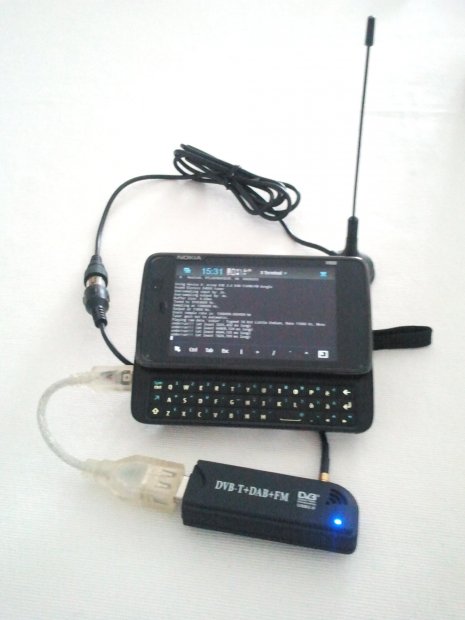
Over on the maemo.org forums, user xes has written a post explaining how to get the RTL-SDR working on the Nokia N900 mobile phone. The Nokia N900 runs a modified version of Linux known as maemo, and so is able to use the RTL-SDR drivers with some modifications. Attached to the post by xes are the N900 compatible RTL-SDR drivers, GNU Radio 3.6.2, GQRX and also MultimonNG.

Nokia N900 running RTL-SDR