Reverse Engineering a Wirelessly Controlled Adjustable Bed with a HackRF and Logic Analyzer

Over on his blog Chris Laplante has written up a post showing how he was able to reverse engineer his wirelessly controlled adjustable "TEMPUR-Contour Elite Breeze" bed. Originally the bed did have an Android App for smartphone control, however it was never updated since 2014 and so it no longer works on his modern Google Pixel device. So in order to have it controllable by his home automation system Chris decided to reverse engineer the wireless signal used by the bed's remote control. 

He first searched the FCC filing, finding that it transmitted in the ISM band at 433.050 to 434.790 MHz. Then using his HackRF he was able to capture the signal and determine that it used Gaussian frequency shift keying (GFSK) modulation.
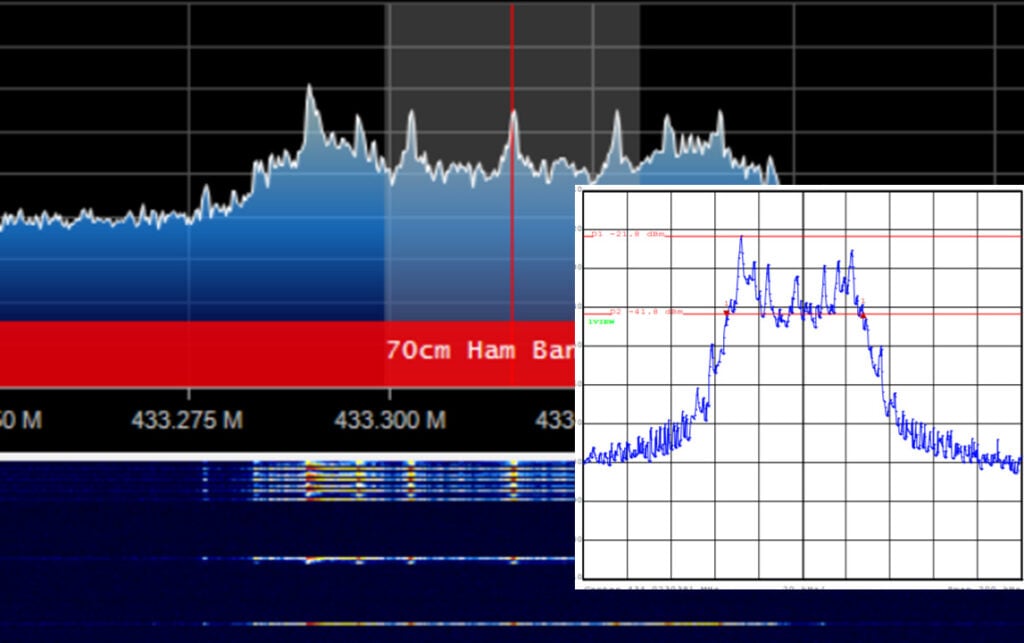
The GFSK signal from the Tempur Pedic wireless remote control.

While the HackRF got him this far, he decided to follow a new line of investigation next, instead now using a logic analyzer to probe the SPI bus which talks to an Si4431 RF transceiver on the remote control. From this he was able to determine the important properties of the signal such as the frequency, data rate, frequency deviation, channel mapping and packet structure.

With all this information Chris was in the end able to create a product called "Tempur Bridge" that he is now selling on Tindie. It consists of an ESP32 WiFi connected microcontroller and a Si4463 RF transceiver chip. With his product Chris is now able to control his bed through a WiFi connection in Home Assistant.
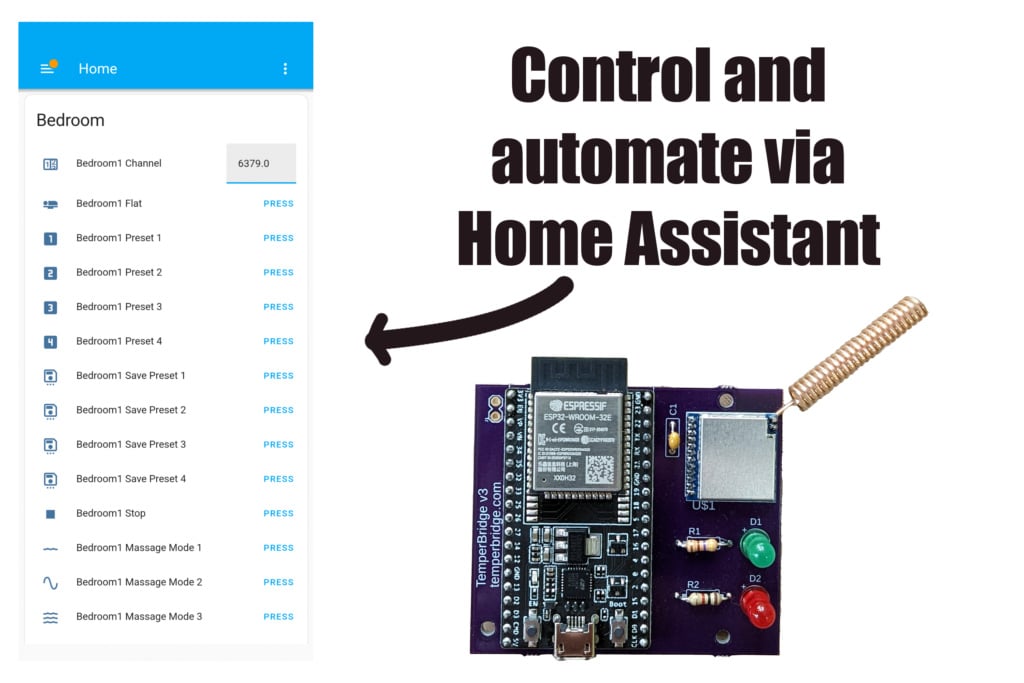

Chris's TemperBridge product for WiFi control of a Tempur Pedic adjustable bed.

[This story was also seen on Hackaday]

Passive Radar Sensing via Ambient Radio Noise from the Sun and Jupiter

Recently Dr. Sean Peters from the Naval Postgraduate School, in Monterey, CA presented an interesting webinar titled "Leveraging Ambient Radio Noise for Passive Radar Sensing of the Terrestrial and Space Environment".

In passive radar, the radio source is typically an existing powerful terrestrial broadcast station, such as FM, DAB, TV or cellular. However, Dr. Peters makes use of more ambient radio noise sources, such as sun noise, and even noise from Jupiter.

By using Sun noise as the source and an Ettus USRP SDR as the receiver, he's been able to measure the ice sheet thickness at the Store glacier in Greenland. Furthermore he's also been able to utilize sun radio noise and radio noise from Jupiter for passive synthetic aperture radar, with the application being planetary remote sensing.

Traditional active radars transmit a powerful electromagnetic pulse and record the echo’s delay time and power to measure target properties of interest, such as range, velocity, and reflectivity. Such observations are critical for investigating current and evolving conditions in extreme environments (i.e., polar regions and planetary missions); however, existing radar systems are resource-intensive in terms of cost, power, mass, and spectrum usage when continuously monitoring large areas of interest. I address this challenge by presenting a novel implementation of passive radar that leverages ambient radio noise sources (instead of transmitting a powerful radio signal) as a low-resource approach for echo detection, ranging, and imaging. Starting from theory, simulation, and lab-bench testing, I first present the results of our passive radar sounding demonstration using the Sun to measure ice sheet thickness at Store Glacier, Greenland. I then project the passive radar’s performance and ability to provide valuable glaciological observations (such as melt rates, bed reflectivity changes, and englacial water storage) across Greenland and Antarctica.

In the second part of my presentation, I then extend this technique to enable passive synthetic aperture radar (SAR) imaging using radio-astronomical noise sources (e.g., the Sun and Jupiter’s radio emissions). I conclude by highlighting applications of this technique to planetary remote sensing, such as (1) using Jupiter’s HF radio emissions alongside an active VHF radar to characterize and correct for Europa’s ionospheric dispersion during a flyby mission and (2) using the Mars Reconnaissance Orbiter (MRO) Shallow Radar (SHARAD) to analyze solar radio burst candidates for Martian passive sounding.

Leveraging Ambient Radio Noise for Passive Radar Sensing of the Terrestrial and Space Environment

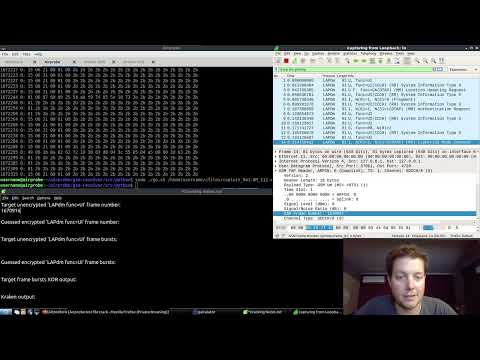
A Video Demonstration on Cracking a GSM Capture File

Over on YouTube Rob VK8FOES has been uploading some fairly comprehensive demonstrations and tutorials showing how to crack a GSM capture file which can be recorded with any SDR.

It's well known now that GSM aka 2G communications are insecure, with the encryption having been breakable on a standard PC for a long time now. It is for this reason that GSM is now mostly phased out, however in many regions the GSM system is still operational in reduced capacity due to some legacy users who are mostly industrial.

In his video Rob makes use of the opensource Airpobe GSM decoder tool, as well as the opensource Kraken tool (not to be confused with KrakenSDR) which is a brute force password cracking tool.

We want to note that doing this is only legal if it is your own communication that has been recorded, or you have permission from the communicating parties.

My GSM cracking content has been getting quite a lot of attention lately. Previous videos of mine relating to this topic were only boring screen recordings with no real explanation on what steps are required to crack the A5/1 stream cipher and decrypt GSM traffic by obtaining the Kc value.

I was bored one day and decided to present a live-style workflow of how hackers and security researchers 'crack' 2G cellular communications in real-time. Be warned that if you don't have an interest in cryptography or cellular network security, you might find this video rather boring.

The GSM capture file used in this video, to my knowledge, has never been publicly cracked before. 'capture_941.8M_112.cfile' was recorded and uploaded with permission by the owner of the data themselves as a decoding example for testing Airprobe.

I make a few mistakes in the video that I can't be bothered editing out. But they are not critical, just myself misreading a number at the 10 minute mark somewhere, and saying the wrong name of a software tool at 17 minutes.

Additionally, l am not a GSM technology engineer, nor a cryptography expert. I do my best to explain these concepts in a simple and easy to understand way. But due to my limited knowledge of these subjects, it's possible that some of this information may be incorrect or lacking context.

However, this video will still allow you to crack a real GSM capture file if you are able to follow along with my flip-flopping style of presentation. Haha. But please, only replicate this tutorial on GSM data that originated from YOUR OWN mobile phone. Do not attempt to decrypt private telecommunications from any other cellular subscriber, EVER.

Video Demonstrating Hydrogen Line Detection with an RTL-SDR and WiFi Dish

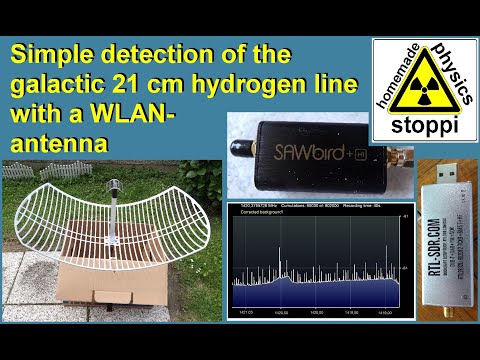
Back in January 2020 we posted a tutorial showing how it's possible to detect and measure the galactic Hydrogen line using a simple 2.4 GHz WiFi dish, RTL-SDR Blog V3 and a filtered LNA. Since then many people have used the same setup with great results.

Over on YouTube user stoppi who is one such person who is using the same steps from our tutorial, and he has uploaded a video showing his setup and results. If you're thinking of getting started with Hydrogen Line reception, his video slide show tutorial would be a good complimentary overview to go along with our text tutorial.

Detection of the galactic hydrogen - the 21 cm radiation - Wasserstoffstrahlung der Milchstrasse

TechMinds: Receiving and Decoding Packets from the GreenCube Cubesat Digipeater

GreenCube is a CubeSat by the Sapienza University of Rome, and it is designed to demonstrate an autonomous biological laboratory for cultivating plants onboard a CubeSat.

While this is an interesting mission in itself, for amateur radio operators there is another interesting facet to the satellite. Unlike most CubeSats which are launched in Low Earth Orbit (LEO), GreenCube was launched higher in Medium Earth Orbit (MEO) which provides a larger radio reception footprint over the earth. The satellite also contains a digital repeater (digipeater) at 435.310 MHz, which allows amateur radio operators to transmit digital radio packets up, and have the satellite repeat the packet back over a wide area footprint on earth. 

Over on his latest video, Matt, from the TechMinds YouTube channel shows us how to receive and decode the packets from the GreenCube digipeater. In his demonstration Matt uses an SDRPlay RSPdx as the receiver, SDR++ as the receiver software, SoundModem as the packet decoder, GreenCube Terminal for displaying the messages, and GPredict for tracking the satellite and compensating for the doppler effect. He also notes that while a directional antenna on a motorized tracker is recommended, he was able to still receive packets with his omnidirectional terrestrial antennas without much issue.

RECEIVING AND DECODING GREENCUBE CUBESAT

Building an OpenWebRX Server with an RTL-SDR Blog V3 for HF Monitoring

Thank you to Ramadhan (YD1RUH) who has put together a brief set of commands showing how to quickly get setup with OpenWebRX and an RTL-SDR Blog V3. OpenWebRX is a web based SDR program that allows users to use their SDR over a network or internet connector. It is compatible with several SDRs including the RTL-SDR.

 The installation is based on Ubuntu, and uses docker for the install. He also shows how to set up the OpenWebRX configuration file so that it will use the Q-branch direct sampling mode in RTL-SDR Blog V3 dongles for HF reception.

A demonstration of the result can be seen on Ramadhan's public OpenWebRX page. You can select between the various enabled HF bands in the lower left.

OpenWebRX HF reception running on an RTL-SDR Blog V3 dongle.

uSDR: A TX/RX 300-3700 MHz, 30.72 MSPS Capable SDR with M.2 Interface and Web Browser Control

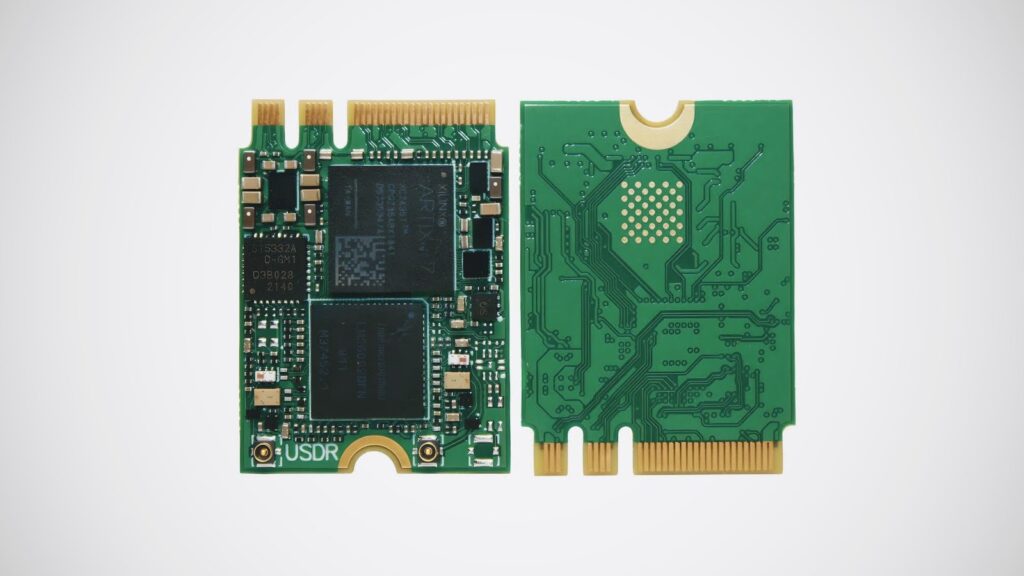
Over on CrowdSupply a new SDR called "uSDR" created by Wavelet SDR has been announced (not to be confused with the uSDR software). uSDR is a tiny SDR that interfaces via an M.2 slot on a PC/laptop motherboard. Typically M.2 slots are what you would use to connect a solid-state drives (SSD), but can also be used for adding expansion cards. However, a simple M.2 to USB adapter could be used to convert it into dongle form.

The uSDR is advertised of being a duplex TX & RX capable SDR, with a frequency range of 300-3700 MHz, and up to 30.72 Msps of sampling rate. It also has a 0.5 PPM TCXO. To keep it's tiny form factor, it uses small MHF4 antenna connectors.

The device appears to be based on the AMD Xilinx ARTIX-7 FPGA and the LimeMicro LMS6002 transceiver IC.

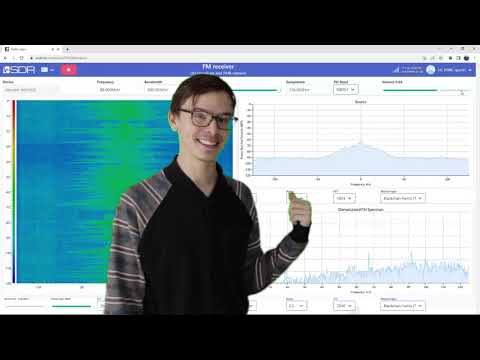
One interesting differentiating feature of the uSDR is that it is designed to be operated via it's web interface which can be accessed through Chrome. They make use of WebUSB technology, which allows Chrome to directly connect to USB devices. This should help eliminate installation and compatibility issues, and allow the SDR to easily be used over a network. Apart from the web interface it is also compatible with SoapySDR and GNU Radio. Sergey, one of the creators of uSDR wrote:

During development we focused on ease of use, thus it supports WebUSB interface. Meaning you can view Spectrogram, record or playback IQ data, do some signal analysis and even share your device over the internet to get others access to it. And all this doesn’t require any software or specific drivers and works in Linux/Windows/Mac OS/Android and more. One can even extend these applications and run their own.

The device is single channel covering a range ~230MHz-3.7GHz for TX / RX and we’re making it affordable. Last but not least you still can use this device with SoapySDR as a regular SDR.

The project is currently in it's early stages, with Crowd Funding expected to begin soon. Pricing is still unknown, however Sergey did mention that it will be affordable. Subscribe for announcements via their CrowdSupply page.

uSDR: A tiny, single-sided M.2 SDR board that you can operate easily using your web browser
uSDR web platform. FM Receiver showcase

RFinder P10 – An Android Tablet with a built in Two Way Radio and RTL-SDR

Recently we came across a company called RFinder / AndroidDMR who are a shop selling custom made two way radios and Android Tablets with built in radio hardware. One of their new tablets that is currently in pre-order is being advertised with a built in RTL-SDR. The preorder status notes that they should be shipping within less than a months time.

The "RFinder Android Radio 10 Inch Tablet - 136-174mhz, 400-490mhz DMR/FM - Embedded RTL-SDR" is able to be pre-ordered for $1,499.95 USD + shipping. It is a ruggedized 10 inch Android tablet with a built in two way 4W VHF/UHF DMR/RF radio as well as an additional built in RTL-SDR. In terms of computing hardware, it comes with an Octa-Core 2.3 GHz CPU, 4GB RAM, 64GB ROM, and it supports cellular connectivity.

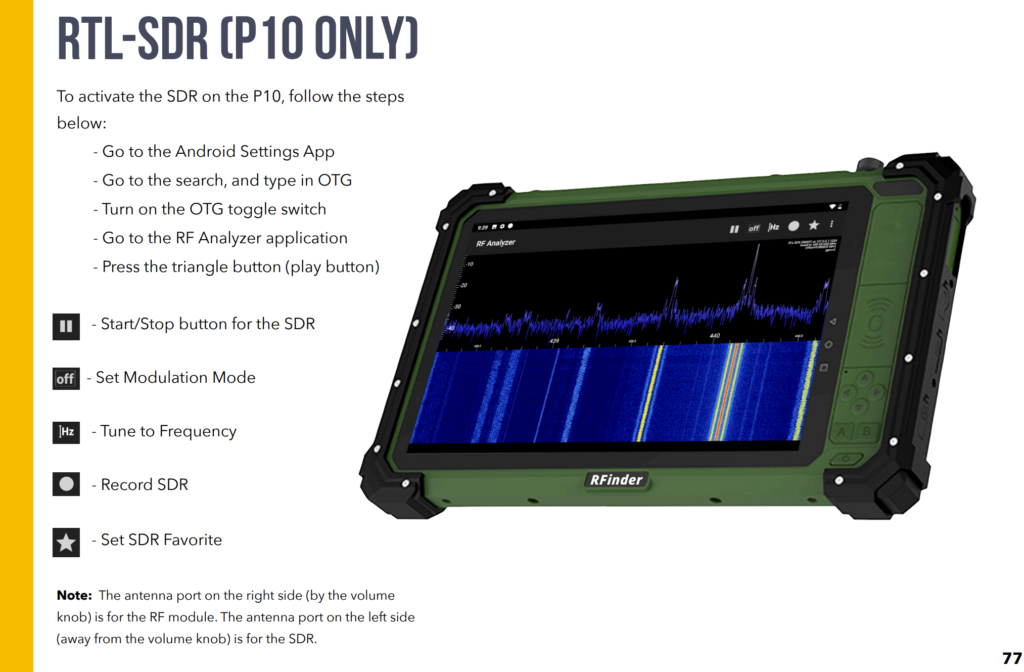
In their manual they share the following slide showing the built in RTL-SDR running the RF Analyzer Android app.

Various reviews of the RFinder P10 have been showing up on YouTube. Here is one review by Ham Radio 2.0 where the RFinder P10 is demonstrated at the Huntsville Hamfest.

New RFinder P10 Tablet with Dual Band DMR and RTL-SDR Receiver - Huntsville Hamfest