Over on the Techminds YouTube channel, Matt has uploaded his latest video which is a review of the GA-450 portable HF active loop antenna. The antenna costs between US$60-$80 + shipping and is available on Chinese market sites like Aliexpress and Banggood. It's advertised as covering 2.3 - 30 MHz, and uses a very portable and sturdy 20cm stainless steel loop. The active base amplifier is powered via a USB-C connector, and it even has a built in lithium battery for portable field use.
In his review Matt shows the antenna in action, noting that it's performance is quite a lot better than expected for it's small size, but it can't compare to his large half-wave end fed antenna. He notes that it appears to work best from 7 - 21 MHz, but not so well below 7 MHz. Overall he recommends it if you're looking for a small sized loop antenna.
Over on his blog Nils Schiffhauer (DK8OK) has recently uploaded a review of our RTL-SDR Blog Active L-Band Patch Antenna (original site is down - archive.org link). This is a satellite patch antenna designed for experimenters who want to receive Inmarsat, Iridium, GPS and other GNSS signals. It covers 1525 - 1660 MHz. (Please note it does not cover GOES or other L-band weather satellites as these are much weaker signals that require a dish). The antenna comes as a set with mounting hardware and extension cable and can be purchased on our store for $49.95 including free worldwide shipping to most countries.
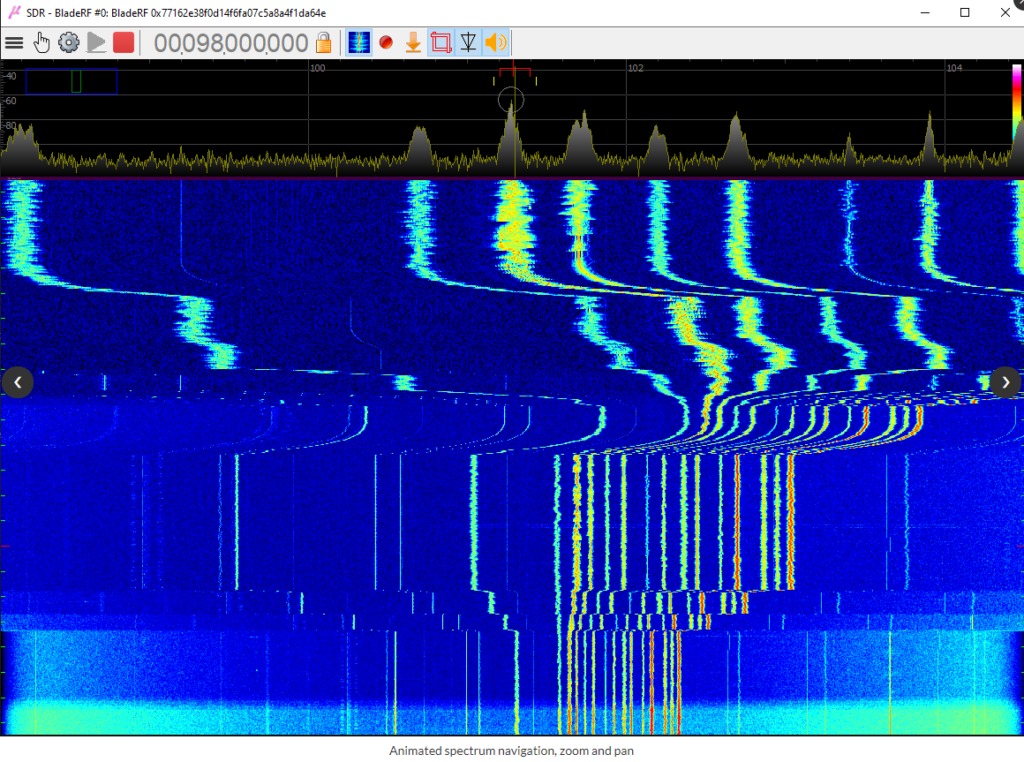
In his review Nils tests the patch antenna with his wideband BladeRF software defined radio showing a wide 60 MHz of bandwidth being received. He then goes on to show it being used to receive AERO, via the JAERO decoder, and STD-C via the Tekmanoid decoder.
We want to take this opportunity to pre-announce that due to rising shipping costs the price of this antenna set will be going up by $10 in early 2022. Before the price raise we will put out another post, but if you are interested in one we'd recommend picking one up soon.
A new decoder for RS41 and DFM09 radiosondes has been released as a plugin for SDR++ by dbDexter. A radiosonde is a sensor package with RF transmitter that is attached to a weather balloon. Meteorological agencies around the world typically launch two per day in order to gather weather forecast data. With an RTL-SDR, appropriate antenna and a decoder it is possible to receive this data, and plot the GPS location on a map.
Installing a plugin for SDR++ requires adding the build options to the SDR++ source, and building SDR++, so it could be a little difficult for Windows, but relatively simple build instructions for Linux are provided in the Readme.
A Radiosonde Decoder for SDR++
Over on Twitter FelixTRG (@OK9UWU) has tested the plugin out and has found it to work well.
dbDexter developed a WX radiosonde decoding plugin for @ryzerth's SDR++, i tested it rn on Vaisala RS41 launched from Prostejov (CZ) and works wonders.
Tested on linux, question when it will be in win release is on Ryzehttps://t.co/K5vq2iJnW1
Supports RS41 and DFM09 so far. pic.twitter.com/XEK4tci3Vd
In his post Marko explains the architecture he's set up which consists of multiple antennas, and a Raspberry Pi running multiple RTL-SDRs right by each unique antenna. The Raspberry Pi's send the complete receiver bandwidth over the network to a more powerful virtual server running OpenWebRX. This architecture allows for scalability, and for many users to be able to connect at once.
Marco's Scalable OpenWebRX Architecture
The rest of Marko's post shows how he set up OpenWebRX and supporting software such as SoapyRemote, which handles the network transfer of the raw SDR data. Marko has created a YouTube video demonstrating multiple connections to the OpenWebRX server, and you can also try out his server directly via this link https://sdr.v4.si.
An Raspbery Pi running multiple RTL-SDR dongles, sending raw data to the OpenWebRX server.
Thank you to Marco Greco, author of Guglielmo for writing in and noting that v0.3 has now been released. Guglielmo is a Linux based RTL-SDR FM and DAB tuner software that supports SDRs including the RTL-SDR, Airspy, SDRplay, HackRF and LimeSDR. It is designed to be an easy to use program designed for media users, rather than hobbyist technical users. He notes:
In the last two releases I have substantially improved FM and RDS decoding and added support for MOT slides.
MOT slides allow DAB broadcasters to send JPEG or PNG images files over the DAB broadcast, and compatible receivers will display it.
A ready to use Appimage for Linux systems is availalble on the Github Releases page.
Gerrit's weather station wirelessly displays data on a wirelessly connected LCD screen, but he notes how difficult it is to view historical data, or to graph trends. Having discovered that the rtl_433 RTL-SDR decoder supports his particular weather station (a Fine Offset Electronics WH1080/WH3080 compatible Weather Station (Alecto WS-4000)), Gerrit decided to write some code to log data to a SQL database, and display that data via a Python Dash.plotly web interface. The RTL-SDR, rtl_433 and custom software all run on a Raspberry Pi.
The interface allows Gerrit to view live and historical data all on neatly plotted graphs. HIs complete open source code can be found on Github.
Dash.pltly based weatherstation with data received by RTL-SDR and rtl_433
Over on the Great Scott Gadgets blog Michael Ossmann, the lead creator of the original HackRF has put out a post comparing his original HackRF with one of the many clones on the market. The HackRF is a low cost wideband transmit capable SDR that was released via Kickstarter crowd funding back in 2014. Even up until today it is one of the most popular SDRs for radio experimenters due to it's versatility, open source nature, and low cost.
Within the past few years Chinese clones of most SDRs including the HackRF have appeared on the market often at substantially reduced pricing. As the HackRF is fully open source hardware, copies are legally allowed, however buying a clone does not support the original developer and can put strain on their support services. The general consensus amongst clone purchasers is that they work fine, but when there are problems you take the risk of not being able to expect any sort of support or warranty from the the cloner. Also while the clones work fine, up until now we have not yet seen any performance comparisons yet.
In his post Michael Ossmann tests a clone which is even advertised to have improved upon the original design. Michaels post goes into more detail, but long story short, the clone has clear transmit performance issues above 1 GHz, and at the worst point produces 22 dB (150x) less power out compared to the original. In terms of receive performance the clone performs even worse, showing very poor sensitivity when compared to the original. Michael notes that this clone would not have passed the QC procedure used for the original.
We believe that the original HackRF has created significant value to the RF community through software, tutorials and their hardware. Over the years countless projects and research/conference papers have been enabled by the HackRF. So even regardless of potential performance and warranty issues we think it is ethical to support the original creators if your budget allows it.
HackRF Receive Performance Test. Above 5 GHz the test signal was below the noise floor.
Thank you to Apostolos for sharing with us his educational video that introduces "scattering parameters" (aka S-Parameters), and how these parameters relate to antennas and RF networks. S-Parameters are a matrix of values that can be used to describe an electrical network. Apostolos' video explains these parameters in detail, giving good visual examples. Apostolos writes: