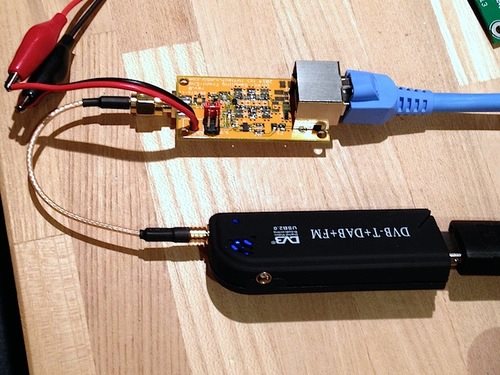
Over on this Japanese language blog, ttrftech has been experimenting on a type of direct sampling front end board (Use Google Translate) for a direct sampled RTL-SDR dongle. More info about his direct sampling front end can be found on this post. Translated, it appears his board has the following feautres.
Filter x2 up to fifth order
RF switch
Amplifier
Power regulator
Input transformer (optional)
The RJ-45 (optional) or the SMA input connector
Power supply to the antenna
Output to U-FL or SMA (ipex) connector
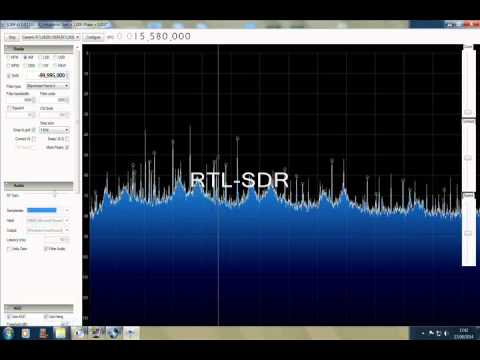
The results seem to show his board does improve reception. Note that the RJ-45 appears to be the antenna. There also appears to be review of the board by “pup” here and a video showing the board filtering out a broadcast FM image in the video below. On Pups blog there are also more posts about the board under this tag.
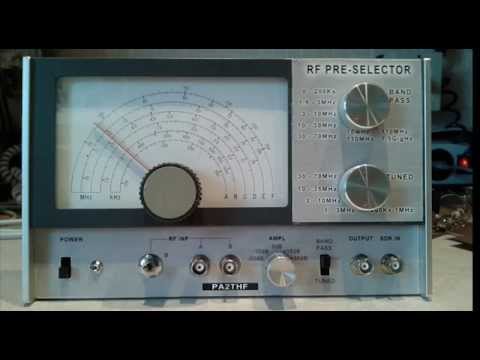
Over on YouTube user Theo Faber has uploaded a video showing his adjustable multiband HF preselector project for his RTL-SDR dongle. The preselector covers the entire HF band. Theo designed and built his own homemade upconverter for this project as well.
Preselectors on the RTL-SDR can vastly improve reception quality. Without preselection, noise and strong images of other nearby stations can cause strong interference.
My project ‘pre selector’ for wideband radios and in particular the popular tv-sticks than can be used for SDR reception. The sticks are very cheap and the software free available on the internet. SDR Sharp in this case, is operating stable under XP and W7. Sticks are sensitive, however the input level can only vary +- 20dB. The sticks are easely overloaded and will produce cross and intermediation. So you need in front of the stick / converter band pass or tunable filters. Hopefully this inspired you to build your own set of filters, to fully benefit from the perfect performing of this affordable SDR.
for more info contact me on: t.faber87__AT__upcmail.nl
kind regards and 73’s
Over on YouTube user mutezone has posted a video comparing the RTL-SDR with upconverter against a Softrock Ensemble II software defined radio. The Softrock Ensemble II is an SDR dedicated to the HF frequencies and is thus expected to have better performance for that purpose. Mutezone writes
A performance between the Softrock Ensemble II vs the RTL-SDR (R820T) on shortwave. Here we are trying to see which one is best at receiving AM broadcasters. Both SDRs were using the same longwire antenna connected to an ATU (Antenna Tuning Unit).
Although I know this comparison is somewhat unfair, since the RTL-SDR is not meant for shortwave & the Softrock is, it is to show that there is a difference in performance, even though the RTL-SDR has a much wider frequency range & cannot be beaten when it comes to value for money. My opinion is that if you want an SDR that should deliver on HF / Shortwave performance, then go for a dedicated one like the Softrock, Afedri, SDR-IQ or any others that do the same job on the market. Even when using a decent HF Upconverter, the RTL-SDR will still not match the performance of more upmarket HF SDRs.
The direct sampling mod is a hardware modification to the RTL-SDR which allows it to receive HF frequencies between 0-14.4 MHz without the need for an upconverter. It works by connecting an antenna directly to the RTL2832U chip, thus bypassing the tuner. Teejez’s modification tells the RTL-SDR to bypass the tuner in software, allowing antennas to be connected to the normal antenna port. HF reception with the experimental driver is very poor in comparison to the direct sampling hardware mod or an upconverter, but even so Jengal was able to receive AM Radio, an SSB ham radio signal and an HF weather report with a simple longwire antenna.
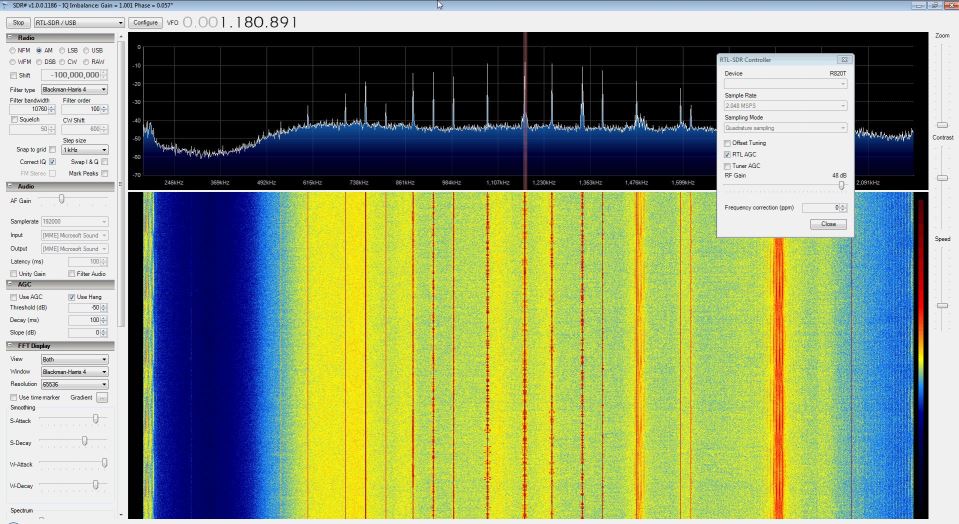
To use the modified dll, simply download it from this link, rename it to rtlsdr.dll, and replace the original rtlsdr.dll in the SDR# folder. Then connect an HF antenna to the normal antenna port and in SDR# tune to a frequency between 0-14.4 MHz. Next turn ON the RTL AGC option in the configure menu. Jengal replaced the function of the RTL AGC option with the direct sampling mod. He found that best reception occurred when he set the gain to 48 dB.
No Hardware Mod Direct Sampling in SDR# Receiving AM Radio
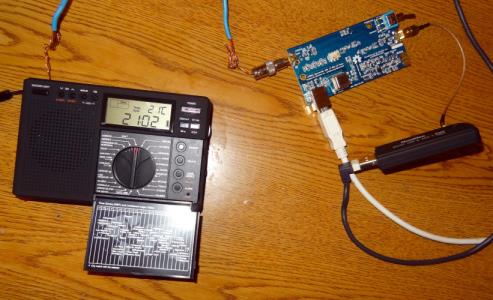
His results show that the RTL-SDR and portable receiver are comparable in terms of performance, with a slight edge to the RTL-SDR. He adds that software tweaks available in SDR# can improve the voice quality for the RTL-SDR. However his final recommendation for general shortwave listening is that the portable is still the better option due to it’s ease of use.
RTL-SDR + Upconverter vs. Portable Shortwave Radio
Revision 5 promises to be lower priced as it will run using the direct sampling mod instead of using an upconverter which would require more components. It will also use a Mini-Circuits MAR 8 wideband amplifier to improve weak signal performance.
For each test he used a gain of 0dB and the same 20 foot random wire antenna. Interestingly, his results show that the SDR Up 100 significantly outperforms the Ham-it-up upconverter. We believe that this may be as the SDR Up 100 has an LNA built into it whereas the Ham it up does not.
Update: Akos has now included comparisons with various RTL gain settings.