Tagged: rtl-sdr

Review of Adam 9A4QV’s Folded Monopole ADS-B Antenna

Recently we bought and tested one of Adam 9A4Qv’s ADS-B folded monopole antennas. This is a well thought out 50 ohm antenna designed for receiving ADS-B signals between 1030 and 1090 MHz. It has an omni directional radiation pattern (receives from all directions in the horizontal) and 3.67 dBi gain.

This antennas main defining feature is that it uses a DC grounded design which eliminates the static electricity problems other antennas can have. This allows this antenna to be connected to a receiver 24/7 without having to worry about ESD destroying the front end of your receiver or LNA. It is also small enough to be able to be used as a desktop antenna.

Folded Monopole ADS-B Antenna
Folded Monopole ADS-B Antenna. Comes in two pieces which need to be soldered together.

The antenna is made of FR-4 laminate (PCB material) with a conductive layer covering the ground plane board and an upside down U-shaped trace in the vertical section. The antenna requires assembly and detailed assembly steps can be found on the antenna’s web page. Assembly of the antenna itself was straight forward just requiring two solder joints to be made to connect the vertical part to the ground plane. You will need to take care to ensure that the vertical antenna is completely vertical once soldered in.

The antenna also comes with no included coax cable and so a cable must be soldered on to the antenna first. The assembly instructions recommend using Teflon coax cable (such as RG316), however we didn’t have any on hand, so we just used regular RG174U and carefully soldered it on, making sure to not melt the inner insulation too much.

Fully constructed ADS-B antenna with RTL-SDR dongle for size comparison.

After fully constructing the antenna we ran a SWR test using an RTL-SDR and a noise source and found the antenna to have a SWR of approximately 1.46 at 1090 MHz resulting in about a 0.155 dB loss due to mismatches. A SWR value of 1.46 is very good for a receive only antenna like this. In one of Adams videos he used some higher quality coax and his tests showed the SWR of the antenna with a value of about 1.2102.

As for actual real world ADS-B performance we did not test it against any other ADS-B antennas, but it received aircraft from almost 350 km away from an indoor desktop location which we think is pretty good. In comparison the standard 11.5 cm stock antenna that comes with most dongles only had a range of about 250 km when placed in the same location. The maximum range of an ADS-B signal is around 500 – 600 km, which should be easily achievable with this antenna mounted outside on the roof.

Compared to other hobbyist ADS-B antenna offerings, Adam’s folded monopole antenna is one of the cheapest we could find, costing only 20 euros + 5 euros for shipping (~$26.5 USD total), although it does not come with a mount or weatherproofing. It is also one of the smallest, measuring just under 6 cm high and 14 cm in width and depth. Below we table Adam’s antenna with some alternatives for a comparison (prices converted from Euro to USD where applicable).

Note remember that as passive antenna gain is increased, the receive radiation pattern becomes flatter (which you may or may not want – you’ll receive better out towards the horizon but worse at higher elevations) and that an active antenna with an LNA is most useful when long runs of coax cable is used.

Antenna Type Passive Gain (dBi) Length (cm) Notes Price (Excl. Shipping) (USD)
9A4QV Antenna Folded Monopole 3.67 6 DC Grounded. No cabling, mounts or weatherproofing included. $21.9
Diapason MCX PCB Stripline 2.1 21 Comes with 3 m of RG174 with MCX connector, mast clamp and weatherproof radome. $63.36
A3 ADS-B ? 5 55 Comes with mast clamp and weatherproof radome. $85.23
Active Diapason PCB Stripline 2.1 21 Has built in LNA and SAW filter. Comes with bias tee, USB cable, mount and weatherproof radome. $193.870
DPD ADS-B Vertical 1/2 Wave Colinear 9 144 Very high gain passive antenna. Comes with mount and weatherproof radome. $149
DPD ADS-B Indoor Blade 1/2 Wave Colinear 4.6 61 Aesthetically pleasing as it is designed to be mounted indoors. $89.95
DPD ADS-B Double 1/2 Wave Mobile 1/2 Wave Colinear  5 33 Magnetic mount mobile antenna. $68.95
5/8 ADS-B Antenna 5/8 Wave Ground Plane 5.15 30 Comes with mount and weatherproof radome. $21.55
ADS-B J-Pole J-Pole 4.45 30 Comes with mount and weatherproof radome. $14.85

Disclaimer: We bought this antenna with our own funds and we are not being paid or reimbursed in any way for this review.

Have you tried any other commercial ADS-B antennas? Let us know in the comments how well they work.

BigWhoop: Global Spectrum Monitoring Network with RTL-SDR Dongles

The American space agency NASA runs a yearly challenge called the “International Space Apps Challenge”. The challenge encourages global collaboration in solving several space and Earth related problems. This year one of the challengers is creating a system called the “BigWhoop” which will be a global networked system of radio receivers that will be used to continuously monitor the radio spectrum. They write:

[BigWhoop] is a full system for collecting data from small radio-receivers measuring everything within the radio spectrum around the world. BigWhoop schedules the monitoring, the collection of data via the internet, the database handling and the final analysis as well as visualization.

As well as being able to constantly track aircraft through ADS-B signals, they write that BigWhoop will have the following other applications:

We can detect places of high spectrum activities such as radio towers and tell you, when a new music channel starts its broadcast service. Or we can find sweet spots of radio silence where radio telescopes can be placed and listen to weak cosmic radio sources, that would have been drowned in man-made radio noise otherwise.

The BigWhoop code is still in “pre-alpha”, but they are currently asking for owners of RTL-SDR dongles to be volunteer testers.

Recently we also posted about some similar networked radio projects. One called ThumbNet which has a greater emphasis on education and promotion of the sciences, and another called SatNOGs which focuses on the receiving and global networking of satellite communications.

bigwhoop global spectrum monitoring spaceapps2015 stuttgart local winner airtraffic

More videos can be found here.

New SDR# Plugin: IF Recorder

On rtl-sdr.ru, the author of several SDR# plugins has uploaded a new one called “IF Recorder”. This plugin allows you to easily record an IQ file of just the intermediate frequency (IF). In SDR#, the IF is the shaded area with the red line which you use to tune with.

This plugin looks to be great for recording example IQ samples of signals because the output file will be significantly smaller and more manageable compared to recording the entire bandwidth. It is also useful for recording IQ files for use in decoding METEOR M2 weather satellite images, as the decoding software requires an IQ file of the LRPT signal. The plugin also has a schedule option which could be used to start and stop recording the METEOR M2 weather satellite signals automatically.

IF (Intermediate Frequency) Recorder SDR# Plugin

Running an RTL-SDR on OpenWRT

OpenWRT is a special custom Linux based firmware designed to create a fully functional Linux system on a internet router by replacing the stock firmware. Since OpenWRT is Linux based, it is possible to install the RTL-SDR software and run it on the router itself. On his blog Tom Jones has posted a brief tutorial showing how he got the RTL-SDR working on a WR703N router that is running OpenWRT. Basically he just installs the RTL-SDR package which is available through the OpenWRT package manager and runs rtl_tcp, but he talks about a few adjustments he had to make to the rtl_tcp buffers to make it run smoothly. The WR703N is a mini wireless router that goes for about $30 USD on Amazon.

We also looked around for more information about running RTL-SDR on OpenWRT and found this older post from Yuval Adams showing how he got dump1090 and the flightradar24.com feeder running also on an OpenWRT’d WR703N router.

The WR703N wireless router which is capable of running OpenWRT and RTL-SDR.

How to Setup CWSkimmer with an RTL-SDR and HDSDR

Over on YouTube user Brent Crier has uploaded a tutorial video showing how to set up CWSkimmer with an RTL-SDR and HDSDR. CWSkimmer is regarded as one of the best pieces of software that can be used to decode CW a.k.a Morse code.

Morse code is a communications technique still used widely by the amateur radio community in the HF bands. The RTL-SDR can receive HF frequencies and Morse code with an upconverter or direct sampling modification.

In the video Brent goes over the installation of HDSDR, Virtual Audio Cable, and a program called Virtual Serial Port (VSP) manager as well as the needed settings for each program. The set up he shows allows CWSkimmer to automatically change the frequency in HDSDR when tuning in CWSkimmer.

How to setup a CWSkimmer with a RTL SDR and HDSDR

ThumbNet – A Low Cost Satellite Groundstation Network using modified RTL-SDRs

The ThumbNet project is a project that is aiming to provide low cost satellite receivers to students and any other interested communities in order to promote worldwide education in science, technology and engineering.

In addition to ThumbNet, there is also the ThumbSat project which hopes to launch it’s own satellites sometime next year. However, at the moment the focus is on ThumbNet where the team are currently building their ground station network by supplying customized RTL-SDR dongles to schools and interested communities all around the world for free.

Once the satellites are launched the receive stations will be used to download data from the ThumbSat satellites, creating a large network of receivers. To raise the incentive for participation, in the future they also hope to provide a small amount of money to each actively participating school or organisation. They write that the RTL-SDR’s could also be used for receiving other educational signals such as communications from the ISS. More information about the project can be found on their website www.thumbsat.com, and in this white paper (pdf).

As generic RTL-SDR dongles were not up to their specifications they decided to develop their own. Their RTL-SDR receivers are custom made to have a 1 PPM accuracy Temperature Controlled Oscillator (TCXO), a R820T2 tuner chip and a F-Type connector. The Type-F connector was chosen as they found that it was the most commonly found connector around the world and would be the easiest for students in remote areas to have access to.

If you are interested in getting one of these dongles and you meet their criteria (school or similar), you can either ask to participate in the ThumbNet program for free, or alternatively if you just want a dongle for your own use you can buy one through us. We have decided to help with the ThumbSat project by helping them advertise and sell off some of their surplus units through our blog.

In their official blurb ThumbSat writes:

Scoutek LTD, in the United Kingdom and ThumbSat Inc, in the United States are proud to have partnered together to provide an opportunity for schools and educational groups around the globe to promote radio science, technology, engineering and mathematics to their students and attempt to influence the next generation of scientists and engineers.  By donating small radio kits to each school or educational group, the project has already begun making a positive change in the lives of hundreds of students.

ThumbSat has been working with schools and educational groups around the globe and to date, more than 20 groups have committed to volunteering where students and staff members will operate the satellite monitoring stations as part of their science courses!  As a few examples, stations are being operated in diverse areas the Cook Islands, Christmas Island, Singapore, Ecuador, Tanzania and Botswana. One individual in Micronesia was operating the station by himself at 12 years old!

ThumbNet is open to anyone who is interested in participating and has a desire to setup and operate a small ground based radio listening station. No permits or licenses are required, since there is no transmission of any sort and no permanently installed antenna systems.

ThumbSat and Scoutek encourage education for everyone and is looking for anyone young, old, educated or uneducated, individuals or groups to participate.

Questions can be directed to [email protected], or by visiting the company websites: www.thumbsat.com or www.scoutek.com .

ThumbNet SDR Dongles
ThumbNet SDR Dongles with Wade, one of the people behind the project.

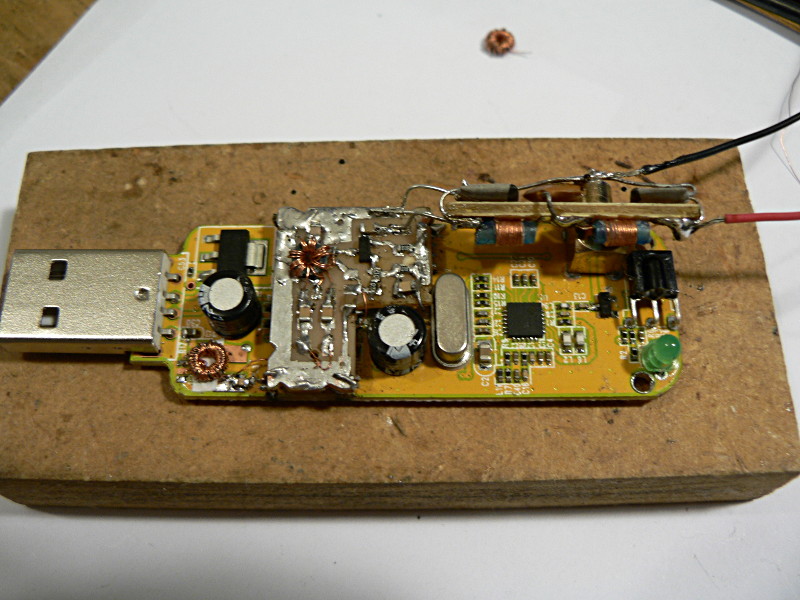
Homemade Upconverter for the RTL-SDR Running on a Cellphone Battery

Over on YouTube user ek6rsc has uploaded a video showing his home made upconverter for the RTL-SDR. His upconverter uses a diode mixer design with a low pass filter and 40 MHz oscillator which he obtained from a USB-WIFI adapter. Usually an upconverter is powered by a power plug or USB cable, but ek6rsc has powered his with a 3.7V 860ma cellphone battery. He writes that the battery lasts a long time and helps avoid interference caused by power adapters and the PC. Ek6rsc has also uploaded a second video showing the upconverter in action.

Up-converter for RTL-SDR 40MHZ Lo. & cellphone battery

How work Up-converter for RTL-SDR 40MHZ Lo. & cellphone battery

New ADS-B Mapping and Decoder App for Android from FlightAware

Flightaware.com is a web based online radar service for aircraft. The plane position data is obtained from contributors running ADS-B decoding hardware, such as a special ADS-B receiver box or simply an RTL-SDR dongle.

To increase the number of contributors, the team at FlightAware have released a new RTL-SDR compatible ADS-B decoder app for Android devices. The App is totally free and is also ad free. It can be downloaded from the Google Play store at https://play.google.com/store/apps/details?id=com.flightaware.android.flightfeeder. The intention of the app is to target users who may have an old Android device lying around, which can be put to good use in contributing data to FlightAware. More information about running the app can be found on their webpage.

When sharing data with FlightAware you are then eligible for a free enterprise account valued at $89.95 a month which allows you to access several advanced flight tracking features.

To use the app you’ll need an Android device, a USB OTG cable (ideally with external power port) and an RTL-SDR dongle. The USB OTG cable should ideally have an external power port and be powered from the mains with a power adapter as the battery can drain fast.

FlightAware ADS-B App