Rob from Frugal Radio has recently uploaded part three in his airband monitoring series. The the last video Rob discussed what communications can be received from the airport. In this weeks video Rob explains how air traffic control is handled over large areas, and also shows examples of what you might hear when an aircraft communicates with it's parent company.
Air Traffic Control Centres provide ATC coverage across most of the globe. This video gives an overview of how you can listen to pilots and Air Traffic Controllers as along their routes.
This video talks about the en route Air Traffic Control systems in the USA (ARTCC managed by the FAA), UK (managed by NATS) and Canada (managed by Nav Canada).
Company frequencies are also covered in this video, along with examples of conversations received at my location in the last few days.
Monitoring En Route Air Traffic Control, Oceanic Clearances, and Company Frequencies
Rob from Frugal Radio has recently uploaded the next video in his airband monitoring series. In this video Rob explains various airband communications that can be received from the airport, and explains about needing to be in the line of sight of an airport in order to receive them.
He goes on to explain signals and airport radio communications channels such as ATIS, Clearance Delivery, Tower, Arrivals (Approach), Departures, Radar and Terminal communications. The video provides various examples of these communications being received with an SDRplay software defined radio.
Monitoring VHF Airband Aviation Frequencies at the Airport
Rob from Frugal Radio has recently started a new YouTube series all about monitoring aviation communications. In his first video Rob gives an overview on what can be aviation signals can monitored and recommends a few hardware scanners as well as software defined radios for monitoring.
This is an introductory video to my new series aimed about monitoring aviation communications. Throughout the series we will talk about:
Civil Airband (aka VHF airband)
Military Airband (aka UHF airband)
HF Aeronautical communications
Decoding aircraft data on HF and VHF
Decoding CPDLC transmissions and much more!
Good frequency scanners to use, like the Uniden BC125AT and BCT-15X
Aside from these results, Steve's post goes on to explain how he gathers and stores these analytics and an example of using the Graphs1090 software for producing nice plots of the aircraft receive. One important tip that he mentions is to be careful when constantly logging ADS-B data to the SD card as the card can easily get corrupted over time since there are read/write cycle limits.
Air traffic graphs showing the effect of the latest snow storm on air traffic
AirNav is the company behind RadarBox24.com, a flight data aggregation service similar to sites like FlightAware.com and FlightRadar24.com. RTL-SDR hardware is typically used to receive ADS-B, and like other providers AirNav have their own custom ADS-B optimized RTL-SDR unit. In addition they sell RTL-SDR's optimized for UAT 978 MHz and the VHF Airband. They also have a range of ADS-B/UAT/VHF airband outdoor antennas as well as filters.
Currently their products are discounted by 20% for Black Friday/Cyber Monday sales. The discount is available on Amazon, as well as directly from their store with coupon GET20.
At this years ICNP 2020 IEEE conference a paper titled "Real-World ADS-B signal recognition based on Radio Frequency Fingerprinting" (pdf file) was presented by researchers from Harbin Engineering University in China. The idea presented in the paper is to use RF "fingerprinting" techniques to uniquely identify and confirm that the ADS-B signal originates from the correct aircraft source.
RF fingerprinting works on the premise that every transmitter has small manufacturing variances that result in slightly different signals be transmitted, resulting in a unique "fingerprint" that can be traced to a particular transmitter. The idea here is to use these fingerprints to ensure that a known aircraft is indeed transmitting an ADS-B signal and the signal is not being transmitted from a fake spoofer. ADS-B is completely unencrypted and not authenticated, so spoofing of ADS-B signals may be a real security threat.
In the teams research they use an RTL-SDR to collect ADS-B signals from five different aircraft. They then use that data to create "Contour Stellar Images" and train a deep learning neural network which after training accurately identifies which aircraft a signal comes from.
Over on his blog Ian Renton has posted about his dual plane and ship tracker project that he's titled "Plane/Sailing". The project consists of several elements including one FlightAware Pro Stick and Pimoroni ADS-B antenna for the aircraft tracking, and an RTL-SDR Blog V3 dongle and Diamond X-50 AIS antenna for the ship tracker.
Ian runs each dongle on a seperate Raspberry Pi. For aircraft the dump1090 software is used to decode the data, and it passes that data to multiple aggregator feeders such as FlightAware, FlightRadar24, ADS-B Exchange and OpenSky. For ships he uses rtl_ais which feeds into AIS Dispatcher which in turn feeds multiple marine aggregators such as Marine Traffic, VesselFinder, AIS Hub, Pocket Mariner and Ship Finder.
His system also feeds a personally hosted web front end based on his umid1090 software. umid1090 is a replacement for dump1090's web interface, the main difference being that the map is presented using military symbology. For the "Plane/Sailing" project he also extended umid1090 to be able to read the AIS ship position data from AIS Dispatcher's KML output file, and created a clean dark interface. The result is a slick looking map displaying both the tracked aircraft and ships. Ian's web interface for his system is public, and can be viewed at planesailing.ianrenton.com.
The Plane/Sailing Web Interface (Based of UMID1090)
In the past we've posted about the QIRX software a few times as it is an RTL-SDR compatible program that has a focus on DAB+ decoding. However, recently QIRX author Clem wrote in to let us know about version 3 beta, which is now a multi-mode receiver supporting modes such as ADS-B, AM, NBFM, WFM, SSB as well as DAB+ as it did in previous versions. It also now support ADS-B plane mapping, and can run multiple RTL-SDRs at once. We note that this version is not yet available for public download, however you can get the beta by contacting the author (details below). Clem writes:
In short, there are two main new features:
Multi-Receiver: More than one hardware RX can be connected, all I/Q data are fed via TCP/IP, local or remote. The configuration is read from the config file, per default prepared for three receivers.
As before, TCP/IP drivers for RTL-SDR dongles, the RSPs (RSPDuo single-channel), and Airspy. All binaries are part of the installer.
Although the software is "general purpose", particular emphasis has been given to serve aviation enthusiasts.
ADS-B: Aircrafts are displayed on the map. Information for about 450.000 aircrafts comes from an open database kindly provided by Opensky-network.org, updateable by the user from within the software, similar like the DAB database. The ADS-B decoder is a C# port of the well-known dump1090 software, with enhancements to decode aircraft ground movements.
The displayed aircrafts are those within the range of the attached receiver. In contrast to some other applications, it might be noted that the software is capable to decode the movements of the aircrafts not only when airborne, but also on the ground, of course when in range. This might be interesting for plane spotters, perhaps in the vicinity of an airport.
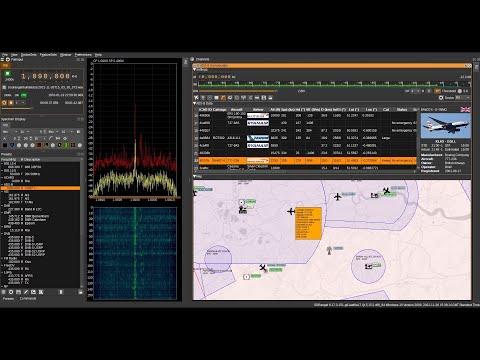
The AM decoder provides special features when tuned to the airband range and - as should be standard nowadays - 8.33kHz channel separation has been selected. In contrast to older times, in airband communications no longer frequencies in MHz are communicated, but channels. The software (in live mode, not visible in the above picture taken from a file replay) provides an own airband channel selector, directly accepting channel numbers as spoken by ATC controllers. This is paired with the indication of channels in the spectrum, together with the corresponding frequency. With 8.33kHz channel separation, cheap dongles should be calibrated to receive the correct frequency, e.g. with QIRX's DAB decoder (where DAB is available).
Readers interested to give this version a try might send an email to [email protected] and they will receive the current beta version (Win10 .msi installer). As it might not yet have its final stability, it is not yet provided for download. Of course all beta users are requested to give some feedback.
QIRX V3 ADS-B Interface: Showing activity over Zurich Airport
Clem has also provided a YouTube video demonstration 20 minutes of ADS-B and airband voice activity over Zurich airport via the new multi-receiver and ADS-B mapping features in QIRX.