Back in 2020 we released a tutorial about how to use a 2.4 GHz WiFi Grid Dish antenna as a radio telescope which can detect and measure the Hydrogen line emissions in our Milky Way galaxy.
Recently matt from the TechMinds channel has uploaded a video showing this same project but using the NooElec mesh antenna that has been slightly modified for improved performance on 1.7G and 1.4G.
In his video Matt sets up a drift sky scan, where the rotation of the earth drifts the Milky Way through the beamwidth of the dish. Matt uses Stellarium to virtually visualize the live sky map, SDR# and the IF average plugin to average the spectrum, and an Airspy software defined radio.
Thank you to SDR# author Youssef for updating SDR# (SDRSharp) and fixing a recent bug that was causing RTL-SDR units to crash whenever the frequency was changed. We are putting this post out to inform everyone who was having this issue to please update their SDRSharp version to 1915 which can be downloaded from airspy.com/download. Our guide at www.rtl-sdr.com/QSG can be used to walk you through the installation procedure for RTL-SDR dongles in SDR#.
The new update brings the RTL-SDR control menu down to the sidebar making it much easier to control the gain and sample rate settings. Other recent changes have also brought improvements to the RDS decoder which will be useful for DXers.
Please remember to show your appreciation to Airspy for allowing RTL-SDR users on their platform by checking out their range of higher end softwire defined radio products at airspy.com.
Thank you to RTL-SDR.com reader André for submitting and sharing with us his QO-100 ground station setup. The setup also includes antennas and equipment to receive HF and VHF/UHF. His setup can serve as an example of a well set up permanent installation.
André's set up consists of a 1.8 meter prime focus dish, Raspberry Pi 4, GPIO connected relay, Airspy R2, Ham-it-up upconverter, coaxial relay for switching between Mini-Whip and Discone Antenna, and FM bandstop filter and a power terminal rail block. The Airspy R2 is used for HF/UHF/UHF reception and the antennas and upconverter are all controlled via a web connected relay system. All equipment is enclosed in an outdoor rated box, and André notes everything has been working well from temperatures range from -10C to 35C.
Inside the satellite dish feed is housed an Adalm Pluto SDR, and a wideband LNA and a USB to LAN converter with power over Ethernet. A small log periodic Yagi serves as the feed. In order to work the wideband DATV band on Qo-100, André' swaps out this feed for a custom feed and brings the PlutoSDR indoors where it is connected to a 120W Spectran Amplifier and modulator.
Back in March of this year we posted about an OpenWebRX fork called OpenWebRX+, which adds multiple built-in and ready to use decoders such as SSTV, AIS, CW and RTTY. OpenWebRX+ is a fork of the OpenWebRX project which is now officially maintained by DD5JFK.
Since our last post OpenWebRX+ has progressed in development further, and now includes a HFDL decoder via dumphfdl, various ISM band equipment decoders via rtl_433, FLEX pager decoding via multimon-ng, and a SELCALL decoder has also been added. Many other improvements and changes to the software have also been added, and the full changelog can be viewed here.
OpenWebRX+ is software for Linux. If you want to install OpenWebRX+, an easy path is to use the ready to use Raspberry Pi 4 image available on the releases page, or to use their PPA.
SSTV Image received by the luarvique fork of OpenWebRX. Credit: Neil Howard
Airspy is currently holding their annual summer sale which gives 15% off their line of products until June 25. The sale brings the price of the popular Airspy receiver products down to the following in US dollars (note that actual pricing may vary across local resellers):
Airspy R2: $169.00 $143.65
Airspy Mini: $99.00 $84.15
Airspy HF+ Discovery: $169.00 $143.65
Airspy SpyVerter R2: $49.00 $41.65
YouLoop Antenna: $39.95 $33.95
The sale is active at all participating resellers, which includes our own store where we have the YouLoop on sale for US$33.95 including free shipping to most countries in the world. Please note that due to new EU VAT collection laws, EU customers must purchase the discounted YouLoop from our eBay or Aliexpress stores.
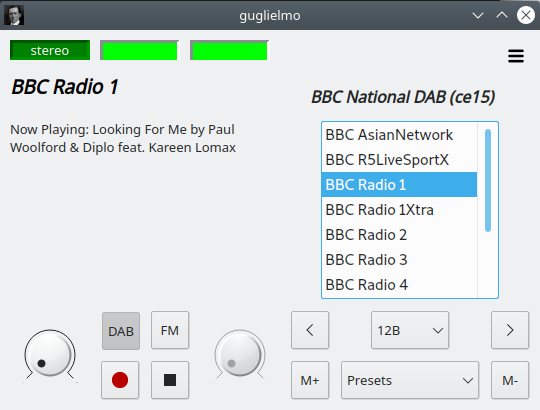
Guglielmo is a Linux, Windows (and in this recent update x86 MacOS) based RTL-SDR FM and DAB tuner software that supports SDRs including the RTL-SDR, Airspy, SDRplay, HackRF and LimeSDR. It is designed to be an easy to use program designed for media users, rather than hobbyist technical users.
Regarding the release of Version 0.5, Marco writes:
This release sports full mac (x86 only, sorry) and windows installers, DAB and FM scans and a preset editor.
DCF77 is a long wave time keeping signal transmitting at 77.5 kHz from Frankfurt, Germany. It has been active since 1 January 1959. Using simple amplitude modulation, the signal encodes the current time and date, which is used by some devices like railway station clocks in Germany. Because it's a long wave signal transmitting at 50kW, it's possible to receive the signal across Europe, and sometimes even further away if propagation conditions are good.
Currently the decoder has been tested to work with an Airspy HF+ Discovery SDR, but it should work with any SDR capable of receiver 77.5 kHz if the GNU Radio source block is changed out.
OpenWebRX is an open source web based SDR receiver program that allows you or others (if you allow them to), to access your SDR over the internet. It is compatible with KiwiSDR, RTL-SDR, Airspy, SDRPlay and many other software defined radio hardware. It was originally developed by Andras Retzler, but since abandoned by him, with a semi-official fork being maintained at openwebrx.de. However, other forks like luarvique can exist that implement a new set of features.
The full set of additions and improvements reads as follows:
This is the package repository for the improved version of the OpenWebRX online SDR. The new and original features available in this version of OpenWebRX:
Built-in SSTV decoder with background decoding.
Built-in AIS decoder.
Built-in CW decoder.
Built-in RTTY decoder.
Built-in MP3 recorder for received audio.
Image browser for received SSTV images.
Adjustable noise filtering based on spectral subtraction.
Adjustable tuning step.
Improved touch screen operation, with panning and zooming.
Improved scroll wheel support, with tuning and zooming.
Improved tuning in CW mode.
Bandpass filter adjustable with scroll wheel.
More reliable SDRPlay devices operation.
Better map information, with distances.
Better APRS map information, with weather.
Configurable session timeout, with a policy page.
HTTPS protocol support (requires SSL certificate).
The code comes packaged for Ubuntu 22.04 (amd64, arm64) and Debian 11 (amd64 arm64, armhf). There is also a ready to use Pi 4 SD card image available, linked on the GitHub readme. The original forked code can be found at https://github.com/luarvique/openwebrx.
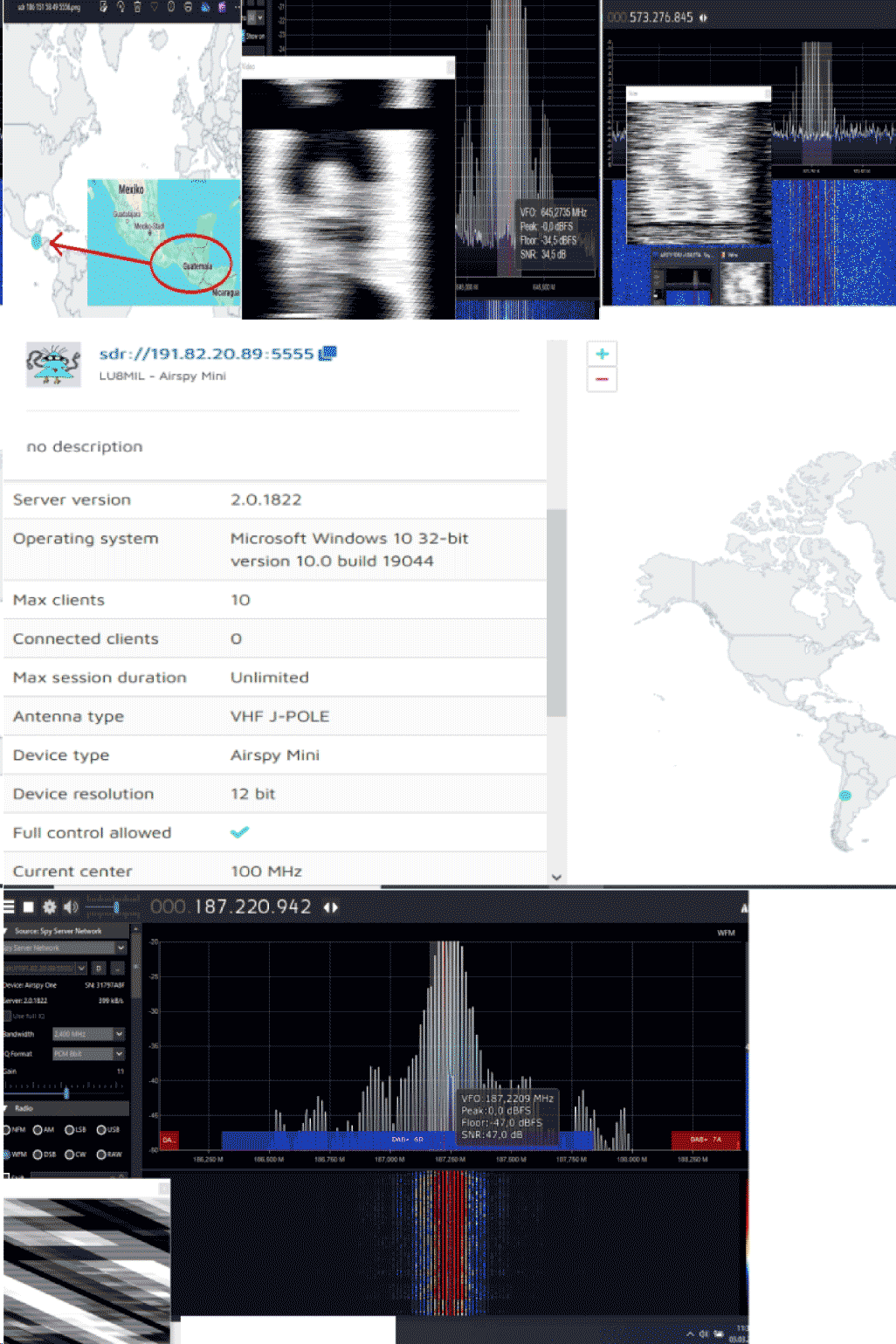
According to discussion over on the OpenWebRX groups.io, the fork also runs on a Pi 3. In the image Neil Howard from the groups.io forum demonstrates an SSTV image he received with an SDRplay clone using the luarvique fork of OpenWebRX.
SSTV Image received by the luarvique fork of OpenWebRX. Credit: Neil Howard
Stefan also notes:
The maker of OpenWebRX+ Marek and also the maker of the original version of OpenWebRX Jakob are reachable via a Telegram channel: https://t.me/openwebrx_chat