Category: Antennas

NyanSat: A Low Cost Open Source Satellite Ground Station

Thank you to John D for writing in and letting us know that Wired magazine has recently run an article about the "Nyansat" project. Nyansat aims to bring low cost open source satellite ground stations to the masses. The goal is to democratize citizen access to space by allowing for easier collection of satellite data, or even for collaborative citizen science radio astronomy projects such as the detection of space debris or undocumented satellites. John writes:

While most people think of a satellite ground station as a giant dish mounted on top of a building in the desert, technically any radio receiver that tunes into a satellite's signal can be called a ground station.  Somewhere between the giant dish and the GPS chip in your phone is a ground station that uses a directional antenna to pull in the faint signals.  So unless you're only interested in geosynchronous satellites, the antenna needs to be aimed at the satellite, and that's where NyanSat comes in. 

The design of the NyanSat consists of a pan-tilt head, an Inertial Measurement Unit (IMU) for precise azimuth and elevation measurements, a motor-driver board, an optional OLED display, an optional GPS module, and is powered by an ESP32.  Full source code is available in their git repo, found at https://github.com/RedBalloonShenanigans/antenny. The NyanSat's software is written in micropython specifically for the ESP32, but obviously could be ported if desired.

Mounting an antenna, adding an RTL-SDR, and actually tuning in a satellite, is still up to the builder.

One of the goals of the NyanSat project is to eventually build up a network of ground stations that can collaborate to contribute frequently updated satellite ephemeris information.

When they're in stock, the project's sponsor, Red Balloon Security, has occasionally been offering a kit containing a custom PCB that is pre-populated with the ESP32 and motor driver; a pan-tilt gimbal; an IMU; and an RTL-SDR.  They've been selling them for $1.00(!), just to get them out in the hands of people.  Keep your eye open in case they get another batch in.

The Red Balloon store lists the kit as currently out of stock so we suggest keeping an eye on their store just in case any of the $1 kits come back in stock.

NyanSat will also present a live twitch demo at this years online DefCon conference on Friday Aug 7 6:30-8PM EDT and Sat Aug 8 6:30-8PM EDT. On Sun Aug 9 12:30 EDT they will hold another event where they judge the best work of the Nyansat community.

The SatNOGS project which we have covered many times before on this blog is quite similar with it's own open source antenna rotator design, however the Nyansat design looks a bit easier to build as it doesn't require 3D printed parts. Although critically from their demos we haven't seen what sort of sized antennas the gimbal chosen by Nyansat is capable of moving.
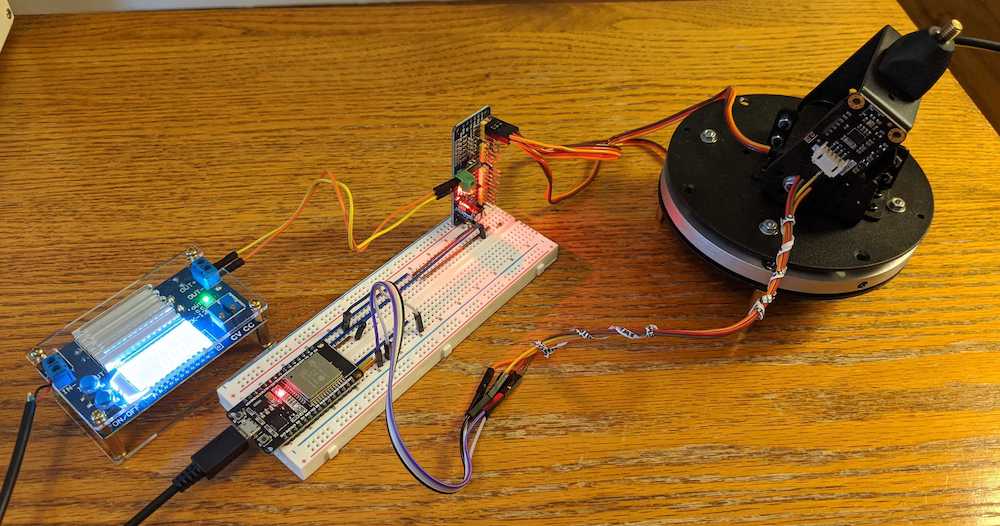

The NyanSat Pan/Tilt Gimbal Control Setup

Analyzing Lightning Discharges with an RTL-SDR and the Sage Network

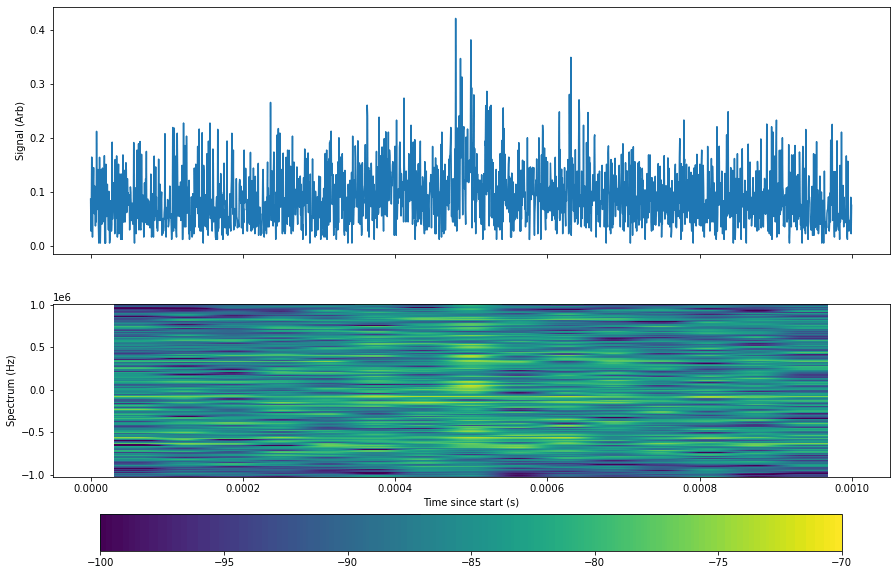
Sage is a project working on creating geographically distributed sensor systems including cameras, microphones, weather and air quality stations in order to benefit the work of scientists. Recently on their GitHub they have uploaded a Jupyter Notebook showing how they have used an RTL-SDR V3 on a Linux Laptop to analyze lightning discharges. When lightning strikes, it creates a broadband RF pulse generally across the lower frequencies. This is how live lightning maps like Blitzortung work.

In their example Sage use a dipole antenna and analysis frequency of 30 MHz. The notebook doesn't offer much additional information, but provides Python Numpy and Scipy code which can be used to detect and plot the lightning pulses.

Graphing Lightning Pulses for the Sage Network

Frugal Radio: SDR Guide Ep 4 – Antenna Basics for SDR Beginners

In this episode of Frugal Radio's series of SDR beginners guide videos he discusses some antenna basics. He shows the most common types of antennas, provides several tips to help improve reception, and shows how to properly tune antennas using online calculators.

Near the end of the video he shows our multipurpose dipole antenna kit and shows how to adjust the telescopic elements for best reception. He demonstrates that simply extending the elements to the maximum length does not result in the best tuning, rather you need to tune the element length for the frequency being received to get the best results.

2020 SDR Guide Ep 4 : Antenna Basics for SDR Beginners inc RTL-SDR / Nooelec NESDR SMArt bundle

TechMinds: Building a 3D Printed 2.4 GHz Dual Feed Helix for QO-100

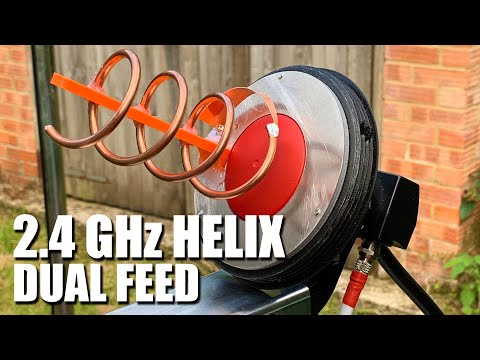
The Bullseye LNB that we have in our store is great for receiving the QO-100 amateur geostationary radio satellite which is available in some parts of the world. However it cannot be used to transmit to the satellite. Over on his YouTube channel Tech Minds shows us how to build a transmit helix antenna that connects to the Bullseye or other suitable LNB, resulting in a dual feed antenna.

The antenna that was built is based on DO8PAT's "Ice Cone Feed" design. The design requires some 3D printed parts for the mount and housing, as well as a copper wire helix, metal reflector and copper matching strip. The Bullseye fits onto the back of the helix mount. Once mounted on a dish Tech Minds shows that he was able to make contact with a friend via the QO-100 satellite with good signal strength.

2.4 GHz Dual Feed Helix Antenna For QO100

Testing a YouLoop on an RTL-SDR Blog V3 with Direct Sampling

Thank you to Frugal Radio for submitting a YouTube video where he tests the YouLoop on an RTL-SDR Blog V3 running in direct sampling mode. The YouLoop is a passive HF loop antenna that requires a highly sensitive SDR like the Airspy HF+ Discovery to work at its full potential. However, in direct sampling mode the RTL-SDR Blog V3 does have enough sensitivity to work with the antenna to some extent thanks to the HF amplifier that is used on the direct sampling circuit. In the video Frugal Radio demonstrates the YouLoop receiving various HF signals.

Will an AirSpy YouLoop work with an RTL-SDR v3 on HF in direct sampling mode? It shouldn't...

We also note a second video by Bartłomiej Marcinkowski which shows an RTL-SDR Blog V3 in direct sampling mode running with a DIY YouLoop and MiniWhip. The MiniWhip does have increased signal strength, but the YouLoop is still usable and may be a better choice in the presence of interference. Later in the video he compares the RTL-SDR Blog V3 with MiniWhip against the Airspy HF+ Discovery with DIY YouLoop. 

RTL-SDR v3 & YouLoop vs RTL-SDR v3 & MiniWhip vs AirSpy HF+ Discovery & YouLoop [80m,40m,20m]

Imaging the Milky Way in Neutral Hydrogen with an RTL-SDR Part 2

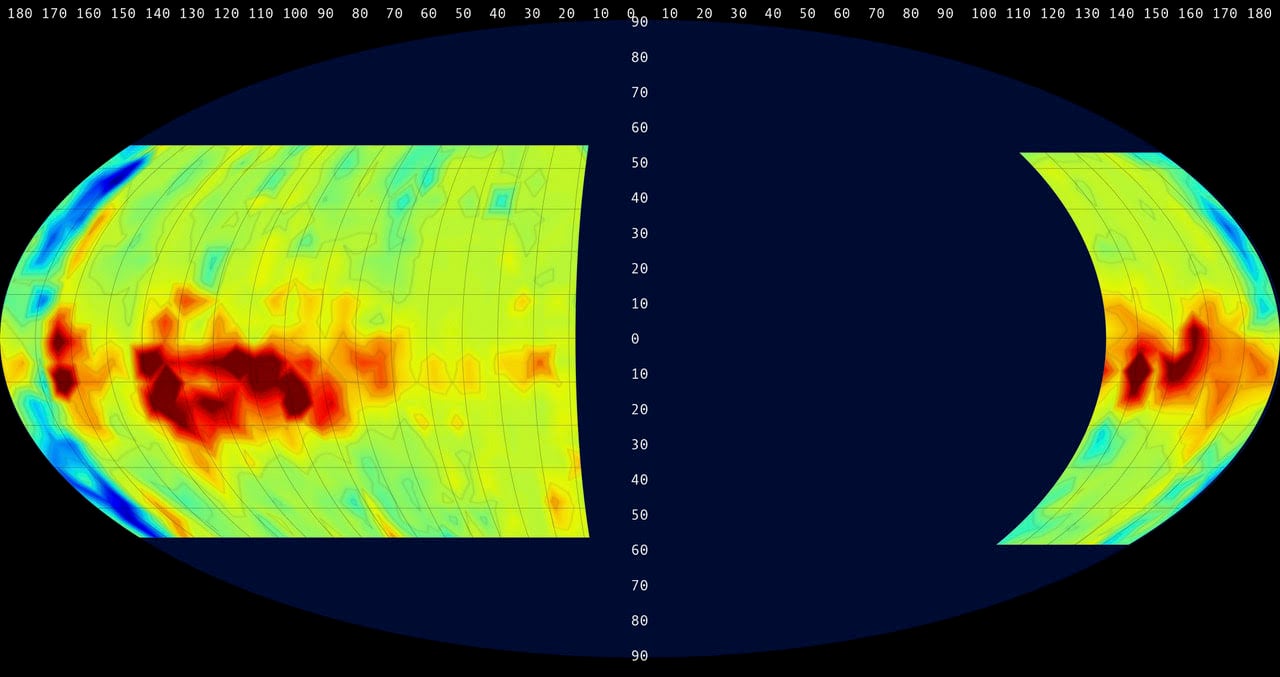
Last month we shared information about Job Geheniau's success with using an RTL-SDR dongle to image our galaxy in neutral Hydrogen. Our galaxy is full of neutral Hydrogen, and lots of neutral Hydrogen together results in a detectable radio peak at 1.42 GHz. This peak is called the Hydrogen line. By scanning the galaxy at the Hydrogen line frequency with a 1.5 meter dish on a motorized mount, an RTL-SDR, and a few filters and LNAs, Job is able to create a radio image of our galaxy.

In Job's previous attempt he created an image by pointing the dish antenna at 168 predefined grids calculated to cover the Milky Way, resulting in 168 points of exposure data. In his latest work Job has created an even higher resolution image by taking 903 points of exposure data. Each exposure took 150s and the total 903 exposures took 8 nights to record. Once all data was collected he uses the same process as before, which is to input all the Hydrogen line data into a standard 2D excel sheet, then use conditional formatting to create a heatmap which reveals the image. He then applies a blur and stretches the image into the Mollweide Cartographic which can represent the entire Universe in one image.

Job has shared with us his PDF where he documented his process and shares his images (note 16 MB PDF file). We also share his full resolution images below, just click to open. We think that these images are quite amazing and an excellent achievement for a backyard radio astronomer.

If you're interested in Hydrogen line radio astronomy we have a tutorial that will help you observe the Hydrogen line peak on a budget. The tutorial could be improved upon by motorizing the dish, allowing you to create images like the ones above. You might also be interested in a similar project by Marcus Leech who took 5 months of hydrogen line observations with an RTL-SDR in order to create an even higher resolution image.

Characterizing Yagi Antenna Directionality via ADS-B Reception

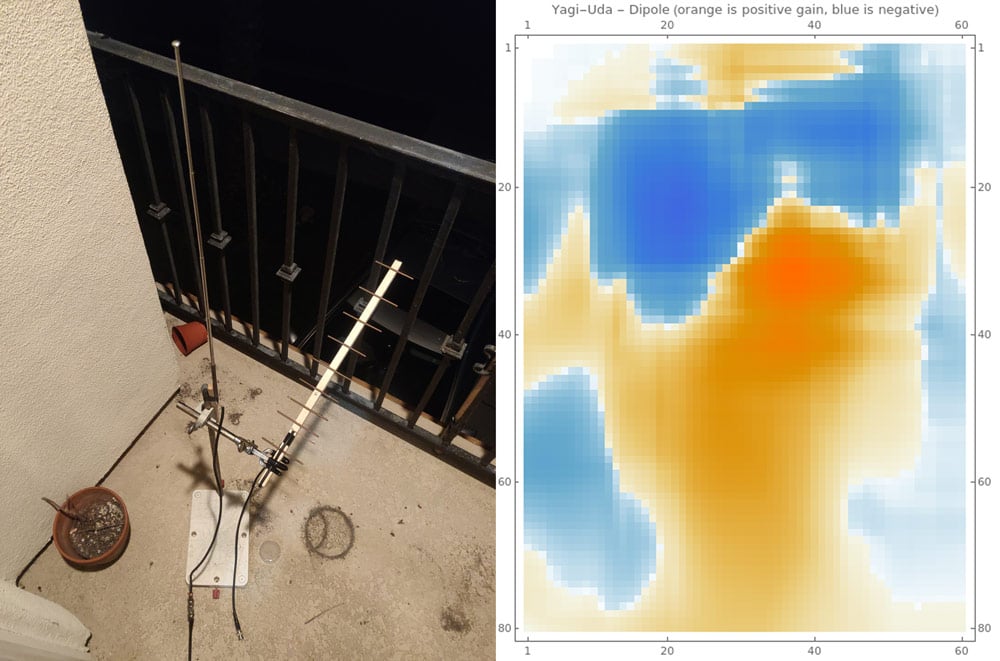
Over on his blog Alex Krotz has been investigating whether adding more passive director elements actually affects the directionality of his home made Yagi-Uda antenna. Instead of using modelling software, Alex wanted a more accurate result that took into account all the imperfections of his antenna.

His idea was to receive ADS-B signals with his Yagi and a dipole antenna, then compare the data received in order to determine in which directions the Yagi receives better than the dipole. To do this he first creates a standard 2D map of plane tracks collected over a 24hr period for both the dipole and Yagi. A gaussian blur is applied to the two maps in order to fill in blank space and the data is normalized. Then he simply subtracts the dipole plot from the Yagi-Uda plot. The resulting difference plot reveals a mapping of where the Yagi receives better or worse compared to the dipole in a 2D plane.

Directivity of the Yagi revealed by comparing against a dipole

DragonOS: Decoding Iridium Satellites with the Iridium Toolkit and an RTL-SDR

DragonOS is a ready to use Linux OS image that includes various SDR programs preinstalled and ready to use. The creator Aaron also runs a YouTube channel that has multiple tutorial videos demonstrating software built into DragonOS.

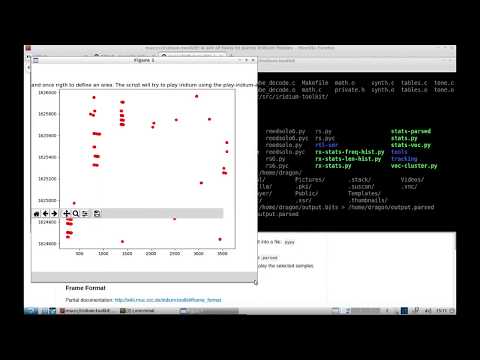
In his latest video Aaron explores Iridium reception with an RTL-SDR Blog V3, RTL-SDR Blog Active L-Band Patch Antenna and Iridium Toolkit/gr-iridium. Iridium is a satellite constellation that provides services such as global paging, satellite phones, tracking and fleet management services, as well as services for emergency, aircraft, maritime and covert operations too.

In the video he shows how to edit the config file to turn the bias tee on, how to record Iridium data, how to install the AMBE voice decoder, and finally how to decode the Iridum data with Iridium toolkit and play voice recordings.

DragonOS LTS Decoding Iridium satellites with the Iridium toolkit (gr-iridium, RTL-SDR)