Category: Antennas

Imaging the Milky Way in Neutral Hydrogen with an RTL-SDR

Over on Facebook Job Geheniau has recently been sharing how he's taken an image of our galaxy (the Milky Way) with a radio telescope consisting of a 1.5 meter dish, RTL-SDR and a few filters and LNAs. In the past we've posted several times about others observing the Hydrogen line with an RTL-SDR, and we have a tutorial here showing how to observe it on a budget.

In this case, Job went a step further than just a single measurement. He used a used a motorized dish and RTL-SDR to scan the entire Milky Way over one month, resulting in a full radio image of the galaxy. As his posts and pdf document are on Facebook and not visible to those without Facebook accounts, we asked for permission to reproduce some of them here for all to see. We have also mirrored his PDF file here, which contains more information about his radio telescope, results and setup.

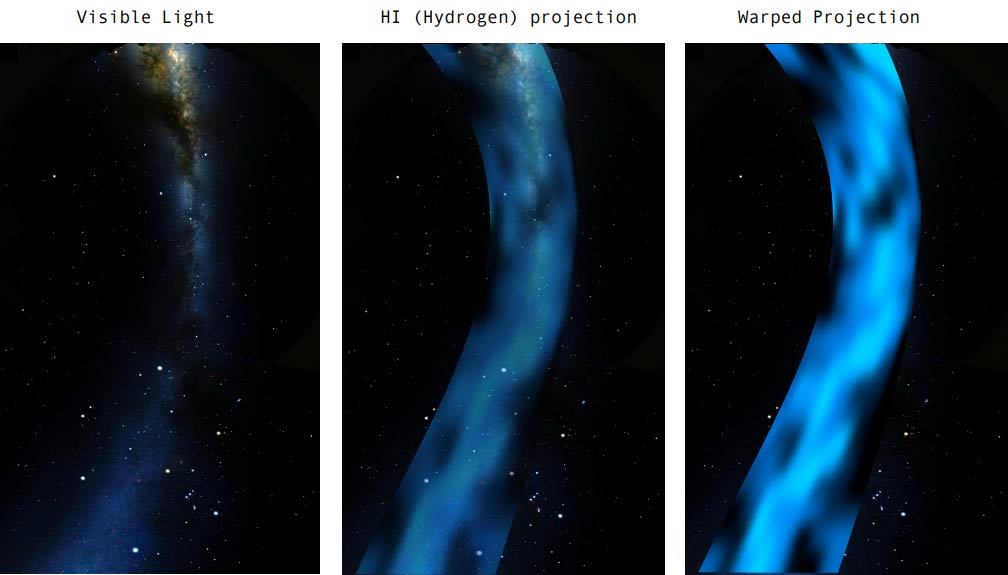
To make a very long story short. After a month of angel patience (and that says something to me) I managed to take a 'picture' of our entire galaxy (galaxy) in neutral hydrogen! I attach some pictures. If you are more interested, please come after this and PDF with explanation. It was a hell of a job I can tell you. But here's the ' picture s' of the house (230 million light years wide) in which we live and in which we all have a big mouth......

Hydrogen Line Image of the Milky Way produced by Job Geheniau

For the Scientists among us... a beautiful plot of the Milky Way Graphically explained in neutral hydrogen....... In short, summarized... if you look up on a beautiful summer evening you will see a beautiful galaxy, this is graphically the same but then on a different frequency than the eye can perceive. own dates of course.....

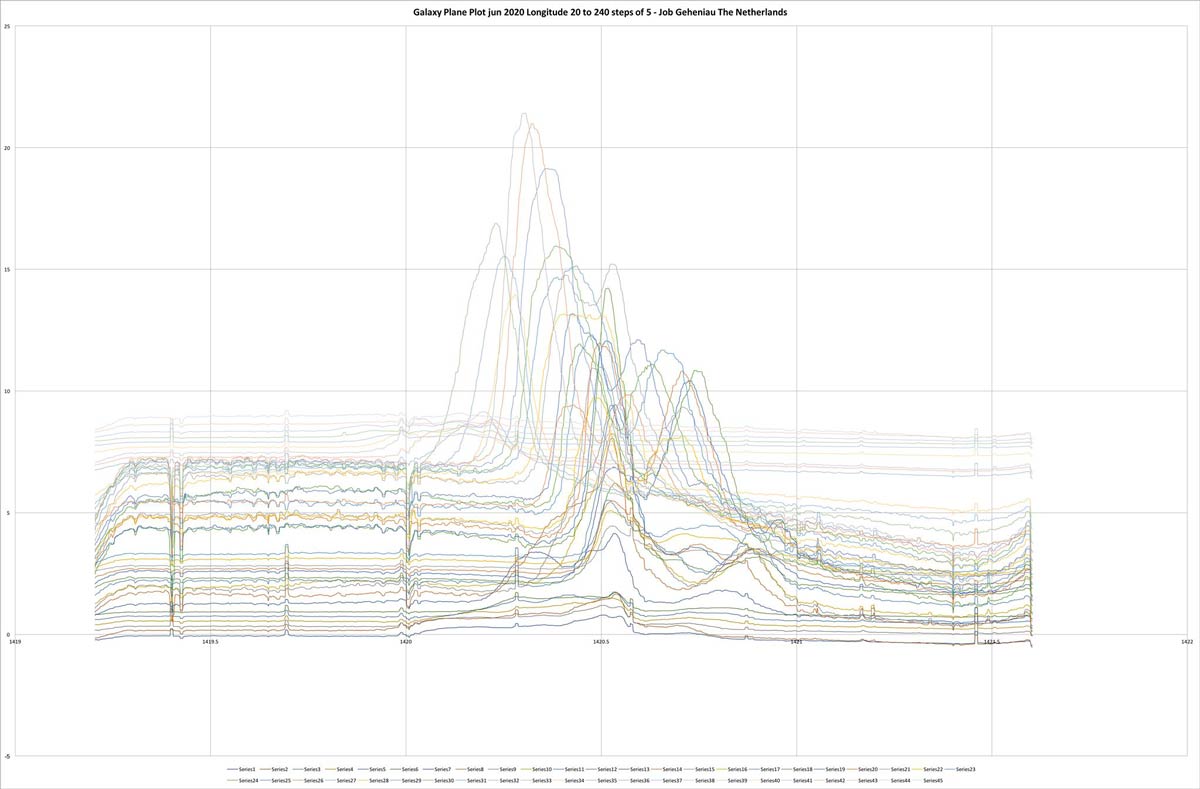
A composite of Hydrogen Line readings at different points of the Milky Way
A composite of Hydrogen Line readings at different points of the Milky Way produced by Job Geheniau
An image of the Galactic Plane (longitude 20 to 240 steps of 5 degrees and latitude 0)

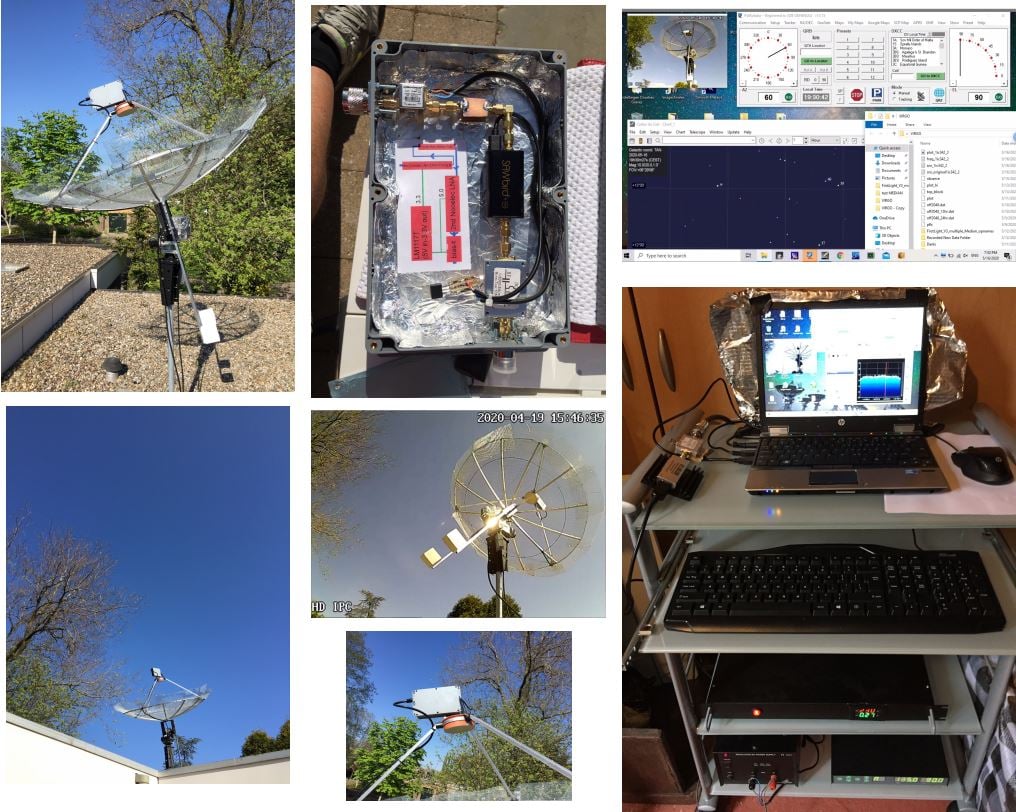
His setup consists of a 1.5m dish, extended to 1.9m with some mesh. A 1420 MHz tuned feed, Mini Circuits ZX6-P33ULN LNA, Bandpass Filter, NooElec SAWBird LNA, Bias-T, RTL-SDR V3, PST Rotator Dish Software, VIRGO software, SDR#, Cartes due Ciel sky chart and a home made netfilter.

He uses a modified version of the VIRGO software to read sky coordinates from a text file, and this points the telescope at each predefined coordinate. He then uses VIRGO to record data for 180 seconds before moving on to the next coordinate. The data is then plotted in Excel, and the highest peak is taken at each coordinate and put back into an 8x21 matrix in excel. Conditional formatting is then used to generate a color gradient resulting in a rough map. Then a Gaussian blur is applied, and it is projected over the Galaxy, resulting in the images above.

Job Geheniau's Radio Telescope Setup

In the past we've seen a very similar project performed by Marcus Leech from ccera.ca. However, his measurements use 5 months of observations resulting in much higher resolution data.

The Hydrogen Line is an observable increase in RF power at 1420.4058 MHz created by Hydrogen atoms. It is most easily detected by pointing a directional antenna towards the Milky Way as there are many more hydrogen atoms in our own galaxy. This effect can be used to measure the shape and other properties of our own galaxy.

Techminds: Building a V-Dipole for Weather Satellite Reception

A new video showing how to build a V-dipole for weather satellite reception has been uploaded over on the Tech Minds YouTube channel. A V-dipole isa dipole antenna arranged in a 120 degrees "vee" shape, and mounted horizontally. It was first popularized by Adam 9A4QV who realized that such a simple antenna would work well for low earth orbit satellites like the NOAA and Meteor weather sats.

The video shows how to use some steel rods, a plastic pipe and terminal block to build the v-dipole. After building and mounting the antenna in the required North-South orientation he shows how he's using Gpredict with SDR# and WxToImg to decode the NOAA satellite image.

How To Build A V Dipole For Receiving Weather Satellites

QO-100 Bullseye TCXO Ultra Stable LNB Now Available in our Store for $29.95 with Free Shipping

Back in March we posted about Othernet's release of their "Bullseye" TCXO ultra stable LNB for receiving QO-100 and other Ku-Band satellites. We have decided to now offer these for sale on our store as well.

They cost US$29.95 with free shipping to most countries. We are currently selling it over on our blog store and on our Aliexpress store. The Aliexpress store uses Aliexpress Standard Shipping which may be better for some countries like Poland, Ukraine, etc. As usual, please expect that there could be shipping delays at the moment due to the ongoing global pandemic. Since the US is not covered by QO-100 we will not be stocking Amazon USA.

QO-100 / Es'hail-2 is a geostationary satellite at at 25.5°E (covering Africa, Europe, the Middle East, India, eastern Brazil and the west half of Russia/Asia) providing broadcasting services. However, as a bonus it has allowed amateur radio operators to use a spare transponder. Uplink is at 2.4 GHz and downlink is at 10.5 GHz. Most SDRs do not tune all the way up to 10.5 GHz, so an LNB (low noise block) is typically used, which contains the feed, an LNA, and a downconverter which converts the 10.5 GHz frequency into a much lower one that can be received by most SDRs.

In order to properly monitor signals on QO-100 an LNB with a Temperature Compensated Oscillator (TCXO) or other stabilization method is required. Most LNBs have non-stabilized crystals which will drift over time with temperature changes.  This means that the narrowband signals used on QO-100 can easily drift out of the receive band or cause distorted reception. It is possible to hand modify a standard Ku-band LNB by soldering on a replacement TCXO or hacking in connections to a GPSDO, but the Bullseye LNB is ready to use and cheap.

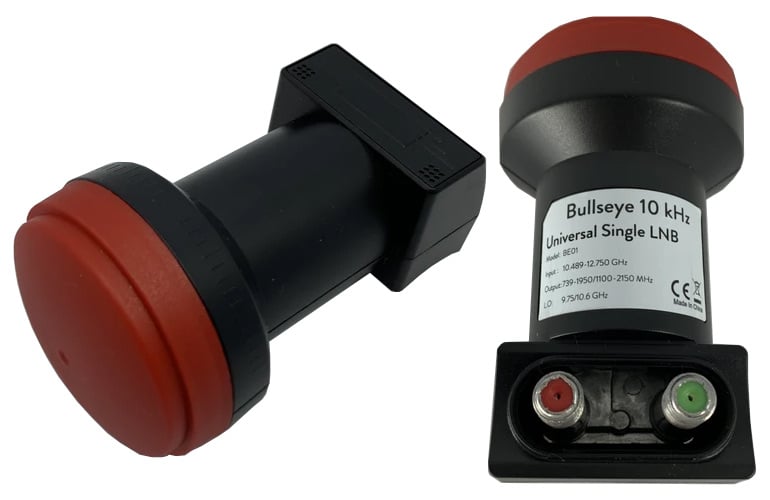
The Othernet TCXO Ultra Stable LNB for QO-100 and Ku-Band Satellites

The official product details read:

The Bullseye LNB is the world's most precise and stable DTH/consumer Ku-band down converter. Even a VSAT LNBF costing hundreds of dollars more is no match for the performance of the Bullseye 10K LNB. Each unit is calibrated at the factory to within 1 kHz of absolute precision against a GPS-locked spectrum analyzer. Under outdoor conditions, the stability of the LNB is well within 10 kHz of offset. As a bonus feature, the  Bullseye 10K provides access to its internal 25 MHz TCXO through the secondary F-connector. This reference output can be used to directly monitor the performance of the TCXO over time. 

Features

  • Bullseye 10 kHz BE01
  • Universal single output LNB
  • Frequency stability within 10 kHz in normal outdoor environment
  • Phase locked loop with 2 PPM TCXO
  • Factory calibration within 1 kHz utilizing GPS-locked spectrum analyzers
  • Ultra high precision PLL employing proprietary frequency control system (patent pending)
  • Digitally controlled carrier offset with optional programmer
  • 25 MHz output reference available on secondary F-connector (red)

Specifications 

  • Input frequency: 10489 - 12750 MHz
  • LO frequency 9750/10600 MHz
  • LO frequency stability at 23C: +/- 10 kHz
  • LO frequency stability -20 - 60C: +/- 30 kHz
  • Gain: 50 - 66 dB
  • Output frequency: 739 - 1950 MHz (low band) and 1100 - 2150 (high band)
  • Return loss of 8 dB (739 - 1950 MHz) and 10 dB (1100 - 2150 MHz)
  • Noise figure: 0.5 dB

We note that an external bias tee power injector is required to power the LNB as it requires 11.5V - 14V to operate in vertical polarization and 16V - 19V to operate with horizontal polarization. The bias tee on the RTL-SDR Blog V3 outputs 4.5V so it is not suitable.

There has also been an excellent review by @F4DAV and a video review by Techminds which we show below.

Ultra Stable Bullseye LNB For QO-100 Es Hail2 10 kHz

A Hydrogen Line Radio Telescope made from a Homemade Helical Antenna and RTL-SDR

Thank you to Geoff for submitting his experience with creating a hydrogen line radio telescope out of an easy to build helical antenna, Raspberry Pi, LNA and an RTL-SDR. The Hydrogen Line is an observable increase in RF power at 1420.4058 MHz created by Hydrogen atoms. It is most easily detected by pointing a directional antenna towards the Milky Way as there are many more hydrogen atoms in our own galaxy. This effect can be used to measure the shape and other properties of our own galaxy.

Earlier in the year we uploaded a tutorial showing how to observe the Hydrogen line with a 2.4 GHz WiFi antenna. In Geoff's setup he used a home made Helical antenna instead. This antenna is basically a long tube with a spiral wire element wrapped around the tube. He also shows how he needed to impedance match the antenna with a triangular piece of copper tape. The result is a directional antenna with about 13 dBi gain. To complete his setup he used a NooElec SAWBird H1+ LNA/Filter, an RTL-SDR Blog V3 dongle and a Raspberry Pi.

The results show a clear increase in RF power at the Hydrogen line frequency when the antenna points at the Milky Way, indicating that the setup works as expected. It's good to see a Helical working for this, as it is fairly light weight and could easily be mounted on a motorized mount to scan the entire sky.

A Hydrogen Line Radio Telescope made with a Helical Antenna.

The YouLoop Passive Loop Antenna Reviewed on HF Reception

Thank you to Robin from the "Frugal Radio" channel on YouTube for submitting his latest video which is a review of the Airspy YouLoop antenna that we currently have for sale on our store for $34.95 including shipping.

The YouLoop is a low cost passive loop antenna for HF and VHF. It is based on the Möbius loop design which results in a high degree of noise cancelling. However the main drawback is that it is a non-resonant design, which means that it needs to be used with ultra low MDS receivers like the Airspy HF+ Discovery. However, a high performance HF pre-amp will be available in the future which will allow it to work well with other radios too.

In his video Robin tests the YouLoop on the HF bands with an Airspy HF+ Discovery and he demonstrates excellent noise free reception from his location. In terms of his setup he notes:

I am running Spyserver on a 10 year old Windows 7 laptop in the loft. The same laptop is also running 3 x SDRSharp instances (following 2 digital trunking systems). It runs 4 x  simultaneous Zello instances each providing a high quality audio feed to my Network Radio / phone.
 
In terms of noise-creating equipment nearby, there is
  • a second laptop used for other duties
  • a Pi 3B used for ADS-B reception, feeds & a second instance of spyserver 
  • a Pi 3A with MMDVM module performing as a hotspot
  • a Motorola HT charger
  • 5 x base station scanners
This means there are 10 x switched mode power supplies constantly running, as well as 4 x 24/7 WiFi devices.
All this equipment is within 10ft of the YouLoop antenna, was one of my primary reason for choosing a passive loop. 
 
Since making the video, cable clips have been added provide support to the antenna which means it is now in the correct shape of a loop.  That means I am unable to rotate the antenna to make use of the nulls when receiving. However I am very pleased with the performance based on the location, noisy environment, and frugal pricing :-)
$35 Airspy YouLoop Passive Antenna Review : tested on HF using Airspy HF+ Discovery SDR

RTL-SDR Blog V3 Units and Antennas Back in Stock at Amazon (Local US Stock)

Just a note that our RTL-SDR Blog V3 units and antennas are now back in stock at Amazon.com with local US stock. There were a few manufacturing and shipping delays related to COVID-19 so they had been out of stock for a couple of months. Currently they are being fulfilled via our partners based in Chicago, and all orders will ship out within 2-business days via USPS First Class. We will look at replenishing the the Amazon Prime warehouses in a few weeks and at the moment we are only shipping to US customers from Amazon. US customers can also order directly from our store at www.rtl-sdr.com/store and this will result in the shipping fee being waived.

If you are based elsewhere in the world, please order directly from our store at www.rtl-sdr.com/store which ships non-US orders direct from our warehouse in China. Alternatively some countries might benefit from our Aliexpress store, which can now utilize the reliable Aliexpress Standard Shipping line.

Our RTL-SDR Blog V3 is an improved RTL-SDR dongle. It includes features like a TCXO, SMA port, software switchable bias tee, built in HF direct sampling mod, aluminum enclosure, improved ESD protection, improved cooling via thermal pad and many other design improvements. The kit comes with a multipurpose dipole antenna which is extremely versatile. It can be used as a standard vertical dipole for terrestrial signals, or can be mounted horizontally in a V-Dipole configuration for NOAA/Meteor LEO weather satellites. It's also easy to mount outdoors through a window for best reception with two mounting solutions included. 

Amazon Links

RTL-SDR Blog V3 Dongle + Multi Purpose Dipole Antenna Set

RTL-SDR Blog V3 Dongle Only

Multi Purpose Dipole Antenna Set Only

RTL-SDR Blog Store

We are also shipping any US orders made from our Worldwide store via our local stock. If you order directly from us you can save $1.99 on shipping.

RTL-SDR Blog Store

Features of the RTL-SDR Blog V3.
The RTL-SDR Blog V3 Set. Includes RTL-SDR V3 dongle, and multipurpose dipole antenna kit.

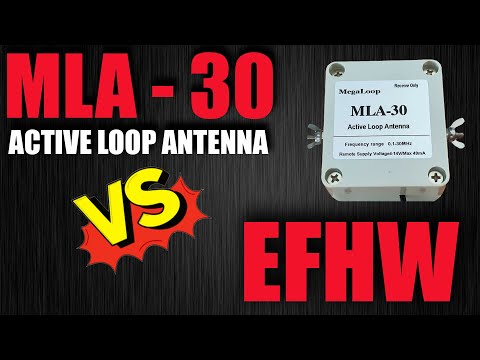
The K-180WLA: A New Low Cost Battery Powered Active Loop Antenna

We've recently seen a few submissions about a new low cost active magnetic loop antenna called the K-180WLA which sells for around US$50 - US$60 over on eBay and Aliexpress. While it appears to be very similar to the well known MLA-30 loop, it's main defining feature is that it's power feeder is battery powered via a built in Lithium ion cell which would make it useful for portable operation. It also advertises a wide usable frequency range of 0.1 - 180 MHz with an amplified gain of 20 dB. They note it can also be pushed up to 450 MHz with reduced gain of 8.9 dB. The battery run time or power draw is not advertised. They write:

  • The P.BOX feed box has a built-in 3.7V 18650 flat-head lithium battery with integrated power supply module. It is the only active antenna that does not require an external power supply and integrates a charge management chip. The MICRO USB charging port is compatible with the 5V charging head of Android phones. And charging cable, very easy to use.
  • UHF low-noise preamplifier is used. The gain flatness is very good within the ultra-wide operating frequency of 0.1-180MHZ. It provides a gain of about 20DB, even when working to 450MHZ gain, there is still about 8.9DB.
  • The receiving frequency covers long wave, medium wave, short wave, FM broadcasting band and VHF aviation band. The small ring diameter 55CM is simple to set up. It can be set up outside the window, balcony, terrace and roof. Lovers erected.
  • All the screws of the antenna are made of 304 stainless steel, and the preamplifier box is fully waterproof, which can be used for long-term outdoor wind and rain.
  • Suitable models include Desheng S-2000 PL-660 PL-880 ICOM R71E YAESU FRG-8800 and all short-wave receivers, especially for SDR receivers.

    Note:

    The antenna is equipped with a dual SMA male adapter cable, an SMA to 3.5 plug adapter cable, and an S2000 BNC adapter, which means that your radio can be used with SMA female, BNC, and 3.5 jacks. Requires additional accessories. Receivers and radios with other interfaces need their own adapters.

We've ordered a unit and plan to compare it against the MLA-30, Wellbrook and YouLoop (with optional HF amplifier that is to be released soon) in a future post. This loop is also being discussed over on the SWLing Post Blog.

The K-180WLA Loop Antenna

Receiving SMOG-P and ATL-1 Nano Satellites with an RTL-SDR

Thank you to Zoltan Doczi (HA7DCD) for submitting his tutorial that shows how to receive signals from the SMOG-P and ATL-1 nano satellites which were launched via Rocket Lab back in late 2019.

SMOG-P is a Hungarian nano satellite developed by BME University. It's payload consists of an on board spectrum analyzer that is designed to measure electromagnetic pollution (electrosmog) from space, and to also monitor the DVB-T spectrum. It currently holds the title of the world's smallest satellite in operation.  ATL-1 is another Hungarian satellite this time developed by ATL Ltd. Its mission is to test a new thermal isolation material in space and to monitor the DVB-T spectrum.

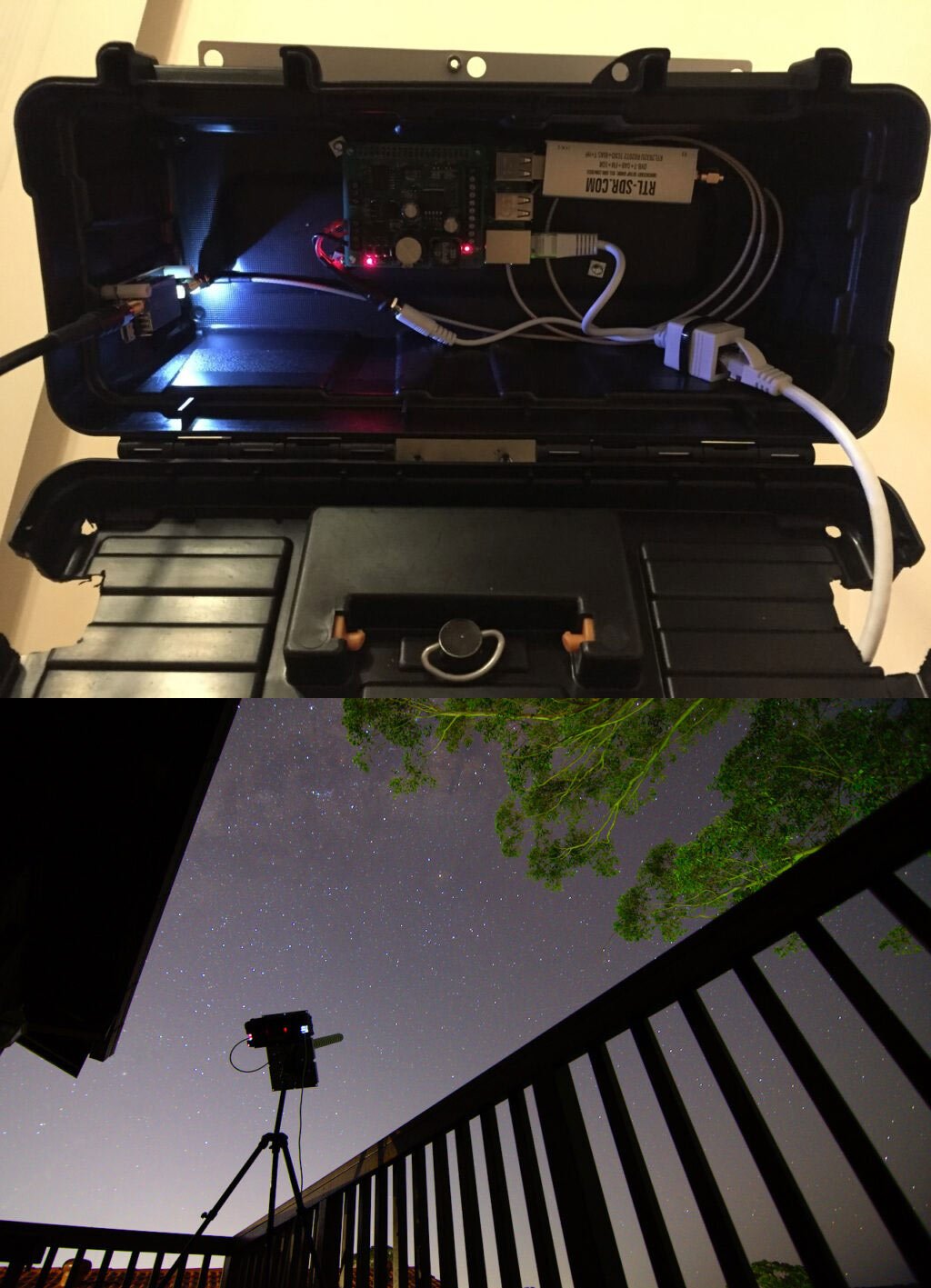
To receive telemetry from these satellites you can use a Raspberry Pi, RTL-SDR, Yagi, and optionally an LNA and filter. In his post Zoltan shows how to install the SMOG-P decoder, and provides a script that automatically decodes, uploads packets to the BME University server, and archives old IQ files and packets.

We note that if you wish to receive these satellites, now is the time to do so as these nano satellites are in a very low orbit and only have an orbital lifespan of only 6-8 months total.

SMOG-P and ATL-1 Satellite Ground Station Receiver Setup