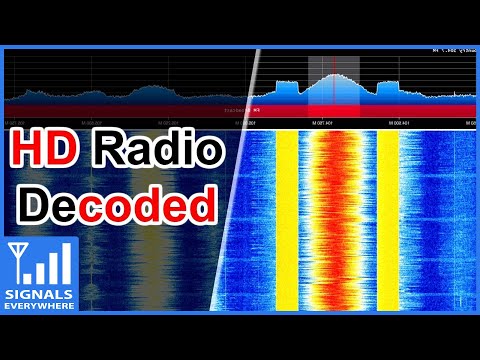
Corrosive (KR0SIV) from the SignalsEverywhere YouTube channel has uploaded a new video that explains and shows HD radio being decoded with an RTL-SDR.
If you are in the USA, you might recognize HD (Hybrid Digital) Radio (aka NRSC-5) signals as the rectangular looking bars on the frequency spectrum that surround common broadcast FM radio signals. These signals only exist in the USA and they carry digital audio data which can be received by special HD Radio receivers. Back in June 2017 we posted about how [Theori] was able to piece together a full HD Radio software audio decoder that works in real time. Later developments saw additional data such as traffic data and weather info extracted from HD Radio too.
Corrosive's video also shows a comparison between analog and HD Radio audio. We note that the "HD" doesn't stand for high definition, so audio quality is not really better than the analog stream. He also notes that the HD Radio data stream can contain multiple audio channels, and often they are not the same as the analog station it surrounds. One example he shows is a Simulcast AM radio station being rebroadcast via HD Radio.
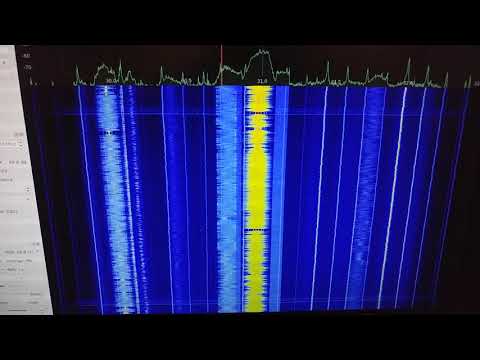
Over on YouTube user Tech Addict Attic has uploaded a video demonstrating what lightning strikes look like on the radio spectrum. To receive the pulses he uses an RTL-SDR and a simple wire antenna located on his roof. He notes that the pulses show up at HF frequencies, and continue all the way up to the broadcast FM band and above.
When lightning strikes it emits a wideband RF pulse that can be detected several miles away by radios. On a software defined radio spectrum display the pulse shows up as a quick horizontal blip. Detecting this blip is how lightning detection websites like blitzortung.org work, although they use their own radio hardware.
In the past we posted about another user who also demonstrated lightning pulses using his RTL-SDR V3.
It is well known that almost all electronic devices unintentionally emit unique spurious RF signals when in operation. By using an SDR like an RTL-SDR to record the spectra from electronic devices, it's possible to build up a database of known emissions. We can then detect when an electronic device is active by comparing the live spectrum to spectra stored in the database.
In a previous post we covered Disney's EM sense which is an experimental smart watch that automatically detects what electronic device the wearer is touching. With EM Sense they use an RTL-SDR and a database of raw pre-recorded spectrum data. To detect what the wearer is touching the live signal from the RTL-SDR is correlated against the database, and the closest match is returned.
José's script does something very similar, however instead of correlating with raw spectrum data he instead uses the waterfall image that is generated by rtl_power and heatmap.py. The rtl_power program allows an RTL-SDR to scan the frequency spectrum over a wider bandwidth by rapidly scanning ~2.4 MHz chunks of bandwidth at different frequencies. Heatmap.py is a program that turns the scanned data from rtl_power into a heatmap image of the spectrum.
To add an entry to the database, the electronic device is placed 7-8 centimeters away from the RTL-SDR, and a heatmap image recorded between 24 - 921 MHz is saved to disk. This can be repeated for multiple electronic devices. Each image will record the spurious signals from the electronic device, resulting in a unique heatmap image per electronic device.
Once the database has been created, you can then place any of the devices found in the database next to the RTL-SDR, and record a heatmap for 20-30s. That heatmap will then be compared against the images in the database using imagemagick which is an image analysis and manipulation library. The electronic device associated with the closest matching image in the database will be returned.
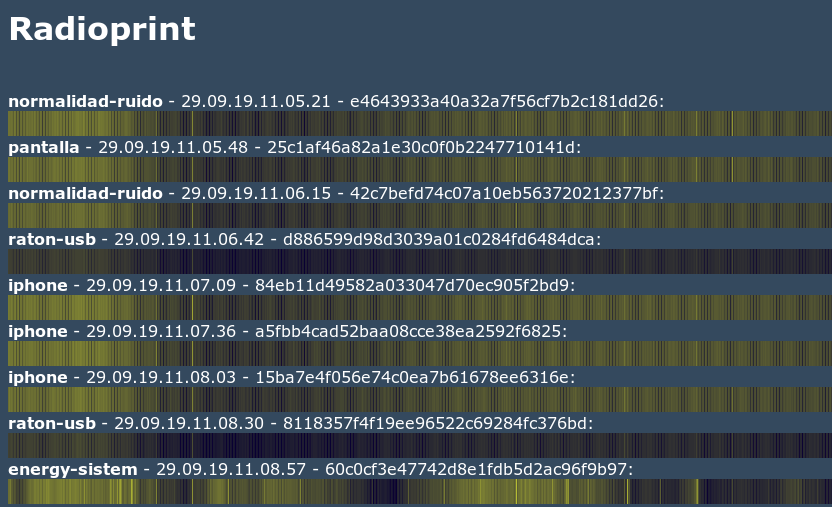
In his experiments he tested various electronic devices like an iPhone and was able to successfully determine when it was nearby.
Various electronic device spectra waterfall images recorded in the database
Recently we came across Electrosense which is an interesting open source project that aims to deploy radio spectrum sensors worldwide in order to analyze and understand radio spectrum usage. This information could be extremely valuable in order to make more efficient use of the limited radio spectrum, and for detecting sources of interference and illegal transmissions. The hardware that Electrosense uses consists of just an RTL-SDR, Raspberry Pi, antenna and an optional GPS for time synchronization.
The ElectroSense network is a crowd-sourcing initiative to collect and analyse spectrum data. It uses small radio sensors based on cheap commodity hardware and offers aggregated spectrum information over an open API.
The initiative's goal is to sense the entire spectrum in populated regions of the world and to make the data available in real-time for different kinds of stakeholders which require a deeper knowledge of the actual spectrum usage.
ElectroSense is an open initiative in which everyone can contribute with spectrum measurements and access the collected data.
Overview of the Electrosense network
There are already several spectrum sensing projects in the works by big companies like Google, Microsoft, and IBM, but these only cover a small portion of the spectrum, or use high cost sensing stations limiting their ability to be deployed on a wide scale. Electrosense solves these problems by using low cost RTL-SDRs, and a crowd sourcing paradigm.
At the time of writing there are 103 sensors registered to the Electrosense network, with 23 being online, most of which are in Europe. Once you register an account on their site, you can browse the active sensors. Clicking on the spectrum button for a sensor brings up a live spectrum graph. For example in the screenshot below we access the data from an RTL-SDR + downconverter sensor in Madrid. We're able to see a live wideband 20 MHz to 6 GHz spectrum scan, and graphs of frequency occupancy rates.
Electrosense Active SensorsElectrosense Spectrum Scan and Occupancy Graphs
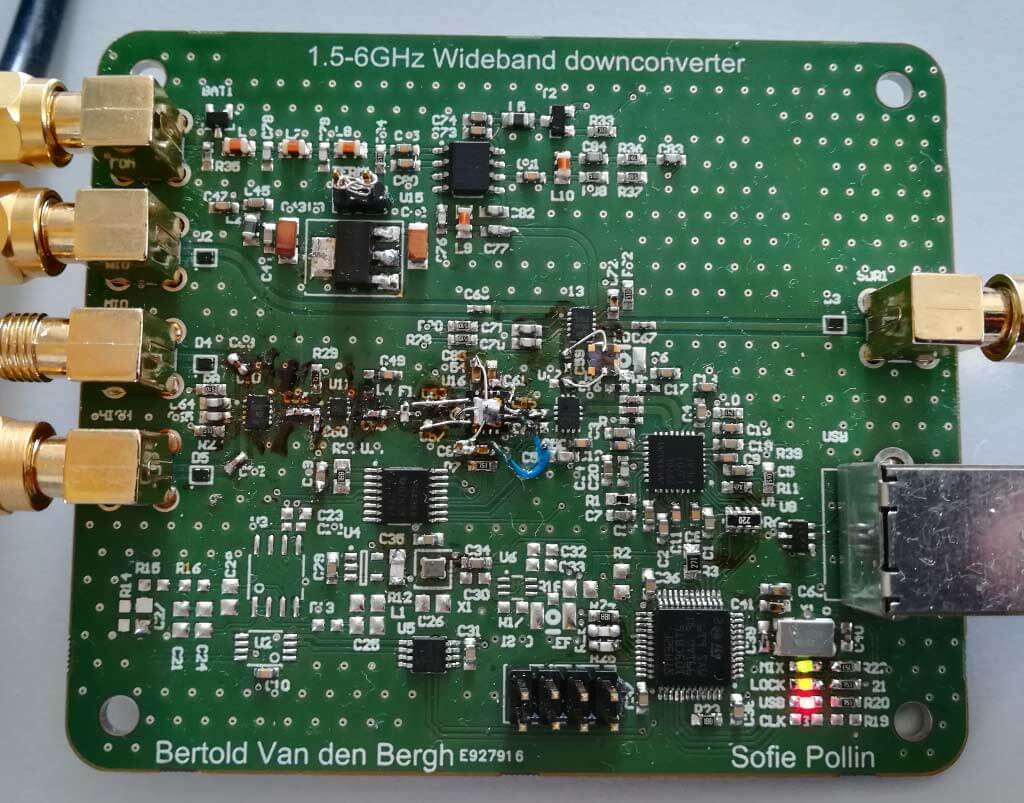
In addition to the standard SDR hardware being used, they've also designed a very interesting open hardware/source DC to 6 GHz up/downconverter board. The board is USB controlled, and switches between the upconverter for the lower HF bands, pass through for receiving DC- 1.6 GHz, and the downconverter for receiving up to 6 GHz. It has a 20 MHz output bandwidth which means that wide band SDRs can also make use of it.
Electrosense Up/Downconverter
The Electrosense website notes that anyone can host a sensor, and if you meet their criteria (permanent internet connection, ethernet connectivity and a low interference location) you can apply for a free kit. If you aren't selected for a free kit, then the Jetvision store based in Europe is selling Electrosense kits that include an RTL-SDR Blog V3, Raspberry Pi 3, power supply, SD card with preinstalled Electrosense software, and either our multipurpose dipole antenna, or a wideband discone with 15m of low loss cable for roof mounting.
The Electrosense team have been working hard on this project and have already published several related papers and a magazine article about the Electrosense network and it's use cases. One interesting paper discusses a method for decoding wideband signals using a network of non-coherent RTL-SDRs. Another paper discusses using using deep learning for automatic signal classification. The full list of publications can be found on their publications page.
If you're interested in this type of crowd sourced spectrum project, then you might also want to take a look at the KiwiSDR which is a networked 0 - 30 MHz SDR. Multiple crowd sourced KiwiSDR's can be used in a TDoA calculation for determining transmitter locations.
Over the last several months we've been working on a versatile active L-band patch antenna that can cover Inmarsat to Iridium satellite frequencies. That antenna is now almost ready, and should be able to ship out from our Chinese storage warehouse by week 1 or 2 of October NOTE: Due to an unfortunate Typhoon near the factory in Taiwan, and the Chinese National Week long holidays and Taiwan National day we are expecting them to ship out in week 3 or 4 of October now. Apologies for the delays. No other components like filters or amplifiers are required to be able to use this antenna, as it is an all in one system.
The expected price will be US$39.95, but right now we're releasing it for a discounted PREORDER price of US$34.95 incl. free shipping.
Preorder sale has ended. Please see our store to order.
Your preorder will ship out as soon as it's stocked in the warehouse in China. If you prefer to wait we'll also have this product on Amazon (at retail $39.95) about 2-3 weeks after it is stocked in our Chinese warehouse.
The antenna is based on the active (low noise amplified with built in filter) ceramic patch design that was used by Othernet (aka Outernet), back when they had their L-band service active. We've asked them to modify the antenna to cover a wider range of frequencies, and include an enclosure that allows for easier mounting.
The antenna is 3.3 - 5V bias tee powered, so you will need a bias tee capable RTL-SDR like our RTL-SDR Blog V3, or a 5V external bias tee. It draws about 20-30mA of current, so it is compatible with other SDRs like the SDRplay, HackRF and Airspy too.
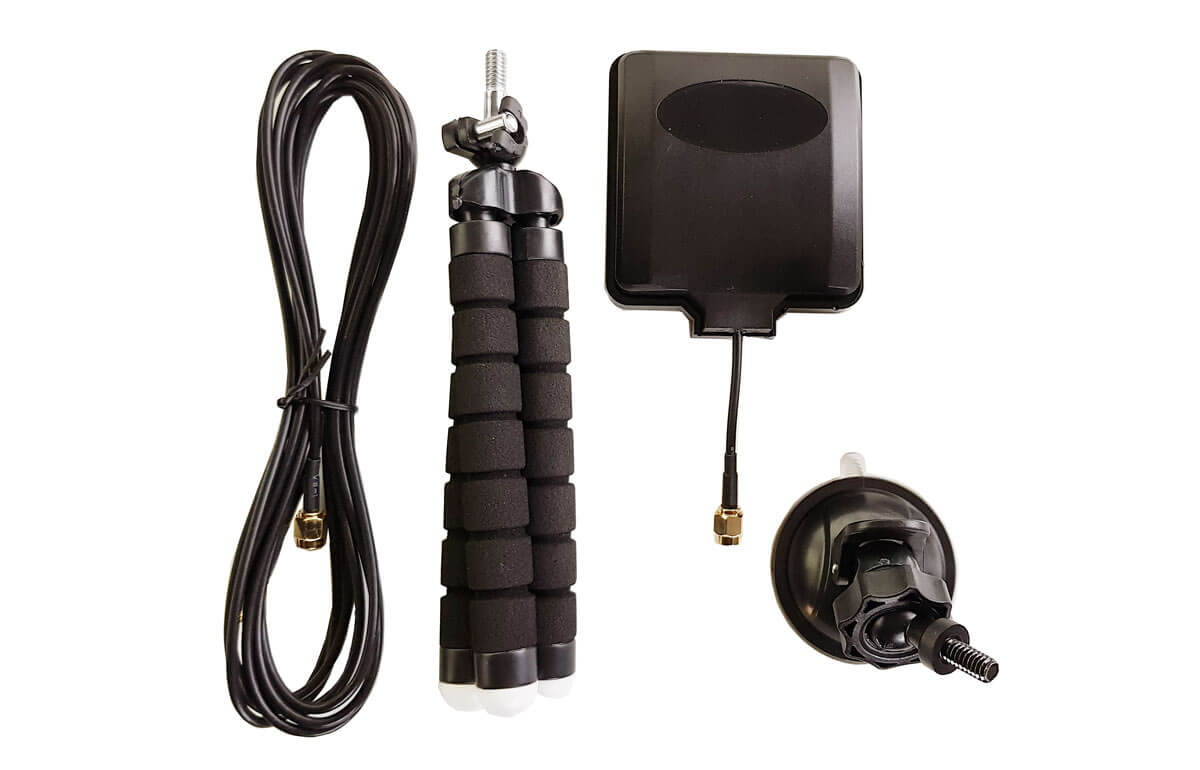
With this antenna we've paid close attention to the mounting solutions. One major difficulty with these patch antennas is finding a convenient place to mount them. The patch is designed with a built in 1/4" camera screw hole, so any standard camera mount can be used. In the kit we're including a window suction cup, a flexible tripod and 2 meters of RG174 cabling to help with mounting. Your own longer coax cabling can be used, however we'd recommend using lower loss cabling like RG59/58 or RG6 for anything longer than 3 meters.
The patch is also fully enclosed in an IP67 weather proof plastic case, so it can be kept mounted outdoors in the rain.
The RTL-SDR Blog L-Band Satellite Patch Antenna SetWays to mount the patch antenna
Performance
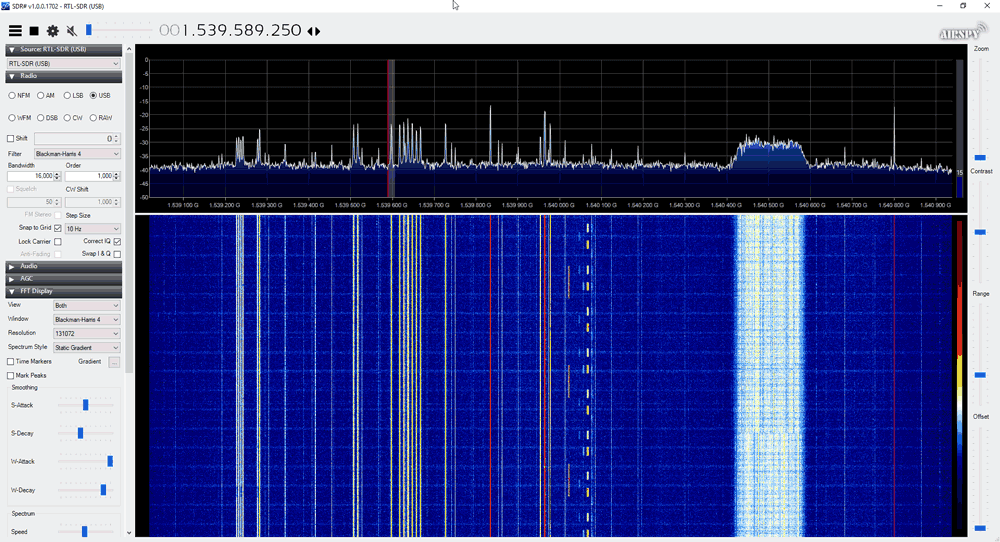
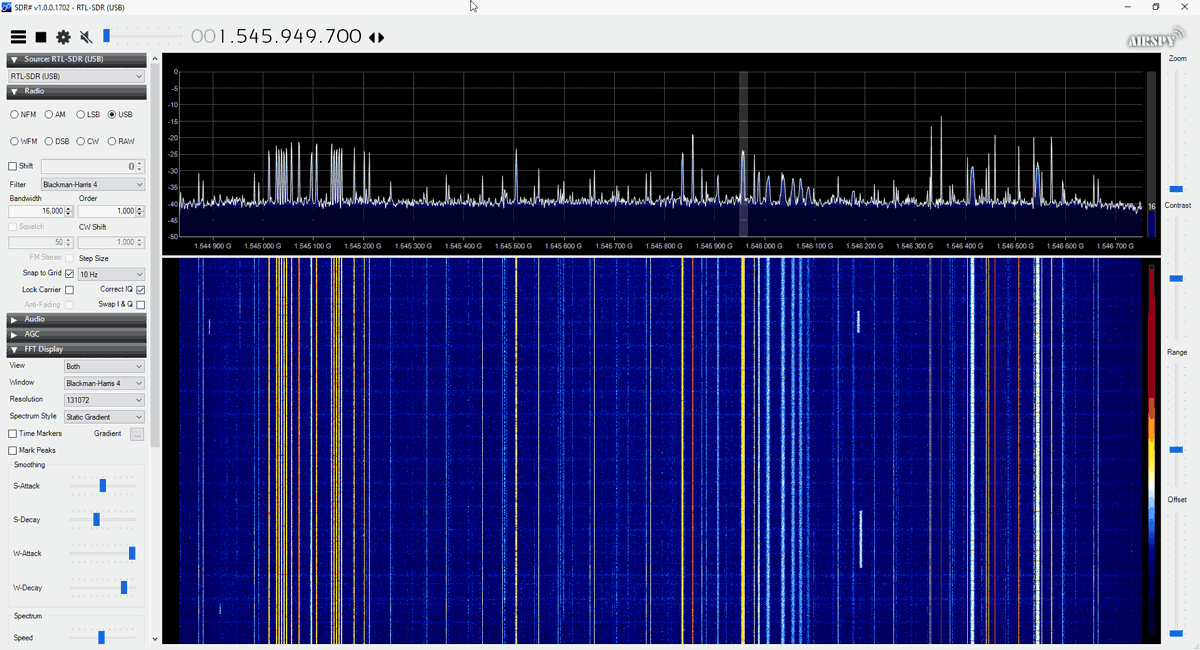
With the patch receiving AERO, STD-C and GPS should be a breeze. Simply point up at the sky, or towards the Inmarsat antenna, apply bias tee power and receive. Below are some sample screenshots showing reception.
The patch is designed to be used with a 1m+ length of coax cable. It may perform poorly if the RTL-SDR is placed right at the antenna due to interference.
If receiving Inmarsat, the patch antenna should ideally be angled to face the satellite.
Rotate the patch until the signal strength is maximized. Rotating the patch optimizes the polarization of the antenna for the satellite and your location. NOTE: Using the wrong orientation could result in 20 dB attenuation, so please do experiment with the rotation.
You can also use the patch on a flat surface for Inmarsat (and rotate for best reception), but signal strength may be a little reduced. Depending on your location and the satellites elevation it should still be sufficient for decoding.
For receiving Iridium and GPS signals you can use the antenna flat, pointing straight up towards the sky. Try to get it seeing a clear view of the sky horizon to horizon to maximize the satellites that it can see.
If you happen to have a very marginal signal, you can clamp on a flat sheet of metal behind the patch antenna for improved performance.
AERO C-Channel: C-Channel transmissions are at 1647-1652 MHz which are outside of the advertised range of this antenna. However, the filter cut off is not that sharp, and you may be able to get results, although we cannot guarantee this. (If you want to test this for us and can demonstrate that you can receive C-Channel already, please contact us at [email protected] for a sample)
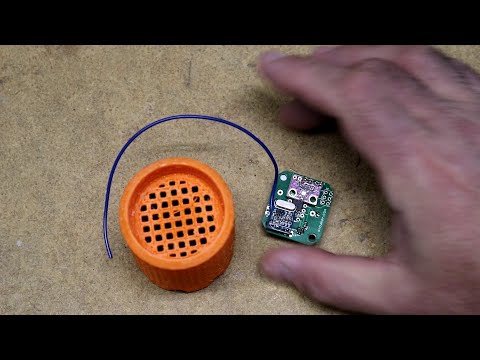
To keep them away from humid air Scott uses "PrintDry" plastic vacuum canisters. Unfortunately he found that the vacuum sealing system wasn't perfect, and that some canisters would lose their vacuum after a few days. In order to ensure that the canisters were properly sealed he decided to add some active monitoring with pressure and humidity sensors and a wireless transmitter.
His monitoring system consists of a cheap 315 MHz ISM band transmitter, ATTINY85 microcontroller and pressure + humidity sensor. To receive and monitor the data he uses an RTL-SDR that runs the rtl_433 software, which is a program that is capable of decoding many different types of wireless ISM band sensors.
DIY Wireless Temp/Humid/Pressure sensors for measuring vacuum sealed 3d printed filament containers
Over on YouTube user JellyImages has uploaded a video demonstrating his Windows based ARESrcvr software. ARES is a railway control communications protocol used by some trains in the USA. His code connects to an RTL-SDR dongle, and demodulates the ARES protocol, providing decoded packets to ATSCMon via UDP on localhost.
ATSCMon allows you to view train telemetry data, and see on a rail map where that control indication came from. It appears that ATSCMon actually already supports ARES decoding via audio piping, but the decoder by JellyImages is a cleaner solution that doesn't require audio piping. In the past we've posted about one other YouTube user whose uploaded videos on using ATSCMon to monitor trains [Post 1][Post 2].
JellyImages also notes that his software only supports the ARES protocol which is used mostly around former Burlington Northern (BN) territory in the USA.
The NanoVNA is an open source VNA project by @edy555 and ttrftech that has recently become extremely affordable at less than US$50 for a fully assembled unit thanks to Chinese manufacturing (or a little more if you order it via Amazon).
Ohan Smit had recently been playing with the NanoVNA and came across a software package from Rune B. Broberg (5Q5R) called NanoVNASaver. NanoVNASaver is an open source program that can be used to read and plot data from the NanoVNA. It has some nice features like the ability to display multiple charts, increase the resolution up to 10k points, measure cable length via TDR calculations, save Touchstone files and more.
Testing our RTL-SDR.COM BCFM Bandstop filter with a NanoVNA and the NanoVNASaver Software.
Later in the same post Ohan also includes an update about his experiments with some new experimental NanoVNA firmware that extends the maximum frequency range from the previous maximum of 900 MHz up to 1500 MHz. Results show that while it can work up to 1500 MHz, accuracy rapidly degrades above 900 MHz.