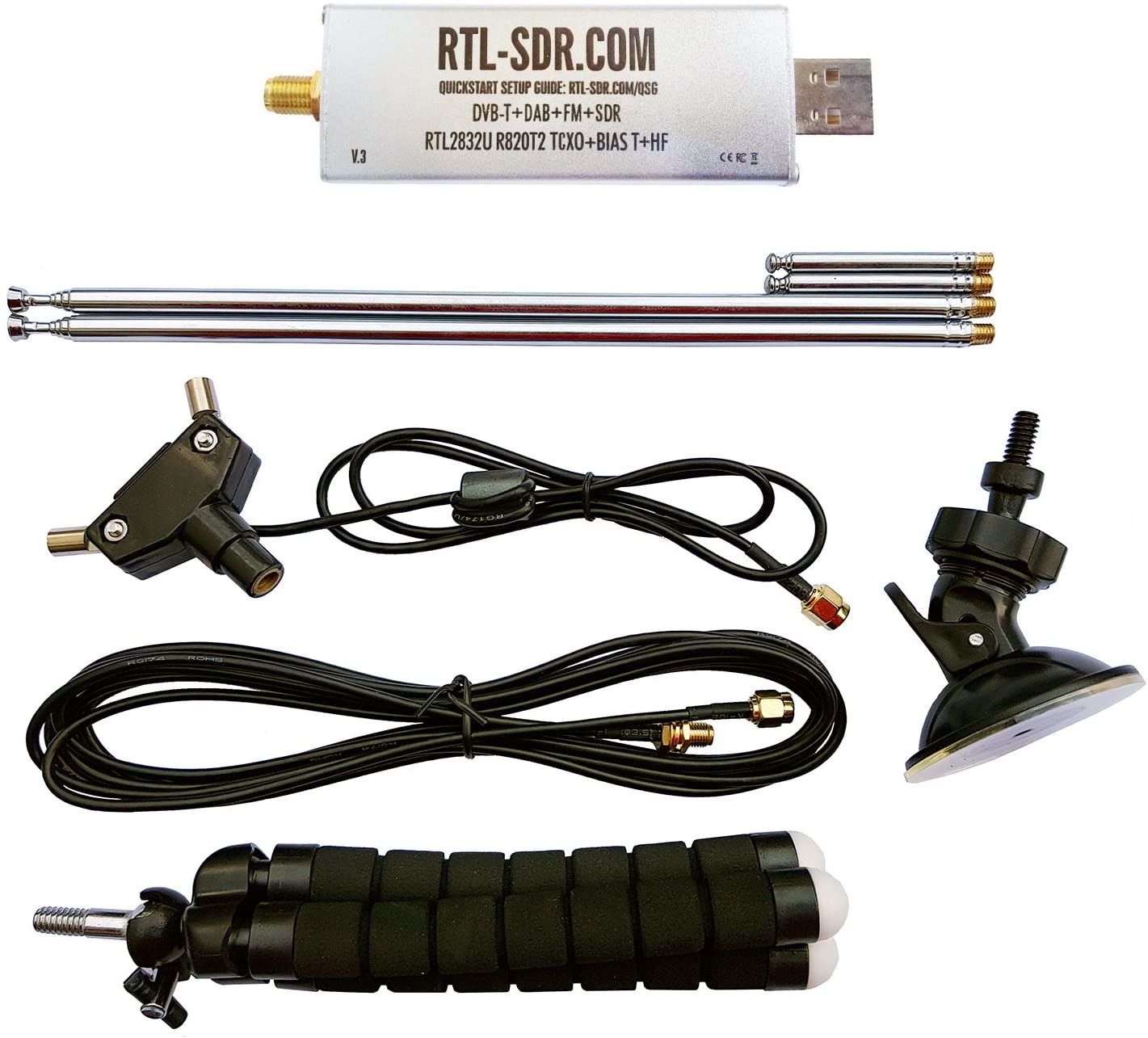
Just a note that our RTL-SDR Blog V3 units and antennas are now back in stock at Amazon.com with local US stock. There were a few manufacturing and shipping delays related to COVID-19 so they had been out of stock for a couple of months. Currently they are being fulfilled via our partners based in Chicago, and all orders will ship out within 2-business days via USPS First Class. We will look at replenishing the the Amazon Prime warehouses in a few weeks and at the moment we are only shipping to US customers from Amazon. US customers can also order directly from our store at www.rtl-sdr.com/store and this will result in the shipping fee being waived.
If you are based elsewhere in the world, please order directly from our store at www.rtl-sdr.com/store which ships non-US orders direct from our warehouse in China. Alternatively some countries might benefit from our Aliexpress store, which can now utilize the reliable Aliexpress Standard Shipping line.
Our RTL-SDR Blog V3 is an improved RTL-SDR dongle. It includes features like a TCXO, SMA port, software switchable bias tee, built in HF direct sampling mod, aluminum enclosure, improved ESD protection, improved cooling via thermal pad and many other design improvements. The kit comes with a multipurpose dipole antenna which is extremely versatile. It can be used as a standard vertical dipole for terrestrial signals, or can be mounted horizontally in a V-Dipole configuration for NOAA/Meteor LEO weather satellites. It's also easy to mount outdoors through a window for best reception with two mounting solutions included.
The yearly GNU Radio Conference (GRCon) is a conference all about the development of GNU Radio and projects based on GNU Radio. GNU Radio is an open source digital signal processing (DSP) toolkit which is often used in cutting edge radio applications and research to implement decoders, demodulators and various other SDR algorithms.
This years 2020 GNU Conference is to be the 10th one ever held and was supposed to take place in Charlotte, NC. However due to the ongoing pandemic the organizers have now decided that it will be held entirely online this year. The starting date is September 14 and the talks and events will probably run for several days. All talks will be streamed for free, however, registering for US$50 will get you access to the live workshops and other events.
There is a great line up of keynote speakers, and if you have a talk that you'd like to submit, submissions are now open. For ideas on what GNU Radio talks are like, you can see full recordings from previous GNU Radio conferences on their YouTube channel playlists.
GNU Radio Conference (GRCon) is the annual conference for the GNU Radio project & community, and has established itself as one of the premier industry events for Software Radio. It is a week-long conference that includes high-quality technical content and valuable networking opportunities. GRCon is a venue that highlights design, implementation, and theory that has been practically applied in a useful way. GRCon attendees come from a large variety of backgrounds, including industry, academia, government, and hobbyists.
GRCon20 will be held starting September 14, 2020 online as a virtual event. The organizing team is hard at work to create a fun and interactive experience.
Our keynote speakers include: Becky Schoenfeld W1BXY, managing editor of QST magazine, Oona Räisänen [ windytan ] hacker of signals and computer programmer, and Jim St. Leger, Director Open Source, Intel.
With an annual program that has broad appeal, GRCon attracts people new to Software Radio just looking to learn more, experts that want to keep their finger on the pulse & direction of the industry, and seasoned developers ready to show off their latest work.
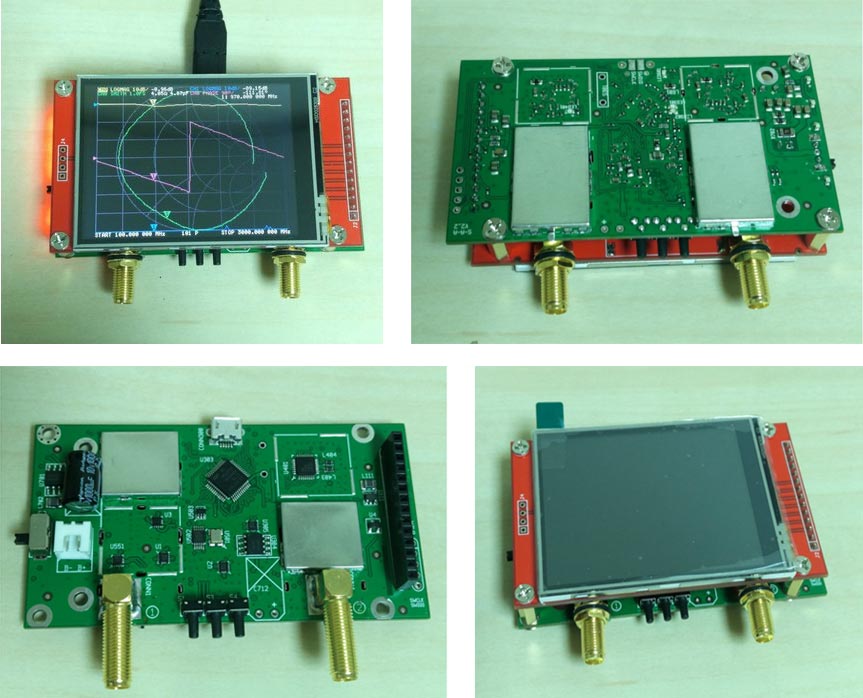
We've received a few notices that the NanoVNA V2 design that we've been following since last year is now available for sale on eBay and Tindie (or Taobao if you live in China). The original official sales appear to have been from Tindie, where it is priced at $58.25 + shipping, although it is now out of stock. On eBay resellers are selling it for up to $150. If you're interested in purchasing the V2 we recommend entering your email into the Tindie form as they will notify you when it's back in stock. Initial reviews posted on the Tindie store indicate that the unit has excellent performance for the price so we expect that it will be popular enough to manufacture many more in the future.
The original NanoVNA brought expensive Vector Network Analyzer (VNA) capabilities to the masses with it's low $40 pricing. A VNA is an extremely useful tool for radio hobbyists as it allows you to tune antennas, filters and measure cable loss among other applications. However, the original design was limited to only a frequency of 900 MHz maximum. The new design pushes this up to 3 GHz official, and unofficially up to 4.4 GHz whilst also improving dynamic range and maintaining the low price point.
The description and specs of the NanoVNA V2 are shown below:
3GHz second generation NanoVNA vector network analyzer, designed in collaboration with OwOComm.
Note: Micro USB cable not included. Fully assembled, without enclosure. Ships within 5 business days.
AFEDRI have recently begun shipping their new software defined radio called the "LAN-IQ". The LAN-IQ is a full standalone SDR with good advertised specifications and a very decent price of only US$339. The advertised specs from the Afedri LAN-IQ website are pasted below:
LAN-IQ SDR is stand-alone, direct sampling Software Defined Receiver (see picture above) it has ability to send it's received I/Q stream in three different modes:
Stand-Alone (Digital processing, filtering , decoding is implemented inside SDR)
Network (LAN)
USB
LAN-IQ SDR has the following specification:
Frequency Coverage: 0.03MHz-35MHz & 35MHz-1700MHz
Noise Figure: ~11dB (for 1MHz-35Mhz range and maximum RF gain 35dB)* *input VGA (Variable Gain Amplifier) has variable Gain from -10dB up to +35dB
Noise Figure: ~3.5dB (for 50MHz-435Mhz range and maximum LNA/MIX gain )
MDS: -136 dBm at 500Hz bandwidth (0.03MHz-35MHz)
MDS: -143.5 dBm at 500Hz bandwidth (50MHz-435Mhz)
Output data format: two 16-bit I/Q channels (audio stereo stream emulation)
Maximum Receiving Bandwidth:
BW = up to 2200kHz (for 2400kHz sample rate) - using Network connection
BW = up to 706kHz (for 768kHz sample rate) - instand-alone mode
BW = up to 230kHz (for 250k samples/s sample rate) - using USB connection
RF ADC sampling rate: 76.800 MHz
Power Supply Voltage Requirements:
5V (supplied from the PC's USB bus or from external) or from external power supply able to provide 5VDC +/-0.2V).
7.0-10V DC to the DC power connector.
Power Supply Current Requirements:
up to 850mA (max. LCD brightness, network cable connected, VHF/SHF band)
The LAN-IQ SDR is designed to be used in stand-alone mode , i.e. without need to use any additional computer and software.
In same time the SDR can be connected and used with Personal Computer (PC) by two interfaces:
1. Ethernet Network connection.
This can now provide up to 2400 kHz sample rate
2. Full Speed USB
From PC point of view, the SDR-Net can be used alternatively as:
1. Network device using two IP protocols: TCP and UDP.
TCP protocol is used to control the SDR parameters.
UDP protocol is used to send received I/Q stream from SDR to PC
2. Or exactly like the AFEDRI SDR-Net -USB Composite Device, that contains two USB functions:
Generic USB Audio device - to transfer baseband I/Q signal, as an audio stereo stream
From the Afedri Groups.io forum we've learned that by default the unit will come without the tuning knob, but a knob can be requested if preferred, although it comes with some limitations.
Ordering of the LAN-IQ is done via email only, and the email address can be obtained at the end of their ordering page. They accept PayPal, and shipping costs anywhere from $18 - $32 depending on the country. Also regarding shipping they note that deliveries may be delayed due to COVID-19 which is of course the case for every global delivery right now.
From the SWLing Post blog post we've also learned of a short demonstration video created by Fenu-Radio which is shown below. We are also awaiting his full review which will be posted on fenu-radio.ch.
Afedri LAN-IQ in Action
In a second video Fenu-Radio compares the LAN-IQ against the Malahit-DSP which is another similar low cost standalone SDR which we posted about back in November 2019.
SDRplay have recently released an update on how the Coronavirus is impacting their supply lines. In short, they note that their fulfillment is currently normal, but there may be delays in the logistics distribution network. In terms of stock levels, they have enough to cover a few more weeks of normal buying, but beyond that the supply chain is not certain and there may be restocking delays.
Dear customer,
We have been fortunate that our suppliers have been able to source the components needed to fulfil our current backlog commitments. In particular the demand for the new RSPdx exceeded our expectations, and that has caused shortages up until now.
However we now have enough product available to continue supply of all three SDRplay production RSPs for a few more weeks at traditional buying levels. Beyond that, we will be dependent on our subcontract manufacturing partners’ ability to source components. As the coronavirus situation unfolds it is likely that restocking will take significantly longer than usual and we are working with both suppliers and our distributors to do our best to plan for the uncertain future.
Meanwhile, regarding orders placed in the next week or so, SDRplay and its fulfilment centres are currently working as normal, BUT please be aware that logistical delays in the distribution network are likely – so please be patient if your shipment takes longer than expected.
We’d also like to take the opportunity to send our best wishes to all our customers and their friends and families as this emergency situation develops.
Since mid-January 2020 the popular Linux and Mac compatible SDR program GQRX has seen a number of new code commits over on it's git repository. Some of the updates include moving to GNU Radio 3.8, new color maps, as well as various bug and performance fixes.
At the moment these updates only appear to be available on the latest git code, so to get them you'll need to install GQRX from source via the instructions on the git readme.
Also thank you to @devnulling for providing us with the screenshot posted below which shows off the various new color maps available for the FFT waterfall.
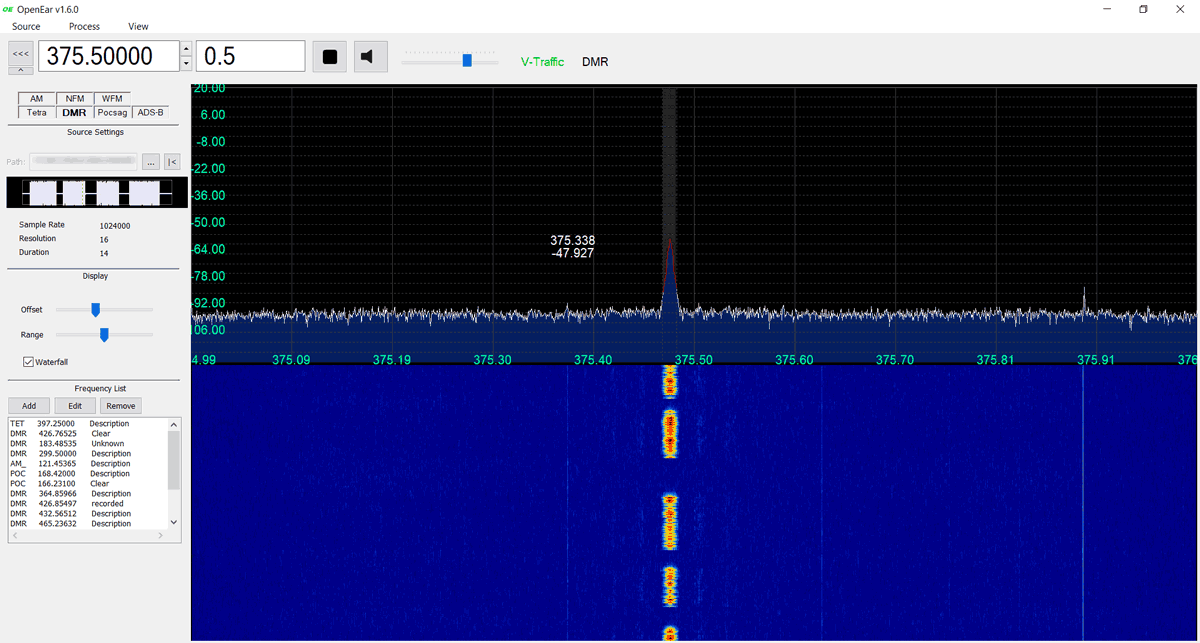
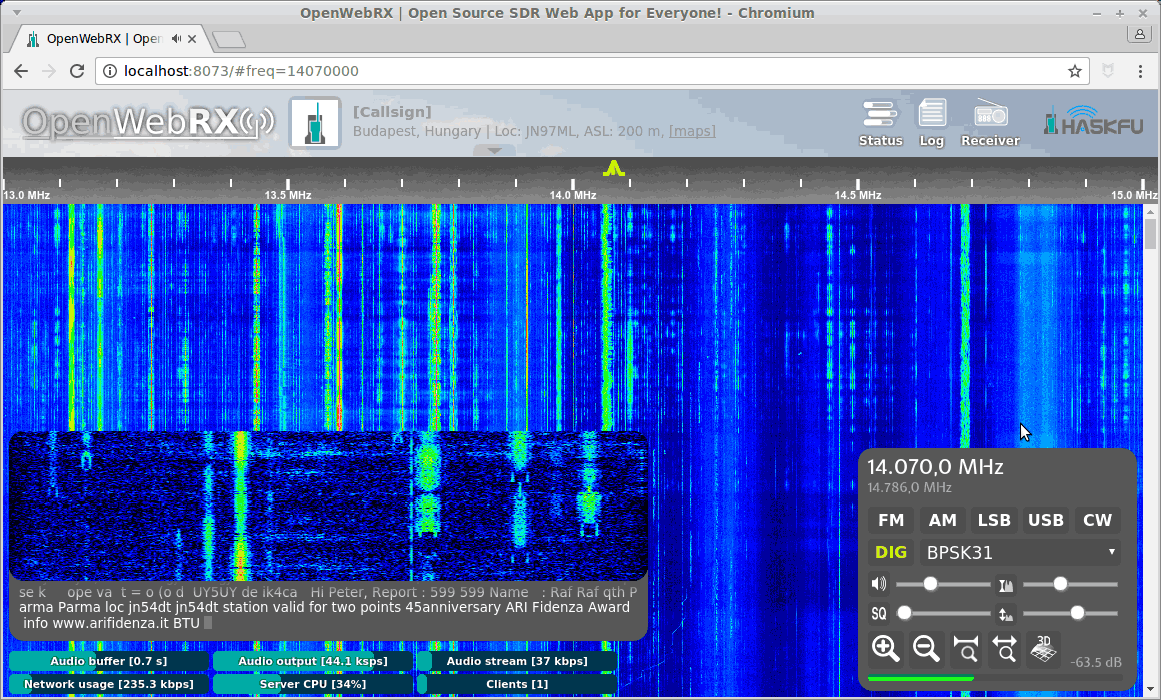
Back in early January we posted about how the popular web based SDR and RTL-SDR compatible receiver software known as OpenWebRX was officially discontinued by the original author. However, thanks to it's open source licence, code contributor Jakob Ketterl (DD5JFK) has been able to continue developing the code and is taking over as the lead developer on his own fork of the code.
Recently he released version 0.18.0 of OpenWebRX which includes a few major upgrades including the much needed shift to Python 3, and the inclusion of multiple new decoders for DMR, D-Star, YSF, NXDN, FT8, FT4, WSPR, JT65, JT9, APRS and Pocsag.
Hello fellow radio enthusiasts,
with great excitement I would like to announce the availability of OpenWebRX Version 0.18.0 as public release. This is the first release of the project in some time, and the first release since I started working on it, so I’m more than happy to bring this to you.
What’s new? Quite a lot, actually. For those that haven’t had the chance to follow the progress of the project in the past months, here’s a quick overview:
Most of the server code has been rewritten for better flexibility, stability and performance. The project is now fully based on Python 3.
Large parts of the frontend code have been updated or polished.
The new core now supports multiple SDR devices simultaneously, as well as switching between multiple profiles per SDR, allowing users to navigate between multiple bands or frequencies.
Added support for demodulation of digital voice modes (DMR, D-Star, YSF, NXDN).
Added support for digital modes of the WSJT-X suite (FT8, FT4, WSPR, JT65, JT9).
Added support for APRS.
Added support for Pocsag.
Bookmarks allow easy navigation between known stations.
Background decoding can transform your receiver into an automatic reporting station, including automatic band scheduling.
The integrated map shows digimode spots as well as APRS and YSF positions.
OpenWebRX 0.18.0 is available via the following channels:
Please check out our updated Setup Guide along with the rest of the documentation on the Wiki!
Questions, ideas, problems? Get in touch with the community at [email protected]!
Best regards and vy 73s
Jakob DD5JFK
We're so glad to see that this excellent software isn't dead in the water and is in fact thriving. We will continue to follow the Jakob's and the OpenWebRX communities' future developments. If you are interested, you can follow OpenWebRX development on the OpenWebRX groups.io forum.
The Elad FDM-S3 is an upcoming high performance Hf speciality SDR that is expected to be released this year with a price of 949.90 € ($1040 USD). Over on the swling.com blog, and the Elad website we've seen some recently released information about the new specs.
Real Time I/Q Stream Bandwidth 192khz, 384KHz, 1536KHz, 12880KHz, 24576KHz
122.88 MSPS - 98.304 MSPS 16bit A/D converter
Clock synchronized to GNSS Global Navigation Satellite System or 10MHz Ext Ref
GNSS works with GPS, GLONASS, GALILEO, BEIDOU
Auxiliary USB used to monitor GPS status or for clock firmware updates
10MHz Clock reference Output
10MHz internal standart TCXO 100ppb referenced, optional 3ppb OCXO referenced
Compared to the FDM-S2 the FDM-S3 looks to have significantly increased bandwidth, meaning now that almost the entire HF spectrum could be monitored. ALso the optional built in downconverter would allow tuning up to 2 GHz, where it was previously limited to only 160 MHz on the FDM-S2. The new GNSS referenced clock and improved TCXO/OCXO is also going to mean significantly improved frequency stability.